Search

fullybooked2017

Tag

witch trials

THE WICKED OF THE EARTH . . . Between the covers

twote003 header

I live in what could be called Cromwell Country. Oliver’s former house in nearby Ely is a tourist attraction, and he is well commemorated in Huntingdon. Was he a Great Englishman? He was certainly an excellent military commander and a successful politician, but I find him hard to warm to. This novel takes us back to the England of 1650. The Civil Wars were over, the King was dead, but the peace was deeply uneasy.

The political situation in 1650 was complex. The country was ruled by the Council of State, a group of forty or so senior politicians who held supreme executive power. It would be another three years before Oliver Cromwell became Head of State, styling himself as Lord Protector. The most significant former Royalists were businessmen and merchants. Their riches and commercial acumen were essential for the country to regain some form of equilibrium after the turmoil of the war years irrespective of their having backed the losing side.

James Archer, a native of Newcastle, is something of a contradiction. He made himself locally notorious by breaking away from his Royalist roots and signing up to fight for Parliament. Although still in his twenties, he has seen – and participated in – great violence, including Cromwell’s barbaric campaign in Ireland. He is sent back to his home town by the Council of State, ostensibly to check that the former King’s men who ran the  vital mining and shipping of coal were playing by the rules.

Archer’s subsidiary mission is to investigate the findings of the now infamous Newcastle Witch trials, which took place in 1649 and 1650. The deaths of these women are only of procedural interest to the Council, but Archer certainly has a dog in the fight, as his sister Meg was one of the accused.

What made me distinctly uncomfortable in Bergin’s narrative is his  reminder that a society dominated and swayed by hellfire preaching and scriptural quotes is a deeply unstable one. Archer observes the Newcastle town-folk, crowded on the benches of St Nicholas Church, quaking as Dr. Jenison, “so skeletally angular that it appeared he was already half way to the grave,” spits out his sectarian venom, and his demeaning view of the place of women in society. Thank goodness we have no places of worship in Britain where this still goes on. Oh, wait….

After a series of violent encounters, Archer becomes the victim of a conspiracy involving the Great and The Good of Newcastle’s commercial and political world, and he resolves to abandon the town, and head north into the countryisde to search for his sister. As the bruised and battered Archer ventures into border country, he notices something.
“…no men were to be seen. The old had died in the hard winters, the young not yet returned from the wars.”

It is in the Teeside village of Norham that Archer finally earns the truth about his sister, and Bergin has created a masterly ironic twist that is worthy of Thomas Hardy. There is so much to admire in this novel, but one or two things stand out. The fight scenes – and there are several – are superbly described, and the reader can almost hear the clash of steel, and smell the sweat and blood of the participants. Bergin’s historical research is immaculate, as befits a Cambridge history graduate, and his portrayal of the dark and foetid alleys of 17th century Newcastle is vivid and memorable. Published by Northodox Press, this fine novel is available now.

Screen Shot 2024-11-20 at 16.52.37

SOLSTICE . . . Between the covers

Solstice spine039 copy

This is the final novel in the Widdershins trilogy, the previous two being Widdershins and Sunwise (both 2022). Most people with a smattering of historical knowledge will be aware of witch trials, perhaps most notably the events  in Massachusetts in the late 17th century, famously dramatised by Arthur Miller in his play The Crucible. Closer to home, of course, were the events at Pendle in Lancashire much earlier in that century, and lovers of Hammer films (and Vincent Price) will be aware of the work of Matthew Hopkins – The Witchfinder General – in East Anglia during the English Civil War. I was totally unaware that there had been a virulent campaign against so-called witches in and around Newcastle in the 1670s. This is Helen Steadman’s subject.

Screen Shot 2023-10-24 at 19.35.56Widdershins, by the way is a strange word. Some say it was German, others say it originated in Scotland. It translates as ‘against the way’, as in going the opposite way to the sun, which was an important part of many pre-Christian religions. The story plays out in the unlikely-sounding hamlet of Mutton Clog, in County Durham, and Helen Steadman (left) has created two dramatically contrasting female central characters. Patience Leaton is the daughter of an Anglican minister, who has been forced to leave his benign and comfortable living in Ely due to the shame brought on the family by his wife’s very public infidelity. Earnest, Patience’s twin brother – due to serve with the Royal Navy – has reluctantly accompanied them. In the opposite corner, as it were, is Rose Driver, the beautiful and passionate daughter of a local farmer, Andrew Driver.

The liberal ideas and  laissez faire of the Restoration have clearly left Reverend Hector Leaton behind, as he is very Cromwellian in his distaste for anything resembling joy and pleasure, certainly where his church and its parishioners are concerned. Spurred on by the puritanical Patience, he is determined to put an end to any customs or celebrations in Mutton Clog that hint at England’s pagan past. He issues an interdict against any celebration of old customs like the equinox or the  solstice, and there is a poignant passage where Rose sits on a black hill top and gazes around at the Beltane bonfires burning joyfully in distant villages.

In Mutton Clog, however, all is dark, both literally and metaphorically. Rose and Earnest have fallen in  – if not love, then certainly lust – with each other, and when inevitable moment of passion is over Rose, ever in tune with her own body, senses that there will be dire consequences – a baby. Patience has been a scandalised witness of what took place, and informs her father. A hasty marriage is arranged, of which the only beneficiaries are Hector and Patience Leaton, and their sanctimony. As for Earnest, he is called to arms, and goes off to join his ship in the long running naval feud with the Dutch.

Rose is kept virtual prisoner in the Rectory, while the baby inside her grows. Very soon, however, comes news that Earnest’s ship has been sunk with all hands, and so she becomes Widow Leaton. Worse is to follow, as Patience tirelessly seeks to prove that Rose and her family are involved in witchcraft. She wants nothing more than to see Rose and her unborn child dead and buried, preferably not in the holy ground of Mutton Clog churchyard, and she uses the primitive criminal justice system of the day to sate her desire for justice against those who defile what she sees as ‘God’s Way’.

Screen Shot 2023-10-24 at 19.46.50

I can’t recall a  more vindictive and unpleasant fictional female character than Patience Leaton, other than Trollope’s Mrs Proudie. The wife of the long suffering Bishop of Barchester had, however, several volumes in which to become more nuanced. Over 232 pages, Patience Leaton is simply vile. Her  scheming does claim a life in the end, but not the one she was seeking.

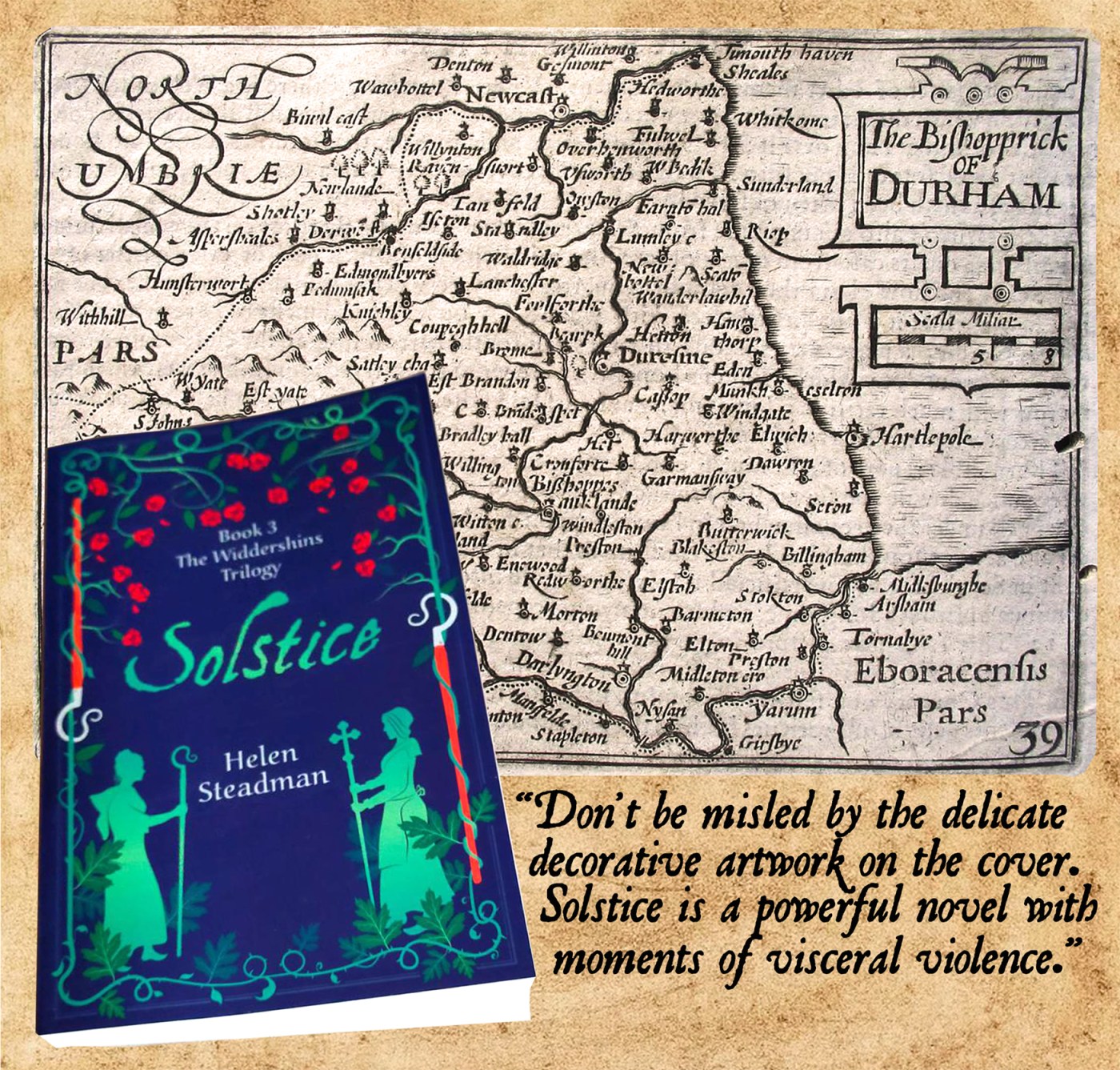
Don’t be misled by the delicate decorative artwork on the cover. There is nothing twee about Solstice. It is a dark and disturbing read, with echoes of the kind of Aeschylean tragedy found in Thomas Hardy’s novels. Helen Steadman’s novel is a stark reminder of a more brutal time, when the English church was at the head of an army of bigoted zealots, determined to wage war on the simple and time-proven beliefs of ordinary people who were in tune with nature and the seasons. Solstice is published by Bell Jar Books and is available now.

THE FAMILIARS . . . Between the covers

Familiars header

TF body text

Fleetwood’s peace of mind and the healthy bloom in her cheeks are short-lived, however. First she discovers a dreadful secret that husband Richard has been keeping from her, and then Alice is caught in the gathering storm conjured up by an ambitious and over-zealous magistrate. It is, quite literally, a witch hunt, and people who are guilty of no more than carrying out folk medicine are rounded up and flung in jail, with the prospect of summary trial and execution. Fleetwood is forced to defy her husband – and convention – to seek a stay of execution for a young woman who, she believes, is all that stands between her and another stillborn child.

Stacey Halls has written a vivid and memorable account of a dark period in English history. The Familiars is based on the infamous events that we know as The Pendle Witch Trials. With the ominous bulk of Pendle Hill louring over events, we meet many real life characters. Roger Nowell of Read Hall, Justice of the Peace for Pendle is there, as are the Device family of whom Alizon, Elizabeth and James were hanged on Gallows Hill in Lancaster on 20th August 1612. Gawthorpe Hall, home to Fleetwood and Richard Shuttleworth is now run by the National Trust.

The Familiars is so much more than a dramatisation of historical events, however. Stacey Halls has a prose style which is uncluttered and often pared to the bone; this has the effect of making her descriptions diamond sharp and brilliant. What is left when unnecessary verbiage is chopped away is a memorable account of a determined young woman, exposed to social expectations which would now be termed abusive, but with a soul of steel.

text

Stacey Halls has produced something that is little short of a modern masterpiece. The Familiars is full of passion, the distant poles of human weakness and strength and, above all, has a central character who lives and breathes so vividly that we share her hopes, fears and vivid nightmares. Fleetwood’s courage burns through the book like a white-hot iron, and she tells a tale which is, in turn, both disturbing and heart-warming.

“More men were approaching now. The gate clanged open and an iron grip held my arm. Alice and I were wrenched apart and suddenly I was outside the gate and she was being marched back down into the darkness.
          ‘Alice!’ I cried. ‘I’ll come back! I’ll come back!’
While a fierce bulk of a man escorted me back to the gatehouse, the door to the dungeon clanged open and the shrieking grew louder.
          ‘She’s dead! She’s dead! She’s dead!’
The words flew out like crows from a forest, echoing around the walls with nowhere to land.”

The Familiars is published by Bonnier Zaffre, and is out on 7th February.

4bb35b50-e925-4c9a-b586-f5690e79670d._CR0,0,970,300_PT0_SX970__

Blog at WordPress.com.

Up ↑
