
Search

fullybooked2017

Tag

Thriller

NASH FALLS . . . Between the covers

Wily veteran of scores of thrillers, Baldacci certainly builds down his central character in the first few pages. Walter Nash is a lanky, scrawny, rather uptight family man who only ever really loved his deceased pet dog. He is, however, thanks to his number crunching skills with a multinational company, prodigiously rich. And, after his fashion, he tries to be a good husband and father.

His own father, recently deceased, was a brawling and profane Harley-riding Vietnam vet who, to all intents and purposed, despised Walt for his prissy ways and lack of physical presence. One night, Walt has an unwelcome visitor in the shape of an FBI agent, and he has grim news to impart. Walt’s firm, coyly named Sybaritic, has been infiltrated (via one of its senior employees) by a criminal corporation connected to Chinese drug producers. The FBI people explain to Walt that the Chinese, unable to match the USA either militarily or economically, have chosen to inflict a slow death on America through the over-production and distribution of drugs like Fentanyl.

We learn that the ‘inside man’ on this operation is none other than Rhett Temple, the son of the firm’s founder. Then with customary narrative verve, Baldacci describes how Walt Nash’s near-perfect life is reduced to rubble by the perfect storm of an international criminal regime, corrupt cops and bent businessmen desperate to hang on to their wealth. Faced with false – but appalling – accusations, Nash is forced to go on the run, helped by one of his father’s old army buddies, a fearsome black man known as Shock.

What follows is, perhaps, the most implausible part of the story. It is a version of the old riff of a physically inept man who, by training and will power, is transformed into a formidable opponent. Under Shock’s watchful eye Nash is transformed from the puny guy who once had sand kicked in his face by beach bullies, to a remorseless killer. If you don’t get the sand reference, Google ‘Charles Atlas’. The internet will do the rest.

The portrayal of Nash, from his buttoned-down corporate executive days, via family tragedy through to his emergence from that chrysalis as someone quite different, is impressive. My last thoughts, are, I am afraid, something of a spoiler, but I always try to be honest. Walt Nash certainly undergoes a dramatic transformation and, motivated by a sense of vengeance, he rejoins the world from which he had been exiled, his true identity hidden from former acquaintances. However, those wishing for a conclusive resolution to the story must await the sequel, which is trailered at the end of this novel. Nash Falls is published by Macmillan and is out now.

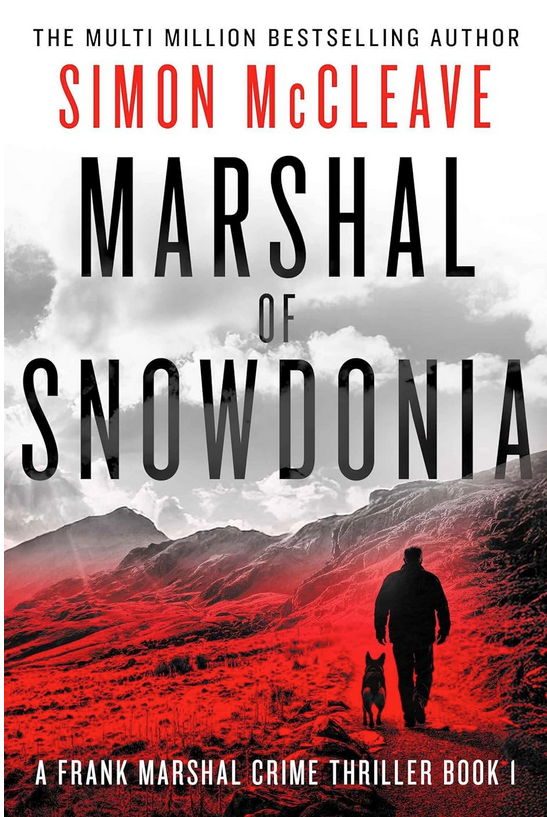
MARSHAL OF SNOWDONIA . . . Between the covers

Frank Marshal is a seventy year-old former senior detective. He lives in a former farmhouse in Snowdonia, and volunteers as a national park ranger. He has, as they say, baggage. His wife Rachel has dementia. His son committed suicide in that self same house. His daughter Caitlin lives in England with her waster of a boyfriend and their son Sam. A not-so-near neighbour, as the area is sparsely populated, is another retired from the justice system, but Annie Taylor was a High Court Judge. Now, her sister Megan has gone missing from her rented caravan in a hilltop trailer park.

The book has a prologue which describes a woman – time-frame presumably the present – being held against her will in a remote location. When Marshal discovers bloodstains beneath the decking of Megan’s caravan, a full police investigation kicks in. Megan’s errant son, Callum, had lived with her in the caravan. Annie and Marshal track him down to his (absent) father’s house. The youth tries to escape on his moped. Marshal pursues him, but only succeeds in running him off the road into a river. Marshal rescues him, but now Callum is in hospital, suffering from amnesia. Big question. Is the memory loss genuine or a pretence?

Marshal may be a gentle father, grandfather and former policeman, but he would never survive the current scrutiny that subtly shapes modern officers to the mould set by the metropolitan liberals who run the UK legal system. Only the knowledge of the disastrous consequences of him shooting a predatory salmon poacher prevents him from pulling the trigger while, when Caitlin’s lowlife partner – TJ – arrives in Wales demanding access to his son, Marshal has no compunction in planting several bags of marching powder (recently discovered hidden in Megan’s caravan) in TJ’s car. And if the local police should find the drugs, then who is he to correct their sums when they make two plus two equal five?P.

When the body of Annie’s sister is found dead on the beach at Barmouth, strangled with thin wire, Marshal has a grim thought running through his thoughts. The wire garotte was the favoured method of a notorious serial killer, Keith Tatchell years earlier. Now Tatchell is serving life imprisonment. Two equally horrific options spring to Marshal’s mind: was Tatchell wrongly convicted and is the real killer still out there?; is Meghan’s killer someone connected to Tatchell and seeking revenge?

McCleave gives us a brilliant plot twist to reveal the true villain, but ends the novel with a suggestion that Frank Marshal may have more trouble on his hands in the next installment of what promises to be an addictive series.

I could no more be a professional writer than I could open the batting for England. The pressure to write something that sells and produces good reviews – and pays the bills – would, for me, be intolerable. Writers (unless they are TV celebrities) must constantly search for some draw, some hook, that will attract readers – and sales. I read hundreds of crime novels and, amid the gimmicks, the split time frames and the hysteria of desperate publicists, it is a relief to read a novel that is just impeccably written, with a solid narrative, and peopled by plausible characters. Marshal of Snowdonia is one such, and I can heartily recommend it. It was published by Stamford Publishing earlier this year.

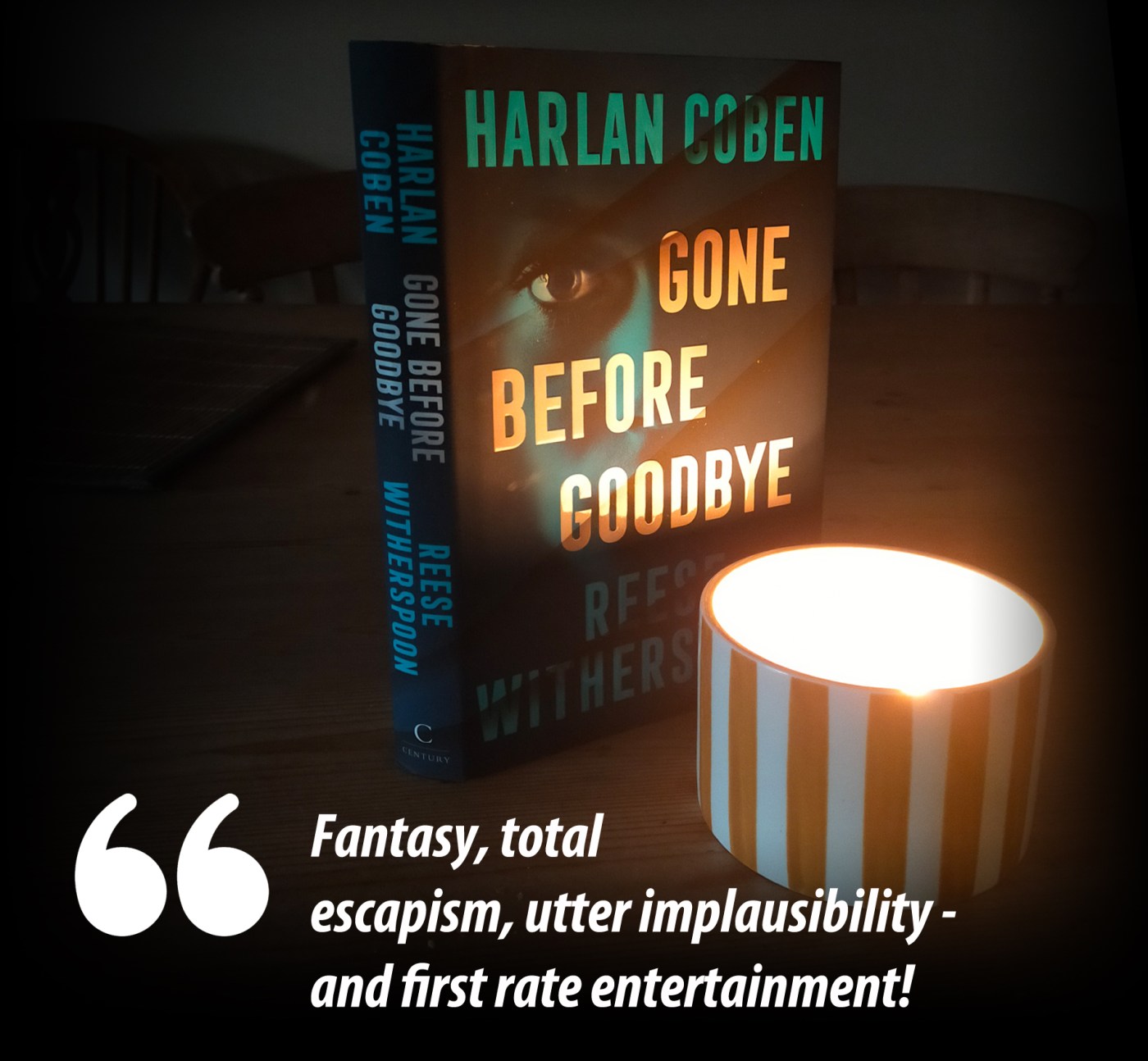
GONE BEFORE GOODBYE . . . Between the covers

Maggie McCabe is – or was – an internationally renowned reconstructive surgeon, who used her skills as a volunteer in some of the worst hell holes on earth, like Libya during its extended civil war. Then, everything went pear-shaped. Traumatised by stress and grief, she took to stabilising herself with pills. Then, one day, she took too many of the wrong kind, botched a surgical procedure, and found herself at the wrong end of a malpractice claim. Now, stony broke and shunned by former colleagues she is offered a job to operate on a reclusive Russian oligarch. All her debts will be cancelled. The malpractice suit will mysteriously disappear.

All too good to be true? Of course it is, but then this is mainstream American crime fiction, where almost anything can happen – and usually does. The novel is the kind of celebrity partnership which makes publicists become dewy-eyed, and makes hard working ‘proper’ novelists apoplectic with a blend of rage and envy. I don’t ‘do’ much mainstream film or TV, so while the name Reese Witherspoon was vaguely on the edge of my consciousness, I had little idea who she was or what she has done. In contrast, I have read many Harlan Coven novels and, with the proviso that they have all had that typical transatlantic slickness, I have found them readable and entertaining. As with most writing collaborations, who wrote what is not immediately obvious, but is the book any good?

Short answer is yes, it is improbably entertaining. You will need, if course, to leave any residual sense of disbelief with the cloak room attendant before you enter this particular literary room. We have ‘griefbots’, totally life-like AI reconstructions of a deceased loved one that can be installed on your ‘phone, and with whom you can chat any time you want; we have a Russian monster do powerful that he can recreate Maggie McCabe’s own operating theatre in an annexe of his winter palace, complete with instrument trays in precisely the same position as she is used to; we have the self same gentleman who has multiple ‘genuine’ copies of the Mona Lisa, one of which was actually painted by LdV himself. Oh I almost forgot. The Russian big shot hosts a gala ball, with a stage set up for a world megastar to perform. The star? None other than Watford’s finest, Sir Reginald Kenneth Dwight (if you know, you know)

Maggie turns in before EJ can sing Rocket Man. She has two surgical procedures to complete the next day – a facelift on the oligarch, a breast augmentation on his girlfriend – and she needs sleep. The surgery goes as planned, but then things begin to unravel. Maggie survives being disposed of (by being tipped out of a helicopter into the bottomless chasm of a disused mine) and ends up (don’t ask) being taken to Dubai by of former physician-turned-CIA-agent.

Meanwhile, back in New York, Maggie’s biker father in law, known as Porkchop, is on the case, and he is a man to be reckoned with. Dubai is, naturally, a whirlwind of opulence, subtly concealed violence – and a mixture of revelation and mystery for Maggie. She has a brief and scary reunion with her Russian oligarch – Oleg Ragorsvich – and learns that his recently enhanced girlfriend – Nadia – is not who she appears to be. Then, via London, Paris and Bordeaux’s Gare Saint Jean (and an escort of French bikers) she and Porkchop are on their way to a former vineyard where all is about to be revealed.

What we have is fantasy, total escapism, utter implausibility – and first rate entertainment. Gone Before Goodbye will be published by Century on 25th October. You can read my reviews of other Harlan Coben novels by clicking the author image (above{

NOBODY’S FOOL . . . Between the covers

In the last Harlan Coben book I read, Think Twice, the DNA of a man who died decades ago turns up at a recent murder scene. Coben loves these ‘impossible’ scenarios, and here, he sets us another one. When he was on a gap year trip to Europe twenty-two years earlier, Sami Kierce had a passionate fling in a Spanish resort with a young fellow American called Anna. It all ended grimly when, after yet another evening fueled by booze, drugs and sex, Sami wakes, as usual, in Anna’s arms. Problem. He is covered in Anna’s blood and clutching a knife.

Now, Sami, thrown off the police force for various indiscretions, scratches a living as a PI in New York, also turning a more-or-less honest buck giving evening classes in criminology to a bunch of weirdos. When one of his classes is joined by a woman who, if not Anna is, surely, a clone, Sami does a classic double-take. So many questions, already. First up is how Sami managed to get back Stateside after the Costa del Sol incident with Anna. We do find out, eventually. Second is how ‘Anna’ appears to be living in a Connecticut mansion, deep in a forest and protected by armed heavies and belligerent dogs.

As if having one dramatic backstory weren’t enough, Sami has two. Before he had to throw in his badge, Sami was engaged to a fellow officer, Nicole Brett. Then she was murdered by a nasty piece of work called Tad Grayson, who was arrested, tried, and given a life term. But now, thanks to nifty footwork by his legal team, Grayson is out, and determined to prove that he did not kill Nicole. All of which, naturally enough, does not improve Sami’s sunny demeanour. ‘Anna’ is actually Victoria Belmond who, back in the day featured in the mother-and-father of all ‘missing heiress’ stories. Victoria disappeared on New Years Eve after a party, and what happened in the next eleven years – until she turned up sitting in a corner booth of a Maine diner – remains a mystery. Victoria was – literally – mute for many months thereafter and even, when speech returned, remembered nothing of where she had been and with whom.

After his abortive attempt to follow ‘Anna‘ on the night she came to his class, Sami has become a person of interest to the Belmond family and, much to his surprise, he is offered a small fortune to do what the police and FBI failed to do – discover the truth about Victoria’s disappearance. He even uses the Belmond’s largesse to take a quick trip to Spain along with wife Molly and their baby son, and here he finds the police officer who dealt with the case back in the day. He learns that he was the victim of a very clever scam involving ‘Anna’ and her drug hustling boyfriend.

Just when this particular reader was reflecting that this was just one more engaging – but slick and formulaic – American thriller, something truly awful happens and, 308 pages out of 414, everything I thought I understood about the plot is turned on its head. Reviewers are forever trying to think up new metaphors and catchy phrases to explain astonishing plot twists, so all I can say is that this one is up there with the best. I can also say that in the hands of a lesser writer that Harlan Coben, it would probably be a disaster, but he pulls it off with his customary flair. Nobody’s Fool was published by Penguin on 27th March.

FLOWERS FROM THE BLACK SEA . . . Between the covers

Screen Shot 2024-11-02 at 17.44.31Revenge thrillers come in many shapes and sizes, and Flowers From The Black Sea by AB Decker (left) begins with the main character, a barely competent English security consultant called Matt Quillan travelling to end-of-season Turkey on an all-expenses-paid favour for his old university chum Ben Braithwaite. Quillan’s task appears relatively simple, and it is to locate the whereabouts of a man called Ahmet Karadeniz, last known of in the vicinity of Karakent, a small town on the south coast. Any job is a job as far as Quillan is concerned, and so he fetches up in Karakent and starts to ask questions. However, on his bus journey from Istanbul he meets a mysterious stranger called Rekan, who gives him a USB flash drive for sage keeping. Anyone with a grain of sense would probably have refused, but Quillan takes it, and when the bus is stopped by the police, and Rekan is taken into custody, our man begins to wonder.

After being questioned by the police Quillan is allowed to continue his journey, and soon makes the acquaintance of a local English estate agent, Pearl, and then her sister Amber, who is in town for her annual holiday. Eventually Quillan learns why he has been sent to Turkey. Ben’s sister Peggy married Karadeniz but died in circumstances which were, from a distance, highly suspicious although, according to Muslim custom, Peggy was interred very quickly, and autopsy was ever carried out.

Having reported back to Ben via phone, Quillan is surprised when his wealthy friend arrives in Karakent, aboard his luxury yacht. Quillan is, perhaps, not the sharpest knife in the drawer, and he is persuaded to stay around while Ben exacts revenge for the untimely death of his sister.

The matter of the flash drive and what it contains is central to the plot. I haven’t been to Turkey since the 1970s, and I won’t pretend that it was an altogether pleasant experience. Yes, countless British holidaymakers go to tourist resorts these days and experience nothing but enjoyment, but these places are pretty much gated off from the real Turkey. Back in the day, we were ‘hippy’ travellers with little cash and, shall we say, we had our moments. Today, Turkey is pretty much an autocracy, and its treatment of minorities such as Kurds and Armenians is often in the news.

This novel is not a sermon about the shortcomings of Muslim societies, but it reference the mistreatment of women in what is predominantly a patriarchal society, by any Western standards. I suppose, aside of the dramatic plot, Decker is simply reasserting what we have known for centuries. Turkey is very much a ‘twixt and between’ place, never sure if it belongs to the urbane West or the visceral certainties of the East.

Long story short, Ben and Matt are captured by gangsters, Ben’s yacht is seized and run aground but, thanks to an intrepid Kurdish nationalist called Leila, the mysterious contents of Rekan’s USB drive, all’s well that ends well. Except it isn’t. Literally in the last paragraph, we have an act of violence that redefines the nature of revenge. Decker has written a convincing and engaging thriller which captures the sense of menace and political uncertainty in a complex country. Published by The Book Guild, it is available now.

Screen Shot 2024-11-02 at 17.49.27

DEATH AT DEAD MAN’S STAKE . . . Between the covers

DADMS HEADER

Death at Dead Man’s Stake sounds like something from the Wild West, but it is, in this new novel by former copper Nick Oldham, an incident at an isolated farm in Lancashire. With his veteran Henry Christie perhaps taking a well-deserved break at his (hopefully) rebuilt moorland pub, Oldham introduces Detective Sergeant Jessica Raker. After fatally shooting a London gangster following a botched raid on a jewellers’ in Greenwich, Raker has been moved to the North West – where she grew up – in an attempt to distance her from the dead man’s vengeful relatives.

Her first day is nothing if not eventful. She has barely unloaded her kit into the Sergeant’s office from her car, when she is called out to a crisis at Dead Man’s Stake. When the local fire brigade attends an unexplained fire in the derelict farmyard, one of the firefighters is grabbed and held hostage by the farmer, a drunken, mildly crazed man called Bill Ramsden. Jessica rescues the fireman after tazering Ramsden. Her day is not over, however. A cantankerous old man, resident of a local cafe home, is found dead, his corpse floating in a nearby reservoir. Raker, viewing the scene, suspects that a physical struggle lead to the old man ending up in the water.

Jessica Raker is a good copper, but she has been dealt a poor hand. At the Greenwich heist, who was one of the customers eying up an expensive item at the moment the robbers burst in? None other than her husband Josh, a high flying player in a City firm. And the piece of jewellery was intended not for Jessica, but for his secretary. Improbably, the marriage has survived, and Josh is now working in Manchester, but resentful at the move.

Meanwhile, we learn a little more about the man Jessica shot dead in Greenwich. He was the most ungovernable  of the sons of Billy Moss, a millionaire crook grown rich on the proceeds of all manner of criminaity, ranging from the inevitable drug trade to trafficking people. Goss wants revenge. He wants the hapless amateurs who lured Terry Moss into the doomed jewellery raid, but most of all, he wants Jessica. The problem is that the Met Police have done a very good job in smuggling her away to the Ribble Valley, and she has gone completely off the Moss radar. Nonetheless, a professional killer is hired to hunt her down and end her life. While on the school run, Jessica bumps into an old adversary. Years ago, when she was growing up in Clitheroe Jessica and Maggie Goss fell out over a mutually desired boyfriend, and Maggie, now boss of huge scrapyard empire, hasn’t forgotten the teenage slights. What is more important is that the scrapyard business is a million miles away from being strictly legit, and one of Maggie’s LinkedIn buddies is none other than Billy Moss.

It is not just Nick Oldham’s years of experience as a working copper that makes his books so good. Nor is it the loving and detailed sense of place, where he describes a beautiful and windswept rural Lancashire, blissful yet only an hour’s drive from pockets of deprivation and criminality like Blackpool. For me, what puts his novels up there on a pinnacle is his sense of dialogue – nothing flashy or pretentiously poetic – but an unerring version of how real people actually speak to each other.

As the Moss organisation moves against Jessica Raker, there is a satisfying symmetry to the main plot, as it ends where it began, out at Dead Man’s Stake. This is a firecracker of a police thriller, and Nick Oldham has established a cast of coppers, with Jess Raker at its heart, who will keep us entertained for many years to come. The novel is published by Severn House, and is available now.

Screen Shot 2024-09-25 at 19.40.39

SERAPHIM . . . Between the covers

SERAPHIM HEADER

Seraphimred-winged angels which, with Cherubim, are among the first hierarchy of angels next to the throne of God. According to the Book of Isaiah in the Old Testament, they had six wings, one pair for flying, another covering the face and the third pair covering the feet.

Ben Alder is a Jewish lawyer from Massachusetts, but currently working, with his partner Boris, in post Katrina New Orleans. The pair work for the Public Defender’s Office, meaning they pick  up what we in the UK call Legal Aid work. It is badly paid and they deal with people who are at the very bottom end of society. The novel deals with Ben’s attempts to save a father and son from a lifetime in jail. The father, Robert McTell is accused of burglary by going equipped with tools to steal copper pipe from a school abandoned after the destruction of Storm Katrina. His son, Robert Johnson is in much more serious trouble. He has admitted shooting dead a much loved community figure, Lillie Scott, who has been a leading light in the attempts to rehabilitate and rebuild the city after the devastation of the storm. Another savage murder, where four youngsters, were gunned down while they were listening to music in a stationary car, works its way into the story

Reviewers  of crime fiction like to put books in genre pigeon holes. If nothing else, it gives potential readers a heads-up about the content and style of a novel. After all, there are thousands of new CriFi books published every year and, for many readers, leisure time is a valuable commodity. I have to say that Seraphim refuses to be categorised. The closest I can get is to call it literary crime fiction. Despite the blurbs, it certainly isn’t a legal thriller. There are no tense courtroom exchanges between defenders and prosecutors. The world Ben Alder inhabits is a dystopia of broken lives, broken homes and broken promises, fogged in a miasma of disillusionment, cynicism and expediency.

One commodity that is notable for its absence in the criminal justice world of New Orleans is truth. Everyone, from the judge down, through legal counsel to the men shackled in cells –  lies. Habitually and constantly. The prisoners don’t deal in truth, because experience tells them it will bring only pain. The lawyers’ version of truth is to put a story together that a jury might possibly believe, and this tale can be many miles away from what actually happened.

The timeline of the novel needs you to pay attention. Some sections are the here and now, while others are pre-Katrina. Other events take place far away from New Orleans in places like Memphis, where the homeless are temporarily re-homed. Neither Ben nor readers of this powerful novel ever do find out who shot Lillie Scott. There was certainly another boy, Willard, present on that fateful evening, but in spite of Ben’s elaborate narrative – designed to be told in court – that Willard was smaller and much more clever, and Robert was clinging to him as his only friend, the ‘truth’ never emerges. This, of course, is entirely in keeping with the premise of the novel, which is basically that there is no such thing as truth. Ben, shyly homosexual, even invents two mythical sons so that he can throw them into conversations to boost rapport with his clients.

The narrative is shot through with grim poetry, sonnets of death, rejection and betrayal. Despite not being a devoted Jew, Ben’s upbringing and education make the symbolism of the Hebrew bible very important to him, hence the title of the book. Seraphim is a provocative and potent work of literary fiction, where violence, revenge and cynicism are shared out equally between the battered streets of New Orleans and its courts of justice. Published by Melville House, it is available now.

Screen Shot 2024-08-01 at 20.03.46

FIRE AND BONES . . . Between the covers

FAB SPINE066 copy

Screen Shot 2024-07-13 at 20.24.17To use a cricketing term, the Dr Temperance Brennan book series by Kathy Reichs (left) is 24 not out, and still looking good. The series featuring the forensic anthropologist began with Déjà Dead in 1997. For anyone new to the novels, I’ll just direct you here for background information. Tempe (her preferred nickname) is in her Charlotte NC autopsy room and has just finished one of her trademark investigations into long-dead human remains. She is planning a few days away with her long-time boyfriend, Quebec cop Andrew Ryan, but when she gets home, she has a series of ‘phone calls  which persuade her to drive to Washington DC to help with the investigation of a fatal fire in an old house in Foggy Bottom.

The Victorian property had been most recently used as a low rent boarding house, and amid the devastation, there are four dead bodies, all victims of the fire. When part of the ground floor gives way under the weight of one of the fire officers, a hidden cellar full of alcoves and passages is revealed, and it is in one of the chambers that Tempe discovers another corpse tied inside a burlap sack. While the charred remains of the four fire victims are quickly identified, the corpse in the burlap bag is more mysterious. The body is that of a woman, small and slender, but how long she had been in that bag, in that cellar is more problematic. Via one of those nerdish experts who specialise in arcane knowledge, Tempe learns that the sack in which the victim was confined probably dates from the late 1940s.

Screen Shot 2024-07-13 at 19.53.48

Tempe, with the help of a TV reporter called Ivy Doyle, learns that the reason for the fire may be connected to a group of hoodlums back in the prohibition era. The Foggy Bottom Gang. The ringleaders were Leo, Emmitt, and Charles “Rags” Warring, who had worked as laborers in their father’s barrel shop. When the (illegal) booze started flowing, all three quickly got caught up in the wild and sometimes violent underworld of Washington, D.C. But what is the connection between events decades ago and modern day Washington DC? Eventually, Tempe finds out the truth, and it reinforces the old adage about revenge being a dish best served cold and, in this case, slow.

The book rattles along at breakneck speed, and Tempe Brennan is her usual sassy, quick-thinking self, a persona that Kathy Reich’s millions of readers have come to know and love over the 27 years since Tempe first appeared. Thy narrative style is unmistakably and uniquely American – slick, witty, and sharp as a tack. It won’t appeal to readers who like gentle cosy crime mysteries set in idyllic British locations, but it is a testament to its style and commercial appeal that a TV series based on the books ran from September 13, 2005, concluding on March 28, 2017, airing for 246 episodes over 12 seasons. 

Fire and Bones is gripping and addictively readable, despite the fact that  – like books in other long-running American series by writers like Jonathan Kellerman, James Patterson and Harlan Coben – it is formulaic. The formula works, readers love it, so you will hear no complaints from me. It is published by Simon & Schuster, and is out today, 1st August.

Screen Shot 2024-07-13 at 20.20.13

IMPOSTER SYNDROME . . . Between the covers

imposter spine064 copy

Joseph Knox made his name with a deadly dark trilogy of police procedural novels featuring Manchester copper Aidan Waits (click to read the reviews) and followed these with the standalone True Crime Story. His latest novel takes a leaf out of the book of Josephine Tey, whose novel  Brat Farrar (1949) many consider to be her finest work. That novel was inspired by a real case, known as The Tichborne Claimant, where a New South Wales butcher claimed that he was Roger Tichborne, heir to a huge fortune, but who  was supposed to have perished in a shipwreck. The butcher, Arthur Orton, was eventually found guilty of fraud in 1874 and given a long jail sentence.

Here, we meet Lynch, a young English conman. He flies out of Paris, with only the cheap suit he is standing up in, with no money, no prospects and only the bitter memory of his latest failed venture on his mind. En route, he meets a milfy heiress called Bobbie Pierce who mistakes him for her long lost brother, Heydon. Lynch immediately corrects her mistake, but is intrigued. Heydon is assumed to be dead. No trace of him has been found since his abandoned car was found on a Thames bridge five years earlier. Bobbie is something a ship foundering on storm tossed rocks, as she is on her way to yet another expensive bout of rehab in the States. She sends him a text message which contains the key codes to her parents’ house, and suggests that, as he is broke and pretty much down and out, he might find plenty of valuable items in the house to relieve his immediate Micawberish state.

Lynch, as much out of curiosity as anything else, goes to the house but, once inside, he is detained by security men. He then meets Miranda Pierce, the family matriarch and former film star, and Bobbie’s sister Reagan. Lynch makes no claim to be the missing Heydon, but Miranda has a use for him. Just before he disappeared, Heydon Lynch borrowed money from a loan shark called Bagwan, and left a case containing family items as security. Badwan has contacted the family, calling in the loan – now greatly inflated. Miranda and Reagan want Lynch, posing as  Heydon, to meet Badwan, pay him off, and recover the  case.

The case is recovered, and one of the things it contains is Heydon’s phone. Through what it contains, Lynch learns two things: one, Heydon Pierce was convinced he was being targeted by some shadowy organisation; two, he had become involved with a man calling himself Vincent Control, basically a conman trying to lure gullible people into a crypto currency scam. Lynch confronts Control and learns that there was, indeed, some dark security agency involved, but their conversation is interrupted by a masked gunman. Control is shot dead, but Lynch escapes.

At this point, half way through the book, I did ask myself why Lynch didn’t just disappear. He now has plenty of money, having being richly rewarded by Miranda Pierce, so why not simply get away, maybe fly back to Paris on his forged passport, and use his new-found wealth to fund another project designed to separate fools from their money? He then sets out his reasons. He has discovered that he is dealing with some very powerful and resourceful people who, he figures, will be able to find him and settle scores wherever he goes, and however long it takes.

The plot is of Chandleresque complexity, as Lynch ducks and dives  between various encounters which prove fatal for some of the characters. He suspects first one person, and then another, as he tries to find exactly why he was hired in the first place, and what actually happened to Haydon Pierce. The truth is only revealed to him (and us) in the final pages of the book.

This is a clever, tense and nervy thriller, which dwells on betrayal and the pernicious effect that the misuse of digital communications and media can have on human lives. Lynch is a long way from being an admirable character, but his street-smarts and survivalist instincts are straight out of the How To Be A Conman instruction manual.. Imposter Syndrome was published by Doubleday on 11th July.

Blog at WordPress.com.

Up ↑