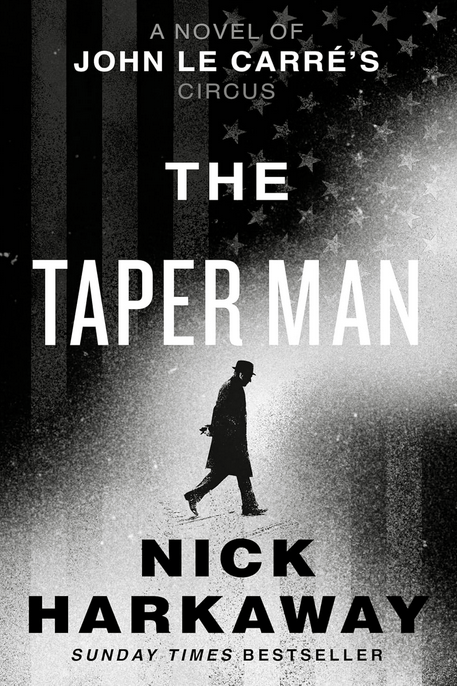

Nick Harkaway, aka Nicolas Cornwell, sets us down in the mid 1960s in this, his second re-imagining of the world of British Intelligence during the Cold War years, a world so memorably portrayed in his father’s novels about George Smiley and ‘The Circus’, properly known as MI6. When Bill Haydon, a field operative is shot and wounded in a Helsinki market, George Smiley is told to investigate. Haydon’s companion, a woman called Lara Koski, was killed in the exchange, as was a man who is later identified as Rolan Gusev, a Russian agent. Gusev was due to fly on to America, where he was booked in to stay at The Reconstruction Club, a luxurious Los Angeles establishment regarded by the CIA as a place with strong links to Soviet Russia.
Another Circus operator, Roy Bland, is meanwhile experiencing problems of his own in Leningrad, where he is staying in a health spa. Bland, officially employed in Bulgaria, is one of the more unusual Circus employees. Although highly educated and multilingual, he is of working class origins. He was brought up in east London, where his father was a docker. ‘Control’, the otherwise nameless boss of The Circus, believes that Gusev was on his way to California to make contact with a Russian spy deeply embedded within the American intelligence services, and he is anxious to find out who this person is. Why? Although Britain was still, notionally, an international power, its post – Suez reputation is not good, particularly in the eyes of the Americans.
To use a seasonal metaphor, it is Britain’s autumn, and the trees, with their leaves blasted away by strong winds, are nearly bare. The American CIA are blunt, disruptive and vigorous. They view the inherent caution and subtlety of MI6 as fey and ineffective. Roy Bland, almost by accident has discovered what might be a key to unmasking the American spy, and it is in Leningrad where most of the serious action takes place. Bland is on the verge of applying for Russian citizenship, more through expediency than conviction, because he realises that his high profile defection may give him the opportunity to help Control.
Smiley, meanwhile, is sent to California, ostensibly to attend a conference but, in reality, to discover why Gusev was headed to Los Angeles, and who he was scheduled to meet. Along the way, we rub shoulders with many of Le Carre’s stock characters, such as the fiercely intelligent Connie Sachs and the devious Toby Esterhase. The more vigorous action – shootings, seduction, film negatives hidden in waste pipes and other skullduggery all takes place in Leningrad, but the quiet and persistent wisdom of George Smiley – ostensibly a mere bookkeeper or accounts clerk – which unmasks the traitor.
Finland features tangentially in the narrative, and it is worth remembering its strange place in European history. Having valiantly resisted the Russians in The Winter War, they then cosied up to Hitler, but suffered a savage revenge by Stalin after the war. The title? It originated in England’s Gunpowder Plot. An unidentified participant had the job of accompanying Fawkes on his fatal mission, carrying a shielded flame to be used in an emergency. In modern espionage terms, it has been used to describe a survivor of a busted spy plot, who keeps his or her head down and keeps the faith while the network is being destroyed above their heads. This is not easy reading. The plethora of references to the original books keeps us on our toes, but Harkaway preserves the enigma of the ‘little round man’, the impenetrable and unknowable George Smiley. The Taper Man will be published by Penguin/Viking on 5th November.