

II. MARCHE FUNEBRE
 Jean-Jacques ‘JJ’ Stoner is a stone cold killer. His creator, Frank Westworth gives us a first glimpse of him as an army sergeant serving in Iraq. One of his squad has just been fatally wounded by a knife thrown by one of a group of Iraqis who:
“….. plainly considered that the knife’s flight was the result of heavenly intervention and that they were all witnesses to a miraculous act, rather than a clever murderous attempt.”
The sergeant quietly but forcefully demands information:
“His words produced only more theatrical incomprehension. Five sets of open palms were paraded before the sergeant; all of them as innocent as the other, was the suggestion. A single shot interrupted the stage grief; one of the Iraqis sagged from seated to fallen, his dark blood draining from his exploded head into the sands of his native home. The sergeant held his smoking handgun in plain view, spread his arms wide to express his regret, his masculine sorrow.”
Sergeant Stoner assassinates the remaining Iraqis with neither hesitation nor sentiment. Shortly after, he is recruited by a government official we come to know as The Hard Man. Stoner’s new job is to use sharp blades and blunt instruments to discreetly resolve difficult situations for the British government. If Stoner has a gruesome talent for taking life, he also has a paradoxical skill which requires sensitivity, a delicate touch and an awareness of the human soul and its emotional depths; he is a gifted guitarist. In one of Westworth’s short stories, First Contract, Stoner uses his musical ear to imitate a Belfast accent when in a pub full of staunch Republicans:
“Beaming broadly, Stoner took a seat with the band. His lady companion ….. watched with some surprise as Stoner changed the tuning on the borrowed acoustic guitar, acknowledged a generous introduction from the leader of the band, then launched into a medley of furious Provo protest songs, familiar to all in that Catholic bar, all with their choruses to share.”
In the short story Two Wrongs Stoner is in America and we are introduced to a character who appears regularly in the Stoner stories, the navy SEAL known as Stretch. He and Stoner are in a bar, tangling with an agent from the FBI. Stoner, though, always has time for music:
“ Stoner finished his Bud, smacked his lips, and moved smoothly through the quietened attentive crowd to the stage, where he picked up the borrowed Fender Telecaster, smacked it a little to confirm the inaccuracy of its tuning, and launched into a spontaneous version of Johnny B. Goode set to a strange rolling rockabilly rhythm which found Stretch running, actually running from the restrooms to the stage in what proved to be a successful attempt to save the song from the amused Englishman’s attempt to publicly destroy such an important icon of American history.”

Westworth’s skill as a writer of quirky thrillers is shown to best effect in his Killing Sisters trilogy. In A Last Act of Charity (2014), The Corruption of Chastity (2015) and The Redemption of Charm (2017) Stoner encounters three sisters who are just as deadly and homicidal as he is. We also learn that in his downtime, when he is not despatching people who are being an embarrassment to HM Government, he is running a jazz and blues club called The Blue Cube. The closest thing that Stoner has to a girlfriend is a diminutive bass player called Bili who plays in the house band from which Stoner is often conspicuously absent due to his murderous day job.
“Bili swung her big red Rickenbacker bass into what might have been a comfortable playing position, and all three looked to far stage left, where Amanda rolled her eyes, took a deep breath and surprised them all by blasting from her shiny tenor saxophone the opening stanza of Baker Street, one of the most recognisable lumps of sax music of all time.”
 It doesn’t take a genius to work out that Westworth (right) is deeply immersed in the lore and legend of pop music as well as knowing his guitars. The Killing Sisters books are scattered with references – some subtle, but others more obvious – to great songs and singers. Later in The Redemption of Charm, Stoner renews his acquaintance with his favourite guitar:
“His old Fender guitar sat easily in his lap as he tuned, fingered a few chords, tuned again, hummed a few verses, tuned some more, strangely restless. The guitar felt odd … polished maybe. The strings were certainly new enough, although of the correct weight for his taste. He replaced it in its case, wandered around and discovered another case, standing by the closed piano, this one containing an acoustic guitar, a fine blonde Gibson model unfamiliar to him.”
Stoner is gloomy, and overcome with melancholy, states of mind with which he is unfamiliar, and strange moods sit heavy on his shoulders:
“He played a finger-picked instrumental tune he half remembered from the days before his playing focused entirely on electric solid-bodied guitars. A famous tune by Davey Graham dedicated to some woman called Anji. Unbidden and unwelcome somehow, his memory unearthed a series of images of women to whom he’d dedicated the song down the years.”
You can follow the blue links to the Amazon pages for Westworth’s novels, and on Fully Booked we have a detailed review of The Redemption of Charm, and an entertaining piece by the author on how to kill people, again borrowing from the title of a classic song – Killing Me Softly.
Next up in our musical journey is the story of a gifted singer-songwriter whose career has been shattered by depression and stage fright, and the sombre tale of a band whose obsession with the Dakota Building and the death of John Lennon takes them to a very dark place.
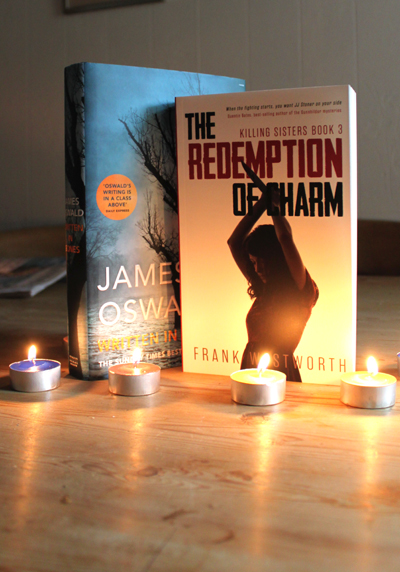

 First out of its protective wrapper was the latest from one of my favourite British writers, Frank Westworth. He has created a noirish world of grimy London music venues, peopled with frequently freakish characters and misfits, all of whom live out the heartbreaking three-chord trick of the Blues in their real lives. Presiding over the mayhem is a moody and reclusive investigator, cum killer, cum doer-of-dirty-deeds for the British establishment. His name is JJ Stoner, and as well as bending his guitar strings into shivering blue notes, he has an uneasy and unique relationship with three weird sisters. Note the absence of capitals, as these ladies are not the cauldron-stirring crones of The Scottish Play, but three violent and devious sexual predators. We have met Charity and Chastity in the first two books of the trilogy, but as Westworth wraps the series up, he introduces us to Charm.
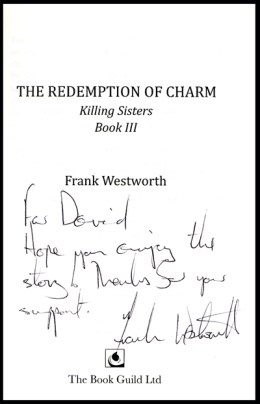 What happens in the book? I can do no better than to quote a line from the best motorbike song ever written. Like the biker outlaw James in Richard Thompson’s awesome Vincent Black Lightning 1952, JJ is “running out of road …running out of breath,” Stoner is surrounded by brutal enemies on all sides, and all the old acquaintances from whom he might expect a favour or three are walking by on the other side. This is one book which will certainly not end up in a charity shop or casually passed on to friends, because mine came with a personal touch. You folks are definitely not going to lay hands on my copy, and I’m afraid you will have to wait until the end of next month for yours. In the meantime, you can check out a mischievous and beautifully written piece by Frank Westworth
 and demanding) day jobs of current authors, Oswald has achieved what might have seemed to be an impossible task. He has created a engaging and totally believable Scottish copper who, over the space of six previous novels, has sharp-elbowed his way in the room crowded with such characters as John Rebus and Logan McRea.


 fullybooked2017