Search

fullybooked2017

Tag

Swaffham

THE SWAFFHAM HORROR . . . Tragedy at Town Farm (3)

Header

SO FAR: 1925, and Swaffham farm labourer Herbert George Whiteman (now calling himself Bloye) has been sent for trial at Norwich Assizes for the murder of his mother-in-law Clara Squires. In the same attack, he badly wounded his wife Alice, and she has subsequently died of her injuries.

The Assizes opened on Monday 19th October and, as was customary, the dignitaries – in particular the Lord Chief Justice himself, Lord Hewart went to the cathedral, no doubt to pray for wisdom.

Assizes

There is very little on record about the trial of Herbert George Whiteman, probably because it took up little of the court’s time. Whiteman’s barristers on Tuesday 20th October went down the only route available to them, which was to plead that when he struck the fatal blows back in June, he was temporarily insane. Neither the jury, nor Lord Hewart, were having any of this. Whiteman, under his adopted surname Bloye, was found guilty and sent back to Norwich Gaol in Mousehold Heath to await the ministrations of the hangman. Photographs rarely appeared in local newspapers in those days, but the Daily Mirror provided the only surviving image of Herbert George Whiteman, (even if they didn’t get his name quite right) and I post it alongside the image of the man who sentenced him to death.

Bloye

What does deem unsatisfactory, at least in my eyes, is that Whiteman’s murder of his wife was not proceeded with. Perhaps this was so as not to ‘waste the court’s time’. The outcome of the case – as well as the sentence – was never in doubt, but it had the effect of reducing Alice Whiteman to a mere footnote, as shown on this document recording details of criminals.

Calendar of Prisoners

On Thursday 12th November, Herbert George Whiteman paid the ultimate penalty for his crimes.This is a detailed report from The Lynn News the following day.

“George Bloye, who was recently sentenced to death by the Lord Chief Justice at the Norfolk Assizese, for the murder of his mother-in-law, Clara Squires, was executed at Norwich prison yesterday (Thursday) morning. It will be remembered that the man was charged also with the murder of his wife, who died as the result of injuries inflicted by him on the same day – June 15th – but this indictment was not proceeded with in the Assizes Court. Punctually at o’clock yesterday morning Bloye walked from a cell near the coach-house with the support a warder on either hand, at the bead of the procession being the Rev. T. E. Hoyden, chaplain of the prison, who recited the usual sentences from the Burial Office. The Sheriff for the County (Mr. Walter K Hansen) was present, and there were also present a prison doctor, the prison governor, and two representatives of the Press. Baxter was the executioner and Taylor his assistant.

Bloye, who at the time of his conviction was stated to be 27 years of age, and was described as a labourer. was a sturdily built man of middle height. He walked firmly and with no sign of acute feeling to the chalk mark on the flap-doors of the scaffold. His death was instantaneous. Less than thirty seconds must have elapsed between the time when he first saw the instrument of death and the time of his decease. There was no tremor or other sign of life after the drop had fallen.”

There were more than two victims of Whiteman’s murderous acts on 15th June 1925. His own blood family would be shamed by his infamy for the rest of their lives, while the Squires would have their own grief to deal with. What became of the two youngest players in this grim drama, Herbert RW Whiteman and his sister Evelyn? They were, of course, orphans. It is always easier to trace males in genealogy research, and the 1939 wartime register has Herbert working at Moat Farm, Tutbury, Staffordshire. He died at Haverford West in September 1992. Evelyn is more tricky. We have two Evelyn E Whiteman possibilities; one marrying a Mr Tingley in Eastbourne in 1954, and another marrying a Mr Jeffrey at Tonbridge in 1947. Either is feasible, but let us end with hoping that Evelyn had no memory of that tragic day in a field just outside Swaffham as she lay in her pram.
THE SWAFFHAM HORROR . . . Tragedy at Town Farm (2)

Header

SO FAR: Swaffham, in the summer of 1925. Herbert George Whiteman and Alice Squires had married in 1921, and after the premature deaths of two babies, they now have a healthy son and daughter, Herbert and Evelyn. The marriage is on the rocks, however, and Alice has been granted a separation order, taken the children and gone to live with her parents.

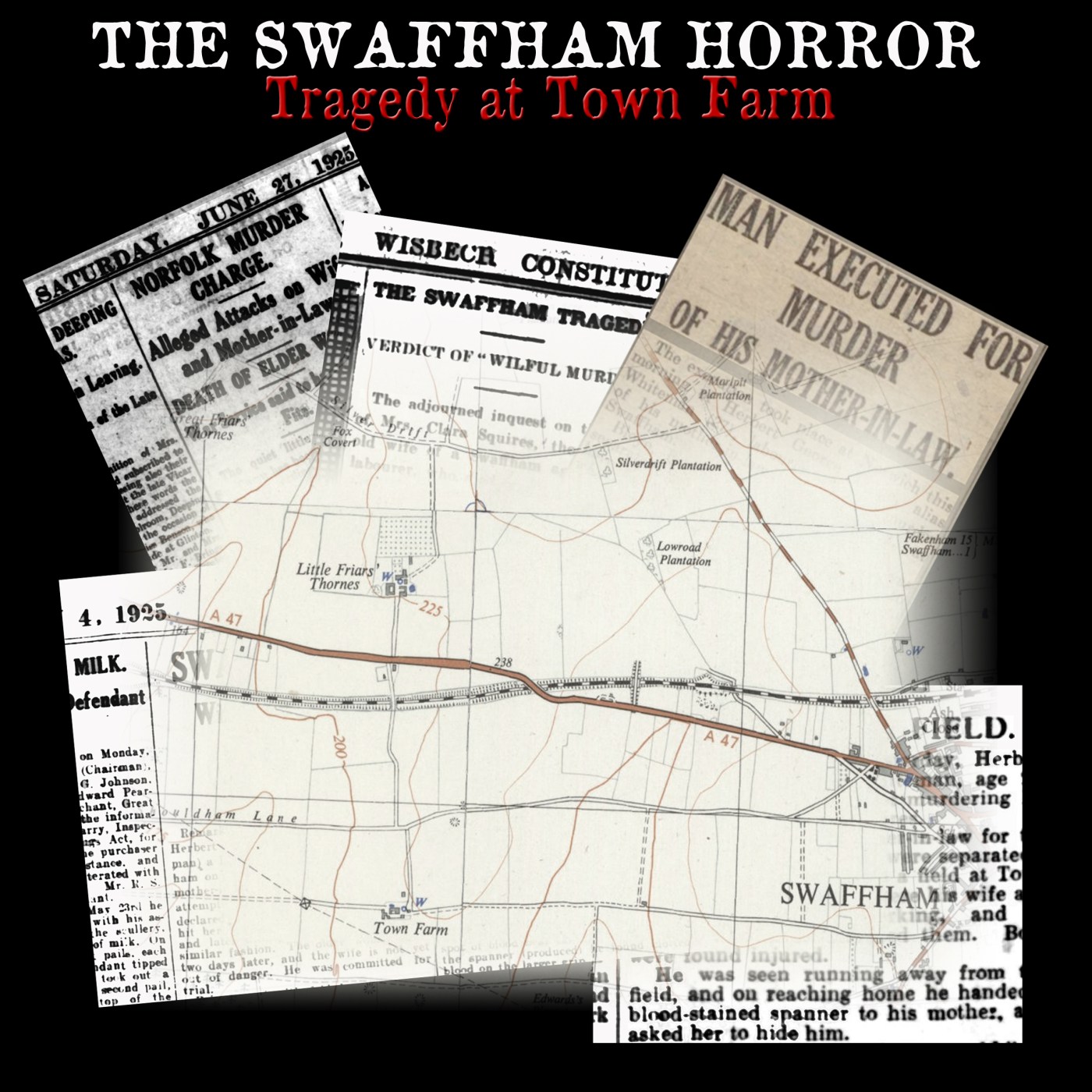
On the morning of Monday 15th June, William Squires was working in a field known as Heathlands  near Town Farm. His wife Clara was similarly busy in an adjacent field. Just before mid-day, Alice Squires, with her two children brought her father his lunch, and walked off in the direction of her mother. Shortly afterwards, Squires heard a terrible scream. He threw down his tools and ran in the direction Alice had taken. He found her lying on the ground, blood pooling around her head. Baby Evelyn was still asleep in her pram, but two year-old Herbert looked on, uncomprehending. Alice was unable to speak, but Squires looked across to where his wife had been working, and saw her tussling with a man. Before he could reach her, she fell to the ground. Running away from the scene was a man, later identified as Herbert George Whiteman.

Others, working nearby, ran to the scene. The police were summoned, as was Dr William Thorpe, and an ambulance was called to take the stricken women to Swaffham Cottage Hospital. Clara Squires died two days later without ever recovering consciousness.

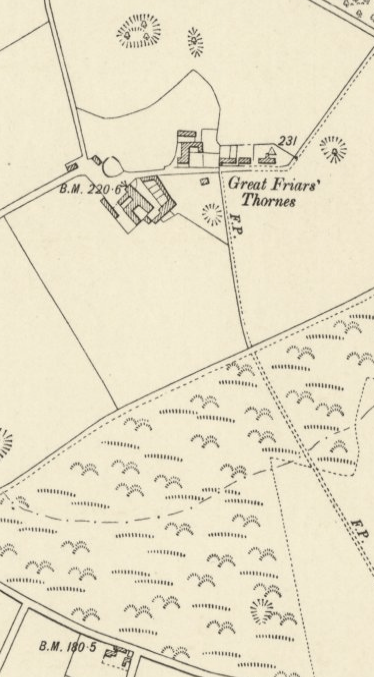
Screen Shot 2022-01-22 at 18.30.45Meanwhile, what of George Whiteman? After the attack on the two women he had headed north across the railway line in the direction of his mother’s cottage near what was known as Great Friars Thornes. Mrs Whiteman was standing in the yard of the farm with another woman, Frances Turner, who later testified:
‘Whiteman came round the corner of the yard. He had blood on his coat and hands, and said to his mother, “Don’t grieve for me, they can’t make you suffer for my sins. I’ve done the two in. I could not kill my two dear children. I want to say goodbye to my father, as the police will be after me in a few minutes.”‘

Whiteman was carrying a large agricultural spanner, and when he went with his mother to her house, he asked to hide it. She put it under a pile of firewood, but it was later discovered there by Police Constable Walmsley. Whiteman was arrested and taken to the cells at Swaffham Police Station. He was brought before the magistrates at the Shire Hall, Swaffham (below) on Tuesday 30th June.

Shire hall

Bizarrely, Whiteman insisted that he now be known as Bloye – his mother’s maiden name. The Yarmouth Independent reported the hearing thus:

Remarkable confessions wore made Herbert George Bloye (Whiteman) – labourer, when charged Swallham Tuesday with the murder of his mother-in-law, Mrs. Squire, and the attempted murder of his wife. He declared that after kissing his wife he hit her on the head with piece of iron, and later attacked his mother-in-law in a similar fashion. The older woman died two days later, and the wife is not yet out of danger. The prisoner sat with folded arms and impassive demeanour, head held high, while the evidence was given, even the distress of his white-haired mother apparently leaving him unmoved. When asked if he had any questions to ask of the witnesses, he stood smartly to attention and replied, “None at all. sir.”

Only once did he interrupt the evidence, and that was when the police read his statement that he said to the dead woman, when she began to cry before striking her, “Guilty conscience needs no accusing.” He then exclaimed. ” right!”

On the way from the police-station to the court-room, faced with several photographers, he smiled and tried to pose, but was hurried on by the police in charge of him.

It appeared that  in May the prisoner’s wife obtained separation order against him, and the prisoner was apparently under the impression that she was influenced in this by her mother. He seemed have made up his mind to murder his wife’s mother. The attack which formed the subject of the charge occurred on June 15th, and Mrs. Squires died two days later.

Dr. Kenneth Thorpe, Swaffham, said about 1.40 p.m. on the 15th June he was called to the Town Farm, about two miles out of the town, and saw Mrs. Whiteman lying on the side of Green Lane. She was unconscious and bleeding from wounds on the head, which he attended to temporarily. There were 24 wounds in all, and one had fractured the skull. They were not severe in themselves, but the number made them severe. Mr. Squires showed him where his wife was lying in the field. She was unconscious and bleeding from a large ragged wound on the left temple, about five inches long, from which the brain was protruding.

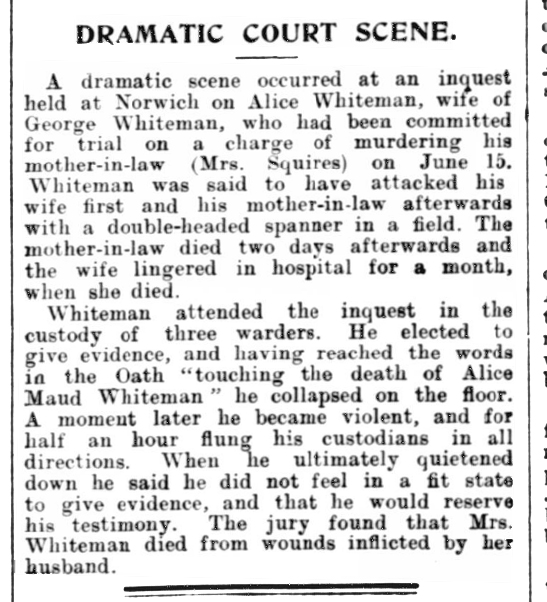
This particular newspaper report also expressed optimism about the condition of Alice Whiteman, even going as far as to say that she was expected to make a full recovery. They were wrong. Alice Whiteman hovered between life and death in the hospital for almost a month, but since her mental state had deteriorated owing to the terrible head wound she had sustained, she was transferred to Norwich Mental Hospital on 23rd July, but she was beyond medical help and died there on Monday 3rd August. A separate inquest on her death was held in Norwich, and was not without incident. By this time, the magistrates had found Whiteman guilty of the murder of Clara Squires, and he was sent to stand trial at the Autumn Assizes in Norwich.

Inquest

IN THE CONCLUDING PART
Trial and justice – of a kind

Blog at WordPress.com.

Up ↑