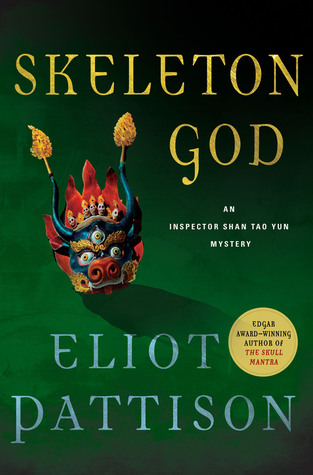
It is hard to believe that in the not-so-distant past western crime authors were prone to portraying Chinese detectives as little more than grotesques, acting out every preconception of what such a person must look and sound like, and how they should behave. The excellent Robert van Gulik, with his Judge Dee novels (1950 – 1968), was one of the earliest writers to move crime fiction set in China out of the Fu Manchu mode, and into a more credible world. Eliot Pattison introduced us to his modern day Chinese policeman, Shan Tao Yun, in Mandarin Gate (2012).
Shan is a former Beijing Police Inspector who has managed the not-so-difficult task of upsetting the monolithic party machine which controls The Motherland. After exile to the Chinese equivalent of the gulags, he has been paroled to an isolated town in Tibet, where he is officially The Constable. His main tasks seem to be rescuing yaks stranded in the winter mud or chasing goats away from municipal buildings. Above all, he must and uphold the law in a community largely stripped of its traditional identity by decades of Chinese Imperialism.
 The book actually begins with Shan rescuing one of the aforementioned yaks, but events take a more sinister turn. An ancient grave is uncovered, but the inhabitants are unlikely bedfellows. The original occupant is a long dead priest, mummified and gilded. But his companions are the remains of a Chinese soldier, and the very recent corpse of an American visitor. There is cultural confusion when a mobile ‘phone, presumably not the property of either the priest of the soldier, chimes out Handel’s Hallelujah Chorus across the chill mountain air and into the ears of alarmed Yangkar locals.
Shan discovers that the American is an ex-US Navy rating called Jake Bartram. Unlikely though it may seem, Bartram’s mother is Tibetan, and came from Yangkar itself, before marrying an American citizen and settling in Pennsylvania. Rather like the relationship between Philip Kerr’s Bernie Gunther and his Nazi bosses, Shan is regarded with a mixture of caution and tolerance by those who sit in power within the Communist Party of China and, ipso facto by every single one of its eighty million members.
Shan walks a never-ending tight-rope. If he falls to one side he risks the wrath of The Party, and he is ever aware of their power. Should he fall to the other side, he knows that he will betray the Tibetan people with whom he lives. A young Chinese Public Security officer who is, effectively, moonlighting, alerts Shan to the misdeeds of a prominent retired military hero, General Lau, and the resultant investigation taxes to the limit both Shan’s integrity and his instinctive desire to keep his head in physiological contact with the rest of his body.
Pattison’s evocation of the fragile remnants of Tibetan culture is masterly. The rich and mystical Buddhist past is now little more than the rags on a scarecrow, buffeted and shredded by the savage winds of conformity which have howled from the east since the 1950s. The monasteries have gone, and their timbers and stone recycled to build barns. Gone, too, are the monks, but the ancient Tibetan ghosts remain, at least in the minds and imaginations of those who still scratch out a living in the valleys and high passes.
Readers are left in little doubt as to where Pattison’s sympathies lie, between the hard put-upon Tibetans and their Chinese masters. The sheer enormity of the chain of command between Sinophile officials in the windswept uplands of Tibet and their  masters far away to the east is described with wit and a certain degree of compassion. I am never completely convinced by the regular use of italicised foreign language nouns in novels, particularly when the original words would have used an entirely different alphabet, but this is a tiny complaint dwarfed by what is a brilliant and evocative police procedural, albeit one set in a world as far away from our European certainties as it is possible to recreate. Pattison (right) has written a novel which reminds us that China’s eminence as a world power has not been achieved painlessly.
Skeleton God is published by Minotaur Books and is out now.


 SKELETON GOD by ELIOT PATTISON
 FATAL PURSUIT by MARTIN WALKER
 AMNESIA by MICHAEL RIDPATH
 DEFECTORS by JOSEPH KANON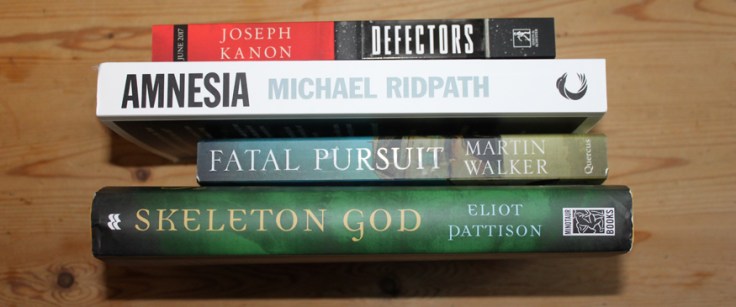


 fullybooked2017