
Search

fullybooked2017

Tag

Sherlock Holmes

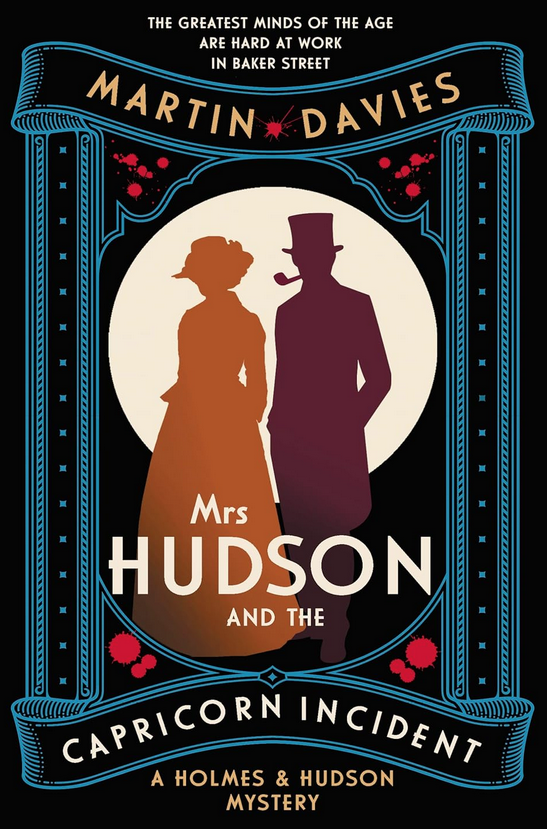
MRS HUDSON AND THE CAPRICORN INCIDENT . . . Between the covers

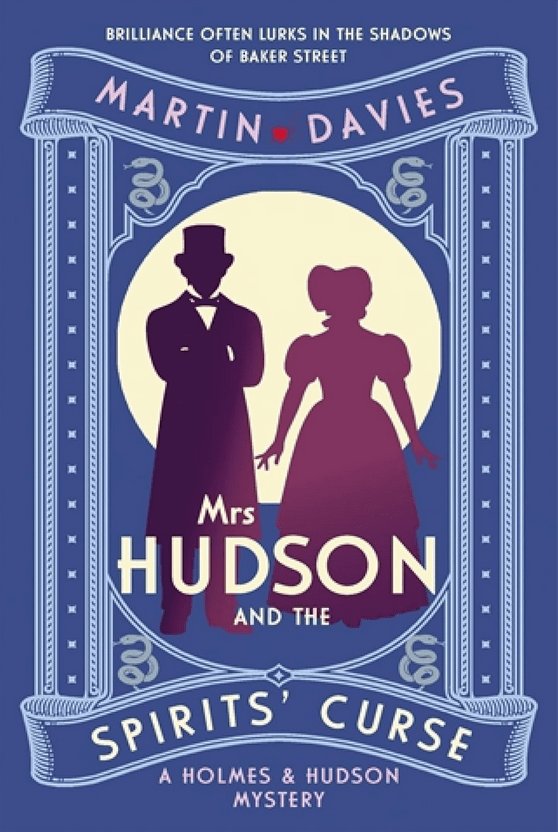
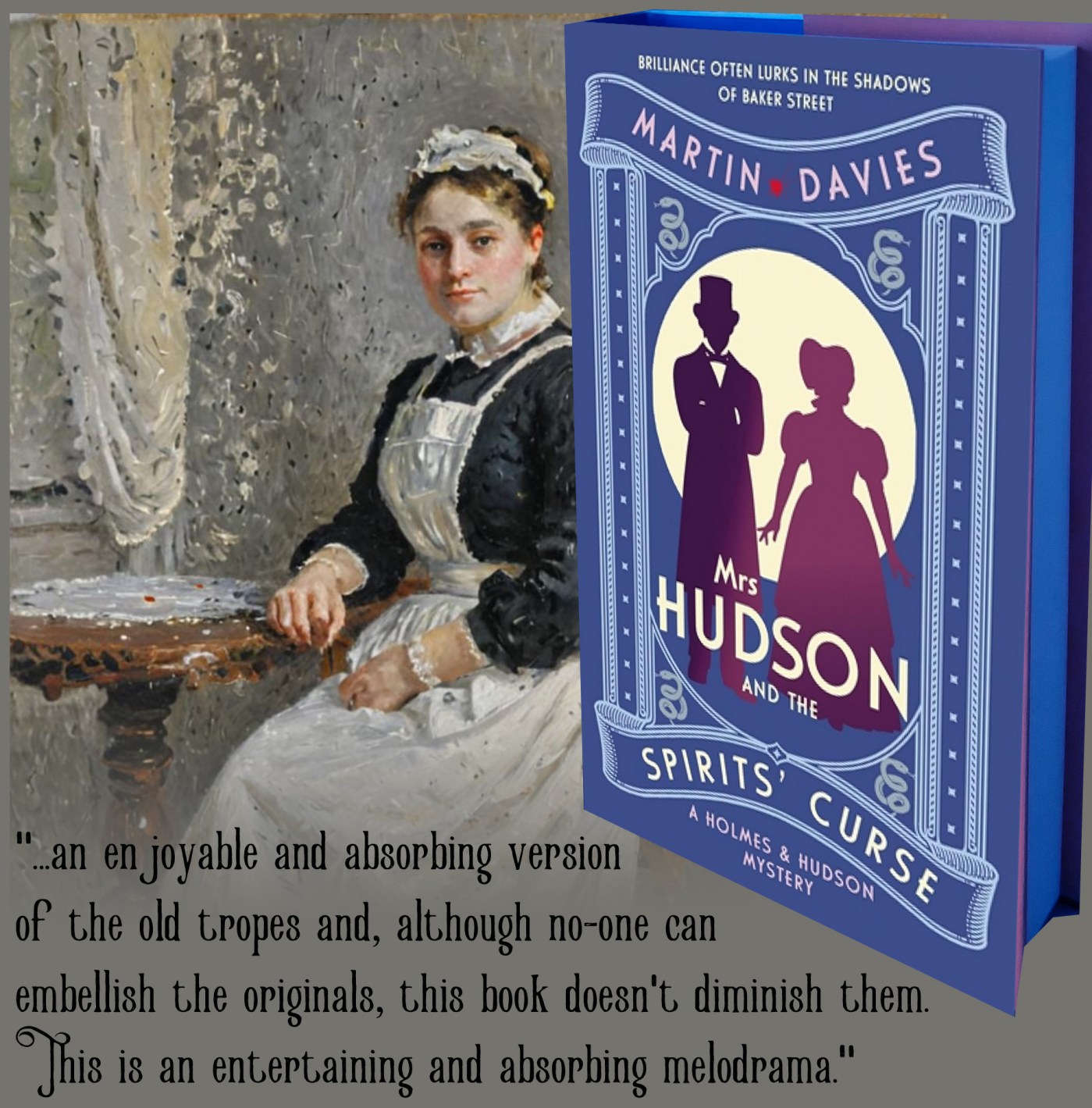
The canonical 56 short stories and four novellas featuring Sherlock Holmes have left so-called ‘continuation’ authors with plenty of subordinate characters to draw on. Dr Watson, inspector Lestrade, Moriarty and brother Mycroft have each been the central character in novels. I suppose it was only a matter of time before Mrs Hudson took centre stage. Martin Davies took up the challenge in 2002 with Mrs Hudson and the Spirit’s Curse, but here, events are narrated by a girl called Flotsam, who recalls events rather in the way that the good Doctor reminisces about the cases his old friend solved.

Flottie was an orphan girl, saved from a life of degradation by the kindness of Mrs Hudson, but is now a very bright young woman who has seeks education where and whenever she can find it. She is now highly literate and socially adept (but still working downstairs).The story unfolds through her eyes and ears. The substantive plot centres on Rosenau, a tiny Duchy in the Balkans, squeezed between the competing demands of the ailing Ottoman empire, Austria-Hungary and fervent Serbian nationalists. It’s survival depends on an impending marriage between Count Rudolph and Princess Sophie who, hopefully will provide a legitimate heir, ensuring the Duchy’s survival. Rosenau is, of course, fictional, but the Balkan powder keg was, at the turn of the century, frighteningly real. Everything goes awry when, first, the Count goes missing while on a European skiing trip and, second, when the princess is abducted from a London residence.

Reviewers and critics are perfectly entitled to question the validity of the still-vibrant Sherlock Holmes industry. Why, over a century after the last Conan Doyle tale was published, are we still seeing (and here, choose your own description) continuations, homages, pastiches and re-imaginings of crime fiction’s most celebrated character? The answer is simple – because people buy the books or borrow them from the library. Conan Doyle tired of his man, and tried to end it all, in the hope that readers would be drawn towards his other novels, like Micah Clarke or the Brigadier Gerard series. He was forced to relent. As a former prime minister said, “You can’t buck the market.” She was correct, and it must be assumed that two decades after the first novel in the series, people still buy these books and, for publishers, that is it and all about it.

Is this book any good? Yes, of course. Conan Doyle planted a seed which has grown into the mother of all beanstalks, and the Sherlock Holmes phenomenon is as busy as it ever was. Martin Davies reconnects us to a world which is endlessly appealing: chaste bachelors of independent means, a strictly ordered society, a London unsullied by antisemitic mobs, a railway system that ran with clockwork precision, handwritten letters delivered several times daily, a world that challenged the chant of Macbeth’s witches, ‘fair is foul and foul is fair’. This moral ambiguity has no place in the world of Mrs Hudson or Flottie. The tone of the book? Light of heart in some ways, with a certain amount of comedy. Here, a caricature aristocratic old gent opines on marriage:

“Wedding, for goodness sake? Weddings are ten a penny. When I was a lad, a man got married in the morning, introduced his wife to his mistress at lunchtime, and was at the races in the afternoon. And so long as he honored his debts, no one thought the worse of him.”

The humour reminded me very much the very underrated series of Inspector Lestrade novels by MJ Trow. As in those novels. this author provides some good jokes: A famous actress confides in Flottie.

“The important thing is to remember that your skirts are your enemy and speed is your friend. Which is quite the opposite of how we usually think about things, isn’t it?”

She is talking about the new enthusiasm among young women for cycling.

I have made this point before, but it is worth repeating. The canonical Holmes short stories were just that – short. Conan Doyle could take one problem, and allow his man to solve it in just a few pages. Even the four novels were brief. Short stories don’t sell these days and the concept of novels serialised in print and paper magazines is dead and buried, therefore modern Holmes emulators have to spin out the narrative to the regulation 300-400 pages. So, there has to be subplots and other investigations going on, and this almost always means that the narrative tends to drift. So it is here, with the Rosenau crisis sharing the pages with the search for someone called Maltravers, a serial swindler. Martin Davies handles this dilemma as well as anyone else, and presents us with an entertaining tale that is well worth a few hours of anyone’s time. There were occasional longeurs, but the last few pages were rather wonderful. Mrs Hudson and the Capricorn Incident is published by Allison & Busby and is available now.

THE SERPENT UNDER . . . Between the covers

TSU spine008 copy

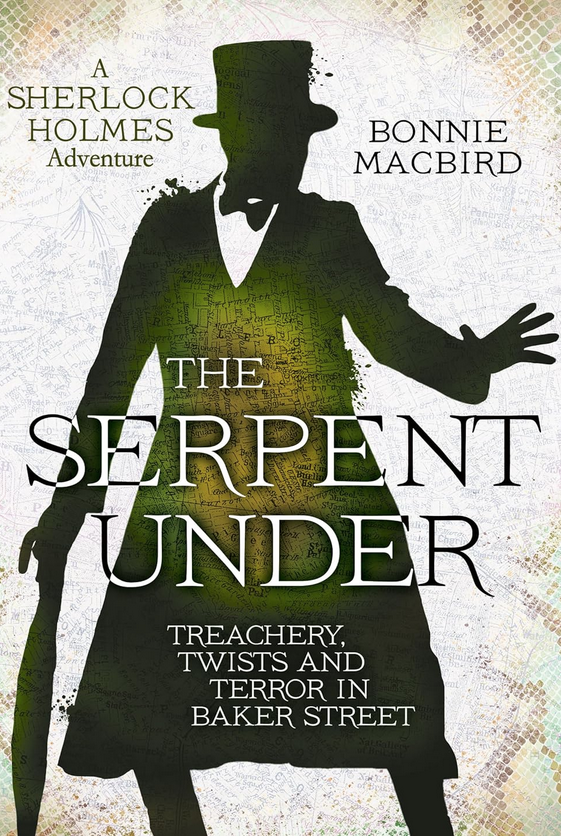
Leaving aside for a moment the question of whether or not this Sherlock Holmes pastiche is any good, I will tell you that in terms of design and printing, it is to be treasured. The cover is magnificent, and the illustrated capitals at the beginning of each chapter are a  delight – each a miniature masterpiece.

To the text. Holmes and Watson receive an urgent summons to Windsor Castle, where a lady-in- waiting to an elderly duchess has been found dead in her bath. Palace officials have  peremptorily declared the death as suicide, cleaned the area where the body was found, and moved her remains to another chamber. One glance at the corpse of Miss Jane Wandley is enough for Holmes to realise that she has been murdered. Not only is it impossible that the two slashes on her wrists to have been self administered, she is covered in fresh and unhealed tattoos, depicting an ancient symbol, the Ouroboros – a snake eating itself. 

We are reunited with one of the more improbable characters in this series, a young girl known as Heffie, who is an ex-officio member of the Baker Street Irregulars (a staple of the original stories), a gang of street urchins who use their anonymity to eavesdrop on conversations between ladies and gentlemen on London’s highways and byways. They were a brilliant invention by ACD, as they give Holmes eyes and ears in places where he would be too conspicuous to be effective. Heffie is roughly spoken, but highly intelligent and observant. There is just a hint of Pygmalion about this, as Heffie is anxious to speak ‘proper’ as Holmes, in his Henry Higgins mode, corrects her language and pronunciation.

Bonnie MacBride wastes no time in presenting us with a selection of dubious characters. Jane Wandley’s own father will not leave his Home Counties mansion to identify his daughter’s body sending, instead, his estate manager Peter Oliver, a handsome and charismatic university graduate. Jane Wandley’s fiancée, a vulgar and vain German of very minor royal descent, has a cast iron alibi for the probable murder timeline, but  is definitely a person of interest.

The key to the mystery lies in the elaborate and professionally executed tattoos on the dead woman. Someone is obviously sending an arcane message, but to whom? And what is the message? Holmes traces the tattoos to the work of a celebrated Japanese artist, much in demand in his home country where his top customers are Yakuza gangsters. However, he was in London at a Japanese cultural event, was kidnapped along with his little daughter and forced to work on Jane Wandley with a knife held to his daughter’s throat. She has been released, but of him there is no sign. Things become more complex when it is discovered that Jane Wandley’s younger brother is an artist who creates designs for an upmarket fabric company. His patterns all feature, guess what? Snakes.

Holmes tributes, pastiches, homages – call them what you will – are almost as old as the original stories. I can cope with most of them, provided they stay in period. Attempts to put him in modern dress, or make him Steampunk, or recast him in a comedy parody, are, for me, beneath contempt. Life shortens by the day, and so I don’t have statistics, but I make an educated guess that SH ‘reimaginings’ probably now outnumber the originals.

I have made this point before, but it is well worth repeating. With the exception of the four novella-length tales, A Study in Scarlet, The Valley of Fear, The Sign of Four and The Hound of the Baskervilles, all other Holmes stories were short and pithy, aimed at magazine readers. Modern novelists are, therefore faced with an inbuilt challenge, which is to keep their stories ticking over throughout 400 pages or so. Hence the need for having other story lines running parallel to the main one – in this case the mystery of who is attempting to damage and disrupt a fledgling women’s rights movement. I have a rather ‘left field” yardstick for these books. If I can imagine Holmes’s dialogue being delivered by Jeremy Brett, then all is well. In The Serpent Under, all is not just well, but flourishing. This is a clever re-imagining of our old friend, and very, very readable. Published by Collins Crime Club, it is available now.

Screen Shot 2024-12-26 at 16.26.47

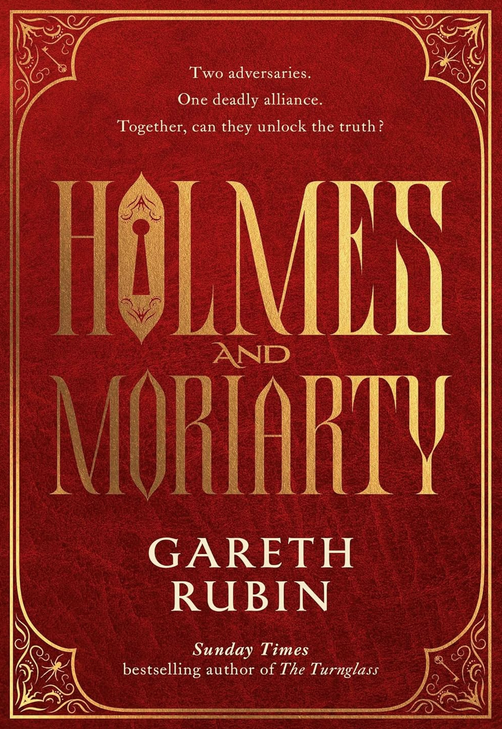
HOLMES AND MORIARTY . . . Between the covers

handm spine079 copy

No fictional character has been so imitated, transposed to another century, Steampunked, turned into an American, or subject to pastiche than Sherlock Holmes. In my late teens I became aware of a series of stories by Adrian Conan Doyle (the author’s youngest son) and I thought they were rather good. Back then, I was completely unaware that the Sherlock Holmes ‘industry’ was running even while new canonical stories were still being published in the 1890s. Few of them survive inspection, and I have to say I am a Holmes purist. I watched one episode of Benedict Cumberbatch’s ‘Sherlock’, and then it was dead to me. As for Robert Downey Jr, don’t (as they say)”get me started.” For me, the film/TV apotheosis was Jeremy Brett, but I have a warm place in my heart for the 1950s radio versions starring Carleton Hobbs and Norman Shelley.

How, then, how does this latest manifestation of The Great Man hold up? The narrative has a pleasing symmetry. The good Doctor is, as ever, the storyteller, but as the book title suggests there is another element. Alternate chapters are seen through the eyes of a man called Moran who is, if you like, Moriarty’s Watson. Gareth Rubin’s Watson is pretty much the standard loyal friend, stalwart and brave, if slightly slow on the uptake. Moran’s voice is suitably different, peppered with criminal slang and much more racy.

The case that draws Holmes into action is rather like The Red Headed League, in that a seemingly odd but ostensibly harmless occurrence (a red haired man being employed to copy out pages of an encyclopaedia) is actually cover for something far more sinister. In this case, a young actor has been hired to play Richard III in a touring production. He comes to Holmes because he is convinced that the small audiences attending each production are actually the same people each night, but disguised differently each time.

Meanwhile, Moriarty has become involved in a turf war involving rival gangsters, and there is an impressive body count, mostly due to the use of a terrifying new invention, the Maxim Gun. There is so much going on, in terms of plot strands, that I would be here all week trying to explain but, cutting to the chase, our two mortal enemies are drawn together after a formal opening of an exhibition at The British Museum goes spectacularly wrong when two principal guests are killed by a biblical plague of peucetia viridans. Google it or, if you are an arachnophobe, best give it a miss.

Long story short, three of the men who led the archaeological dig that produced the exhibits for the aborted exhibition at the BM are now dead, killed in some sort of international conspiracy. It is worth reminding readers that as the 19thC rolled into the 20thC, the pot that eventually boiled over in 1914 was already simmering. Serbian nationalism, German territorial ambitions, the ailing empires of the Ottomans and Austria Hungary, and the gathering crisis in Russia all made for a toxic mix. This novel is not what I would call serious historical fiction. It is more of a melodramatic – and very entertaining – romp, and none the worse for that, but Gareth Rubin makes us aware of the real-life dangerous times inhabited by his imaginary characters.

Eventually Holmes, Watson, Moriarty and Moran head for Switzerland as uneasy allies, for it is in these mountains that the peril lurks, the conspiracy of powerful men that threatens to change the face of Europe. They fetch up in Grenden, a strange village in the shadow of the Jungfrau and it is here, in a remarkably palatial hotel given the location, they are sure they have come to the place from which the plot will be launched. By this stage the novel has taken a distinctly Indiana Jones turn, with secret passages,  and deadly traps (again involving spiders).

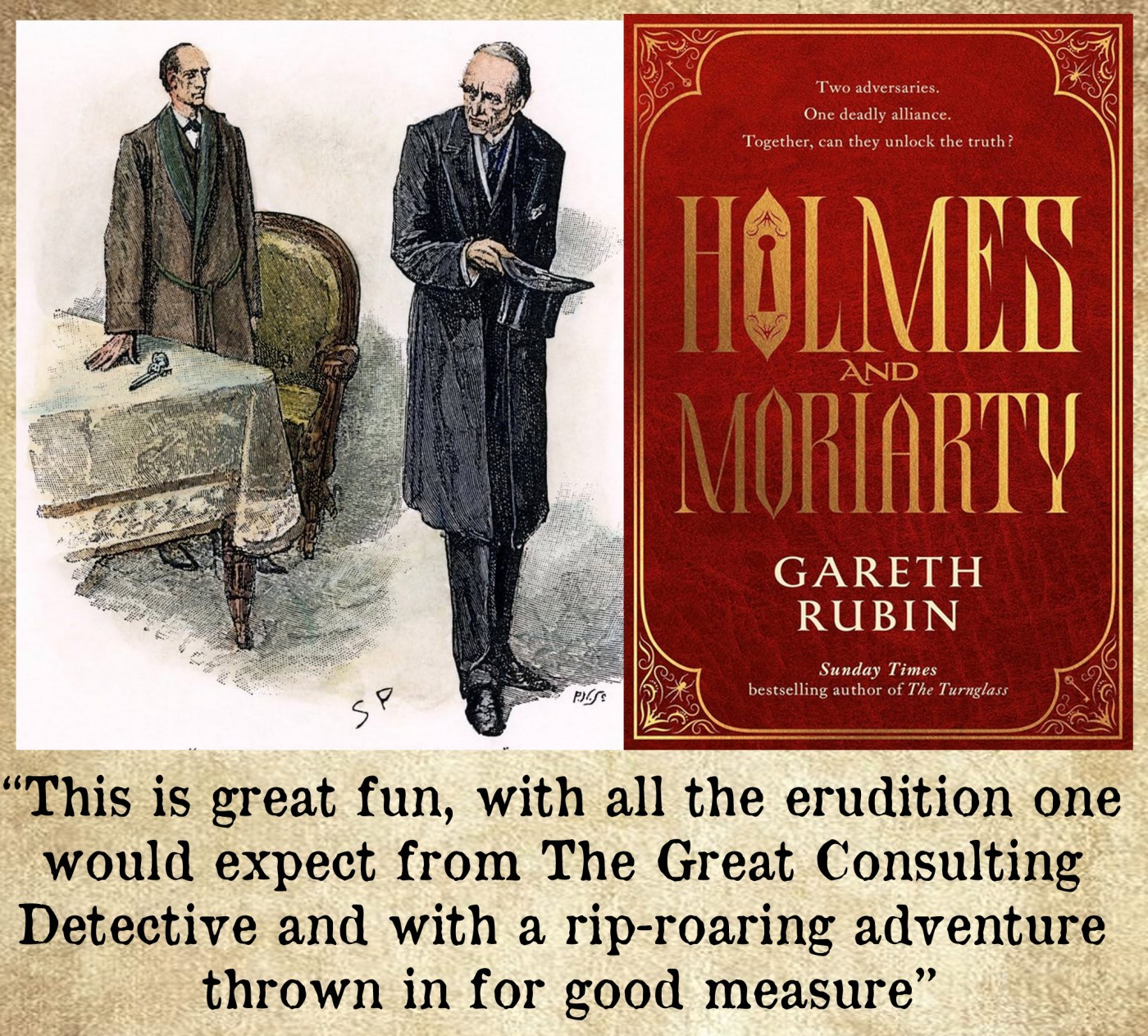
This is great fun, with all the erudition one would expect from The Great Consulting Detective and with a rip-roaring adventure thrown in for good measure. It is published by Simon & Schuster, and will be available at the end of September.

Screen Shot 2024-09-05 at 17.54.58

WHAT CHILD IS THIS? … Between the covers

wcit spine052 copy

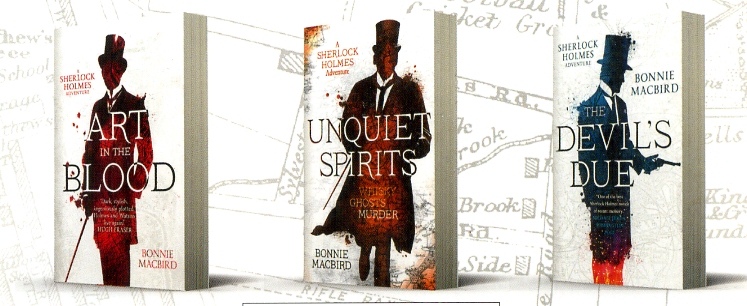
Screen Shot 2023-11-30 at 19.45.54In 2021 I reviewed an earlier contribution to the Sherlockian canon by Bonnie MacBird (left) – The Three Locks – and you can read what I thought by clicking the link. Her latest contribution is unashamedly aimed at the Christmas market, but it is worth reading. It begins with that reliable staple –  the box of hitherto unseen papers and notebooks written by John Watson MD. The cynic in me thinks that the good doctor would have had no time to help his great friend with his investigations, as his every waking hour would have been consumed in filling boxes with notebooks, in the expectation that they would be discovered in an auction – or someone’s attic – a century later.

Be that as it may, we are in London in December 1890, and it is snowing (obviously). Watson persuades Holmes to accompany him for lunch, but after they have consumed their roast beef sandwiches and cider, they are forced to intervene when a masked man attempts to abduct a child from his mother. Holmes pursues the villain, while Watson tends to the woman and her frightened child.

Watson eventually catches up with what is happening, while Holmes, perspicacious as ever, soon realises that  the attempted kidnap is related to the boy’s own history as the object of a transaction by an adoption agency. The search for the boy’s real father occupies most of the narrative. I have mentioned before the significant inbuilt challenge facing modern recreators of Holmes – that the majority of the original tales were very short stories, thus posing the problem of how to fill the three hundred pages or so of a modern novel. MacBird opts for the eminently reasonable solution of having a parallel mystery – that of a wealthy (but not particularly sensitive) man of property whose youngest son – something of an aesthete – has gone missing, along with his manservant. Holmes, with the help of a redoubtable Cockney reprobate called Hephzibah, locates the manservant in an expensive apartment, where he has been seen with an alluring young woman. Holmes solves this particular conundrum in a rather 2023 fashion and . . . well, perhaps you can guess, but I won’t spoil the fun.

The illustrations by Frank Cho are delightful, and the whole book is beautifully produced, with elaborate illuminated capital letters at the beginning of each chapter. Some might argue that drawings ask that readers bypass their own visual impressions suggested by the text, but I think this is specious. Generations of readers of the original stories will have had their imaginations shaped by external sources – for example the wonderful Strand Magazine drawings of Sidney Paget – while, for me, the face of Holmes will never be anything other than that of Jeremy Brett.

Some unkind people will moan and roll their eyes at what they consider yet another milking of the Holmes legacy. “Isn’t the teat already dry,” they ask? No, it is not. Chandler’s Philip Marlowe has engendered many imitators, and some of them are very good, but Arthur Conan Doyle created a legend. ACD was mortal, and lived to a decent age, but he bequeathed a character that is for all time. As long as there are writers as skilful and observant as Bonnie MacBird to keep the Holmes flame alight, I will be warming myself in its glow. What Child Is This is published by Harper Collins and is available now.

A CASE OF ROYAL BLACKMAIL . . . Between the covers

acorb header038

Sherlock Holmes pastiches, if not a growth industry, provide regular and steady employment for many writers. There is an erudite and entertaining feature on Holmes impersonations by Stuart Radmore here, but now we have a new entrant to the lists. It is written by none other than the great man himself (of which more later) and the 24 year-old sleuth has stolen some of his future companion’s thunder by recounting the case in his own words.

acorb cover039We are in London in the summer of 1879, and young Holmes has yet to meet the man who will write up his greatest cases. Holmes works for a guinea a day, and is striving to build his reputation. Within the first few pages, he has been hired to investigate two cases on behalf of a man who was already a celebrity, and another who would become infamous in his lifetime, but revered and admired after his death. The celebrity is Albert Edward, Prince of Wales, the future King Edward VII, a notorious Lothario whose battleground has been country houses and mansions the length and breadth of the country, the vanquished being a long list of cuckolded husbands. It seems that the heir to the throne has been in the habit of entering his sexual achievements in a diary – a kind of fornicator’s Bradshaw, if you will – but it has gone missing, and Holmes is charged with recovering it.

The second case is a strange request by a 25 year-old Irish aesthete and writer – one Oscar Fingal O’Flahertie Wills Wilde, who has lost – of all things – an amethyst tie-pin, a gift from his mother, the formidable Jane Francesca Agnes, Lady Wilde, and is desperate for Holmes to find it before an impending visit from Wilde mère.

Rosa_Corder,_by_James_McNeill_WhistlerOne hundred pages in, and it is clear that the author is enjoying a glorious exercise in name-dropping. James McNeill Whistler, Lillie Langtry, Francis Knollys, Patsy Cornwallis-West, Frank Miles, Sarah Bernhardt, John Everett Millais and Rosa Corder (right) are just a few of the  real life characters who make an appearance, and it is clear that ‘Sherlock Holmes’ moves in very elegant circles.

In the course of his investigations our man presages some of the talents for which he will later became famous when the as-yet-unmet Dr John Watson takes over the narrative. He disguises himself as a waiter at a royal banquet on one occasion, and manages to impress his clients with his uncanny observational skills. The case is complicated when Holmes becomes inadvertently involved with the attempt by scandal-sheets to sell papers off the back of the very public rift between Lillie Langtry and her husband Ned. The case of Oscar’s missing tie pin rather goes on the back-burner as the hunt for the royal blackmailer intensifies, but it is resolved at the very end of the book with a rather delicious twist.

So just who, exactly, is this particular Sherlock Holmes? The last five words of the book reveal the true identity of the author, but I won’t do all the work for you. A little clue that you can Google – this person is a peer of the realm, an old Etonian, and wrote the biography Never Fear: Reliving the Life of Sir Francis Chichester.

The worst that can be said of A Case of Royal Blackmail is that is a little over-egged with the cast of celebrity names, but once in a while we all need a few hours of enjoyable escapism, and this well-researched and cleverly plotted homage fits the bill perfectly. It is published by Affable Media, and is available now.

acorb footer040

ARE YOU A SHERLOCKIAN? Let’s see !

SHbanner

Here’s a quiz to test how much you know about the great consulting Detective and all things associated with him and his creator. Click the image below to make a start.

Screen Shot 2021-05-20 at 19.37.30

THE THREE LOCKS . . . Between the covers

TTL006In a sappingly hot Indian Summer in central London, Dr John Watson is sent – by a relative he hardly remembers – a mysterious tin box which has no key, and no apparent means by which it can be opened. Watson and his companion Sherlock Holmes have become temporarily estranged, not because of any particular antipathy, but more because the investigations which have brought them so memorably together have dwindled to a big fat zero.
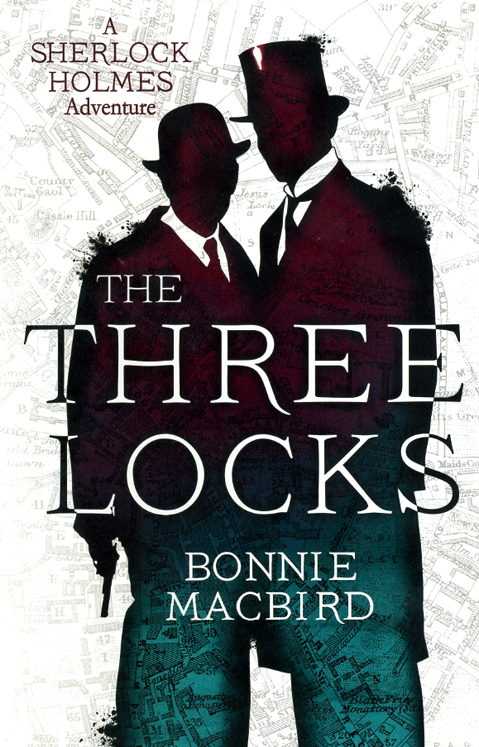
TTL007But then, in the space of a few hours, Watson shows his mysterious box to his house-mate, and the door of 221B Baker Street opens to admit two very different visitors. One is a young Roman Catholic novice priest from Cambridge who is worried about the disappearance of a young woman he has an interest in, and the second is a voluptuous conjuror’s assistant with a very intriguing tale to tell. The conjuror’s assistant, Madam Ilaria Borelli is married to one stage magician, Dario ‘The Great’ Borelli, but is the former lover of his bitter rival, Santo Colangelo. Are the two showmen trying to kill each other for the love of Ilaria? Have they doctored each other’s stage apparatus to bring about disastrous conclusions to their separate performances?
As for the missing young woman, Odile ‘Dilly’ Wyndham, she is only ‘missing’ because she has a pied-à-terre, unknown to her parents, where she can flirt with her admirers to her heart’s content, and it transpires that the thoughts of the young priest-in-waiting are not wholly as pure as the waft of incense. Was he responsible for the doll found on Jesus Lock footbridge, dressed to look like Dilly, but with its arm wrenched off?

TTL009

As an aside, this tale has Holmes and Watson as younger men, perhaps in their thirties. MacBird includes all the standard tropes – Watson’s bemused geniality and stiff upper lip, Holmes’s mood swings and reliance on cocaine when life becomes too dull, and even the stern but maternal presence of Mrs Hudson.

Much of the action takes place in Cambridge, and it is there that the murder which occupies much of the book is committed. MacBird does a fine job of keeping the two strands of the plot – the warring conjurors, and the love life of Dilly Wyndham – running together side-by-side, and she shows us some magic of her own by bringing them together by the end . Watson’s mysterious box? It does get opened eventually, and what it reveals is rather moving. Fans of the great detective will not be disappointed by The Three Locks – it has enough twists and surprises to satisfy even the sternest Holmesian.

TTL009
Is ‘pastiche’ the right word for this book? Maybe ‘re-imagining’, or ‘tribute’ might be kinder. Whichever word we use, the central problem facing modern writers of Sherlock Holmes stories is that of length. Even the four full length canonical novels – A Study In Scarlet, The Sign of The Four, The Hound of the Baskervilles and The Valley of Fear – are very short compared to modern books. The bulk of the Holmes canon are the short stories, which spark and fizz brilliantly for a few thousand words, and then are gone. Yes, short story writing is an art in itself (which very few have mastered) but maintaining pace and narrative drive for four hundred or more pages is a different challenge.  A writer of a Holmes and Watson homage has to spin out every gesture, comment and impression which, in the originals, crackle and then are gone in a moment. I haven’t read the previous three MacBird Holmes novels, but The Three Locks works as well as most other novels in the genre, and certainly better than some. It is published by Collins Crime Club and is out on 1st April. If you click on the image below, it will take you to Bonnie MacBird’s website, and a very entertaining set of annotations linked to the novel.

TTL008

SHERLOCK HOLMES . . . Personation, pastiche and parody

Holmes header

Soon after his first short story appearance in 1891, Sherlock Holmes became a phenomenon.   The first parodies, by JM Barrie and Robert Barr (friends of Arthur Conan Doyle), were published within months, and dozens of light-hearted short parodies and pastiches continued to appear regularly in magazines for the next twenty years or so.

Conan Doyle’s final Holmes story appeared in 1927, and Conan Doyle himself died in 1930.   From about 1940 “new adventures” by Holmesian specialists began to appear, fitfully, in magazines and private printings. More so than earlier pastiches, these tended to keep closely to the fictional world established by Conan Doyle. A selection of these tales was later collected in “The Further Adventures of Sherlock Holmes” (1985), edited by Richard Lancelyn Green.

600px-1948-03-adrian-conan-doyle-with-pipe-and-magnifying-glass-02

Conan Doyle’s copyright
of his works originally lasted for fifty years after the author’s death. These rights were jealously guarded by the Conan Doyle Estate, in the person of Adrian Doyle, the author’s youngest son (above).  So it’s no surprise that he should be involved in the publication of the first authorised Holmes pastiches. These “Exploits of Sherlock Holmes” (1954) comprise twelve cases mentioned but never recorded in the original stories. They were to be written by Doyle and mystery writer John Dickson Carr, but  Carr fell ill after writing (or co-writing) six tales, and the remainder were written by Doyle alone.

Looking at the Exploits, it’s clear that the stories plotted by Carr are extremely imaginative.  Carr was the master of the locked room mystery and he re-used ideas from his earlier writings here. The six stories by Adrian Doyle are closer to the language of the original Holmes stories. However, they are also closer in plot; each of the tales has taken its main story line from one of the Holmes adventures written by Conan Doyle.   That said, it remains an enjoyable collection. Both men realised that the strength of the Holmes legacy lay in the short stories, which were generally superior to the novels.

The next pastiches were the by-product of two Sherlock Holmes films.

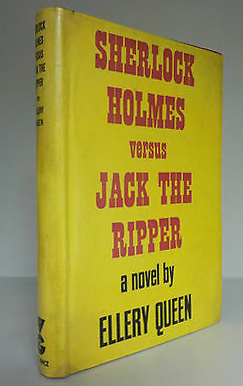
Ellery-Queen-Sherlock-Holmes-Versus-Jack-TheThe first, Sherlock Holmes versus Jack the Ripper, by ‘Ellery Queen’ was published in 1967. This was a novelisation of the screenplay of  ‘A Study in Terror’, co-produced by Sir Nigel Films Limited, a company formed by the Estate to exploit Conan Doyle’s works on screen.   The book added a framing story wherein Ellery Queen reads a manuscript (written by Dr Watson) which sets out the action shown in the film. Queen then applies his own detective skills to ascertain whether Holmes correctly identified the Ripper.  The Ripper section of the book was the work of pulp writer Paul Fairman, and the Ellery Queen part by presumably ‘Ellery Queen’ himself.  An early line of Dr Watson’s narrative reads:

“It was a crisp morning in the fall of the year 1888″:

A warning for American writers attempting this sort of thing.

Next, in 1970, came The Private Life of Sherlock Holmes, a novelisation (by Michael and Mollie Hardwick) of the screenplay of Billy Wilder’s film of the same name. Again, produced in association with Sir Nigel Films.   Wilder called the screenplay respectful but not reverential. The film was much cut by the studio before its release, and the resulting story is unwieldy and at times near parody. All this is reflected in the book.  Still, some say it captures the Holmesian atmosphere reasonably faithfully.

IMG_0930

The early 1970s
saw a growing interest in Victorian/Edwardian detective fiction, and with Sherlock Holmes in particular. The Estate was aware that its copyrights would expire at the end of 1980, and authorised a number of Holmes pastiches (for which they took a share of the sale proceeds).

The first was Nicholas Meyer’s The Seven Percent Solution (1974).    A contemporary review states:-

Seven_Percent_Solution_first_edition_US“The story is couched as an alternative explanation for the period between Holmes’s  supposed death at the hands of Moriarty (‘The Final Problem’) and his resurrection (‘The Empty House’). The hiatus which began with Holmes drying out extends into a case involving a pasha, a baron and a red headed temptress, during which Holmes instructs Freud in the mechanics of detection and gives some advice about the meaning of dreams.”

This highly successful novel is influential for two reasons.   It’s the first story to mix Sherlock Holmes with  real historical figures – in this case Sigmund Freud in 1890s Vienna – a plot device which has formed the dubious basis of countless tales since;  and it’s the first book  to question the accepted facts of the canon. Nicholas Meyer would develop both these themes in his second Holmes pastiche The West End Horror (1976), set in London’s 1890’s theatreland.

Now the gates had opened. 1977/8 saw the publication of Loren D Estleman’s Sherlock Holmes vs Dracula, Robert Lee Hall’s Exit Sherlock Holmes, and Michael Dibdin’s The Last Sherlock Holmes Story.    The first is a re-telling of a Dracula legend, with Holmes involved in the investigation; the second a Moriarty Lives! tale with elements of science fiction in the conclusion, and the last a return  to the world of Jack the Ripper. These novels can best be described as adventure stories featuring Sherlock Holmes, rather than Sherlock Holmes stories.   None of them were bestsellers, but they have all been reprinted over the years and have in turn inspired many more variations on these themes.

Three novels

A few years earlier
, another promising seam was opened with the publication of The Return of Moriarty by John Gardner; the first of what now seems an never-ending series of books by various hacks featuring subsidiary characters from the canon.

Finally, to top off the decade’s continuing fascination with all things Holmesian, 1979 saw the release of the film Murder by Decree  – a grafting of Sherlock Holmes onto Steven Knight’s then popular Freemasonry/Ripper theories. A novelisation of the screenplay duly followed.

Now seems a convenient place to stop. By December 1980 when the Doyle copyrights initially expired (they were extended to 2000 a few years later) almost all the elements of the present day copyright-free Sherlock Holmes industry were in place. For good or ill, all had been authorised by the Conan Doyle Estate.

From now on, almost all the pastiches were in the form of novels (short stories required too much work, and didn’t sell).

This presented a problem. The original Holmes novels are structurally flawed; the author cannot present a very intelligent central character with a case to solve, and then have that character take two hundred pages to solve it without making him look slow or obtuse.  Sub-plots, or  a back story,  must be introduced to fill the pages.   This is why the genius of Holmes (and Doyle) is best seen in the short stories.

Conan Doyle only once solved this conundrum – with The Hound of the Baskervilles – the pasticheurs never have.

THE POSTMAN DELIVERS . . . Riviera Gold

TPD header

I haven’t written one of my The Postman Delivers features for a while – because he hasn’t! I don’t know about other reviewers, but while my Kindle is pretty much bursting at the seams, print copies have been like hens’ teeth since The Great Lockdown began back in March.

But today a real book arrived, reassuringly solid, with a beautifully designed cover and actual pages to turn. The Mary Russell series, written by Laurie R. King, is apparently a big seller in the States, but although this is the sixteenth, the books have passed me by up until today.

It is 1925, and we are in the exotic and sun-soaked French Riviera and amateur detective Mary Russell is teamed up with the man himself, none other than Sherlock Holmes who must be fairly elderly by now!

What the pair get up to is, for now, a mystery, but I have bumped it to the top of my (mostly digital) TBR pile and when I have discovered what is going on, you will be the first to know.

Riviera Gold is published by Allison & Busby, and is out now.

footer

Blog at WordPress.com.

Up ↑