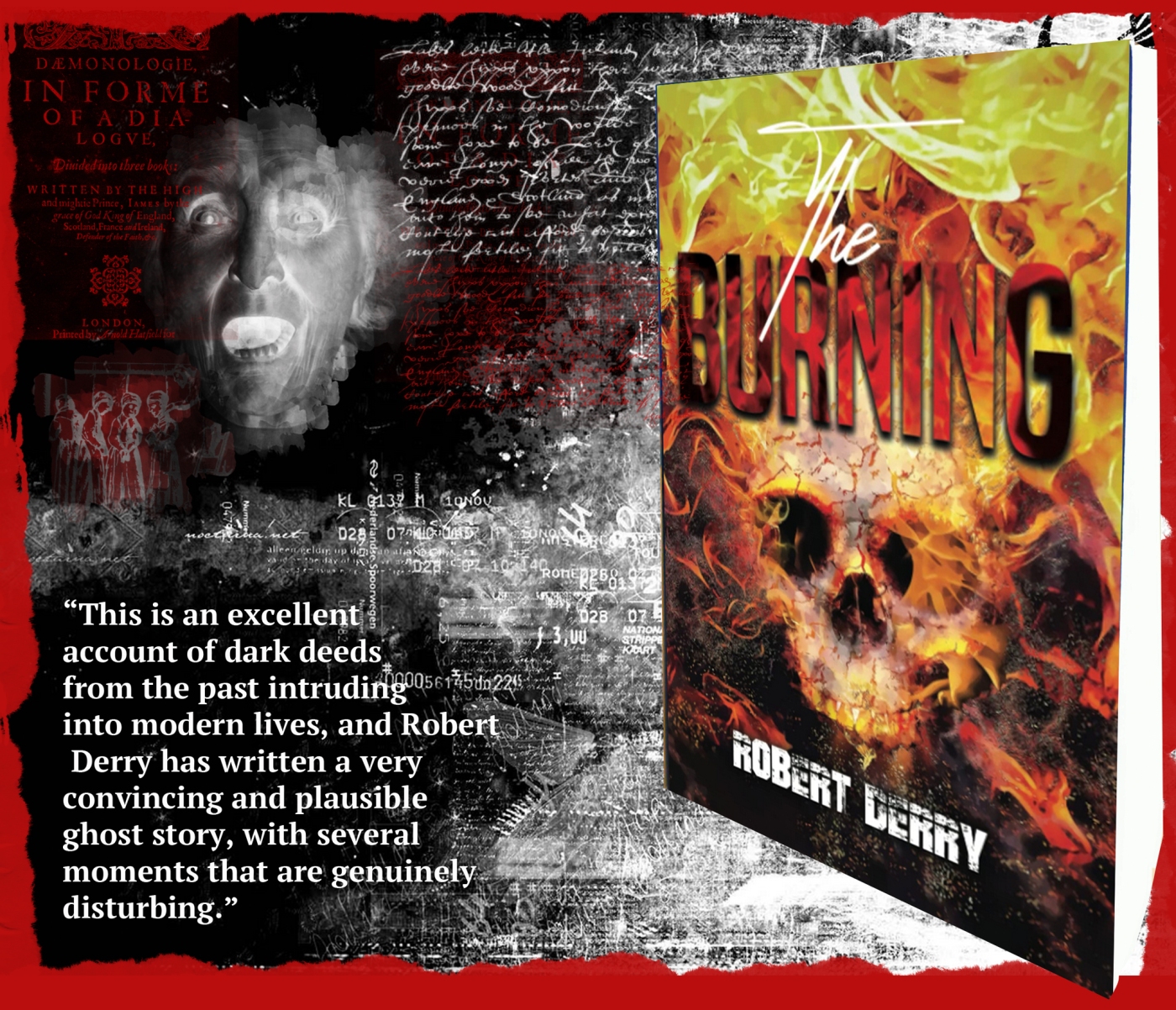

The novel starts in London, March 2020 and, like millions of other people, the Mountford family are sitting watching the news, and there is only one item – The Lockdown. Stringent rules about association and movement have been imposed, but Tony Mountford is nothing if not a quick thinker. He and his family are lucky. They own a holiday cottage in the south of England, and he decides on the spur of the moment to pile everyone and everything into the car and head south. They avoid police patrols, and arrive safely at the cottage. Across Britain, and the rest of Europe, a million nightmares are being enacted as the Covid death toll rises, but for the Mountfords, their nightmare is only just beginning.
The cottage, although it has been brought up to date after a fashion, is ancient: it has a resident ghost, or other-worldly presence; when sensed, it has been entirely benign, to the extent that it is mentioned as a selling point in the advertising brochure. Some renters have even placed a ☹️in their Trip Advisor review, disappointed that it never appeared during their stay.
Something, however, has jarred and jolted the spiritual ambience of the old stones out of kilter, and a far more sinister manifestation has claimed the cottage. There is a dramatic moment when, while Tony and his wife Charlie are making love in front of the log burning stove, with the children all sound asleep upstairs, a spectral hand grips Charlie’s throat. Far more chilling, however, is the moment when eight year-old Alfie appears at the foot of the stairs one night and says:
“Daddy, there’s a man in my room.“
Without giving too much away, the Mountfords’ stay at the cottage doesn’t end well, and after a few months the property is back on the market. Gavin and Simon are a fairly wealthy gay couple and they become the new owners. They decide to gut the interior of the building, stripping it right back to beams, brick and stone and – as far as the local council planners will allow – fully modernise it. In the process they make two startling discoveries. They find a deep well beneath the house, but of greater significance is that the builders have unearthed steps leading down to what can only be described as some kind of a cell. It has bars on the door, through which something of the inside can be seen, but the door remains resolutely locked. Robert Derry has a profound understanding of the latent power of old buildings, ghosts or not, and he describes it beautifully:
“After all, the heavy wooden beams were once living breathing things, until some mediaeval carpenters had cut them down in their prime. Then as seasoned joists they’d been hoisted up to hang from finely crafted oak A-frames, each chiselled peg dovetailed into carved sockets like ancient teeth in an angled jawbone. Dead men, whose hands had once lovingly laboured to shape each broad blade that would one day bear a ton or two of hand-hewn reads. The same dead men that now lay their heads further up the lane; a yew lined root that leads to a secluded graveyard which has long since laid its single tracked secrets to rest.”
As Gavin researches the history of what they pair had hoped would be their ‘forever home’, it is clear that in the mid seventeenth century the house witnessed truly evil acts, and that trauma seems to have been absorbed into the very bricks and mortar. Someone – or something – seems trapped, angry and in pain, and will not leave Gavin and Simon in peace until it is freed. This is an excellent account of dark deeds from the past intruding into modern lives, and Robert Derry has written a very convincing and plausible ghost story, with several moments that are genuinely disturbing. The Burning is independently published, and is available now.


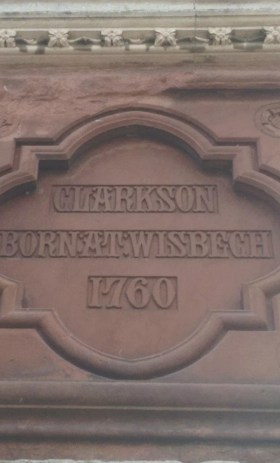
 Every schoolboy of my generation was taught the history of Britain’s great social reformers of the 19th century, and we were able to rattle off their names – Elizabeth Fry for prisons, Florence Nightingale for nursing, Cobbett for agriculture and Wilberforce for slavery. I have to confess that until I moved to Wisbech in the early 1990s, I hadn’t heard of Thomas Clarkson. Now, as I pass his imposing memorial every time I walk into town it is a constant reminder of a man who has been called ‘the moral steam engine’ of the movement to end Britain’s connection to the slave trade.
 Clarkson narrowly avoids becoming the victim of a mob in Liverpool. Meanwhile, as readers, we are privy to Dr Gardner’s diary written during the voyage of The Brothers. The two narratives become parallel: at sea, once the slaves have been offloaded, the voyage of the vessel – in theory a relatively safe and simple return home – is blighted by what seems to be a malignant spirit at work in the depths of the ship. The crew members disappear, one by one, and the barbarous Captain Howlett is driven mad.


 fullybooked2017