

“May you be in heaven half a full half hour before the devil knows you’re dead”
(Traditional Irish toast)
In this thriller, FBI partners Gus Wheeler and Vanessa Lambert travel to rural Maine to investigate the death of a teenage boy, whose shallow grave has been discovered by scavenging animals. His face is unrecognisable and, lying on his chest inside the rough pine coffin is a cross made of lead. He is eventually identified as Adam Carson. On arrival in Maine, the two agents, who might actually be on the young side to get the movie reference, realise that they are about to drive into what we older mortals might call ‘Deliverance Country’.
Fans of John Connolly’s superb Charlie Parker novels will be familiar with the forests of Maine, with its decaying cemeteries, isolated communities and memories of ancient evil. The author gives us little opportunity to draw breath. Adam Carson’s girlfriend has also gone missing, but neither her parents or their neighbours seem particularly bothered. Then, two more bodies are discovered. One is male, purely skeletal, and has been dead for some time. The second, a woman is equally unidentifiable, but for a different reason. Her corpse is charred beyond recognition, but the pathologist delivers a disturbing conclusion. She was standing while she burned.
If there was any lingering doubt in the minds of Wheeler and Lambert that they are – literally – in a dangerous place, their motel room is firebombed and they are lucky to escape with their lives. Stories of unspeakable deeds committed by religious zealots, using their faith as an excuse, are nothing new in crime fiction. An essential staple of such plots is the existence of a spiritually powerful central figure, revered but his or her congregation. The minister of the Slaves of the Secret Heart of Jesus is a forbidding character called Father Benedict, a former Jesuit now excommunicated by the Roman Catholic Church.
Few thriller writers can resist the trope of a bad guy hiding within the ranks of the good men and true. The trope works best when it comes as a complete surprise, with readers being given few if any clues, and so it is here. Authors with musical axes to grind can be mildly irritating. The late Peter Robinson’s Inspector Banks had a very individual CD collection and, of course, Morse was a music lover. Mark Billingham’s Tom Thorne’s almost perpetual depression was usually accompanied by the lonesome tenor of Hank Williams. Gus Wheeler, however is a jazz man, and a string bass player. He even takes a rather dismal fold-up bass with him on his assignments. In my (probably limited) view, jazz died with Bix Beiderbecke, and so I couldn’t connect to Wheeler’s obsession, but that didn’t ruin a good novel, which has a captivating blend of menace, human frailty and the power of landscape.
R. John Dingle lives and writes from a restored 200 year-old house, on a small island in Mid-Coast Maine. The often-haunting themes of the rocky coast, as well as a lifetime of experiences in and around New England’s small towns, farms, and cities, provide excellent inspiration for the tones and moods reflected in Dingle’s mysteries and psychological thrillers. The two previous novels in this series are Karma Never Sleeps and Wings of Madness. Before The Devil Knows will be published by Tule Publishing on 29th July
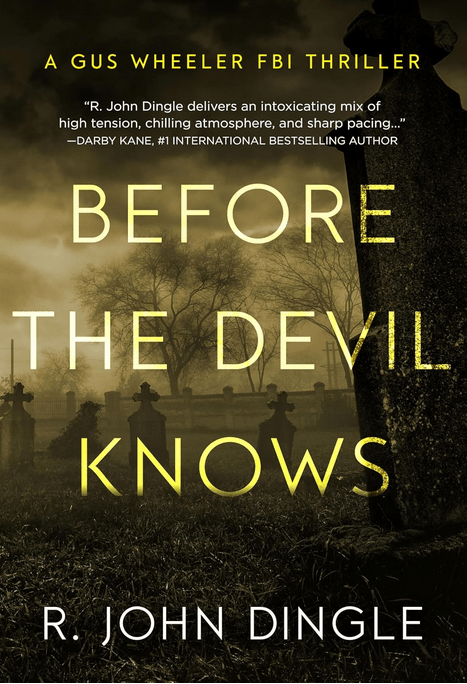
The book will be available from Tule Publishing from 29th July.


