Search

fullybooked2017

Tag

Police Prodedural

THE DARK WIVES . . . Between the covers

TDW SPINE072 copy

Readers who have also watched the successful TV series dramatising the Vera Stanhope novels will have their own views on how Brenda Blethyn’s Detective Inspector matches up to the woman on the printed page. I stopped watching TV versions of police procedurals years ago, with the demise of John Thaw, so my take is purely based on the book. Vera Stanhope is a dowdy, frumpish woman in her 50s, lonely and probably a social misfit. Brought up by an eccentric father, Hector, in a moorland cottage in Northumbria, denied (by premature death) a mother’s love, she is a formidably intelligent detective. She drives a battered Land Rover, has holes in her socks, and doesn’t suffer fools gladly.

Here, she is handed a complex case that has splintered into myriad issues. At its heart is the apparently motiveless murder, by hammer attack, of an undergraduate and part time social worker, Josh Woodburn. A teenage girl, Chloe Spence, who was a reluctant resident at Rosebank, where Josh worked shifts, has gone missing. Where is she, and why was film and media enthusiast Josh, unbeknown to his family, moonlighting with shifts at a children’s home?

Vera has the death of one of her team, a Detective Constable called Holly, on her conscience, but she takes a maternal interest in Holly’s replacement, Rosie Bell, a rather glamorous and fashion conscious young woman who is actually a very good copper. When another inmate of Rosebank, a young chancer called Bradley Russell is found dead in a remote hillside bothy, the case becomes more complex.Without, I hope, giving too much away, Vera’s hunch is that Josh Woodburn’s death is connected with what he was really doing at Rosebank. Josh was a decent, caring young man, and very good with the children, but that wasn’t the main reason he was there. When Vera, with the help of  fellow officer Charlie, joins the dots, the picture also explains why Brad also had to die.

Both the season and the mood of the book are distinctly autumnal. Vera’s work is her life, and there seems to be little outside the job. The depressing world of broken homes, absent fathers, and a society where children’s homes are run by shadowy corporations on a distinctly for profit basis does not improve Vera’s downbeat view of the world but, to borrow a line from Matthew Arnold’s Thyrsis, “The light we sought is shining still.”, and in Vera’s case the faint glimmer is provided by bringing justice to the dead. She couldn’t be more different from Derek Raymond’s nameless detective in the Factory Novels (click for more information) but they have the same fierce resolve.

If years of reading police-procedural crime novels has taught me anything, it is that well-balanced, happily married Detectives are not fun. Vera Stanhope is forever on the edge of things, caught up in her own personal history and sense of regret, reluctantly wearing a halo of missed opportunities and ‘what ifs’.. Her fierce empathy with those society has cast aside, combined with her innate shrewdness and ability to pick out a ‘wrong-un’ make her one of the genre’s most treasured creations.

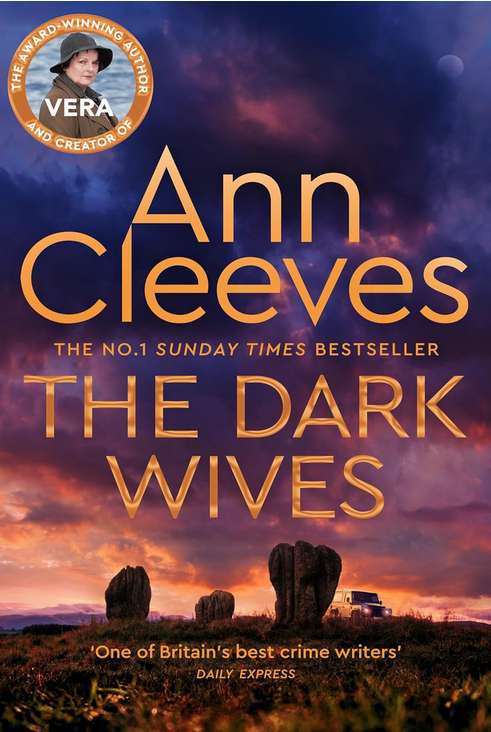
The Dark Wives of the title are three stone monoliths on the fellside near Vera’s home. Legend has it that they were three strong willed women who were turned to stone by husbands fed up with their feistiness. In the preface, Anne Cleeves writes:
“The book is dedicated to teens everywhere, and especially to The Dark Wives – uppity young women with minds of their own, struggling to find a place in a difficult world.”
The novel is published by Macmillan and was published on 29th August.
Screen Shot 2024-08-21 at 18.12.57

THE DEVIL STONE . . . Between the covers

TDS spine019 copy

Detective Inspectors – and their bosses the DCIs – are hardly a dying breed in crime fiction, so what is distinctive about Christine Caplan, the central figure in Caro Ramsay’s latest book? For starters, she has been demoted from DCI because her previous case involved some evidence mysteriously going ‘walkies’. Her run of bad continues when, after a night out the ballet in Glasgow (she used to be a dancer) she inadvertently becomes involved in a mugging, and the drug-frazzled perpetrator  subsequently dies from falling from his bike. Family-wise, things are not much better. Her husband, Aklan, formerly something of a creative high flyer, has a serious case of depression and rarely leaves his bed. When he does, it’s only to stagger to the sofa where, wrapped in a blanket, he binges on daytime TV. Son Kenny is a ne’er-do-well drug user, flunking college and a bit too handy with mum’s credit card. Daughter Emma is the only glimmer of light. She seems relatively healthy, bright and has something of a future once she finishes her degree.

Things don’t improve for Caplan when she is sent off to the Scottish west coast where, near the village of Cronchie, a multiple murder has taken place. Two teenage boys – “neds”, to use the Scottish slang, have broken into Otterburn House, a mansion belonging to the McGregor family. The intruders get more than they bargained for:

“…jerking the phone, causing the beam to drop suddenly where it caught the ghostly white face staring at the ceiling with nacreous clouded eyes. Unable to stop himself, he looked along. Another face. Then another. Five of them in a row, cheek to cheek. Dried white skin clinging to thin cheekbones, mouths open, teeth bared.”

The lads – one of whom is a devotee of Satanism –  have burgled the house looking for a legendary artifact known as The Devil Stone which, according to the ancient lore, is able to predict impending tragedy. They leg it away from the house as if Old Nick himself is chasing them. They are hospitalised suffering from shock, the police are summoned and a major investigation is triggered.

In charge of the investigation is Detective Chief Inspector Bob Oswald, a highly respected officer just weeks away from retirement. When he goes missing, Caplan finds herself put in charge of the case, rather to her own discomfort and the resentment of the local team. One member of the McGregor family – Adam, a New Age hippy and something of a black sheep – is missing from the gruesome line of corpses, and thus he becomes the main suspect.

When Bob Oswald is finally located dead – in mysterious circumstances – Caplan realises that whatever happened at Otterburn House is part of a much bigger conspiracy, involving the distribution of a dangerous new narcotic known as Snapdragon. While she suspects that a nearby New Age community living on the nearby island of Skone may be involved, another discomforting thought is nagging away at her, and it is the suspicion that someone in the police team is batting for the other side. How far can she trust DC Toni Mackie, a larger-than-life woman, with a slightly cartoonish air about her? And what is to be made of the bumbling DC Craigo, with his strange slow blink, and his lack of social graces?

Already facing a twin-pronged attack on her career, Caplan realises that her relentless determination to solve the Otterburn House mystery has brought her head-to-head with some people who are determined to take her life if she gets in their way.

This edition of The Devil Stone is published by Canongate and is out now.

THE SANDRINGHAM MYSTERY . . . Between the covers

tsm001

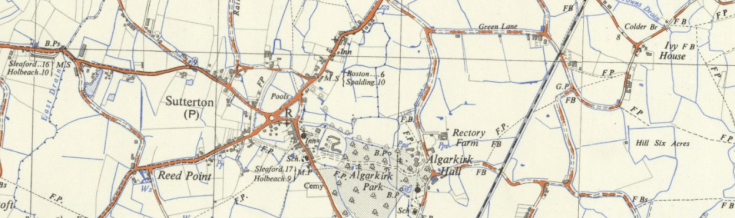
I found this novel intriguing in two ways. Firstly, the action takes place on my home turf. I live in Wisbech (well, someone has to) and Spalding, Sutterton, Sutton Bridge (just over the border in Lincolnshire), and Sandringham in West Norfolk are all very familiar. Christina James (real name Linda Bennett) writes:

“I was born in Lincolnshire, in England, and grew up in Spalding. I’ve had a lifelong fascination with the South Lincolnshire Fens, with their huge skies, limitless landscapes and isolated communities; I have always been interested in the psychology of the people who have lived there over the centuries. I have now put some of this interest and fascination into the fictional world of Detective Inspector Tim Yates.”

I believe she now lives in Leeds, but the Lincolnshire (South Holland is the administrative district) landscape is as vivid as if she were just still standing there.

Secondly, she employs two narrative viewpoints. The first is centred on DI Tim Yates – obviously one of the good guys – but the second is narrated by a rich industrialist called Kevan de Vries, and we are not sure if he is on the side of the angels or the devils.

Kevan de Vries lives in a palatial country home called Lauriston, in the village of Sutterton. Almost by accident (police are investigating a suspected burglary) a package of forged UK passports is discovered in the cellar, but de Vries claims he has no knowledge of how they got there.  Then, a more shocking discovery is made, in the shape of skeletons which, when examined, appeared to be those of black people. They have been there since the 19th century.

Screen Shot 2022-11-17 at 18.45.11

For all his riches, de Vries had not been able to buy happiness. His wife Joanna has terminal cancer, and their autistic son attends a boarding school in nearby Sleaford. The couple spend much of their time on the Caribbean island of St Lucia, while the business of running the huge processing plant in South Lincolnshire is largely left to a manager called Tony Sentance who, surprisingly, de Vries loathes and abhors. So, does Sentance have some kind of hold on de Vries?

Screen Shot 2022-11-17 at 18.46.47Tim Yates’s life is made even more complicated when the remains of a young woman are found on the Queen’s estate at Sandringham, across the border in Norfolk. It should be none of Yates’s business, except that the dead woman was wearing branded work clothing from Kevan de Vries’ factory. Meanwhile, a mysterious diary dating back to Victorian times, and found in the cellar at Lauristan, reveals that the controversial colonial politician Cecil Rhodes had connections with the family who owned the house at the time.

When Yates investigates the connection between the girl whose remains were concealed on the royal estate and the de Vries factory, he comes up against a wall of silence which convinces him that the dead girl was caught up in a trafficking and prostitution racket linked to the huge numbers of Eastern Europeans who came to work in the area during the years of *freedom of movement.

*The tens of thousands of people from Poland and the Baltic states who arrived in Eastern England in the 2000s transformed towns like Boston, Spalding and Wisbech. The owners of food processing factories and farmers grew rich, and the immigrants found they could earn far more for their labours than they could back home. There was a downside to this, in that along with the hard working immigrants came unscrupulous people who made fortunes exploiting cheap labour, renting out multiple-occupancy homes and – worst of all – establishing a thriving slavery and prostitution network.

This is an enjoyably complex novel which works on one level as an excellent police procedural while, on another, takes a long hard look at how powerful people – both now and in times past – exploit the most vulnerable in society. The Sandringham Mystery is published by Bloodhound Books and is available now.

Blog at WordPress.com.

Up ↑