Search

fullybooked2017

Tag

Police Procedural

A KILLING IN NOVEMBER . . . Between the covers

akin spine

Somehow, I missed this first time round, but reviewed books two and three in this excellent series but Simon Mason. In Ryan Wilkins and Ray Wilkins we met one a rather unusual cop partnership. Ryan is something of a chav, scruffily dressed and with a huge chip on his shoulder. He is, however, very astute. Equally clever, but much more an establishment man, despite his ethnic origin, is black officer Ray. He is a family man, suave and well spoken, and clearly destined for higher things. Their beat is Oxford.

The contrast between the Oxford educated Ray and Ryan, graduate of a seedy South Oxford caravan site (trailer park for American readers) couldn’t be greater. Simon Mason chooses a superb location for their first professional engagement. Barnabus College is where a young woman has been found strangled in the rooms of the college Provost. Ray is all diplomacy and respect, while Ryan, much the more observant, needles the well-to-do members of the college by refusing to grovel at the altar of their social and academic status. It is eventually confirmed that the dead is Syrian, from a wealth family, but due to the political situation, has been forced to earn a living as a porn model. Working as a domestic servant in the college is Ameena Najib, also from Syria, but from a very different background. She is a devout and militant Muslim, and when she is found dead, also strangled, the mystery deepens.

In the background to this murder investigation is civil unrest in the Oxford district of Blackbird Leys. A child has died after being hit by a police car, and protests are violent and bloody. The Leys is a real place, and is a superb example of urban planners concocting idyllic rural names for dire housing estates. I was at Teacher Training College nearby and, trust me, if it was announced the Leys was where you were sent for Teaching Practice, you were not happy.

Simon Mason lets us know, in one of the most scary scenes in the book, why Ryan is so disturbed. Ryan’s wife Michelle died of a drug overdose, leaving him to bring up their little son, also called Ryan. When Ryan senior fails to collect the lad from nursery, the staff phoned one of the contact numbers – that of the little boy’s grandparents. Bad call. They are a disaster. Grandma is, literally, bruised and battered by her feral husband, and when Ryan and Ray break into the shabby caravan on the grim site in South Oxford to rescue the child, all hell breaks loose.

Ryan’s propensity for violence, his unwillingness to ‘play the game’, and his chaotic personal life make it inevitable that he is dismissed from the force. However, his sharp insight into what makes people tick combined with his intuition, enable him to solve the mystery. Ray, despite his initial horror at Ryan’s manner and attitude, keeps the phone line open with his former colleague, and the Barnabus killer is brought to justice.

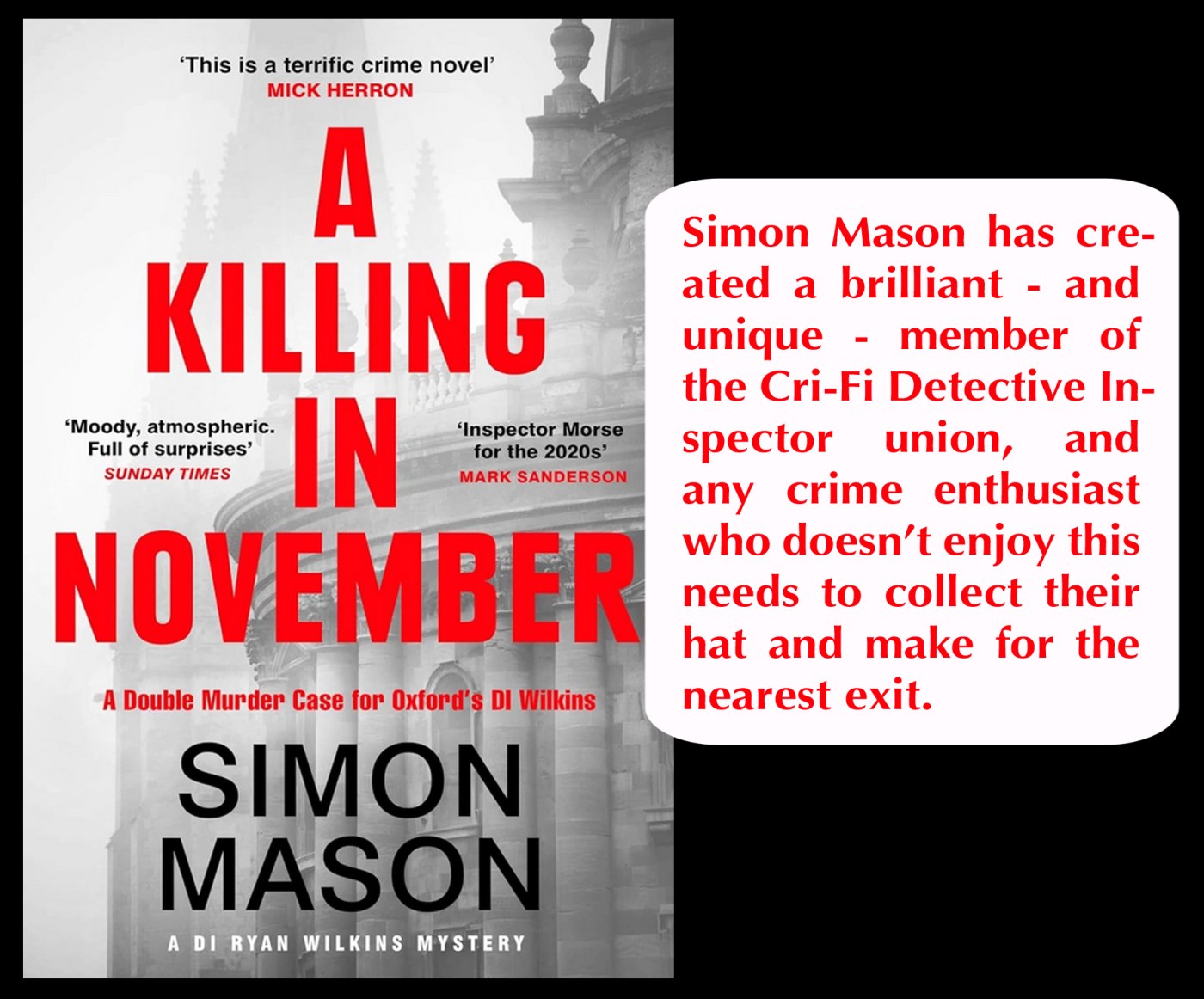
This is a wonderful read, and I finished it in just a few sessions. My only quibble is that Ryan Wilkins is such an outrageously out-of-kilter character, dressed in his trackies, trainers and baseball cap (back to front, naturally) that it is hard to imagine him making senior rank in the modern police force, which is notorious for signing up to all the latest DEI fads, and renowned for its many acts that seem woker than woke. Simon Mason has created a brilliant – and unique – member of the Cri-Fi Detective Inspector union, and any crime enthusiast who doesn’t enjoy this needs to collect their hat and make for the nearest exit. A Killing In November is published by Riverrun, and is available now.

Screen Shot 2024-11-14 at 15.13.52

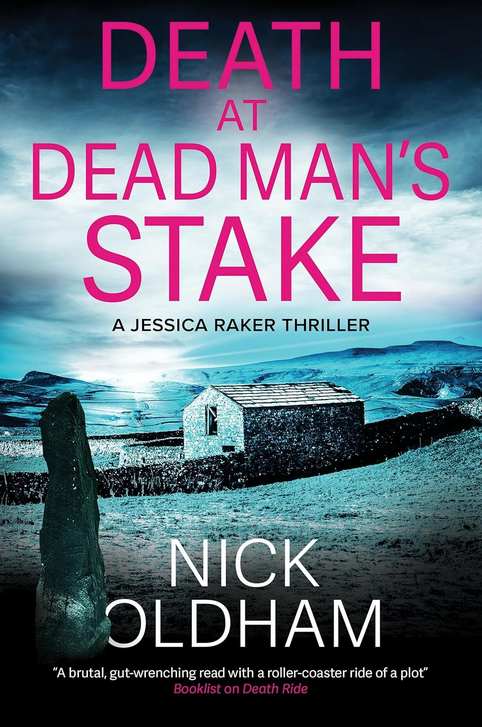
DEATH AT DEAD MAN’S STAKE . . . Between the covers

DADMS HEADER

Death at Dead Man’s Stake sounds like something from the Wild West, but it is, in this new novel by former copper Nick Oldham, an incident at an isolated farm in Lancashire. With his veteran Henry Christie perhaps taking a well-deserved break at his (hopefully) rebuilt moorland pub, Oldham introduces Detective Sergeant Jessica Raker. After fatally shooting a London gangster following a botched raid on a jewellers’ in Greenwich, Raker has been moved to the North West – where she grew up – in an attempt to distance her from the dead man’s vengeful relatives.

Her first day is nothing if not eventful. She has barely unloaded her kit into the Sergeant’s office from her car, when she is called out to a crisis at Dead Man’s Stake. When the local fire brigade attends an unexplained fire in the derelict farmyard, one of the firefighters is grabbed and held hostage by the farmer, a drunken, mildly crazed man called Bill Ramsden. Jessica rescues the fireman after tazering Ramsden. Her day is not over, however. A cantankerous old man, resident of a local cafe home, is found dead, his corpse floating in a nearby reservoir. Raker, viewing the scene, suspects that a physical struggle lead to the old man ending up in the water.

Jessica Raker is a good copper, but she has been dealt a poor hand. At the Greenwich heist, who was one of the customers eying up an expensive item at the moment the robbers burst in? None other than her husband Josh, a high flying player in a City firm. And the piece of jewellery was intended not for Jessica, but for his secretary. Improbably, the marriage has survived, and Josh is now working in Manchester, but resentful at the move.

Meanwhile, we learn a little more about the man Jessica shot dead in Greenwich. He was the most ungovernable  of the sons of Billy Moss, a millionaire crook grown rich on the proceeds of all manner of criminaity, ranging from the inevitable drug trade to trafficking people. Goss wants revenge. He wants the hapless amateurs who lured Terry Moss into the doomed jewellery raid, but most of all, he wants Jessica. The problem is that the Met Police have done a very good job in smuggling her away to the Ribble Valley, and she has gone completely off the Moss radar. Nonetheless, a professional killer is hired to hunt her down and end her life. While on the school run, Jessica bumps into an old adversary. Years ago, when she was growing up in Clitheroe Jessica and Maggie Goss fell out over a mutually desired boyfriend, and Maggie, now boss of huge scrapyard empire, hasn’t forgotten the teenage slights. What is more important is that the scrapyard business is a million miles away from being strictly legit, and one of Maggie’s LinkedIn buddies is none other than Billy Moss.

It is not just Nick Oldham’s years of experience as a working copper that makes his books so good. Nor is it the loving and detailed sense of place, where he describes a beautiful and windswept rural Lancashire, blissful yet only an hour’s drive from pockets of deprivation and criminality like Blackpool. For me, what puts his novels up there on a pinnacle is his sense of dialogue – nothing flashy or pretentiously poetic – but an unerring version of how real people actually speak to each other.

As the Moss organisation moves against Jessica Raker, there is a satisfying symmetry to the main plot, as it ends where it began, out at Dead Man’s Stake. This is a firecracker of a police thriller, and Nick Oldham has established a cast of coppers, with Jess Raker at its heart, who will keep us entertained for many years to come. The novel is published by Severn House, and is available now.

Screen Shot 2024-09-25 at 19.40.39

A VIOLENT HEART . . . Between the covers

AVH spine078 copy

David Fennell introduced us to London copper DI Grace Archer in The Art of Death (2021) Now, she returns  in a complex new case which involves cold case crime and the murders of sex workers, decades apart. The investigation becomes very here-and-now when the body of a young Croatian woman called Elena Zoric is found. She died from a puncture wound to her chest, but whatever killed her, it wasn’t a bullet.

The best police procedurals always give us a fly-on-the-wall account of the personalities and tensions that exist inside a police station. Because her previous superior has been sideline and has to care for her husband, struck down with Long Covid, Grace Archer has a new boss, Chief Inspector Les Fletcher, He is described as a “gammon-faced Yorkshireman” with more than a trace of the toxic masculinity common to that breed. Archer’s wing man is Belfast born DS Harry Quinn – reliable and intuitive. Less helpful is DI Lee Parry, nephew of the Metropolitan Police Commissioner, but about as much use as a chocolate fireguard. He is lazy, venal and prepared to cut corners for an easy life.

I have often observed that Detective Inspectors in British crime novels are, perhaps, overused. There are very sound reasons for this, however. DIs are perfectly placed to be both at the centre of investigations bureaucratically, while able to be out on the street, at the crime scene, and in the faces of the bad guys. Much more rare is the novel where a humble DC is the locus of activity. I can think of only one series, and that was written by Alison Bruce, and featured Cambridge Detective Constable Gary Goodhew. My review of The Silence is here. That being said DI Grace Archer is a welcome guest at a party held in a very crowded room.

We have here something of a whirling dervish of a plot, which spins this way and that and incorporates apparently disconnected events. We have a bizarre (but sadly all-too-credible) social ‘influencer’ called Calvin ‘Dixy’ Dixon whose latest Tik-Tok sensation shows him talking to the dessicated corpse of a woman sitting in a wheelchair in an abandoned house. There is also something that might become a ‘love interest’ angle, when Liam, a builder friend of Harry Quinn, is booked to renovate Archer’s house. He also happens to be extremely handsome, and brings with him freshly baked croissants to share before he starts work each day.

Then there is Mallory Jones, the guiding light in a successful podcast called Mallory Jones Investigates. She alternately helps and hinders Archer’s search for a man whose weapon of choice appears to be some kind of bolt gun. Finally, in far-off Berwick on Tweed, we have the Mercer family. Barry and Isla, and Isla’s brother Simon. Barry and Isla are both ex-coppers, but their teenage daughter Lily has fallen in with a bad crowd, and makes fistfuls of cash by appearing in amateur porn videos with her bestie, Gemma.

Archer is concerned to discover that, back in the day, her new boss Les Fletcher was, as a young PC, involved in the older murder investigations, and her informants tell her that he was rude and unsympathetic, strongly showing his prejudice that as ‘working girls’, getting assaulted by clients just went with the job.

As you might expect, David Fennell seizes the frayed ends of these plot strands and weaves them together to make for a highly satisfying conclusion. There is a savage and sanguinary denouement in, most appropriately, a disused abattoir. Not everyone survives the carnage, but as the emergency vehicles trundle off into the night, we have catharsis. Grace Archer certainly has her own demons to torment her, but she is a courageous and resourceful copper with a fierce determination to pursue the truth. A Violent Heart is published by Zaffre and is available now.

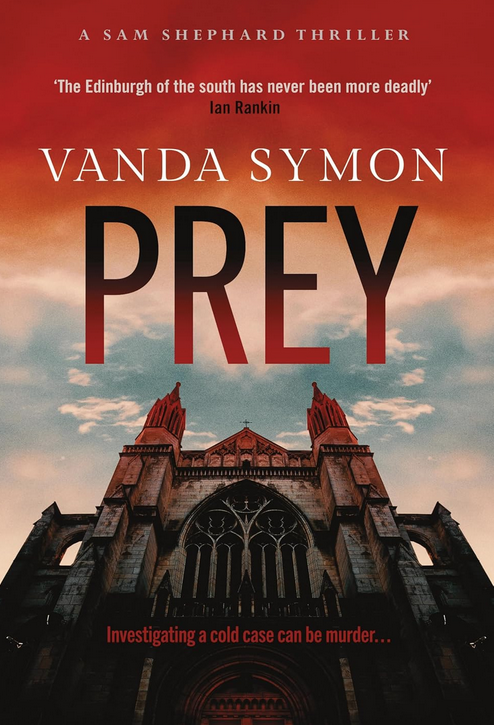
PREY . . . Between the covers

prey SPINE070 copy

I have to confess that I haven’t read a crime novel written by a New Zealand writer since, years ago, I blitzed the Inspector Alleyn stories by Ngaio Marsh. Although she was born and died in Christchurch, those stories are quintessentially English. Vanda Symon, by contrast, has written a successful series featuring Dunedin cop Sam Shephard, and Prey is the latest of these. Sam has returned from maternity leave, and almost immediately  the state of open war between herself and boss, DI Greg Johns, resumes. He immediately gives her a cold case to work on. Twenty five years earlier, a priest at St Paul’s Cathedral, was found dead at the foot of some stone stairs. He had been stabbed, but also had a broken neck. Despite every best effort, no-one was ever arrested for the murder. And there is a problem. The Reverend Mark Freeman had a teenage daughter, Felicity. And now she is married to DI Johns.

As Sam  struggles to adjust being back at work, and worries about ‘abandoning’ baby daughter Amelia (for those who like that sort of thing the author spares us no detail of the baby’s rather spectacular digestive system) she realises she has been handed a poison chalice. The crime scene has since been walked over by tens of thousands of pairs of feet, and there are a mere handful of people alive now who were connected to the case at the time. These are, in no particular order:
Yvonne Freeman, the murdered man’s widow. She has terminal cancer.
Felicity Johns, née Freeman, now married to DI Greg Johns.
DI Johns himself was on the investigating team as a young police constable.
Brendan Freeman, Felicity’s brother.
Mel Smythe, a young youth worker at the time of the killing. She has since become estranged from the church, and has fallen on hard times.
Aaron Cox, of Maori origin, and a former criminal. Mark Freeman had worked hard to put him on the straight and narrow path.

When Sam goes to interview Mel Smythe (for the second time) she finds her dead – stabbed with a kitchen knife, which makes the case very much a current murder investigation. But is it – and if so, how – connected to the death of Mark Freeman? It has to be said that in the first few pages of the book, a female witness watches, from behind a church pillar, a struggle between two people, one of whom is the Reverend Mark Freeman. Make of that what you will.

Sam Shephard is a very human creation with none of the foibles and weaknesses that many British writers love to give their police detectives. She is a proud mum and loyal partner to little Amelia’s father, fellow copper Paul Frost. She has a keen brain and a healthy sense of humour, and it is her intuition that allows her to finally realise she has been lied to, and thus crack the case open. This only happens, however, in the final pages of the novel, and not before we are led up many a garden path. The connections to the case of DI Johns and his wife only make more hot coals for Sam to walk over, and she faces an unenviable task of doing her job without becoming badly burned.

Vanda Symon creates a convincingly clammy picture of a wet and wintry Dunedin, and at the centre of it all, glowering over the wrongdoings of its congregation, is the  menacing Victorian Gothic bulk of St Paul’s Cathedral. In addition to the gripping plot, Symon explores those eternal ingredients of all good crime novels – money, greed, shame, blackmail, hypocrisy and family secrets. Prey is published by Orenda Books and is available now.

Screen Shot 2024-07-28 at 20.20.53

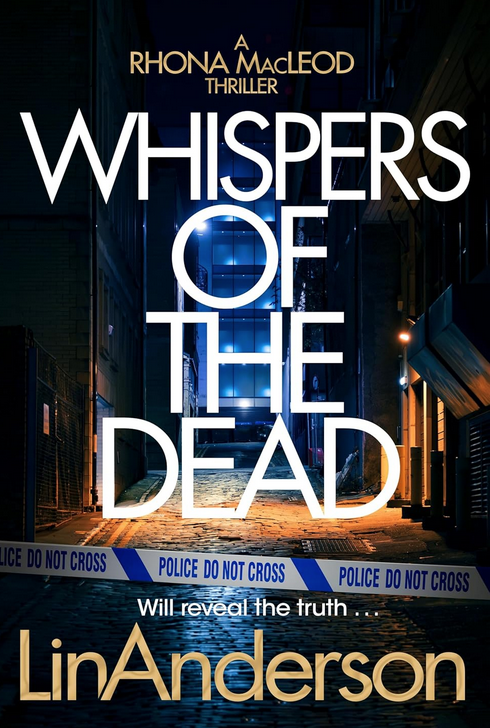
WHISPERS OF THE DEAD . . . Between the covers

WOTD SPINE067

Lin Anderson’s battle-hardened forensic investigator Dr Rhona MacLeod returns to make another journey through the grisly physical mayhem that some human beings inflict on others. In a disused and vandalised farmhouse in Glasgow’s Elder Park, a man’s body has been found. His eyes and mouth have been sewn shut and, strapped to a metal chair, he has been thrown through an upstairs window. A trio of teenage scallies have been using the old building as a base for their minor law-breaking, and they are the first people to see the body,

In another part of the city, an American film crew have informed the police that their leading man is missing. With the assistance of DS McNab, who has interviewed the movie-makers, Rhona MacLeod becomes involved, and wonders if the missing actor is the mutilated corpse found in the park.

At the very beginning of the book Lin Anderson introduces what develops into a parallel plot thread. A woman called Marnie Aitken has served six years in prison for the murder of her four year-old daughter, Tizzy, despite the fact that no trace of Tizzy, dead or alive, has ever been found. Marnie is known to Rhona MacLeod, and to her colleague, psychiatrist Professor Magnus Pirie. On her release, Marnie – abused as a child and as a young woman – is placed in sheltered accommodation. She goes missing. but not before sending a bizarre gift to Rhona. It is a beautifully sewn and knitted doll, in the likeness of a young Highland dancer. Rhona realises its significance, as Tizzy Aitken was a promising dancer, but she is also appalled to see that the doll’s lips have been sewn shut with black thread. What message is Marnie sending?

Marnie is located at her old cottage on the Rosneath Peninsula, and but she returns to Glasgow, where the police find that she is linked – albeit at a tangent – the the killing of the man in Elder Park. Meanwhile, DS McNab – who was involved in the original investigation into Tizzy’s disappearance, but kicked off the case – has realised that the script and screenplay of the film – now abandoned after the disappearance of its star – is inextricably tangled up with the murder.

Right from the beginning of the novel, we know that Marnie still talks to Tizzy, and Tizzy still talks to her. Is this merely, as Magnus Pirie suggests, a grieving woman’s way of coping with her loss? Or is it something else? On the first page of the book, Marnie looks out of the window:

“It was at that moment the figure of a girl, dressed in a kilt and blue velvet jacket, arrived to tramp across the snow in front of the main gate. As though sensing someone watching, the girl stopped and turned to look over at her. Marnie stood transfixed, then shut her eyes, her heart hammering. ‘She’s not real. It’s a waking nightmare. When I look again, she won’t be there.’
And she was right.
When Marnie forced her eyes open, the figure had gone, or more likely, it had never been there in the first place except there were footprints in the snow to prove otherwise.”

When Rhona visits Marnie’s seaside cottage, she walks down to the beach where Tizzy used to go with her mother:

“The snow at sea level had gone and the muddy ruts were studded with puddles and the shape of footsteps leading both ways. Her forensic eye noted three in particular, ranging in size: a small childlike print, a medium one and a large one, going in both directions.”

Lin Anderson doesn’t resolve this for us. She leaves us to draw our conclusions, and I suppose it depends on how feel about Hamlet’s oft-quoted words to Horatio in Act 1 Scene 5 of the celebrated play. The police procedural part of this novel plays out in the favour of the good guys, but aside from this, Lin Anderson has written a thoughtful and moving account of the nature of grief, and the indelible legacy that the death of a child bequeaths. Whispers of The Dead was published by Macmillan on 1st August.

Screen Shot 2024-07-17 at 20.19.00

BEYOND CLOSED DOORS . . . Between the covers

BCD SPINE065 copy

This enjoyable police procedural novel is the sixth in the series (to read reviews of the previous two, click this link) following the career of Norfolk copper Detective Chief Inspector Greg Geldard, his girlfriend Detective Sergeant Chris Mathews, and the rest of their team. These novels pretty much follow on from each other, and in the previous book Geldard battled a violent Lithuanian gangster called Constantin Gabrys. Now, it’s March 2020, Gabrys is serving a long prison sentence and his psychotic son is dead. However, all is not well, because a key figure in the case, now under witness protection has been attacked. He survived, but a police officer has been seriously injured, and it is obvious that the leak of information can only have come from within the police forced itself.

Despite the Gabrys empire having been apparently dismantled, their poisonous legacy hangs over Norfolk like a miasma. Norfolk, I hear you ask? Surely not that wonderful holiday destination with its abundant wildlife, historic homes and beautiful coastline? While the entire county might not be a wretched hive of scum and villainy, there are places – like Yarmouth and Gorleston – which suffer deep deprivation, and are consequently ripe feeding grounds for organised criminals, whether imported from Eastern Europe or of the home-grown variety.

Geldard traces the leak to a civilian police secretarial worker, but is dismayed to learn that part of the conspiracy involves Helen Gabrys, a member of the family he thought to have been as innocent of wrong doing as she was disgusted at her father’s career.

You will notice in the first paragraph that the story is set in March 2020. Remember that? As the country begins to shut down against the ravages of Covid, life just gets more difficult for Geldard and his team. Right across the criminal justice system things are starting to unravel. Court backlogs become years rather than months, prisons are struggling with absent staff, and the police themselves have to try to hold important conversations yards apart from each other. As the cover blurb suggests, however, the streets may be nearly empty, but evil is just as happy within four walls as out in public places.

There is a parallel thread in the story, which I found unsettling and hard to read. In Yarmouth live the Mirren family. Children Karen and Jake don’t have the happiest lives. Their mum is well-meaning, but weak, and browbeaten by her brutish husband. Karen has a place where she feels valued, can be herself and feel comfortable with trusted adults. It is her primary school, and when it shuts, forcing all the children to stay at home, it is a life sentence for the little girl. The reason this part of the novel affected me is that I taught in Norfolk for over thirty years, and for the latter part of that I led Safeguarding, and the scenes that Heather Peck describes were uncomfortably familiar.

When tragedy strikes in the Mirren house, the subsequent events become very much the concern of Greg Geldard, and he has to add a significant missing persons search to his mounting caseload. In the best traditions of great Victorian writers like Dickens and Hardy, who serialised their novels in popular magazines prior to publishing them in their entirety, Heather Peck leaves us on a knife edge, eagerly awaiting the next novel in this impressive series. Beyond Closed Doors was published by Ormesby Publishing on 22nd June.

Screen Shot 2024-07-08 at 19.11.05

BACK FROM THE DEAD . . . Between the covers

bftd spine044 copy

Screen Shot 2024-04-15 at 15.51.25I have to confess that the crime fiction obsession with Scandi crime a decade ago came and went, as far as I was concerned. Some of it was very good, but to this old cynic it seemed that as long as an author had a few diacritic signs in their name, they were good for a publishing deal. Heresy, I know, but there we are. Back From The Dead is not a Scandi crime novel translated into English. The author (left) was born in Copenhagen, but has lived for many years in London, and she writes in English.

DI Henrick Jungerson is a Copenhagen cop, and his city is enduring a heatwave. This adds to his discomfort when he has to stand on the harbour side and watch a corpse being removed from the water. The body is not leaving its watery grave without a struggle. Jungerson, when he sees that the body is minus its head and hands realises that that wasn’t some poor fellow who fell into the water after imbibing too well during the interval of La Traviata at the nearby Opera House.

Jungerson ticks many of the boxes on the Classic CriFi Detective Inspector Checklist: he is middle aged, has a less than idyllic personal life, and doesn’t suffer fools gladly. ‘Loose cannon, womaniser and too unorthodox‘ are just a few of the descriptions laid at his door. He has an on/off relationship with a journalist called Jensen. She works for Dagbladet, a Danish tabloid which is, like many print journals, struggling against the inexorable rise of digital media.

She has received a ‘phone call from Esben Norregaard, a national MP. His chauffeur and factotum, a Syrian immigrant called Aziz Almasi, has vanished from the face of the earth. Almasi’s wife is beside herself with worry. Jungerson and Jensen share information, and it seems possible that the harbour corpse might be that of Almasi. Both were huge men, built like the proverbial brick whatnot, and well over six and a half feet tall. The body fished from the harbour was also that of a very big man but despite the missing head, it is almost certainly not that of the missing Syrian. A burnt-out hire car seems to have been the vehicle which transported the unknown corpse to the water’s edge, but Jungerson is frustrated to learn that the name on the rental agreement, Christopher Michael White, was a ten year old British boy who died of a brain tumour twenty years earlier. Everything about the case seems to be going pear shaped. There is a glimmer of hope when a head is found dumped in a bin, but when the pathologist tells Jungerson that it did not belong to the harbour man, the detective feels like punching the wall.

The room or, more likely, the assembly hall, containing fictional Detective Inspectors is certainly crowded, but Henrik Jungersen stands out for his faults rather than for his triumphs. He is a good copper, for sure, but he is swept along by events rather than controlling the flow. This makes him all the more credible. It also ticks that vital box that asks the question of readers, “do you care what happens to him/her?” Yes, we do, and that’s what makes Back From The Dead such an entertaining read.

The title is something of a giveaway in terms of the fate of Aziz, but Heidi Amsinck steers the plot in an entirely unpredictable direction, as both Jungersen and Jensen have their lives – both professional and personal – turned upside down by the course of events. They are both swept along by the tide of a case neither can control, and this makes for a gripping and immersive police thriller. As is so often the case, the Bard of Avon can have the last word. There is, truly, something rotten in the state of Denmark.

Back From The Dead is published by Muswell Press and is available now.

REVENGE KILLING . . . Between the covers

RK spine036 copy

I reviewed an earlier book in this series, Final Term, in January 2023 and thoroughly enjoyed it, so it was good to become reacquainted with York copper, DI Geraldine Steel. Revenge Killing is a little bit different in that DI Steel is off on maternity leave. As much as she loves baby Tom, she is feeling very much out of the loop in terms of her police career. When her friend and colleague DI Ariadne Moralis asks for her advice, she leaps at the chance to help.

Moralis has a complete puzzle of a case on her hands. Initially, her husband – Greek, like Ariadne – has been visited by a friend and compatriot called Yiannis Karalis. Yiannis owns a property where one of the tenants – a small time drug dealer called Jay Roper – has been found dead at the foot of the stairs leading up to his flat. Ariadne assures him that he has nothing to worry about, but when the post mortem examination reveals that Jay was suffocated, things become more complicated.

Ariadne discovers that Yiannis is something of a fugitive, as he fled Greece during the fallout from the murder of his older brother and a subsequent vengeance death. Did he visit Jay to remonstrate with him about the drug dealing? Did the visit turn violent. One of Jay’s girlfriends, Lauren Shaw, has gone missing. What does she know? Another girlfriend, Carly, who works in what is euphemistically known as a gentleman’s club, is located, and she is completely antagonistic towards the police. Despite claiming that she and Jay had an ‘open’ relationship, was jealousy simmering just below the surface, and did she kill Jay on the grounds that if she couldn’t have him, no-one else would?

Leigh Russell cleverly lets us spend some time with Lauren, who has panicked. We know. from the early pages of the book that she and Jay had a blazing row which ended in him falling down the stairs. Now, terrified that the police will blame her for his death, she goes on the run, and we share her misery as she her meagre savings run out, and she discovers that life on the streets is miserable and dangerous.

Revenge Killing is, at its heart, an excellent and engaging police procedural, but Leigh Russell has an intriguing little subtext ticking away in the background, and it centres on Geraldine’s misgivings about her life trajectory. She dutifully attends a mothers and toddlers group, but feels only alienation:

“But the other mothers at the toddler group had never dealt with murder investigations in the real world. None of them had watched a post-mortem, knowing the cold flesh on the slab had once been a living breathing human being, whose life had been snatched away by someone in the grip of an evil passion. The other mothers had never learned to close their minds to the horrors of every day human brutality, so shock couldn’t prevent them from doing the job. Gazing at the cheerful faces around her, she regretted her choice of career and wished her life could be as simple as it was for the other women in the room. But her experience had cut her adrift from these chattering young women, with their sheltered upbringing and cosseted lives. They discussed their various tribulations as the infants crawled or toddled around the room, or sat propped up watching warily, like Tom.”

As with all good whodunnits, we are presented with just the right blend of surprise at the identity of the killer, and a few helpful nudges to point us in the right direction. Revenge Killing is published by No Exit Press and is available now.


CITY ON FIRE . . . Between the covers

COF spine

In all my 76 years, I have never visited Brighton. Nothing personal, but I have never had a reason to go there. As a locus for crime novels it is certainly up there with its not-so-near northern neighbour, London. It probably all started with the evil doings of Charles ‘Pinky’ Hale in Graham Greene’s classic 1938 novel. In more recent times Peter James, with his Roy Grace series, has dispelled any notion that the resort is a happy and cheerful place of innocent fun, handkerchief hats, deck chairs and donkey rides. In a totally different vein, the Colin Crampton novels written by another Peter – this time Bartram – have hinted at a less malevolent Brighton in the 1960s.

Graham Bartlett’s Brighton is simply foul. Drug addicts from all over the country huddle in their rancid blankets in shop doorways. In summer, the warm breezes from the south still entice Londoners to take the trains from Victoria, and the shingle beaches still remain attractive. Walk just a hundred yards or so from the promenade, however, and you come face to face with the unique dangers generated by shattered human lives colliding with the vicious criminals who provide the drugs on which their victims have become reliant.

When Ged, a Liverpudlian undercover cop briefed to penetrate the Brighton drug scene announces that, after this current job, he is looking forward to a spell of paternity leave to welcome his firstborn, it is an obvious ‘tell’. You don’t need to have a PhD in contemporary crime fiction to know that this means he is not long for this world. He gets on the wrong side of Sir Ben Parsons, a Brighton legend, and a man who has worked his way from the metaphorical barrow boy to be CEO of an international pharmaceutical giant. Parsons’ latest money spinner is Synthopate, a drug that replicates the peaceful oblivion of heroin, but has no need of drug cartels, murderous enforcers, and street trash addicts.

Chief Superintendent Jo Howe has a dog in this fight. Her sister Caroline is not long dead, a victim of her opiate addiction. She is spearheading an initiative to get as many addicts as possible off the street , cleaned up, and into rehab. It is working well, but it is the last thing that Parsons wants, as it will hit the sales of Synthopate. Parsons has powerful friends everywhere – in politics, business, the media – and even the police. Together with Brighton crime boss Tony Evans, he starts to target the police officers themselves, and their families. All of a sudden, officers are calling in sick, becoming unavailable for court cases and showing a marked reluctance to volunteer for extra duties. Howe is furious but then it hits her world, too. Her journalist husband Darren is arrested by the Metropolitan Police for alleged corruption, and he looks to be facing serious jail time.

Things get even worse. Service companies employed by Sussex police – court staff, mortuaries, vehicle maintenance – all suddenly become unavailable – and there is a killer blow. Jo Howe’s two young sons go into convulsions after eating their school packed lunches and are on life support. There is a trope which suggests that there is no more dangerous being in creation than a mother when she realises her children’s lives are threatened. So it is here. Jo Howe becomes a blistering force of nature, and in a literally explosive finale she saves her sons, her own career – and ends the malevolent reign of Ben Parsons and Tony Evans.

One of the trademarks of the great film director Roger Corman (and he is still with us, aged 97) was to end his Hammer films with a fire – mansion, castle, cottage, it didn’t matter. Graham Bartlett makes a nod in his direction at the end of this book. Good prevails in the end, but the author paints a picture of a police force and justice system that is just a few malign keystrokes away from dystopia – and we should all be very worried. City On Fire is published by Allison & Busby and is available now.

Blog at WordPress.com.

Up ↑