

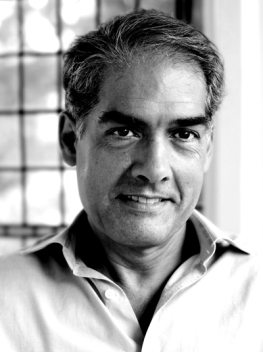
 “One of the greatest anti-heroes ever written,” says Lee Child of Bernie Gunther, the world weary, wise-cracking former German cop, and sometime acquaintance of such diverse historical characters as Reinhard Heydrich, Joseph Goebbels, Eva Peron and William Somerset Maugham. I was several chapters into this, the latest episode in Gunther’s career, when I heard the dreadful news of the death of his creator, Philip Kerr (left) at the age of 62. “No age at all,” as the saying goes.
We rejoin our man in 1957, where he is eking out a living in the economic miracle that is Konrad Adenauer’s West Germany. The prosperity and new international respectability created in a country that just ten years earlier lay devastated by war, has largely passed Gunther by. Under an assumed name, he is working as a mortuary attendant in a Munich hospital. It is not his ideal job, but as he says:
“So, until I could find myself something better, I was stuck with it and my customers were stuck with me. I certainly didn’t hear any of them complaining about my bedside manner.”

After being blackmailed into taking part in a financial scam involving local politicians, Gunther manges to come out of the affair smelling, if not of roses, like something fairly neutral, like amaryllis. He is rewarded with a new job – that of an insurance adjuster, investigating fraudulent claims and saving his employers precious deutschmarks. Gunther reflects, with typical hard nosed perception, about the state of modern West Germany, with the Third Reich having done one of the most spectacular disappearing acts in history.
” Germany would try its best to be nice to everyone and, in the interests of making money, everyone else would try their best to forget what Germany had done during the war. Bureaucracy and trade were to be my country’s new method of conquering Europe, and lawyers and civil servants were to be its foot soldiers.
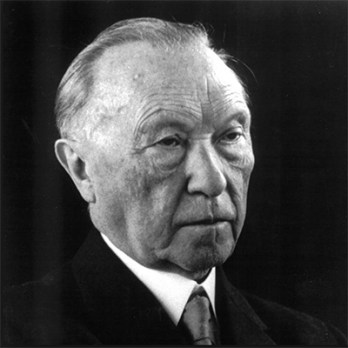 Hitler could certainly have taken a lesson from the Old Man (Adenauer, left) It was not the men with guns who were going to rule the world but businessmen …. with their slide rules and actuarial tables, and thick books of obscure new laws in three different languages.”
Gunther is sent to Greece to investigate the sinking of boat used by a German maker of underwater films, but soon he finds the owner shot dead through both eyes, and a trail of deception and murder that links the sunken boat to the shameful treatment of Thessaloniki’s thousands of Jews during the war. They were deceived, robbed, brutalised – and finally shipped off to the death camps – by men who seem to be still alive and well in Athens.
As Isaac Watts wrote so memorably, “Time, like an ever rolling stream, bears all its sons away..” and Gunther, while not dead yet, is not the man he was. He suffers a minor heart attack while chasing one of his suspects, but his remedy is not one that would appeal to modern cardiologists.
“But straightway I knew what needed to be done: I lurched into the café, ordered a large brandy, and lit a cigarette but not before snapping the filter off the filter to smoke it plain and get my breath. The old remedies are usually best. Throughout both wars it was a strong cigarette and a tot of something warm that kept the nerves in check, especially when the shells were falling around you like rocks at Muslim stoning. Once the nerves were sorted, the bullets wouldn’t touch you; and if they did, you hardly cared.”
Part of the delightfully complex plot involves the intervention of the Israeli secret service, the fearsome Mossad. The woman who is heading up their Athens operation is witheringly sarcastic when Gunther claims that, albeit under trying circumstances, he had kept a relatively clean conscience during the 1930s and 1940s.
” I’ve heard of the unicorn, the griffin, the great auk, the tart with a heart, and little green men from outer space. I’ve even heard of the good German, but I never thought to see one myself. You never voted for the Nazis, and you never liked Hitler. I suppose there was even a Jew you helped to survive the war. You hid him in your lavatory for a couple of days. And of course some of your best friends were Jews. It amazes me how many of us died.”
This is a magnificent book. Gunther’s cynicism, his basic decency, and his ability to keep the candle flame of his conscience flickering in the dark while still keeping his head attached to his body, are described by an author at the very peak of his powers. Philip Kerr may have passed from the sight of men, but Bernie Gunther is immortal.



 I met Joseph Knox (left) at a publisher’s showcase event in London, where he presented his debut novel,
  Just as George MacDonald Fraser had his magnificent bounder Harry Flashman working his way through all the major political and military events of the the second half of the 19th century, so Philip Kerr (right) has positioned his wearily honest – but cynical – German cop Bernie Gunther in the 20th. We know Gunther fought in The Great War, but his service there is only, thus far, alluded to. We have seen him interact with most of the significant players in the decades spanning the rise of the Nazis through to their defeat and escape into post-war boltholes such as Argentina and Cuba. In the 13th book of this brilliant series, Gunther, joints creaking with advancing old age, is now working for an insurance company who want him to investigate a possible scam involving a sunken ship. His work takes him to Athens, where he discovers an unpleasantly familiar link to evil deeds committed under the baleful gaze of Adolf Hitler and his henchmen. Some of Bernie Gunther’s earlier exploits are covered

 Gunther is something of a ladies’ man, and he usually manages to attract the attention of females, most of whom are either damaged, or damaging, and sometimes both. Here, he makes a night-time visit to an English woman who says that she is anxious to meet Somerset Maugham with a view to writing a biography.
 He is asked to investigate a disappearance and a death. The disappearance is of a minor functionary of the Raj from the country town he helped administer, and the death is that of the son of a powerful – and widely disliked – British entrepreneur and colonialist. Le Fanu’s search for the missing Southlake, and the all-too-dead Hargood takes him far from Madras, and to the exotic Malay island of Penang, where he finds a beguiling mixture of colonial and Chinese culture. He also finds himself in the equally beguiling arms of a beautiful Chinese woman. Unfortunately, she is the daughter of a wealthy merchant who appears to be right at the centre of Le Fanu’s investigations.
 The police investigation into Selena’s disappearance is handled by an unusual crime fiction pairing. Finn Hale and Leah Mackay are brother and sister. Finn has leap-frogged his sister in the promotion stakes, despite her evident superiority – evident, that is, to us readers, but not the local constabulary personnel department. Kavanagh plays the relationship between the siblings with the touch of a concert violinist. There are all manner of clever nuances and deft little touches which enhance the narrative.
 Philip Kerr’s Bernie Gunther novels bestride the 20th century, from the rise of the Nazis in 1930s Germany to the post war period when many countries still sheltered mysterious German gentlemen whose collective past has been, of necessity, reinvented. Gunther is a smart talking, smart thinking policeman who has kept his sanity intact – but his conscience rather less so – by dealing with such elemental forces as Reinhardt Heydrich, Joseph Goebbels, Juan and Evita Peron, and Adolf Eichmann.
 A Man Without Breath (2013) sees Gunther is working for an organisation whose very existence may seem improbable, given the historical context, but Die Wehrmacht Untersuchungsstelle (Wehrmacht Bureau of War Crimes) was set up in 1939 and continued its work until 1945. In 1943, on a mission from the Minister for Propaganda, Joseph Goebbels, Gunther is sent to Smolensk and entrusted with proving that the thousands of corpses lying frozen beneath the trees of the nearby Katyn Forest are those of Polish army officers and intellectuals murdered by the Russian NKVD, and not those of Jews murdered by the SS.
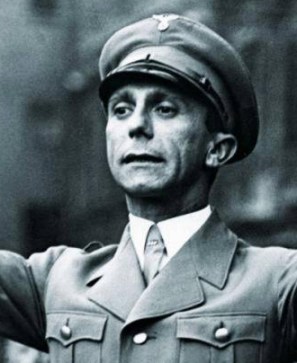 the German military that Hitler is a dangerous upstart who has already damaged the country beyond repair, and must be stopped. Adrift on a sea of violent corruption, Gunther constantly plays the role of the decent man, but in the end, he follows one theology, and one theology only. If he wakes up the next day with his head firmly attached to his shoulders, and has feeling in his extremities, then he has done the right thing. His conscience has not died, but it is far from well; it competes a whole chorale of competing voices in his head, each wishing to be heard. As he is left helpless by the world of spin and disinformation orchestrated by Dr Goebbels, (right) he must resort to his basic copper’s instincts to protect himself and uncover the truth.


 fullybooked2017