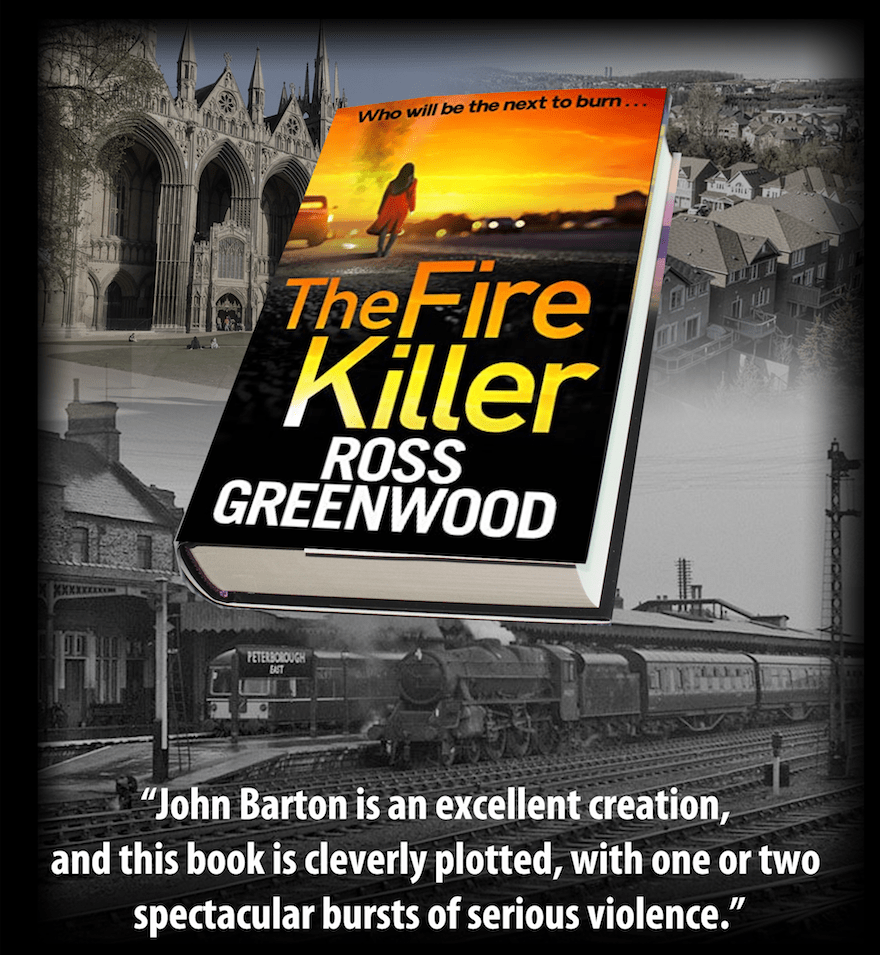

 Late again! My excuse is that I am a one-man-band here at Fully Booked, and notwithstanding the occasional erudite contribution from Stuart Radmore (who has forgotten more about crime fiction than most people will ever know), there are only so many books I can read and review properly. My first experience of Peterborough copper DI Barton is the fifth of the series (written by Ross Greenwood), The Fire Killer. Peterborough is a big place, at least for us Fenland townies, but is rarely featured in CriFi novels. I am pretty sure that Peter Robinson’s DI Banks grew up there (The Summer That Never Was) and Eva Dolan’s Zigic and Ferreira books are certainly set in the city.
Peterborough is a strange city in some ways. Its heart is divided in three. One third is its medieval heritage and its magnificent cathedral; another third is its railway history, while the final slice belongs to the fact that some anonymous civil servants decided, in the 1950s, that it should be a ‘new town’. Hence its sprawling suburbs, divided by interminable dual carriageways and countless roundabouts, stippled with anonymous housing developments, most with the faux-pastoral suffix – choose your own – such as Meadows, Leys, Gardens, Fields and even Waters. I digress. No matter that Peterborough isn’t quite sure whether it is in Cambridgeshire or Northamptonshire, this novel is rather good.
We are in standard police procedural territory here. DI John Barton is large, bald, busy, rather unglamorous, but a decent copper. He and his team are called in to investigate a body found in a skip that has been deliberately set alight. The body is eventually identified as that of a young woman whose life has unraveled after she had fleeting success as a fashion model. Barton and his ‘oppo’, Sergeant Zander, are sure that the culprit lives in one of a row of four shabby terraced houses not far from the skip, but which one is the home of the arsonist?
 Ross Greenwood (right) has fun inviting us to make out own guesses, but also makes the game a little more interesting by giving us intermittent chapters narrated by The Fire Killer, but he is very wary about giving us too many clues. The dead girl, Jess Craven had been involved with a very rich dentist with links – as a customer – to the London drug trade.
There are a couple of other mysterious blazes, but when one of Barton’s suspects meets a horrifying end in another fire – but this time in a torched Transit van – the search for The Fire Killer just seems to be chasing its own tale. The rich dentist, Stefan Russo, is clearly hiding something, but he is ‘lawyered up’ and even though he has some very questionable contacts in London, the police are unable to get close to him.
Then, there is a breakthrough – or at least Barton thinks it is – and someone confesses to being The Fire Killer. As readers we can judge how much of the book is left, and it is clear to us that Barton has some work still to do before he closes the case. There is, as we might predict, a very clever twist in the tale, but when an exhausted Barton finally goes off for a family caravan holiday in Sunny Hunny (Hunstanton), we suspect that at the back of his mind there is still a some doubt about the true identity of The Fire Killer.
John Barton is an excellent creation, and this book is cleverly plotted, with one or two spectacular bursts of serious violence. It is published by Boldwood Books, and will be available in paperback and Kindle from 30th May.


 Not the least of Eva Dolan’s achievements in this remarkable novel is to pinpoint with painful accuracy and honesty what happens to children and wives when a father – originally Colin Sawyer – decides to abandon the male role and become a woman. Even after the nightmare scene where Sawyer’s daughters come back to the house unexpectedly, and find their father en femme at the sink, doing the dishes, Jessica and Lily have come to think of their dad as ‘mum’. The pain that this must cause a biological mother in this situation can only be imagined, and it is interesting that Nina Sawyer is drawn as a fairly unpleasant piece of work.
 Aside from the nuanced description of gender politics and psychological challenges faced by the characters in this novel, we have to ask the burning question. Does Watch Her Disappear work as a crime story? My answer is a resounding and emphatc ‘Yes”. The whodunnit aspect of the story is teasingly effective, with Dolan (right) scattering little hints, false leads and blind alleys in her wake as she races along ahead of us. Crime fiction is full almost to the brim with Detective Inspectors and their trusty Sergeants, but Dolan breathes on those particular embers and makes them fire up afresh in the shape of Detective Inspector Dushan Zigic and Detective Sergeant Mel Ferreira of the Hate Crimes Unit. The neat twist is, of course, that both Zigic and Ferreira are themselves children of immigrants, and the chemistry between the two is potent and complex.

 Watch Her Disappear, the latest episode in the career of Zigic and Ferreira is expected to be on the shelves in January 2017, and it reminds us that hate crime can involve other issues than the colour of someone’s skin or the language they speak. A wave of sexual assaults has left Peterborough women wary and fretful, but when the next victim – a fatality – is revealed to have been a genetic man, the case becomes something different altogether.


 fullybooked2017