Search

fullybooked2017

Tag

Northumberland

DON’T SAY A WORD . . . Between the covers

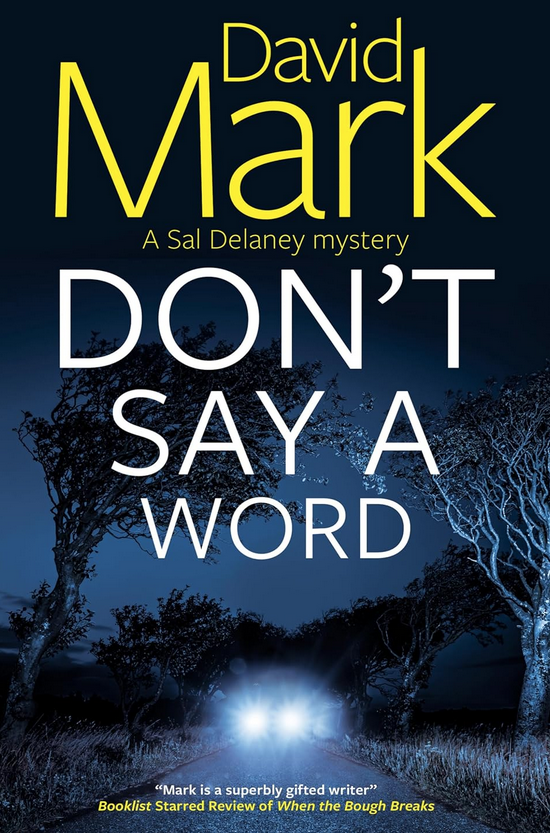
Cumbria traffic cop Salome ‘Sal’ Delaney has a startling back-story, which you can speed-read by checking my review of the previous novel, When The Bough Breaks. Now, we have a mysterious prologue which seems to describe a man being buried alive, but then Sal is called out on a bleak and rainy night to discover why a 4×4 has swerved into an unforgiving dry stone walk out in the middle of nowhere. The past hangs over this narrative like a pall, forcing the reader to be very careful about distinguishing between then and now.

Former drama student Theo Myers has spent an age in prison for a murder he did not commit. Now, finally, he is free of his prison walls, but shackled to a life of uncompensated poverty and a society that views him with suspicion. He reconnects with someone from his past, former policeman Wulf Hagman, who has also spent long years in jail.

Sal’s road accident takes a bizarre turn. The driver of the 4×4 swears he swerved into the wall to avoid what he calls a ‘zombie’. 4×4 man Sycamore Le Gros is stone cold sober but, hearing unearthly noises in a thicket beside the road, Sal discovers a stricken creature, whose state justifies the description Le Gros has given.

We are reunited with Detective Superintendent Magdalena Quinn, a police officer nicknamed The Succubus by male colleagues. She is certainly the embodiment of evil, devious, beautiful, manipulative and corrupt. If you are a Thomas Hardy aficionado, think Eustacia Vye, but with the moral compass of Lucretia Borgia.

The ragged, undead thing with horror in his eyes that Sal discovered in the undergrowth now has a name – Mahee Gamage, a solicitor of Sri Lanka origin, last known to be living in a village near Middlesbrough. The case takes an even more sinister turn when Sal learns that Gamage was the duty solicitor on the fateful night that Theo was arrested, and it looks probable that the advice he gave the young man was fatally flawed.

David Mark, like a cat with a mouse, enjoys playing games with his readers. As Mahee Gamage hovers between life and death in his intensive care bed, it seems clear that he was captured, imprisoned and brutalised because of his incompetence in representing Theo Myers. Was the culprit Theo himself, his obsessive mother Tara, or maybe her second husband Alec, the campaigner with his hatred of the British establishment? Perhaps it was joint enterprise? Or is Gamage’s torturer someone completely from Left Field? Further evidence, if any were needed, that the ambience of this novel is not sun dappled Cotswold limestone, thatched cottages and Inspector Barnaby, comes by way of an examination of the contents of Mahee Gamage’s stomach where the investigators find clear evidence of partially digested human flesh. Like Aector McAvoy, David Mark’s other memorable character, Sal Delaney frequently has to face a world of almost unfathomable moral blackness, and it is only her own spiritual integrity which enables her to survive. Don’t Say A Word is compulsive, dark – and sometimes extremely graphic. It is published by Severn House, and  available now.
THE DARK WIVES . . . Between the covers

TDW SPINE072 copy

Readers who have also watched the successful TV series dramatising the Vera Stanhope novels will have their own views on how Brenda Blethyn’s Detective Inspector matches up to the woman on the printed page. I stopped watching TV versions of police procedurals years ago, with the demise of John Thaw, so my take is purely based on the book. Vera Stanhope is a dowdy, frumpish woman in her 50s, lonely and probably a social misfit. Brought up by an eccentric father, Hector, in a moorland cottage in Northumbria, denied (by premature death) a mother’s love, she is a formidably intelligent detective. She drives a battered Land Rover, has holes in her socks, and doesn’t suffer fools gladly.

Here, she is handed a complex case that has splintered into myriad issues. At its heart is the apparently motiveless murder, by hammer attack, of an undergraduate and part time social worker, Josh Woodburn. A teenage girl, Chloe Spence, who was a reluctant resident at Rosebank, where Josh worked shifts, has gone missing. Where is she, and why was film and media enthusiast Josh, unbeknown to his family, moonlighting with shifts at a children’s home?

Vera has the death of one of her team, a Detective Constable called Holly, on her conscience, but she takes a maternal interest in Holly’s replacement, Rosie Bell, a rather glamorous and fashion conscious young woman who is actually a very good copper. When another inmate of Rosebank, a young chancer called Bradley Russell is found dead in a remote hillside bothy, the case becomes more complex.Without, I hope, giving too much away, Vera’s hunch is that Josh Woodburn’s death is connected with what he was really doing at Rosebank. Josh was a decent, caring young man, and very good with the children, but that wasn’t the main reason he was there. When Vera, with the help of  fellow officer Charlie, joins the dots, the picture also explains why Brad also had to die.

Both the season and the mood of the book are distinctly autumnal. Vera’s work is her life, and there seems to be little outside the job. The depressing world of broken homes, absent fathers, and a society where children’s homes are run by shadowy corporations on a distinctly for profit basis does not improve Vera’s downbeat view of the world but, to borrow a line from Matthew Arnold’s Thyrsis, “The light we sought is shining still.”, and in Vera’s case the faint glimmer is provided by bringing justice to the dead. She couldn’t be more different from Derek Raymond’s nameless detective in the Factory Novels (click for more information) but they have the same fierce resolve.

If years of reading police-procedural crime novels has taught me anything, it is that well-balanced, happily married Detectives are not fun. Vera Stanhope is forever on the edge of things, caught up in her own personal history and sense of regret, reluctantly wearing a halo of missed opportunities and ‘what ifs’.. Her fierce empathy with those society has cast aside, combined with her innate shrewdness and ability to pick out a ‘wrong-un’ make her one of the genre’s most treasured creations.

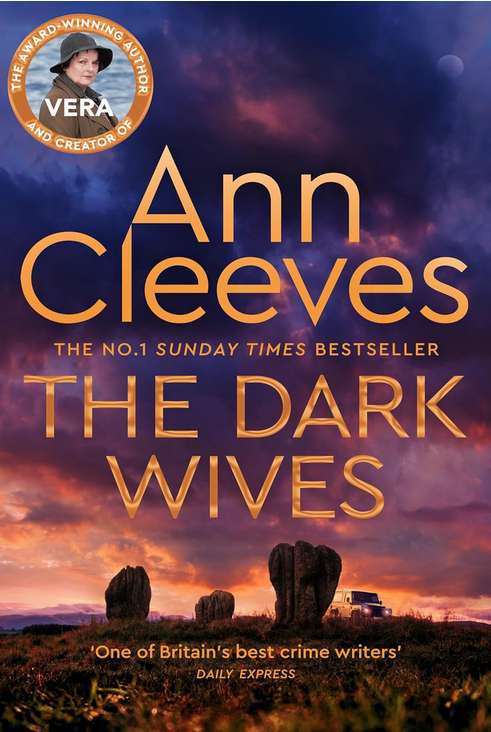
The Dark Wives of the title are three stone monoliths on the fellside near Vera’s home. Legend has it that they were three strong willed women who were turned to stone by husbands fed up with their feistiness. In the preface, Anne Cleeves writes:
“The book is dedicated to teens everywhere, and especially to The Dark Wives – uppity young women with minds of their own, struggling to find a place in a difficult world.”
The novel is published by Macmillan and was published on 29th August.

Screen Shot 2024-08-21 at 18.12.57

Blog at WordPress.com.

Up ↑