Search

fullybooked2017

Tag

murder

THE SCREAM OF SINS . . . Between the covers

TSOS header

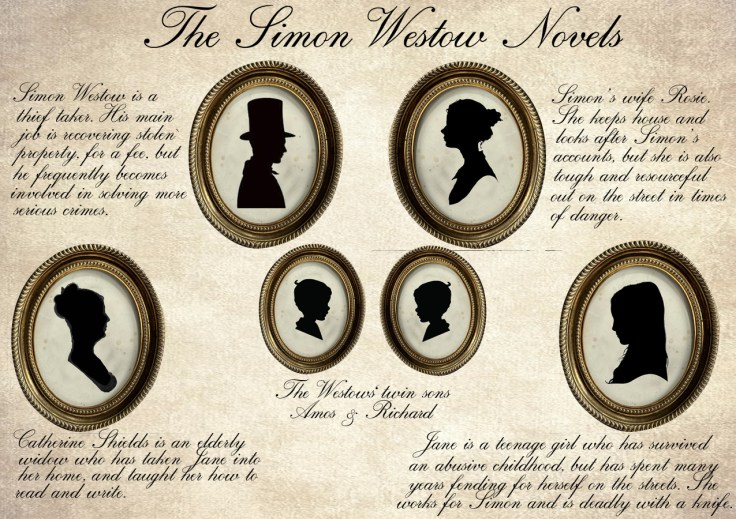
Leeds, Autumn 1824. Simon Westow is engaged by a retired military man, Captain Holcomb, to recover some papers which have been stolen from his house. They concern the career of his father, a notoriously hard-line magistrate. Newcomers to the series may find this graphic helpful to establish who is who.

TSWN graphic

Westow takes the job, but is concerned when Holcomb refuses to reveal what might be in the missing papers, thus preventing the thief taker from narrowing down a list of suspects. As is often the case in this excellent series, what begins as case of simple theft turns much darker when murder raises its viler and misshapen head.

Jane, Westow’s sometime assistant, has taken a step back from the work as, under the kind attention of Catherine Shields, she is learning that there is a world outside the dark streets she used to inhabit. The lure of books and education is markedly different from the law of the knife, and a life spent lurking in shadowy alleys. Nevertheless, she agrees to come back to help Westow with his latest case, which has turned sour. When Westow, suspecting there is more to the case than meets the eye, refuses to continue looking for the missing documents, Holcomb threatens to sue him and ruin his reputation.

More or less by accident, Westow and Jane have uncovered a dreadful series of crimes which may connected to the Holcomb documents. Young girls – and it seems the  younger the better – have been abducted for the pleasure of certain wealth and powerful ‘gentlemen’. Jane, galvanised by her own bitter memories of being sexually abused by her father, meets another youngster from the streets, Sally.

Sally is a mirror image of Jane in her younger days – street-smart, unafraid of violence, and an expert at wielding a viciously honed knife. Jane hesitates in recruiting the child to a way of life she wishes to move away from, but the men involved in the child abuse must be brought down, and Sally’s apparent innocence is a powerful weapon.

As ever in Nickson’s Leeds novels, whether they be these, the Victorian era Tom Harper stories, or those set in the 1940s and 50s, the city itself is a potent force in the narrative. The contrast between the grinding poverty of the underclass – barely surviving in their insanitary slums – and the growing wealth of the merchants and factory owners could not be starker. The paradox is not just a human one. The River Aire is the artery which keeps the city’s heart beating, but as it flows past the mills and factories, it is coloured by the poison they produce. Yet, at Kirkstall, where it passes the stately ruins of the Abbey it is still – at least in the 1820s – a pure stream home to trout and grayling. Just an hour’s walk from Westow’s beat, there are moors, larks high above, and air unsullied by sulphur and the smoke of foundry furnaces.

The scourge of paedophilia is not something regularly used as subject matter in crime fiction, perhaps because it is – and this is my personal view – if not the worst of all crimes, then at least as bad as murder.  Yes, the victims that survive may still live and breathe, but their innocence has been ripped away and, in its place, has been implanted a mental and spiritual tumour for which there is no treatment. Two little girls are rescued by Westow, Jane and Sally and are restored to their parents, but what living nightmares await them in the years to come we will never know.

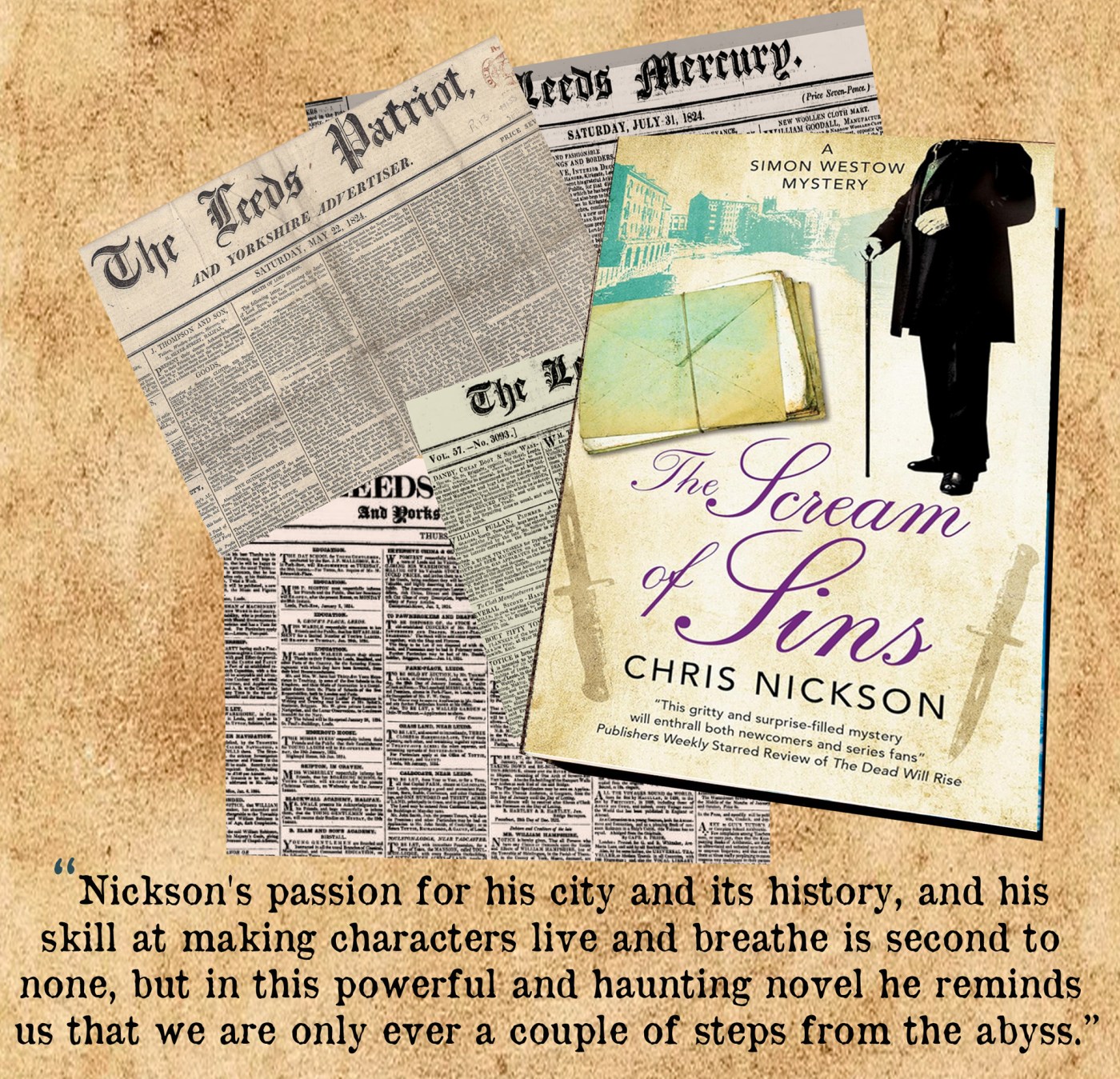
I have come to admire Nickson’s passion for his city and its history, and his skill at making characters live and breathe is second to none, but in this powerful and haunting novel he reminds us that we are only ever a couple of steps from the abyss. The Scream of Sins will be published by Severn House on 5th March.

LAYING OUT THE BONES . . . Between the covers

LATB header

Kate Webb introduced us to DI Matt Lockyer and DC Gemma Broad in Stay Buried, which I read, reviewed and found most impressive. Briefly, Lockyer is a single man, son of Wiltshire farmers – who would be described as ‘hard-scrabble’ in America. His younger brother, Chris, was murdered in a street brawl a few years earlier. He is involved – at a distance – with Hedy Lambert, a woman whose murder conviction he helped overturn. She still served over a decade in prison.

Because of a previous professional misjudgment, Lockyer has been sidelined into cold-case crimes. One such is the death of Holly Gilbert who fell – or was pushed – from a bridge into the path of a an HGV. Now, the remains one of the men suspected as having being involved, and who disappeared shortly after, have been discovered on Salisbury Plain. Lee Geary was a giant of a man, superficially very scary with his height, skinhead hair and tattoos, but he was simple in mind and spirit and his criminal convictions were all for minor and non violent crimes.

Three other twenty-somethings who were suspected of being involved in the death of Holly’s death have all since died in ambiguous circumstances. Lockyer has much on his mind. His mother lies dangerously ill in hospital, infected by a Covid variant, while his father struggles to keep the farm going. Lockyer lives in – and is slowly renovating – an old cottage, but he discovers that something horrific happened within its walls decades ago and, as is often the case, the past can often rear its ugly head to disrupt the relative tranquility of the present. I’ll give you a teaser – the book’s title is shared with another of the same name. If you take the trouble to Google, you will discover a rather delicate and elegant connection.

In trying to find out the truth about Lee Geary’s death, Lockyer is drawn, as if pulled by a magnet, to Old Hat Farm. It is owned by Vincent and Trish O’Neill, who lead something of an alternative life. They are are almost archetypal ‘hippies’, with lives organised around the ancient festivals such as Samhain and Beltain. Fellow seekers after truth are welcome at the farm but, unfortunately all of the key residents had lives in the real world, and it is their misdeeds in their previous lives which make up the puzzle Lockyer and Broad have to solve.

The novel is lovingly set in a part of England that the the author clearly knows well, and Lockyer’s intimate connection with the landscape – the vastness of Salisbury Plain, Wiltshire’s ancient sites and old trackways – brings a literary sense of place that was deployed so well by Thomas Hardy, but has been used by more recent writers in the crime genre such as Jim Kelly and Phil Rickson. As locals will know, the ravages caused by military training are brutal scars on the old fields and byways, but they are what they are.

Laying Out The Bones is not just a superior police procedural novel, but a powerful evocation of how historic lies and misjudgments can return to plague those involved. The empathy between  Lockyer and Broad is utterly convincing, as is the awareness of what happened to us all during the Covid outbreak. The book’s  plot is intricate, but beautifully fashioned, and although Matt Lockyer has something of a shock in the last page, I am sure he will survive to feature in a future episode of his career story. Published by Quercus, this book is available now.

DEADLY ANIMALS . . . Between the covers

DA spine020 copy

The district of Rubery, on the edge between Birmingham and Worcestershire. 1981. Ava Bonney is thirteen years old, She lives with her mum and sisters in a rudimentary council flat. Her dad has flown the coop, but mum Colleen has a feckless boyfriend, Trevor. Ava is an unusual girl. She is fascinated with animal physiology, and absorbs information mostly from books, but also – on the rare occasions when her fellow pupils are not being disruptive – from science lessons at school.

Ava is startlingly intelligent, but also wise enough to disguise herself as an ordinary teenager when needs must. She has an unusual hobby. She collects roadkill – mostly small mammals – and she takes them to secret sites close to her home, and installs them in little shrines. She secretly visits these special places as the remains decompose, and records her observations in a notebook. The largest specimen she has collected is a fox, but when she sneaks out one night to examine it, she has an unpleasant surprise. The smell of putrefaction is far more pungent than she would have expected, but the reason is obvious. Just a couple of yards from the dead fox is the body of a local schoolboy who went missing a couple of weeks earlier.

Not the least of Ava’s skills is a talent for mimicry, and she disguises her voice as that of a well educated middle-aged woman to make a 999 call, reporting what she has found. Another body is found, and then a third boy disappears. By this time, after interviewing local youngsters who knew the boys, Detective Sergeant Seth Delahaye has his suspicions that ‘Miss Misty’, the caller nicknamed after the anonymous woman in the 1971 Clint Eastwood film, is none other than Ava. Given the nature of the wounds inflicted on the boys the police are, despite common sense and experience, coming close to believing that they might be seeking a ‘what’ rather than a ‘who.’

Ava, with the help of her friend John, begins to put together a theory about what might be happening, and she believes that there is a connection to an elderly man – a former farmer and dog breeder – who is languishing in a care home with dementia. Delahaye, meanwhile, is receiving strange and disturbing reports of a large unidentified animal being seen at night in several places. As the police and Ava – in their different ways, close in on the killer, they realise that the truth is indeed stranger than fiction.

In Ava, Marie Tierney has created one of the most startling and original characters in modern crime fiction. I suppose she is a savant, but her gifts are not the result of her being on any kind of autism spectrum. She is super-smart, but also sensitive to the needs and natures of other people.

This is an astonishing novel on so many levels. It combines horror, compassion, dark humour, narrative verve, a deeply embedded empathy with landscape and locale and – above all – Ava Bonney, a truly memorable creation. Deadly Animals is published by Bonnier Books and is available now.

THE WINTER VISITOR . . . Between the covers

TWV header

I wasn’t sure if I should tag this review as ‘historical crime fiction.’ The novel certainly takes us back to a 1991 England of Ford Sierras, four-star petrol, Spurs being managed by Terry Venables and captained by Gary Mabbutt. Perma-press slacks from C&A and  – on the telly – the brief wonder that was BSKYB. We are in and around the town of Colchester in Essex, and we are in one of those winters where it always used to snow. I am sure that there is a doctorate waiting to be written on why Essex is perceived to Britain’s Crime Central. Perhaps it might be to do with the White House Farm murders in Tolleshunt D’Arcy, the ‘Essex Boys’ murder at Rettendon, or the exploits of double murderer James Fairweather in Colchester.

In The Winter Visitor, James Henry echoes his love of ornithology by using the term used for birds who fly to Britain during the winter – among them Redwings, Fieldfares, and both Bewick’s and Whooper Swans. I reviewed an earlier James Henry novel with an avian title, Whitethroat, back in 2020, and you can read the review here.

Two birds of very different feather are Detective Sergeants Daniel Kenton and Julian Brazier, based in Colchester. Kenton is married, bespectacled and fairly civilised:

“Daniel Kenton stared blankly into the hairdresser’s mirror. He did not care to see himself as others surely would: a a weary man, with murky red eyes, closing in on thirty five but aged beyond his years.”

Brazier, however, is frequently uncouth, ostensibly insensitive, and with the dress sense of someone preening himself in a Southend pound shop.

“Brazier was in a green bomber jacket and baggy black trousers like Charlie Chaplin, with white trainers poking out the bottom of them. Pegged trousers with turn-ups as well – on such short a leg as Brazier’s they were not at all flattering.”

As a pair, though, they are extremely effective. They need to be. James Henry has presented us with an extremely complex murder case.

Bruce Hopkins, an Essex criminal – not a major gangster, but more of a conman who dabbled in the drugs business – returns from the Spanish hideaway he shares with many other dodgy British expats, but it is a huge mistake. He is kidnapped, shoved into the boot of a Sierra (what else) which is rolled into a reservoir. When the car and body are discovered Kenton and Brazier are assigned to the case, and it is a complex one.

Hopkins did not have a criminal history likely to provoke Mafia-style revenge, so there seems to be no point in rounding up ‘the usual suspects’. Even so, Kenton is despatched to Marbella to interview former Essex bad boys, but he returns literally clueless. There is also a current investigation into an arson attack on a local church, and it is that Kenton and Brazier get the first hint of a breakthrough when they begin to suspect that Hopkins’s death may be linked to a small preparatory school called Bryde Park and some of its former staff and pupils.

James Henry is a very good writer. He captures the period perfectly, and his appreciation of the nature of Essex’s relationship with London is acute:

“Billericay, South Essex. Home of the East Ender made good. Traders, jobbers, grafters on the stock market. Leave school in May at fifteen, straight on the train into Liverpool Street towards plum jobs with brokers in the city, pulling in wedge before their smarter ‘O’ Level classmates finish in the exam hall.”

Kenton and Brazier have to visit an old fashioned mental hospital in the course of the investigation, and Henry captures its menace:

“…the institution itself had teetered on the fringe of an archaic medical world best forgotten. At the forefront of experimental medicine in the fifties, the place was synonymous with lobotomies, padded cells, terrifying screams, and all the nightmares associated with the restraint of insanity.”

We are lead this way and that as we share the detectives’ struggles to make sense of the death of Bruce Hopkins. The solution is as unexpected as it is elegant, and this is superior crime fiction. Published by Riverrun/Quercus, it is available now.

THE GHOST ORCHID . . . Between the covers

TGO spine018 copy

I suppose in the kingdom of detective partnerships, Holmes and Watson will never be dethroned, and quite rightly, too. I would however nominate (alongside Rizzoli and Isles, Morse and Lewis, Bryant and May, Wolfe and Goodwin) Alex Delaware and Milo Sturgis. Jonathan Kellerman’s duo of a child psychologist and LA homicide cop have for me, in dozens of novels, never failed to deliver. Yes, there’s a formula at work here, but that’s what makes all these partnerships work. Sturgis is abrasive, socially insecure and, because of his homosexuality, fighting an endless battle against his censorious LAPD colleagues, but he is a brilliant investigator: add into the mix Delaware’s social awareness, acutely attuned antennae for  people telling lies, and you have a winning mix.

A glamorous woman and a younger man are found shot dead at a Bel Air property. Her expensive jewellery has not been taken, and it looks like a professional job. Sturgis asks Delaware to take a look at the crime scene*.

*For new readers who wonder why Delaware is brought into the case, it’s simple. It’s the way the books work. Sturgis is something of a maverick, loose-cannon, lone-wolf – choose your own metaphor- and as long as he does the business, his colleagues leave him alone, so he always welcomes the extra pair of eyes and psychological insight that Delaware brings. In case you were wondering, Delaware earns a good living as a court-acknowledged expert in legal cases involving children so, thankfully for fans like me, he can afford the time to help Sturgis.

It transpires the dead woman is Meagin March, whose husband Doug is a real estate billionaire, and the corpse alongside hers belonged to, as they say, her toy-boy. Not short of a cent or three himself, Giovanni Aggiunta is the errant younger scion of a top draw Italian shoe making firm. He receives a generous allowance to amuse himself while his older brother and other family continue creating wealth with their exclusive designer footwear.  is not all she seems to have been, however, and it turns out that in a previous life she was a Vegas glamour escort. Yes, she finally snared Mr Right – and a life of luxury – but Delaware and Sturgis can find no-one who has a bad word to say about the murdered lovers, but become convinced that the woman was the intended target, and that her Italian lover was, sadly, collateral damage.

Doug March is a thoroughly unpleasant fellow. He was away on a business trip at the time, so it wasn’t his finger on the trigger of the .38 revolver, but could he have been so angry at Meagin that he hired a contract killer? Delaware is convinced that there is a message waiting to be discovered in one of the rooms of the March’s mansion. Meagin was an amateur artist and the room was her studio. All but one of her paintings are unremarkable ‘chocolate box’ scenes, but the exception seems to be a particularly severe abstract. Eventually, Delaware’s live-in romantic interest, Robin, identifies as a painting of a strange and rare flower, known as a ghost orchid*.

*Dendrophylax lindenii, the ghost orchid (a common name also used for Epipogium aphyllum) is a rare perennial epiphyte from the orchid family. It is native to Florida, the Bahamas, and Cuba. Other common names include palm polly and white frog orchid.

Robin provides more insight by suggesting that Delaware and Sturgis take a look at the unusual spelling of the dead woman’s name. I won’t say any more, but it’s not too hard an anagram to solve. These fresh clues result into a deep dive into ‘Meagin’s’ childhood which reveals horrors hitherto unsuspected. Delaware and Sturgis finally get their killer, but not quite in the way they were expecting. This is another classy and absorbing tale from the casebook of one of modern crime fiction’s most endearing partnerships. It is published by Century/Penguin Random House and will be out on 15th February.

THE SPY COAST . . . Between the covers

tsc spine007 copy

Have you ever wondered were CIA spooks go when they are pensioned off? Tess Gerritsen tells us that a number of them have settled down in the tiny Maine harbour town of Purity. Among them is Maggie Bird, once a stone cold killer for the Company, but now just a chicken farmer with the common ailments – such as aching joints –  shared by all senior citizens. Her neighbours are mostly of a similar age and background – particularly Ben Diamond, Declan Rose and the elderly couple Lloyd and Ingrid Slocum.

When Maggie is visited by a current CIA operative, a young woman who identifies herself only as Bianca, she is reminded of an unwelcome part of her past, in the shape of a fellow agent called Diana Ward. Ward is still active, but has gone missing, her bosses are concerned, and are offering to pay Maggie to help trace the missing woman. Maggie rejects the offer, saying she does not care if Ward is dead or alive.

Why the indifference? It is, as they say, complicated, and we learn that Ward and Maggie go back a long way, with the pivotal point in their professional relationship being an attempt, years earlier to take out a British wheeler-dealer – and international gangster – called Phillip Hardwicke. Long story short, the end result was a CIA sting that ended in disaster for Maggie. Her doctor husband, Danny, had been working as Hardwicke’s personal physician, and a private jet they were were traveling in left Malta, only to explode mid-air and crash into the sea with the  loss of all on board.

Back in present day Maine, Maggie is with her friends, discussing the mysterious visit of Bianca, when she hears that police have surrounded her house. Rushing home to investigate, she finds there is a corpse lying in the frozen snow of her driveway. It is the woman who called herself Bianca, and she has been tortured bt then professionally despatched with two bullets to the head.

Cocktails009

Maggie realises that the carnage is all about her and her past and so reluctantly she packs a few things, arranges some chicken-sitters, and goes back on the road to see if she can exorcise the ghosts of her past. Her travels take her into immediate and present danger, in Thailand and across Europe. My copy of the book came with a couple of cocktail recipes (above). The Spy Coast has all the hallmarks of a classic mainstream American thriller – taut as piano wire, danger round every corner and with convincing portraits of exotic locations.

T

THE LONGEST GOODBYE . . . Between the covers

TLGspine

This tough and unflinching Tyneside police thriller is the latest outing for Mari Hannah’s DCI Kate Daniels. The Longest Goodbye is the ninth in a series which began in 2012 with The Murder Wall. We are in late December 2022, and in Newcastle, like other cities across Britain, revellers are raising two fingers to the recently discovered Omicron variant of the Coronavirus, and are out in the clubs and pubs wearing – because it is Newcastle, after all – as little as possible, despite the freezing weather. Two lads in particular – homeward bound from overseas, and just off the plane –  are determined to have  a few beers before being reunited with mum and dad.

However, neither the two bonny lads nor mum and dad quite fit the ‘home for Christmas’ template. Lee and Jackson Bradshaw are only in their twenties, but have already done serious time for violence, and are returning from a European bolthole where they have been hiding from British police. Mum and Dad? Don Bradshaw is a career criminal, but pales into insignificance beside his wife Christine, who is the ruthless boss of the region’s biggest crime syndicate.

When the two prodigal sons are gunned down on the doorstep of their parents’ (recently rented) home just as they are about to sing ‘Silent Night‘, la merde frappe le ventilateur (pardon my French) The police are called and Don Bradshaw, brandishing the handgun dropped by one of his sons, is shot dead by a police marksman. No-one on the staff of Northumbria police will mourn three dead Bradshaws, but for Kate Daniels, the incident opens up a particularly unpleasant can of worms. Three years earlier, her best friend and police colleague Georgina Ioannou was found dead in a patch of woodland. Shot in the back. Executed. And it was the Bradshaw boys who were prime suspects.

Kate is forced to think the unthinkable: that Georgina’s twins, Oscar and Charlotte, now both police officers, were involved; even worse is the thought that Georgina’s husband Nico, although ostensibly a peaceful restaurateur, has avenged his wife’s murder. Revisiting old cases is never easy, and this one is made even worse by the fact that the Senior Investigating Officer at the time, was lazy, incompetent, and all-too-willing to cut corners.

Mari Hannah does not spare our sensibilities. She takes us through the painful process of self-examination one uncomfortable step at a time. It isn’t just Kate Daniels who must own up to past mistakes and errors of judgment, it is the whole Major Incident Team. Meanwhile, although the appalling Christine Bradshaw is safely behind bars facing a murder charge (the Firearms Officer she brained with a baseball bat has since died) like a badly treated tumour, malignant cells remain, and these men, enabled by her corrupt lawyer, are hard at work on the streets and in the pubs, clubs and private homes of Newcastle, determined to prevent the police from discovering the truth.

The Longest Goodbye, with its gentle nod to the Raymond Chandler thriller of almost the same name, grips from the first page, and we are fed the reddest of red herrings, one after the other, until Mari Hannah reveals a murderer who I certainly had not suspected. While few mourn the two dead criminals, when their killer is finally unmasked it is heartbreaking on so many levels. This is superior stuff from one of our finest writers. The Longest Goodbye is published by Orion and was published on 18th January.

LOST AND NEVER FOUND . . . Between the covers

LANF header

Screen Shot 2023-12-14 at 17.40.34If the tags “Oxford”, “Murder” and “Detective” have you salivating about the prospect of real ale in ancient pubs, choirs rehearsing madrigals in college chapels, and the sleuth nursing a glass of single malt while he listens to Mozart on his stereo system, then you should look away now. Simon Mason (left) brings us an Oxford that is very real, and very now. The homeless shiver on their cardboard sleeping mats in deserted graveyards, and the most startling contrast is the sight of Range Rovers and high-end Volvos cruising into car washes manned by numerous illegal immigrants from God-knows-where, all controlled by criminals, probably embedded within the Albanian mafia.

Against this background, meet Detective Inspector Ryan Wilkins, and his partner DI Ray Wilkins (no relation to Ryan or the late footballer). Ray is from a wealthy Nigerian family, happily married, photogenic and a rising star in the police hierarchy, while Ryan is – to put it bluntly – what some people might call a Chav. His idea of workwear is silver shell-suit bottoms, baseball cap and knock-off Nike hoodie. He is working hard to revive his career after being suspended. His former girlfriend died of a drug overdose, while his son – Ryan junior, – is largely looked after by Wilkins’s sister.

I missed the first novel in the series, but enjoyed the second, The Broken Afternoon, which I reviewed in December last year. Now the unlikely partners are faced with a new mystery. A formerly wealthy heiress, who has frittered away most of her privilege on drugs and a hedonistic lifestyle, has gone missing. Her Rolls Royce is found abandoned after colliding with the gates of the station car park. The tabloids, who have a huge library of back copy on Zoey Fanshawe, sniff a sensation, and they are not wrong. When Ryan finds her body, brutally strangled in an empty Oxford property owned by her former husband, the world and his wife are leaning on him to find the killer.

The concept underpinning this series is the contrast between Ray and Ryan, and that Ryan – the anarchic slob – is the one with the real detective’s brain. He is also unlucky in love. His current girlfriend, ostensibly a flourishing florist, has a dark past. We meet an officer who seems to be everyone’s favourite copper, the charismatic Assistant Chief Constable, Chester Lynch. There isn’t a contemporary box she doesn’t tick. Female?√ Black?√ Media friendly?√ Wears leather and designer shades?√ So far, her career trajectory has not been impeded by awkward bastards like Ryan Wilkins, who has a habit of asking difficult questions. This is all about to change.

While Ray seems mesmerised by Lynch (who has just offered him a serious promotion) Ryan is immune to the hype, and suspects she is a player in the murky back-story of the late Zoe Fanshawe. The plot of Lost and Never Found is beautifully crafted, and the description of the underbelly of Oxford life – the homeless camping in the graveyards of its ancient churches, and the women plying their trade in the derelict garages of its bleak outer suburbs – is a salutary contrast to the “Dreaming Spires” trope. Another part of the spell that Simon Mason casts is the difference between what Ray and Ryan face when they go home at night. Ray is met by his eminently sensible and forbearing wife Diane, while Ryan faces only the wrath of his sister, and the fact that Ryan junior has fallen asleep yet again without a bed-time story from his dad. This book will be published by Riverrun on 18th January.

THE TEACHER . . . Between the covers

Teacher header

This is a welcome return for Tim Sullivan’s distinctive copper, Detective Sergeant George Cross. Based in Bristol, the series is centred upon this unusual police officer – unusual in that he has a mental condition variously described as Autism, or Aspergers Syndrome. Common symptoms of the condition include lavish attention to detail, the inability to understand figurative speech and an intense reliance on pattern and repetition in personal life. I loved the previous book, The Monk, and you can read what I thought by clicking the link.

Now, in a village not far from Bristol an elderly man has been found dead at the foot of the stairs in his cottage. Alistair Moreton was not well-loved in Crockerne . The former headmaster of a private school was abrupt and aloof – except at parish council meetings when he objected to anything and everything on the agenda, mainly because he could, and because he took pleasure at being a contrarian.

A few years previously, he had been wrongfully implicated in the disappearance of a local schoolgirl, and much damage was done before she presented herself at a London police station, admitting she had just run away from home. Moreton had managed to alienate almost everyone in Crockerne, particularly the London couple – the Cockerells – who had a weekend cottage next to his, and with whom he had engaged in several lengthy – and expensive – legal battles.

Moreton’s son Sandy is an MP whose right-wing views have resulted in his being ‘recalled’ by his constituents, and so he faces a by-election. When George Cross’s temporary boss, DI Bobby Warner makes a premature arrest, and organises a press conference alongside Sandy Moreton, Cross quietly continues his own investigations, troubled by the fact that Alistair Moreton’s ‘set-in-stone’ daily routine had changed significantly over the two weeks prior to his death.

Cross discovers that Moreton’s tenure as headmaster of All Saints was characterised by brutality and a cruel disregard, and that there are many grown men whose childhoods were disfigured by beatings at the school – and the almost universal disbelief of their parents when they were told what was going on. A Facebook group of All Saints ‘survivors’ has been set up, and Cross comes to think that Moreton’s killer may be one of the members.

Along the way we have an intriguing glimpse into Cross’s family life. His father came out as gay later in life, but his partner has died, while Cross’s mother has remarried. A local priest is perhaps the closest thing Cross has to a friend and the cleric – Stephen – acts as an unofficial master of ceremonies in this unusual ménage.

The Crown Prosecution Service have been persuaded to put Barnaby Cotterell on trial for murder, but the case falls apart. Meanwhile disturbing information has come to light about the professional behaviour (or otherwise) of DI Bobby Warner.

Tim Sullivan leads us a merry dance and we whirl through a plethora of potential killers until, with just a few pages to go, we finally learn just who – from a classroom full of suspects – did away with the vicious and sadistic former schoolmaster. George Cross is a remarkable character – resolute, hugely intelligent, baffling to many of his colleagues, but blessed with insights that make him unique among modern fictional coppers. The Teacher is published by Head of Zeus and will be available on 18th January.

Blog at WordPress.com.

Up ↑