Search

fullybooked2017

Tag

murder

SOUTHERN MAN . . . Between the covers

SM SPINE

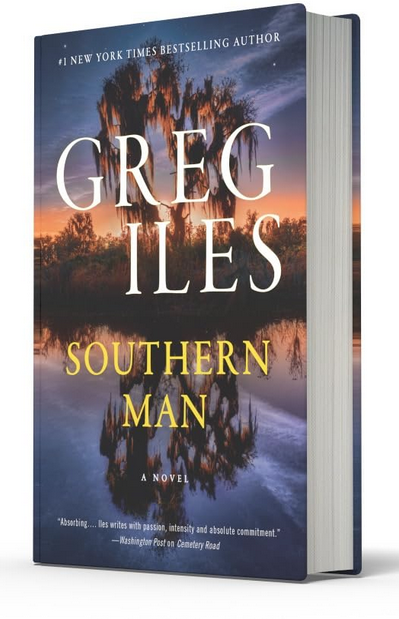
This is a massive book physically as it is over 900 pages long. Emotionally, it is huge, as it deals with suffering, death, revenge, remorse and corruption with relentless intensity. Politically it is intensely topical as it deals with the prospect of a Donald Trump second term as POTUS, and the mood of the voters who put him into the White House in the first place. Historically, it is deeply challenging, as it looks at the legacy of over two centuries of prejudice and cruelty in the southern states of America.

The title refers to a 1970 song by Neil Young where he excoriates the archetypal redneck southern male. The song may (or may not) have triggered a musical duel with Lynrd Skynrd, when their response was Sweet Home Alabama. The novel features Mississippi lawyer, politician and author, Penn Cage, who appeared in previous Greg Iles novels. Click the link for more information.

The back story here is complex, but in a rather large nutshell:

Penn Cage, has an obscure terminal cancer which is slowly killing his octogenarian mother.
Cage lost a leg beneath the knee in a road accident.
He is a civil liberties campaigner.
Dr Tom Cage, Penn’s father, a much respected physician, wrongly imprisoned, died in prison riot at Parchman Farm penitentiary.
Cage is a widower. His wife died of cancer and, much, later, his fiancée was murdered.
He has a twenty-something daughter called Annie, also a liberal minded lawyer.

The early narrative darts back and forth between current events and the days following Dr Tom Cage’s death in the prison riot. The reasons for Tom’s incarceration are complex, but Greg Iles spells it out with great clarity. Present day couldn’t be much more topical. Donald Trump is gathering momentum for a second bid for the presidency, but the almost unthinkable has happened. A charismatic war veteran called Robert Lee White is aiming to be the first independent candidate since Ross Perot in 1992, and he has a huge following via his Tik Tok videos and a very popular radio show. He came to national prominence when he led a special forces team searching for a notorious Taliban leader. They found him, and White administered the coup de Grace.

Present day. As Bobby White hones his media profile for TV audiences, he receives a boost. Attending a largely black music festival, he heroically rescues Annie Cage and several others, mostly black youngsters, who have serious bullet wounds after white Sheriff’s deputies open fire on the crowd after a shooting incident. However, Bobby White’s pitch for POTUS has a serious problem. He lacks the prerequisite adoring wife and clutch of tousle-haired children. Why? I can only direct you to the coded words at the end of many a Times obituary – “He never married.”

The deaths at the music festival have serious repercussions. Within days, a treasured pre Civil War mansion,  is burned to the ground. and there is a calling card from The Bastard Sons of The South, apparently a militant BLM organisation. Penn Cage, as a white man, is thrust onto the horns of a dilemma. He is white with serious influence in political circles, but he is also widely respected with the black community, both for his own integrity, and the legacy of his late father. Can he prevent a bloodbath, as the calls for revenge lead to a disastrous polarisation on the streets between black and white factions?

The conflict is not just between black and white people. America has a bewildering number of layers of law enforcement. At the apex is the FBI. Their remit extends across the nation, irrespective of state boundaries. Then we have Sheriffs, appointed by vote. They and their deputies rule the roost over large state subdivisions, known as Counties. Large towns and cities will have their own independent  police departments. Last, but by no means least, are the National Guard. They are volunteers, but basically members of the armed forces, and will usually have access to military standard weapons and vehicles. In Southern Man, each one of these agencies come head to head in the streets of Natchez, while the barge-trains and freighters battle against the Mississippi current, beneath the cliff top where thousands of black peace protestors stare in the muzzles of National Guard issue AR-15 rifles.

There is a substantive second story which emerges at different times in the novel. Penn Cage’s mother has been researching her family history, and has pretty much completed it. What it reveals is that Cage and his daughter are descendants of a woman who was the product of a union between a slave owner and one his female slaves. This document allows Greg Iles to explain the complex and often contradictory relationships between slaves (before and after emancipation), and their owners. He also makes the point that the members of the victorious Union army were all too often nothing like liberating saviours.

Cage’s declining health make him rather like Tennyson’s Ulysses:

Tho’ much is taken, much abides; and tho’
We are not now that strength which in old days
Moved earth and heaven, that which we are, we are;
One equal temper of heroic hearts,
Made weak by time and fate, but strong in will
To strive, to seek, to find, and not to yield.

With an increasing sense of frustration, he tries to get to the bottom of who seems to be manipulating the perilous situation on the streets, as rival groups – militant Black activists, peaceful protesters, far right militias, City police and Sheriff’s Deputies edge ever nearer to a cataclysmic explosion of violence.

Greg Iles just doesn’t take sides. He is scathing and abrasive about everything to do with the concept of the honourable South. He has little truck with historians like the late Shelby Foote, who, memorably, appeared several times in Ken Burns’ magisterial documentary The Civil War, and attempted to explain that a typical Southern Man of the Confederate era was not always a brutal redneck bent on raping and brutalising black people.

In several ways, Penn Cage mirrors the real life author.

Both lost part of a limb in a road accident.
Both had fathers who were doctors.
Both had mothers who died of cancer.
Both have a rare form of cancer.

This is a brilliant novel, for sure, which rolls a rock away, and exposes all manner of nasty creatures scurrying away from the light. Is there any room for nuance in the north v south controversy? Greg Iles doesn’t think so, and his superb writing underscores his argument. Me? I am on the fence, not because I approved of the concept of slavery, or the horrors meted out to its victims, but because when you severely punish a nation – which the South thought it was – there are unintended consequences, as The Treaty of Versailles proved in 1919. Post Appomattox 1865, a long lasting sense of grievance was born, and it has yet to die of old age. So-called White Guilt looms large in the novel, as my occasional visits to North Carolina suggest to me that it does in real life.

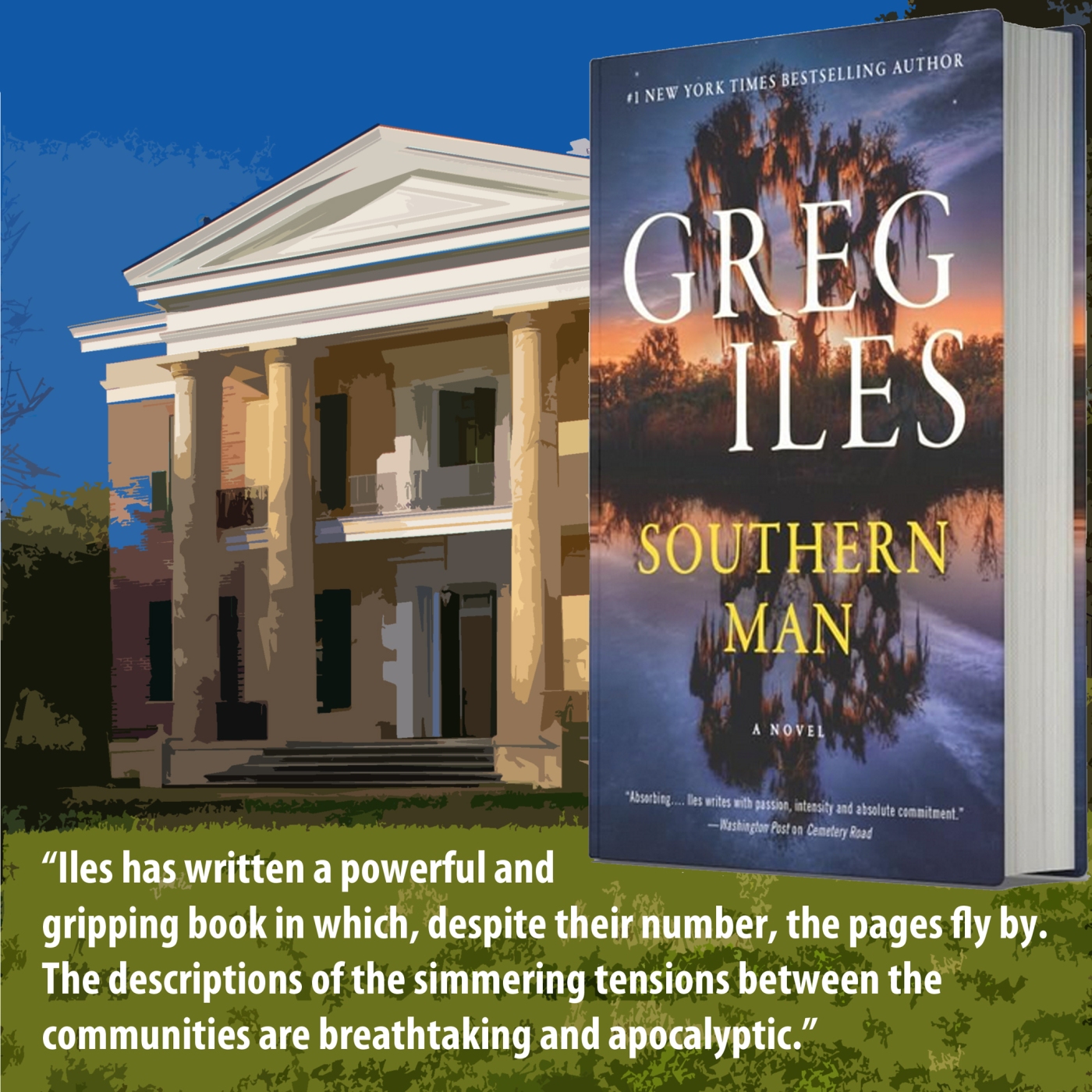
Aside from the politics, Iles has written a powerful and gripping book in which, despite their number, the pages fly by. The descriptions of the simmering tensions between the communities are breathtaking and apocalyptic. I only hope that in the months to come, they remain fictional. if they play out in real life, there will be a second War Between The States, and America will suffer grievously. Southern  Man is published by Hemlock Press and will be out on 6th June.
Screen Shot 2024-06-03 at 17.52.05

THE ESTATE . . . Between the covers

estate spine051 copy

Police Scotland’s Detective Inspector Cara Salt has been sidelined (because of a serious career blip, of which more later) into what can only be described as a dry and dusty branch of law enforcement, the Succession, Inheritance and Executory Department, SIE for short. Their job is to deal with breaches of the law that happen as a consequence of wills that upset people who assumed they were going to be beneficiaries but, for whatever reason, feel they have been short-changed.

A celebrity hedge fund manager, Sebastian Pallander has died on TV. No, not ‘died’ as in a comedian who fails to get a laugh, but ‘died’ as in suffering a massive heart attack while being interviewed on a live politics programme. It is his will – and its consequences – that are central to this story. When one of Sebastian’s sons, Jean Luc, manages to blow himself up while trying to sabotage a wind turbine, DI Salt is initially surprised to be asked to investigate. Along with her recently acquired assistant, DS Abernathy Blackstock, she visits the site of the wind farm, and finds that young Jean Luc is in many pieces, decoratively spread across the Scottish hillside.

Blackstock is not all he seems to be. The fifty-something Sergeant has not only been working on a top secret investigation into the late Sebastian Pallander’s links to highly dubious Russian money men, but he is the scion of a formerly wealthy branch of Scotland’s aristocracy.

One by one, the Pallander siblings seem to be the in the cross hair gun-sights of some rather nasty people. First Tabitha is kidnapped, then rescued by a mysterious man who tells her that she and her husband must make themselves scarce. When the hotel they are staying in, anonymously, catches fire, Cara Salt decides that Tabitha needs sanctuary – with none other than her former boyfriend – and fellow copper, Sorley MacLeod, now running a  laptop refurbishment business in London, but with an lonely fishing cottage out in the Essex marshes as a retreat.

Meanwhile, Silas Pallander, once destined to take over his father’s business but – since the reading of the will – relegated to manager of the family estate, has also been seized, along with his personal assistant Anna. He is forced to sign certain papers, and then the gang make a hasty exit, leaving Silas and Anna to emerge, blinking, from their captivity, to find themselves in a disused Belgian airfield.

About halfway through the book, we learn the reason that Cara Salt is now involved in a policing operation that is as far from the mean streets of Glasgow as it could be. She had headed up a police take-down of a violent local gangster. It went pear-shaped and, faced with her Detective Sergeant – Sorley MacLeod – being held at gunpoint by the man who was the target of their raid, she took a chance and fired two shots. The first shattered MacLeod’s shoulder, but the second hit the gangster right between the eyes. Salt was sidelined and, after a long and painful recovery, MacLeod left both the police force and the world of Cara Salt.

Macleod and Tabitha Pallender, after a helter-skelter chase and a too-close-for-comfort brush with the bad guys, are eventually reunited with Salt and Blackstock, and are whisked back to relative safety in the Pallander company helicopter. However, anyone connected to the Pallander financial empire is about to enter a whole world of hurt. Pallander and his associates had for years basically been operating a Bernie Madoff-style financial scam and, with his death, the corporate chickens are about to come home to roost.

Screen Shot 2024-04-30 at 18.43.53

Towards the end of the book Denzil Meyrick (left) throws a sizeable spanner into the works in terms of what we think we know about what is going on, but this nothing to the shock we get during his version of the classic crime novel denouement in the library. In this case, it’s not the library, but the baronial dining room of Meikle House, the home of the Pallanders. The Estate is fast paced, witty and full of those plot twists that make Meyrick’s books so entertaining. It is published by Transworld/Bantam and is available now.

BACK FROM THE DEAD . . . Between the covers

bftd spine044 copy

Screen Shot 2024-04-15 at 15.51.25I have to confess that the crime fiction obsession with Scandi crime a decade ago came and went, as far as I was concerned. Some of it was very good, but to this old cynic it seemed that as long as an author had a few diacritic signs in their name, they were good for a publishing deal. Heresy, I know, but there we are. Back From The Dead is not a Scandi crime novel translated into English. The author (left) was born in Copenhagen, but has lived for many years in London, and she writes in English.

DI Henrick Jungerson is a Copenhagen cop, and his city is enduring a heatwave. This adds to his discomfort when he has to stand on the harbour side and watch a corpse being removed from the water. The body is not leaving its watery grave without a struggle. Jungerson, when he sees that the body is minus its head and hands realises that that wasn’t some poor fellow who fell into the water after imbibing too well during the interval of La Traviata at the nearby Opera House.

Jungerson ticks many of the boxes on the Classic CriFi Detective Inspector Checklist: he is middle aged, has a less than idyllic personal life, and doesn’t suffer fools gladly. ‘Loose cannon, womaniser and too unorthodox‘ are just a few of the descriptions laid at his door. He has an on/off relationship with a journalist called Jensen. She works for Dagbladet, a Danish tabloid which is, like many print journals, struggling against the inexorable rise of digital media.

She has received a ‘phone call from Esben Norregaard, a national MP. His chauffeur and factotum, a Syrian immigrant called Aziz Almasi, has vanished from the face of the earth. Almasi’s wife is beside herself with worry. Jungerson and Jensen share information, and it seems possible that the harbour corpse might be that of Almasi. Both were huge men, built like the proverbial brick whatnot, and well over six and a half feet tall. The body fished from the harbour was also that of a very big man but despite the missing head, it is almost certainly not that of the missing Syrian. A burnt-out hire car seems to have been the vehicle which transported the unknown corpse to the water’s edge, but Jungerson is frustrated to learn that the name on the rental agreement, Christopher Michael White, was a ten year old British boy who died of a brain tumour twenty years earlier. Everything about the case seems to be going pear shaped. There is a glimmer of hope when a head is found dumped in a bin, but when the pathologist tells Jungerson that it did not belong to the harbour man, the detective feels like punching the wall.

The room or, more likely, the assembly hall, containing fictional Detective Inspectors is certainly crowded, but Henrik Jungersen stands out for his faults rather than for his triumphs. He is a good copper, for sure, but he is swept along by events rather than controlling the flow. This makes him all the more credible. It also ticks that vital box that asks the question of readers, “do you care what happens to him/her?” Yes, we do, and that’s what makes Back From The Dead such an entertaining read.

The title is something of a giveaway in terms of the fate of Aziz, but Heidi Amsinck steers the plot in an entirely unpredictable direction, as both Jungersen and Jensen have their lives – both professional and personal – turned upside down by the course of events. They are both swept along by the tide of a case neither can control, and this makes for a gripping and immersive police thriller. As is so often the case, the Bard of Avon can have the last word. There is, truly, something rotten in the state of Denmark.

Back From The Dead is published by Muswell Press and is available now.

THE KITCHEN . . . Between the covers

kitchen spine039 copy

As her name suggests, Hamburg State Prosecutor Chastity Riley has American antecedents, but her work and life are both firmly centred in the German city that sits astride the River Elbe. Author Simone Buchholz leaves us pretty much to our own devices to imagine what she looks like, but we know she smokes, enjoys a drink or three, can be foul-mouthed, and has an on-off relationship with a chap called Klatsche.

From the word go, Buchholz drops a broad hint about what is going on, but Riley only finds out much later. Her immediate problem is that two packages of body parts have been recovered from the Elbe, disturbed by dredging. The men have – literally – been expertly butchered and the parts neatly wrapped up in plastic and duct tape. It turns out that the dead men have a history of serious abuse towards women, and a witness report suggests that two women are linked to the killings.

A third body is found, this one being intact, but Riley has another problem to solve. She has a friend named Carla, who runs a coffee shop and is a very important part of Riley’s life, fulfilling the dual function of sister and mother. When Carla is attacked and raped by two men, Riley becomes angry with the police’s apparent lack of urgency, but is powerless to intervene. As well as trying to solve the mystery of the Elbe packages she is central in a current court case where two people traffickers are on trial. Their business model was to travel to rural areas in places like Romania, and persuade young women that a glamorous lifestyle awaits them in Germany. The reverse is true, of course, and the girls are soon put to work in Hamburg’s notorious sex trade.

Events in Riley’s personal and professional life seek to be spinning out of control. First, thanks to the defence lawyers in the trafficking case successfully making out that their clients are really nice chaps who had traumatic childhoods, and who’ve just had a bit of bad luck recently, the smirking criminals get the lightest sentence possible. Then, she and Klatsche discover that Carla – with the assistance of a shady friend called Rocco – have done what the police failed to do, and have captured the two rapists. It is only with the greatest reluctance that Riley realises she must persuade Carla to hand the two men over to the police.

Screen Shot 2024-04-05 at 18.48.52

When, with a mixture of instinct and sheer luck, Riley identifies the two women responsible for the three earlier murders, her professional integrity is put to its sternest test. In some ways this is a very angry book and is centred on the evil that men do, particularly to women. It is obviously entirely appropriate to the tone of the book that much of it is set in the St Pauli district of Hamburg, an area that began its notoriety centuries ago as a place that provided entertainment for sailors. Its infamous Reeperbahn remains a living – and sadly prosperous – example of women being made into a commodity to please men. Despite her obvious anger, however, Buchholz (left) doesn’t moralise. Chastity Riley realises that Hamburg is what it is, and  if the needle of her moral compass occasionally swings in an unexpected direction, then so be it.

The Kitchen proves that a book doesn’t have to be 400 pages long to be effective. The prose is precise, spare, icy cool and as dark as ink. Simone Buchholz has serious style – in spades. The book was translated by Rachel Ward, published by  Orenda Books and is available now.

Screen Shot 2024-04-17 at 17.27.08

REVENGE KILLING . . . Between the covers

RK spine036 copy

I reviewed an earlier book in this series, Final Term, in January 2023 and thoroughly enjoyed it, so it was good to become reacquainted with York copper, DI Geraldine Steel. Revenge Killing is a little bit different in that DI Steel is off on maternity leave. As much as she loves baby Tom, she is feeling very much out of the loop in terms of her police career. When her friend and colleague DI Ariadne Moralis asks for her advice, she leaps at the chance to help.

Moralis has a complete puzzle of a case on her hands. Initially, her husband – Greek, like Ariadne – has been visited by a friend and compatriot called Yiannis Karalis. Yiannis owns a property where one of the tenants – a small time drug dealer called Jay Roper – has been found dead at the foot of the stairs leading up to his flat. Ariadne assures him that he has nothing to worry about, but when the post mortem examination reveals that Jay was suffocated, things become more complicated.

Ariadne discovers that Yiannis is something of a fugitive, as he fled Greece during the fallout from the murder of his older brother and a subsequent vengeance death. Did he visit Jay to remonstrate with him about the drug dealing? Did the visit turn violent. One of Jay’s girlfriends, Lauren Shaw, has gone missing. What does she know? Another girlfriend, Carly, who works in what is euphemistically known as a gentleman’s club, is located, and she is completely antagonistic towards the police. Despite claiming that she and Jay had an ‘open’ relationship, was jealousy simmering just below the surface, and did she kill Jay on the grounds that if she couldn’t have him, no-one else would?

Leigh Russell cleverly lets us spend some time with Lauren, who has panicked. We know. from the early pages of the book that she and Jay had a blazing row which ended in him falling down the stairs. Now, terrified that the police will blame her for his death, she goes on the run, and we share her misery as she her meagre savings run out, and she discovers that life on the streets is miserable and dangerous.

Revenge Killing is, at its heart, an excellent and engaging police procedural, but Leigh Russell has an intriguing little subtext ticking away in the background, and it centres on Geraldine’s misgivings about her life trajectory. She dutifully attends a mothers and toddlers group, but feels only alienation:

“But the other mothers at the toddler group had never dealt with murder investigations in the real world. None of them had watched a post-mortem, knowing the cold flesh on the slab had once been a living breathing human being, whose life had been snatched away by someone in the grip of an evil passion. The other mothers had never learned to close their minds to the horrors of every day human brutality, so shock couldn’t prevent them from doing the job. Gazing at the cheerful faces around her, she regretted her choice of career and wished her life could be as simple as it was for the other women in the room. But her experience had cut her adrift from these chattering young women, with their sheltered upbringing and cosseted lives. They discussed their various tribulations as the infants crawled or toddled around the room, or sat propped up watching warily, like Tom.”

As with all good whodunnits, we are presented with just the right blend of surprise at the identity of the killer, and a few helpful nudges to point us in the right direction. Revenge Killing is published by No Exit Press and is available now.


THE ANTIQUE HUNTER’S GUIDE TO MURDER . . . Between the covers

Antiques spine022 copy

Think the beautiful county of Suffolk, with its stately churches and half-timbered villages. Think the timeless Stour and Deben valleys and their rivers, where the sun dapples the glinting water, much as it did when Constable immortalised the scene. Think antiques. Think crime and intrigue. Remind you of Sunday nights back in the day? It reminds me of the antics of Lovejoy and his friends, thirty years ago. However, this is rather different.  We are in the present day, and the central character is Freya Lockwood, a skilled antique hunter who has fallen on hard times. Her former husband has let her keep their house until their daughter grew up, but now he wants it back and she is, to paraphrase the great Derek Raymond, rather like the crust on its uppers.

Freya’s background has elements of tragedy. As a schoolgirl, she was badly burned in the house fire that killed her parents, and she was brought up by her aunt Carole and began her working career as an assistant to antiques expert Arthur Crockleford.  At some point they had a major falling out, and haven’t spoken in years. When Freya gets a ‘phone call from Carole to say that Arthur has been found dead in his shop, she ups sticks and travels down to  Little Meddington where he had his shop.

The police have decided that Arthur’s demise is a simple case of an elderly man falling down the stairs, but then Freya and Carole are handed a letter addressed to them which begins:
“If you are holding this letter in your hands then it is over for me..”

Is there more to Arthur’s death than meets the eye? We know there is, because of the first few pages of the book, but Freya and Carole are in the dark after subsequently being told by a solicitor that the shop and its contents are now theirs. They begin to pick away at the mystery.

Arthur has arranged an antiques weekend to be held, in the event of his death, at Copthorne Manor a nearby minor stately home. He has invited several people connected with the antiques world to stay at the Manor, and it is as if he will be conducting the consequent opera like a maestro from beyond the grave.

We learn that the falling out between Freya and Arthur was a tragedy that occurred in Cairo many years earlier, Arthur and Freya were in Egypt ostensibly verifying and valuing certain items which were thought to have been stolen and were being traded on the antiques black market. Freya fell in love with a with a young Egyptian, Asim, whose family firm specialised in creating very cleverly faked antiquities. When a deal goes wrong, Asim is found dead, and Arthur sends Freya back to England. They have not spoken since, as Freya believes that Arthur was responsible for her lover’s death.

Now, back in Suffolk, at Copthorne Manor, some of the people involved in the Cairo incident are together again under the same roof, and in the vaults of the house are packing crates which contain some of the items which were central to Asim’s murder.

Everyone wants to get their hands on the precious items, but no-one is who they seem to be. The country house setting allows author Cara Miller to run through the full repertoire of Golden Age tropes, including thunderstorms, power cuts and corpses, and she has great fun as Freya and Carole eventually expose the villains.

Screen Shot 2024-03-17 at 19.10.35
Cara Miller
(above) is the daughter of the late Judith Miller of Antiques Roadshow fame, so she certainly knows her stuff. The novel is a splendid mix of murder, mayhem and outrageous characters, and will delight those who love a good old fashioned mystery, with more than a hint of the Golden Age. It is published by Macmillan, and is available now.

MURDER MOST FOUL IN LOUTH . . . Three tragedies

Screen Shot 2024-03-08 at 14.35.44

I have posted these stories separately over the last few years, but now I have organised them so they can be accessed from one page of the website. Click on the images below to go to the episodes.

1875: THE MURDER OF LOUISE HODGSON
Screen Shot 2024-03-08 at 14.49.26

1927: THE MURDER OF MINNIE ELEANOR KIRBY
Screen Shot 2024-03-08 at 14.47.56

1950: THE MURDER OF ALICE WRIGHTScreen Shot 2024-03-08 at 14.46.29

TO KILL A SHADOW . . . Between the covers

TKAS spine023 copy

There was a saying beloved of football managers and commentators that went something like, “He’s a whole-hearted player – he leaves nothing in the changing room.” The metaphor was meant to describe someone who gives – and here’s another cliché – “one hundred and ten percent” on the field. To Kill a Shadow is a bit like that. It has corrupt coppers, SAS types thundering about on motor bikes, a brave-but-flawed heroine, murders, torture, kidnap, a military-industrial conspiracy, ground-breaking neuro-technology and political chicanery. The central character is called Julia Castleton which is, confusingly, also the name of the author of the novel. Of Julia in the book, more later, but the author’s name is the nom-de-plume of what the end papers say is “an internationally best-selling and critically acclaimed writing duo”.

The book’s Julia is actually Julia Danby, the younger daughter of a millionaire businessman and man of influence. Marital fidelity was not his strong point, and while Julia’s mother was dying of cancer, he was off in the south of France with his latest girlfriend. This made Julia furious with her father. At the time, she had a proper job as a journalist with The Times, but the family conflict sent her completely off the rails, and she ended up – in no particular order – being sectioned under the Mental Health Act, losing her job, and becoming mother to a baby boy whose father – such was her mental disorder – remains unknown.

Now, she has somewhat recovered, and writes a political blog called The Castleton Files which seeks to expose fraud and deception. Spurning financial help from her father, from whom she is now estranged, she earns small change from advertisers on her blog, and people who choose to become subscribers. Living in a shabby flat, she tries to keep a roof over her head and that of her little boy, Alex.

When a former military medic who saw service in Iraq and Syria contacts her with what she sees as a breakthrough story, she puts the dossier – basically alleging that British arms manufactures made a fortune selling their goods to ISIS – online, and all hell breaks loose. Initially, hits on her website go through the roof and she is bombarded with requests from mainstream media for interviews and further information.

But – suddenly – it all goes pear-shaped. UK government strongly refutes Julia’s allegations, her history of chaotic mental health is made public but – worse still – many of the details in her dossier are shown to be palpably untrue. The people from Social Services are trying to prove she is not a fit mother to Alex, the police bust down the doors of her flat and then claim they have found Category ‘A’ images of child abuse on her laptop and, in a further descent into her mental hell, Julia starts self harming again, and gulps down her Tegretol – a drug used for controlling the effects of schizophrenia and bipolar disorder.

Julia eventually discovers what the conspiracy is all about, and it  is actually far more alarming than the story of the arms sales. The military medic had discovered something so fantastical and improbable, that were it to be true, the whole nature of warfare would be changed.

I didn’t find Julia a very sympathetic character. Keeping Alex is clearly important to her, but at the first nudge, she heads off with her mates – mostly ex-SAS – to various parts of the country, in order to chase down the latest lead. Meanwhile, the little boy is left in the care of her older sister Elaine, whose elegant lifestyle and bourgeois values Julia clearly disdains.

This reservation aside, I won’t lie. I read the book cover to cover with great enjoyment in a few sessions, and the action is relentless. Needless to say, Julia’s hunches are eventually proved to be solid fact, and her credibility as an investigative journalist is restored. To Kill a Shadow is published by Pendulum books and is available now.

THE SALT CUTTER . . . Between the covers

Tsc spine019 copy

Screen Shot 2024-02-20 at 16.57.12Ask ten different readers what they think qualifies as ‘noir’ and you will get ten different answers. Is it that everything is framed in a 1950s monochrome? Is it because all the participants behave badly towards each other, and have zero respect for themselves? Is it because we know that when we turn the final page, there will be no outcome that could be described as optimistic or redemptive? One quality, for me, has to be an unremitting sense of bleakness – both physical and moral –  and this novel by CJ Howell (left) certainly has that.

Set in Bolivia, The Salt Cutter centres on a young soldier – he is never named – who has deserted, and is on the run, with only his military boots, a rucksack, and his disassembled M16 machine gun for company. It is November 1991, and The Soldier fetches up in the desolate town of Uyuni, on the edge of the Salar de Uyuni, the world’s largest salt flats. Nowadays, there is something of a tourist industry but at the time when the book is set, the place was so bleak that even the rats had given up the ghost and moved elsewhere.

Along with a man called Hector Anaya, who had arrived with his family on the same ramshackle bus that brought him to Uyuni, The Soldier gets a job with a small crew cutting salt out on the flats, and he strikes up a cautious friendship with a woman called Maria, the town baker. He as also attracted a little follower, in the shape of a boy who makes a precarious living shining shoes.

The Soldier is expecting to be followed to Uyuni by his military masters, but why they would bother, for one random young man from an army of tens of thousands is not made clear. Two agents of the army do arrive and The Soldier kills them. The town’s policeman, El Gordo, has a realistic view of what law and order means in his town:

“Law? There is no law.”
El Gordo sucked at his cigarette between gasping breaths. ”
“There is money and there are guns. In a place like this, that isn’t much money, so the guns have the power. Here, the law is guns. Here, you are the law.”

The policeman knows that if the army come in force for The Soldier, they may exact a terrible price on the town, so the young man allows El Gordo to drive him a safe distance from the town, and he ends up in a remote settlement near a lithium mine.

At this point, the book takes an unusual narrative turn, as it jumps back in time – three days before we first meet The Soldier –  and  we are in a large city, presumably the capital La Paz, where Hector Anaya is a college lecturer. When two of his students are arrested by the army, he goes home, bundles his family and a few belongings into their car, and they drive off, putting as much distance between themselves and the city as possible. Eventually, hundreds of miles later, the car has pretty much been driven into the ground, which is how Hector, his wife and children, end up on the bus that brings The Soldier into Uyuni.

We then rejoin The Soldier, where he has the chance to board a bus which will take him even further from Uyuni but, instead, he gets a ride with a driver taking a tanker full of lithium brine to meet the railway at Uyuni. He finds that the army have indeed arrived, and the town, which was a bleak place before, now carries the stench of death.

Dead dogs lined the street. Strays, shut and then left to rot where they lay. Clumps of fur slowly peeled away by the wind. Sunken rib cages and smiles of death.  Leathered gums shorn back high on the tooth. Fangs bared for eternity.

The conclusion of this powerful novel is all about sacrifice and redemption – of a sort. Throughout, the writing is vivid and visceral, sometimes literally so. The Soldier is both victim and creator of a brooding sense of darkness which lies over the landscape – already a savage place – like the smoke from a funeral pyre. The Salt Cutter is published by The Black Spring Press and is available now.

Blog at WordPress.com.

Up ↑