Stuart Neville (left) returns with another hard-bitten and edgy tale of life and crimes in Northern Ireland. Set in a fictional village on the edge of Belfast, we are reunited with DCI Serena Flanagan, who first appeared in Those We Left Behind. Like much of life in Ulster, fictional and real, religion and the stresses and strains it places on secular life is never far from the surface. The sacred influence in this case is provided by the Reverend Peter McKay. The clergyman is a widower, but we find that he has been taking his parochial duties above and beyond what is normally expected. The recipient of his pastoral care is Roberta, the attractive wife of Henry Garrick.
The unfortunate Garrick has been of little solace to his wife in recent times, as he was lucky to escape with his life after a catastrophic road accident which resuted in him losing both legs, and rendering him totally dependent on his wife and visiting carers. When he is found dead one morning, with empty sachets of morphine next to his bed, it is clear that the poor man has had enough of his living death, and decided to make it final. Flanagan is sent to the scene, and as is the way with these things, her bosses expect her to sign off the death as a suicide.
But this is crime fiction, and regular readers will know that suicides in these stories are seldom what they seem to be. They will also know that police Inspectors are rarely happy, healthy people, untroubled by their job and with idyllic family lives. Flanagan doesn’t buck the trend. She is recovering from cancer, and the intensity she brings to the job is having a destructive effect on her relationship with her schoolteacher husband and their two children.
Flanagan has a nagging suspicion about the death of Mr Garrick, and she is troubled, not by the arrangement of family photographs around the bed, but by the one that is missing – that of the Garrick’s young daughter – and only child – who was drowned in a tragic accident in Spain.
This is a cleverly written book on many levels. We know early in the piece that Henry Garrick’s death is not what it seems to be. We can also make a shrewd guess as to who is responsible. Neville uses the narrow space occupied by the few unknowns left to us to expand the characters, describe their unsettled personal lives, and paint a mesmerising picture of the ordinary – but strangely intense – lives of church-goers in the parish of Morganstown. The final action set piece, as Flanagan homes in on the killer, is as gripping as anything Neville has written. The title? It is taken from lines written by the American writer Dennis Lehane.
“I can’t just live for the other world. I need to live in this one now.
So say the fallen. So they’ve said since time began.”
You can buySo Say The Fallen from good booksellers, and from Amazon.
As they say, in America, “School’s Out!” On the evening of Saturday 28th June 2008, school was pretty much out for a group of teenage London boys. Their GCSE exams were finally over and, despite nor being legally old enough to drink, they were having a night out to celebrate. They went to Shillibeers (left), a popular bar and brasserie in Holloway. Among the group was Ben Kinsella, a 16 year-old pupil at Holloway School.
During the course of the evening an argument broke out between one of Ben’s friends and a group of other young men. It seems it was yet another chapter in the sorry tale along the lines of “Who d’you think you’re looking at?” Apparently peripheral in the row, but eager to get involved, was Jade Braithwaite. 19 years old, and 6’6” tall, he already had an extended criminal record for various offences involving drugs, robbery and violence.
Ben Kinsella was at no time involved in the disturbance, which was eventually broken up by the pub doormen. In the small hours of the morning, Ben’s group decided to call it a day, and set off to walk home, unaware that Braithwaite had ‘phoned two friends – Juress Kika and Michael Alleyne, both 18 years-old, and with similar histories of violence – to say that he had some unfinished business and needed their help. Below, left to right, Kika, Braithwaite and Alleyne.
When Braithwaite, Kika and Alleyne reappeared, Ben’s friends – who had been involved in the original fracas – decided to run for it. Ben, wrongly believing that he had nothing to fear, simply carried on walking. In a short but savage attack, lasting just a matter of seconds, the trio kicked Ben to the ground and inflicted a flurry of stab wounds to his body, puncturing his lungs and pulmonary artery. He was able to stagger from the scene, and collapse into the arms of his friends. Despite the best efforts of the medical services, he died later that morning, from catastrophic and irreplaceable blood loss. The moments before and after the attack were captured on closed circuit security cameras.
The map below shows the location where Ben was stabbed.
The three killers were quickly captured by the police, but during the resultant investigation, Braithwaite and Alleyne first denied knowing each other, and then tried to blame each other. Throughout the process, and during the trial, Kika, exercised his right to silence. Each was sentenced to 19 years in jail, and this was later upheld when they appealed against what they said was the severity of the sentence.
It is worth adding, in full, the complete victim statement made to the Old Bailey court by Ben’s mother, Deborah.
“I make this statementand the feelings and emotions are felt by all my family but no amount of words could ever express the daily pain we feel for the loss of Ben. On 29 June 2008 our beautiful son Ben was brutally and savagely stabbed to death. We as his family have been left devastated and in total despair. Our whole world has been totally turned upside down. Ben went for a good night out and never came home again.
Ben had only just finished school – a straight-A student, he had a job and had got his place in college (he never learnt of the wonderful exam results he had achieved and worked so very hard for). Ben loved life, he loved living and he had so much to live for. He knew where he was going and where he wanted to be.
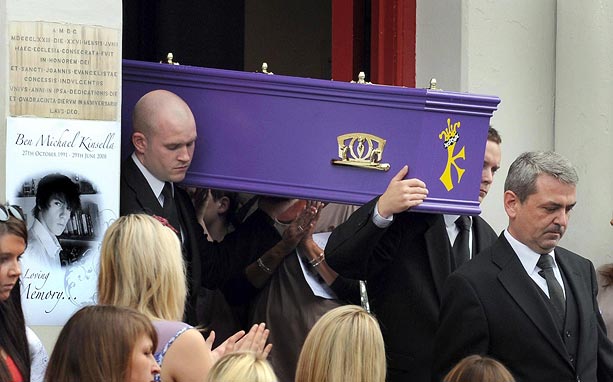
Ben loved nothing more than to make people laugh, he was a fun-loving, happy-go-lucky boy with a heart of gold and would do anything for anyone. A testimony of this was his funeral that was attended by so many friends who filled the church and pavements outside.
Ben loved art and wanted to be a graphic designer, he loved his family, cooking, football, music and girls. The people who murdered him knew nothing about our Ben, not a hair on his head, a bone in his body, not anything about our wonderful son. They had never met him before or spoken to him – they just cruelly took his life away with knives for no apparent reason.
We had brought Ben up to always walk away from trouble. This sadly cost him his life. He walked away to get safely home and they took advantage of that – he was one boy on his own. It seems unfair their intent was to stab someone that night.
We were a big, happy, loving family(we are one down, one missing). We are hard-working and just wanted the best for all our children in life. There are now just three of us at home. We have had to move house because it broke our hearts to not see Ben in his bedroom curled up sleeping and safe in his bed. We so miss Ben’s love and laughter and most of all the boy thing in our family. Ben was our precious son that we cherished and were so immensely proud of, and by the way we had brought him up.
He had values and respected everyone he met. We as a family will never know the man he would have become, the wife he would have met and the children he would have had. This has all now been taken away from siblings, his grandmothers, aunts, uncles, cousins, friends and us.
No parent or sibling should ever have to go through or see what we have seen with our son. He died in front of us, we then had to visit him in a morgue, the undertakers and finally to bury him. We can now only visit Ben at a cemetery, our beautiful son who so loved life.
We cry every day for the loss of Ben, we do not sleep like we did before. Nearly a year on our nights are still filled with nightmares, of our son’s last moments and what he went through that fatal night. Our lives will never be the same – we have all been so deeply affected. We as a family will never get over the loss of our Ben. We are just trying to get through it. Our family now face a lifetime of feeling this way.
Nothing we can say or do will ever bring Ben back. All we can hope and pray for is that justice will prevail, maybe then we can find some form of closure to this awful event that has devastated our family’s lives.”
WHEN YOU ARE OLD AND GREY – if not full of sleep, there will be times when images from youthful days reappear in the mind’s eye. When I was young, there was no internet, little television and, in terms of images, newspapers were King. Mostly, it is the faces of notorious criminals that I remember. Gunther Podola, long forgotten now, but at the time a notorious cop-killer; Harry Roberts, sneering out at us from the newsprint, while he evaded capture for so long; the baleful peroxide glare of Myra Hindley; the troubled but defiant ‘Jack The Lad’ face of James Hanratty. The one face, and figure, that entranced me most, however was the earliest – the sharp, brassy, night club features of Ruth Ellis.
Ellis chose her path in adult life based on her natural vivacity and an appreciation that she could earn more from nude modelling and ‘clipping’ punters in a night club than she could by working in the typing pool or in a factory. As a child her home life had been chaotic, so she had developed the necessary survival skills to make her own way in the austere world of post-war Britain.
Ellis became manager of her own club, The Little Club, and it seems that the clientele included a number of ‘Tim-Nice-But-Dim’ gentlemen, products of minor public schools, but with aspirations way in excess of their capabilities. One such was David Blakely although, to be fair, his wealthy background meant he had attended (and failed at) one of the country’s top schools, Shrewsbury. His passion was racing cars, and although he would never come close to emulating the feats of his friend, Mike Hawthorne, his death could be viewed as equally tragic as that of Hawthorne, four years later.
Ellis and Blakely became lovers, if not partners, but neither was faithful to the other. Blakely was physically violent; Ellis was violently jealous. On 10th April, 1955 – Easter Sunday – Ellis waylaid Blakely as he left a Hampstead pub, the Magdala. She shot him dead with a .38 Smith and Wesson revolver. Despite the day, there was to be no resurrection.
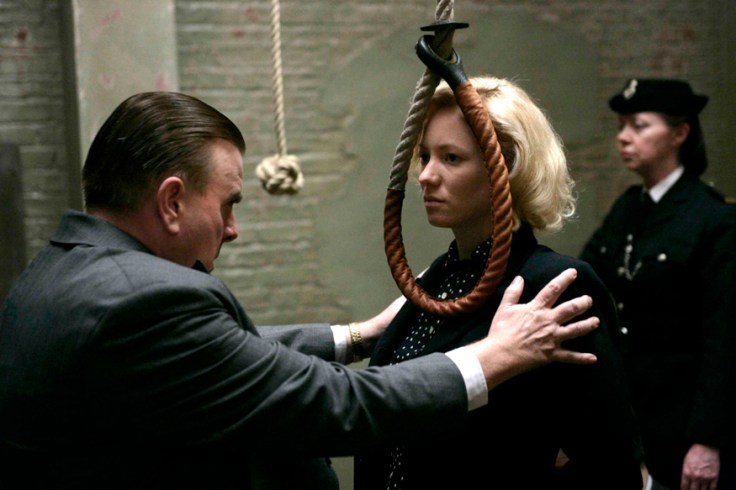
Ellis was arrested at the scene and made no attempt to deny her crime. The trial was something of a formality, and in 1955, the death sentence was mandatory for premeditated murder. Despite various attempts to have the sentence revoked, Ruth Ellis was hanged on Wednesday 13th July, 1955. The hangman was Albert Pierrepoint. (below, a scene from the film Pierrepoint: The Last Hangman, with Timothy Spall and Mary Stockley)
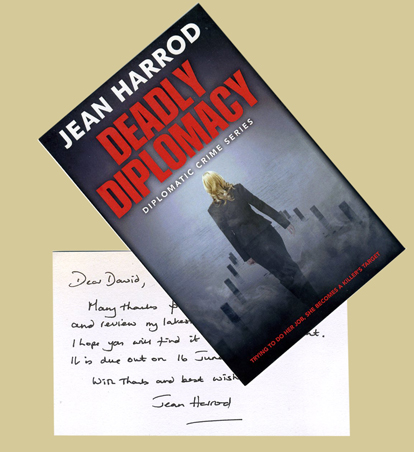
In a former life Jean Harrod was a British diplomat who served all over the world. One hopes that she gave the lie to Sir Henry Wotton’s famous assertion that a diplomat was “an honest gentleman sent to lie abroad for the good of his country.” Now she has retired from that demanding role, and is free to give full reign to her vivid imagination.
She has settled in Yorkshire, and in addition to writing plays, she has embarked on a series of crime thrillers featuring British career diplomat Jess Turner. The second of these is Deadly Deceit, and opens with Turner being sent to the seemingly exotic British Overseas Territory of the Turks and Caicos Islands, TCI for short.
She is on a troubleshooting mission, as the Governor has been involved in a mysterious near-fatal car accident, and someone with the proverbial ‘safe pair of hands’ is required to step into the breach.
Crime fiction has a much used trope – that of ‘The Odd Couple’. Nothing to do with Neil Simon’s immortal characters, of course, but think of Holmes and Watson, Wolfe and Goodwin, Dalziel and Pascoe, Morse and Lewis. They tolerate, irritate, admire and, occasionally, infuriate each other, but the device allows writers to have great fun with the law of opposites. Readers were introduced to Jess Turner’s ‘other half’ in the first book in the series, Deadly Diplomacy. He is Queensland cop DI Tom Sangster. As you might expect, in order to be a foil for the urbane and sleek Turner, he has to be a bit of a rough diamond. Sangster is no fool, however, as his crime clear-up rate testifies.
Given the fact that Turner and Sangster live worlds apart, Jean Harrod will have to continue coming up with convincing reasons for them to meet up. In this case, it is TCI’s proximity to the stricken island republic of Haiti. Boatloads of Haitian migrants are arriving on TCI, and the patience and compassion of the locals has been wearing pretty thin. Sangster’s homeland has its own problems with ‘illegals’ of course, and he has been attending a conference in Miami – a short flight from TCI – with US Immigration officials.
Turner and Sangster uncover a nasty racket in people smuggling, which involves not just shady villains down at the waterfront, but some very eminent people. Although there are a couple of grisly killings, and a very convincing description of a tropical hurricane, I would class this novel as a romantic thriller. It’s none the worse for that, however, and it makes a refreshing change to have central characters who are neither near-alcoholics, black-humoured nor self destructive. I have not had the pleasure of meeting the author, but I suspect that there is a little something autobiographical about Jess Turner. Deadly Deceit is out now. Buy now on Amazon.
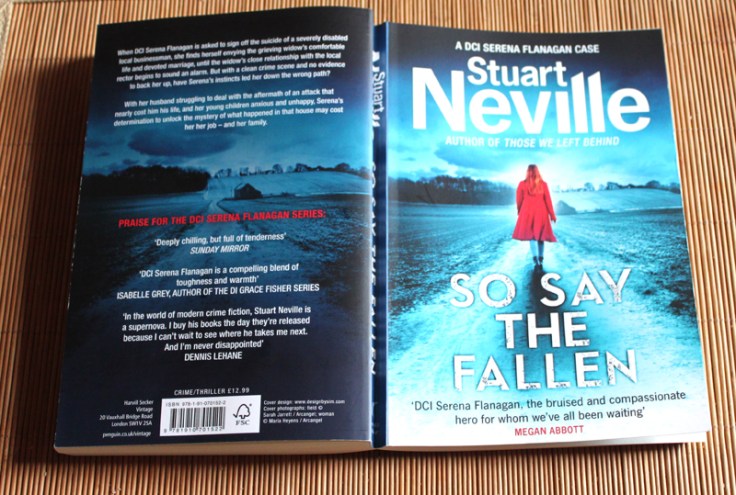
 Stuart Neville (left) returns with another hard-bitten and edgy tale of life and crimes in Northern Ireland. Set in a fictional village on the edge of Belfast, we are reunited with DCI Serena Flanagan, who first appeared in Those We Left Behind. Like much of life in Ulster, fictional and real, religion and the stresses and strains it places on secular life is never far from the surface. The sacred influence in this case is provided by the Reverend Peter McKay. The clergyman is a widower, but we find that he has been taking his parochial duties above and beyond what is normally expected. The recipient of his pastoral care is Roberta, the attractive wife of Henry Garrick.
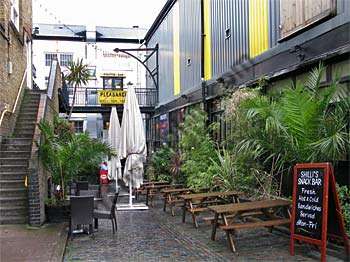 As they say, in America, “School’s Out!” On the evening of Saturday 28th June 2008, school was pretty much out for a group of teenage London boys. Their GCSE exams were finally over and, despite nor being legally old enough to drink, they were having a night out to celebrate. They went to Shillibeers (left), a popular bar and brasserie in Holloway. Among the group was Ben Kinsella, a 16 year-old pupil at Holloway School.


 Ellis chose her path in adult life based on her natural vivacity and an appreciation that she could earn more from nude modelling and ‘clipping’ punters in a night club than she could by working in the typing pool or in a factory. As a child her home life had been chaotic, so she had developed the necessary survival skills to make her own way in the austere world of post-war Britain.
 Ellis and Blakely became lovers, if not partners, but neither was faithful to the other. Blakely was physically violent; Ellis was violently jealous. On 10th April, 1955 – Easter Sunday – Ellis waylaid Blakely as he left a Hampstead pub, the Magdala. She shot him dead with a .38 Smith and Wesson revolver. Despite the day, there was to be no resurrection.