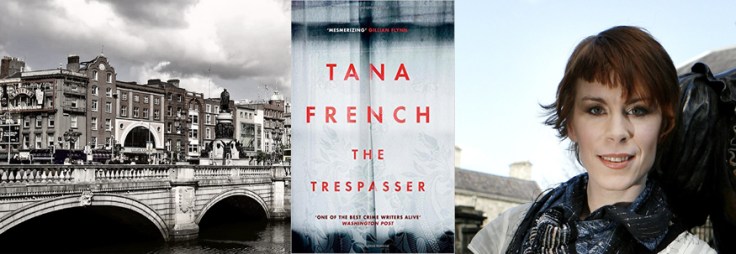
AUTHOR TANA FRENCH beams us down into an endlessly wet, chill and foggy Dublin. The old working class district of Stoneybatter has become, so we are told elsewhere, the epitome of ‘cool’ with all the trappings which that entails – craft ales, artisan bakeries and community spaces. There’s little of that on display when DI Antoinette Conway and her partner Steve Moran are called to a terrace house to view the body of a dead woman. Aislinn Murray is on the floor by her fake rustic fireplace with severe head injuries. Conway says;
“Her face is covered by blond hair, straightened and sprayed so ferociously that even murder hasn’t managed to mess it up. She looks like Dead Barbie.”
Two things puzzle Conway and Moran. Firstly, who was the man who made the ‘phone call alerting the authorities to Aislinn’s demise, and why did he call direct to Stoneybatter police station, rather than using the emergency number? Secondly who was the dead woman’s intended dinner guest that evening? The table was laid for two, with candles lit and a bottle of decent red wine quietly breathing.
As Conway puts her team of ‘D’s’ – murder detectives – together, we learn that she has a prickly relationship with her fellow officers. Yes, she is a woman and, yes, the men’s laddish behaviour – nothing new to readers of novels featuring women detectives – is nastier than simple banter, but the dystopian atmosphere in the squad room is more complex. To be blunt, Conway is something of a pain in the arse at times. She has more chips on her shoulder than a bag of McCains (other brands are available), and the endless baiting and crass pranks from her male colleagues simply stoke the fires of bitterness. Having said that, she is an absolutely pin bright and razor sharp copper, but her fragile equanimity is not helped when her boss forces her to work alongside DI Breslin, a man she loathes. Breslin is glib, sharp-suited and much admired by the other D’s. In short, he is everything that Conway is not.
The consensus among the Gardaí is that the killer of Aislinn Murray is her latest boyfriend, an apparently mild-mannered bookshop owner called Rory Fallon, and he was the intended beneficiary of the candle-lit dinner in the Stoneybatter cottage. From the moment Conway clapped eyes on the Aislinn’s ruined face, however, she is tantalised by a feeling that she has seen the girl before. When that memory clicks into place, the investigation takes a different turn entirely, and it turns over a large rock which has many nasty creatures scuttling around underneath it.
To say that The Trespasser is a police procedural is, strictly speaking, accurate. But the description does the book justice in the same way that simply describing Luciano Pavarotti as a singer fails to illuminate the central truth. Tana French knows her Dublin, and she knows her An Garda Síochána, but those dabs of authenticity are just that – mere paint spots on a subtle, complex and magnificent canvas.
I suppose I must have drawn breath during the five or six minutes it took to read the gripping climax of this book, but I don’t remember doing so. The final pages contain no action to speak of, just four people sitting in an office, but the psychological intensity is quite terrifying. The quality of the writing is such that French does not allow Conway to luxuriate in her victory, such as it is. There is just a terrible sense of pity, of shattered lives, and human frailty. Conway walks away from the police station:
“The cobblestones feel wrong under my feet, thin skins of stone over bottomless fog. The squad I’ve spent the last two years hating, the sniggering fucktards backstabbing the solo warrior while she fought her doomed battle; that’s gone, peeled away like a smeared film that was stuck down hard over the real thing.”
This is a brilliant, savage and uncomfortable read. Don’t pick it up unless you want your emotions scoured and your sense of empathy and compassion put through the mangle.
Tana French has her own website, and you can follow the link to check buying choices for The Trespasser, which is available now.

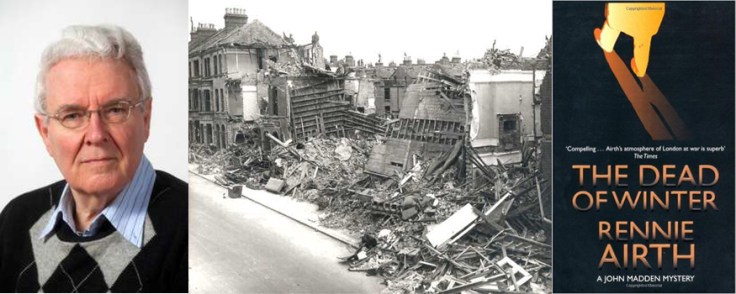
 We are in the weeks leading up to Christmas 1944, deep in what would prove to be the last winter of a war which, thanks to the Luftwaffe, had brought death and destruction to the doorsteps of ordinary people in towns and cities up and down the country. German aircraft no longer drone over the streets of London; instead, the Dorniers and Heinkels have been replaced by an even more demoralising menace – the seemingly random strikes by V1 and V2 rockets. Despite the fact that the rockets need no visible target to aim at, the ubiquitous blackout is still in force. An Air Raid Precaution Warden, whose job has become as redundant as that of those manning anti-aircraft batteries, makes a chilling discovery. He stumbles – literally – on the body of a young woman. Her neck has been broken by someone clearly well-versed in killing, and the only clue is a number of spent matches lying by the body.
 There is more than a touch of The Golden Age about this novel, but it is much more than a pastiche. Although the killing of Rosa Nowak is eventually solved, with a regulation dramatic climax in a snow-bound country house, Rennie Airth allows us to breathe, smell and taste the air of an England almost – but not quite – beaten down by the privations of war. Many of the characters have menfolk away at the war, including Madden himself and his wife Helen. Their son is in the Royal Navy, on the rough winter seas escorting convoys. The contrast between life in the city and in the country is etched deep. In the city, restaurant meals are frequently inedible, the black market thrives unchecked due to depleted police manpower, and even the newsprint bearing cheering propaganda from the government is subject to rationing. Travelling anywhere, unless you are fiddling your petrol coupons, is arduous and unpleasant.

 The Book of Mirrors by E O Chirovici looks to be Penguin’s big promotion for the early autumn. There’s an excellent cover with peep-through perforations, and the promo pack includes a very tasty spiral bound notepad/sketchbook. The author, Eugen Ovidu Chirovici, was born in Transylvania, which all fans of the lethal Count Dracula will know is in modern-day Romania. The story? It’s one part literary novel, in that Chirovici examines the nature of memory and recollection; a second part aims to be stylish, and the author openly admires Raymond Chandler and Mario Vargas Llosa for their flawless technique. The third part, perhaps most importantly, is that we have a cracking CriFi story about a cold-case crime and a lost manuscript which contains clues to the identity of a killer.
 The Vanishing Year by Kate Moretti certainly wins title of the month award, as those of us in the UK cling on desperately to every vestige of summer, while preparing ourselves stoically for yet another northern winter of rain, diminishing days, and media hysteria over football results. Moretti’s novel focuses on Zoe Whittaker, a woman whose life has metamorphosed from desperation and danger into one of luxury, love and positive vibes. But the past is never very far away, and when Zoe’s life comes under threat from those she thought had been cast aside, just as a dream dies at the dawn of day, she must make a decision which will either bring salvation – or damnation.
 Get Lucky by Paul Eagles is one of those confessional ‘Jack The Lad’ stories about someone who has lived his life at the sharp end. It is, I suppose, True Crime, but aficionados of the genre will know that they will need several pinches of salt in order to separate the fact from the fantasy. Basically, Eagles tells his life story thus far. It is as far removed from anything you and I have experienced as is Tennyson from E J Thribb. But, I suppose, there lies the charm. We are invited to gasp and gawp at the goings on, charmed by the fact that we could never, ever have got away with things in the way that Mr Eagles describes.
 The Child Garden by Catriona McPherson tells the story of one of those ‘special’ schools set up in the 1970s, when people still believed that Hippy peace and love was a viable and cogent philosophy. Conventional schools were simply prisons for young minds, Bob Dylan reminded us of “the mongrel dogs that teach”, and, just for a nanosecond, in someone’s mind, there seemed to be a way forward. The school in question was called – clearly with the irony meter turned off – ‘Eden’. Inevitably, it folded, with its alumni and teaching staff scattered to the four winds. But a sinister suicide during the school’s heyday returns to haunt former pupils, and they learn that the dead have ingenious ways of speaking to the living.


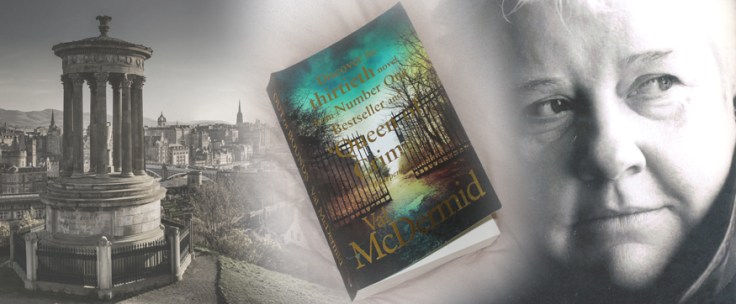 There’s an old expression that describes someone as “having a way with words’. There can’t be any contemporary writer who has a better “way with words” than Val McDermid. There are no dramatic flourishes, no histrionics and no scatter-gun blasts of redundant adjectives. What we have is simplicity, purity, and a command of language that is almost minimalist. She describes DCI Karen Pirie, thus:
 Some historical crime fiction takes us back to times way, way before our own memories could have any validity. Then there are stories set in periods that many of us could reasonably have experienced at first hand. With the former, it is simply the author’s research versus the depth – or lack of – our own historical knowledge. The latter is a much more tricky enterprise, as someone who sets their book in the 1960s, for example, can be exposed to a more searching light – that of readers who actually lived through the years in question.
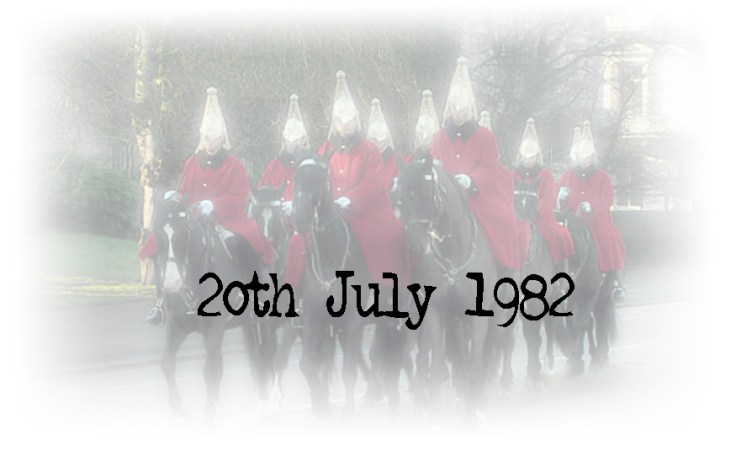 There is, perhaps, a legitimate debate to be had over what to call killings which are carried out in the name of a political cause. No-one in their right mind would label the millions of soldiers who died in the two world wars of the 20th century as murder victims. The wearing of a uniform, and the acceptance of the King’s shilling has always legitimised the act of pulling the trigger, firing the shell, or dropping the bomb.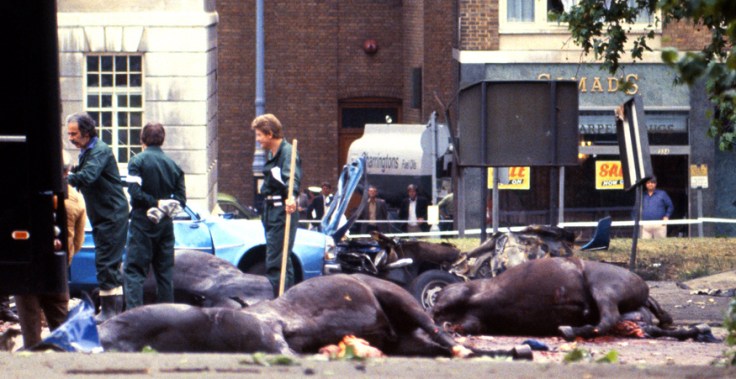

 Just a couple of hours later, as emergency services struggled to deal with the mayhem in South Carriage Drive, the terrorists struck again. It seems barely credible that in another part of the city, life was going on as normal. Remember, though, that these were the days before mobile ‘phones and social media, the days when news was only transmitted in print, by word of mouth and on radio and television. The regimental band of The Royal Green Jackets was entertaining a small crowd clustered round the bandstand in Regent’s Park. They were playing distinctly un-martial music from the musical ‘Oliver!’ when, at 12.55 pm, a massive bomb went off beneath the bandstand. The blast was so powerful that one of the bodies was thrown onto an iron fence thirty yards away, and seven bandsmen were killed outright. They were: Warrant Officer Graham Barker, Serjeant Robert “Doc” Livingstone, Corporal Johnny McKnight, Bandsman John Heritage, Bandsman George Mesure, Bandsman Keith “Cozy” Powell, and Bandsman Larry Smith.
 Downey (right) may or may not have been implicated in the Hyde Park murders. Only he knows for certain. At least he had the decency to cancel a party planned in his honour when he was released. He said:


