Search

fullybooked2017

Tag

murder

A KILLING IN NOVEMBER . . . Between the covers

akin spine

Somehow, I missed this first time round, but reviewed books two and three in this excellent series but Simon Mason. In Ryan Wilkins and Ray Wilkins we met one a rather unusual cop partnership. Ryan is something of a chav, scruffily dressed and with a huge chip on his shoulder. He is, however, very astute. Equally clever, but much more an establishment man, despite his ethnic origin, is black officer Ray. He is a family man, suave and well spoken, and clearly destined for higher things. Their beat is Oxford.

The contrast between the Oxford educated Ray and Ryan, graduate of a seedy South Oxford caravan site (trailer park for American readers) couldn’t be greater. Simon Mason chooses a superb location for their first professional engagement. Barnabus College is where a young woman has been found strangled in the rooms of the college Provost. Ray is all diplomacy and respect, while Ryan, much the more observant, needles the well-to-do members of the college by refusing to grovel at the altar of their social and academic status. It is eventually confirmed that the dead is Syrian, from a wealth family, but due to the political situation, has been forced to earn a living as a porn model. Working as a domestic servant in the college is Ameena Najib, also from Syria, but from a very different background. She is a devout and militant Muslim, and when she is found dead, also strangled, the mystery deepens.

In the background to this murder investigation is civil unrest in the Oxford district of Blackbird Leys. A child has died after being hit by a police car, and protests are violent and bloody. The Leys is a real place, and is a superb example of urban planners concocting idyllic rural names for dire housing estates. I was at Teacher Training College nearby and, trust me, if it was announced the Leys was where you were sent for Teaching Practice, you were not happy.

Simon Mason lets us know, in one of the most scary scenes in the book, why Ryan is so disturbed. Ryan’s wife Michelle died of a drug overdose, leaving him to bring up their little son, also called Ryan. When Ryan senior fails to collect the lad from nursery, the staff phoned one of the contact numbers – that of the little boy’s grandparents. Bad call. They are a disaster. Grandma is, literally, bruised and battered by her feral husband, and when Ryan and Ray break into the shabby caravan on the grim site in South Oxford to rescue the child, all hell breaks loose.

Ryan’s propensity for violence, his unwillingness to ‘play the game’, and his chaotic personal life make it inevitable that he is dismissed from the force. However, his sharp insight into what makes people tick combined with his intuition, enable him to solve the mystery. Ray, despite his initial horror at Ryan’s manner and attitude, keeps the phone line open with his former colleague, and the Barnabus killer is brought to justice.

This is a wonderful read, and I finished it in just a few sessions. My only quibble is that Ryan Wilkins is such an outrageously out-of-kilter character, dressed in his trackies, trainers and baseball cap (back to front, naturally) that it is hard to imagine him making senior rank in the modern police force, which is notorious for signing up to all the latest DEI fads, and renowned for its many acts that seem woker than woke. Simon Mason has created a brilliant – and unique – member of the Cri-Fi Detective Inspector union, and any crime enthusiast who doesn’t enjoy this needs to collect their hat and make for the nearest exit. A Killing In November is published by Riverrun, and is available now.

Screen Shot 2024-11-14 at 15.13.52

VICTIM . . . Between the covers

victi,087 copy

Former Oslo police officer Alexander Blix is trying to put his life back together after serving a spell in prison for killing the man who murdered his daughter Iselin. There was eventually a retrial, and he was acquitted and released. He is doing nothing in particular, while he waits for the full compensation package to come through from the government. He knows he can no longer work as a policeman, but then his world is turned upside down. Back in the day, his most significant failed investigation was the disappearance of Elisabeth Eie, a young mother. The whereabouts of her body, if indeed she was killed – and the identity of the person who abducted her –  remain a mystery. Then, out of the blue, he is contacted by a man who claims to be Elisabeth’s killer. Almost simultaneously, a party of school children out on a forest nature walk discover a body. It is that of Elisabeth.

Blix has few friends, but one is investigative journalist Emma Ramm, with whom he has co-operated on previous cases. She, too, is no longer working, but living on the proceeds of a true crime book she wrote. She is approached by a young woman called Carmen who asks for her help. Carmen’s stepfather, Oliver Krogh is in police custody, suspected of the murder of a young woman – Maria Normann – who worked in his fishing and hunting store, which was destroyed in a mysterious blaze. The only sign of Maria, however, was traces of her blood on the door of one of Krogh’s gun cabinets. Carmen is convinced that Krogh, the only father she has ever known, is incapable of murder.

Blix’s relationship with his former colleagues is, at best fraught, and he is kept at arm’s length as the disappearance of Elisabeth Eie becomes a murder case. The killer seems to be fixated with Blix, however, and has invaded his personal space. here are many brilliant moments in this novel, but one stands out. In order to keep himself vaguely sane, Blix makes fishing flies. It is a process that requires delicacy of touch and a great deal of patience. One particular fly has been very testing, and he has left it unfinished while summoning up the mental energy to have another go.

“He stepped aside and moved over to the bench. A cold shiver ran through him. The fly was finished.

It is obvious that Blix has a stalker, and one who has the keys to his apartment.

The past weighs heavy on Blix. His mother had Munchausen’s Syndrome by Proxy, and kept him constantly unwell by lacing his food with debilitating drugs. After she died of cancer he walked away from his neglectful father and went to live with his grandparents. His father is still alive, but in the later stages of dementia in a nursing home. Eventually, we learn who Blix’s stalker is, and that he had a similarly traumatic upbringing.

Emma finds out how and why Maria Normann died, and there is a dramatic face-off between Brix and his tormentor. Co-authors Thomas Enger and Jørn Lier Horst have captured the ambience of a bleakly autumnal Oslo, and have written a dramatic and atmospheric thriller, with two investigators who are perfect foils for each other. The novel is translated by Megan Turney, published by Orenda Books and is available now.

Screen Shot 2024-10-25 at 20.16.03

THE BURNING STONES . . . Between the covers

tbs spine083 copy

Anni Korpinen is sales director at a firm called Steam Devils. They make stoves for saunas and are based in the little Finnish town of Phutijärvi. She is 53 years old, and married to a waster called Santeri. He is obsessed with historic F1 motor racing, and spends most of his time replaying classic races via scratched VHS tapes. He also buys and sells F1 memorabilia, such as socks reputedly worn by Mika Haakinen. Sadly, he never turns a profit.

When the new CEO of Steam Devils, Ilmo Räty, is found burned to a cinder in his own sauna, the hunt is on for his killer. When the firm’s founder, Erkki Russula, calls a meeting and states that he sees Anni as the obvious successor to Räty, she becomes the person with most to gain from his death. Key personnel at Steam Devils include:
Susanna Luoto – Finance Manager
Mirka Paarmajarvi – Logistics Manager
Jarkko Mutikallio – CEO’s PA
Porkka – Technical Director
Kaarlo – Senior Advisor

Of course, the sauna is completely central to Finnish culture, and part of the accoutrements are little squares of towel cloth which separate the bum cheeks from the wooden bench, and are essential both for hygiene and preventing the skin from becoming stuck to the wood. They are known, at least in English, as ‘bumlets’. When one of the bumlets from Anni’s home sauna, conveniently embroidered with her name, is found in the vicinity of Ilmo Räty’s sauna, she knows she is in big trouble. Reijo Kiimalainen is the community’s senior policeman, and he harbours a grudge against the Korpinen family. Many years ago, both he and Anni’s late father had both been stalking the same elk, the largest in the local forest. The hunting season started at 6.00 am, and at precisely one minute past, Anni’s father shot the beast. Ever since then, Kiimalainen has been convinced that skulduggery had taken place.

Once Anni realises that she is prime suspect in the Rati murder case, she does what all wrongly accused prime suspects do (at least in crime novels) – she turns detective. Although she realises that she is not Sherlock Holmes, but a stove retailer, she is intelligent and resourceful. Her investigations take her to an abandon resort with a sauna the size of a sports stadium, and here she witnesses another sauna related death. This time the victim – the engineer Porkka – is stabbed in the head with the sharpened metal handle of a ladle used to sprinkle water on the hot stones which are an integral part of Finnish saunas.

Anni’s task is made more complicating by the strange behaviour of Kahavuori, a holiday complex owner, to whom Anni had been hoping to sell 64 sauna stoves. When he hears of the death of Raty, he refuses to close the deal. Instead, he adopts what seems to be a very unhealthy obsession with finding the killer. The problem is that Kahavuori is an ardent fan of True Crime documentaries, and he has a vivid imagination. When Anni catches him snooping in her sauna, she clouts him with a lump of wood. When he recovers consciousness, he outlines his theory, and Anni wonders if the crack on the head hasn’t further addled his brain

There is a genuinely touching backstory behind the hunt for the murderer. They are both in their fifties now, but three decades earlier, Anni and policeman Janne were engaged and in love. It was Anni who handed back the ring, but now, as Janne reveals that Anni’s husband Santeri is not the clueless bungler she thinks he is, events take an unexpected turn.

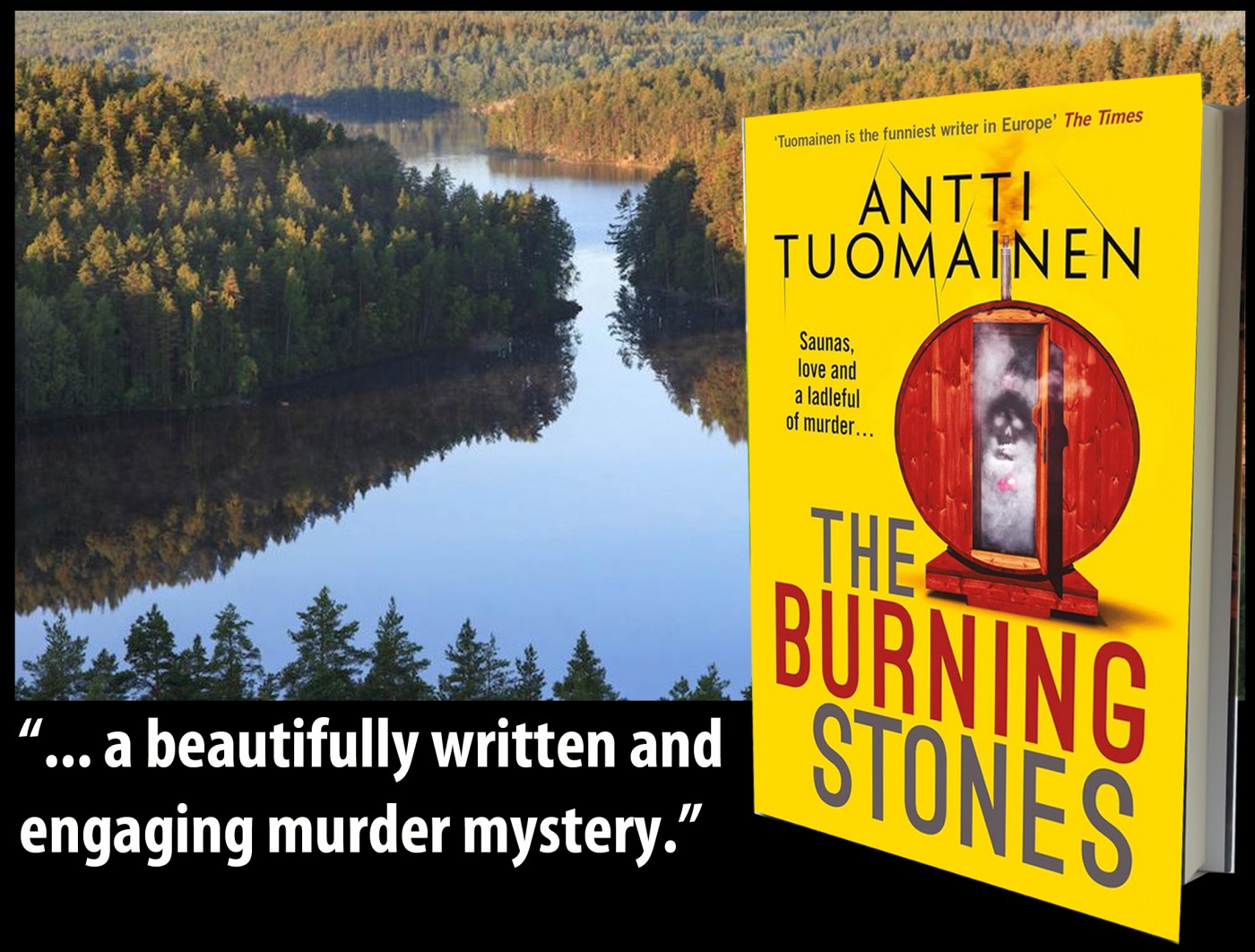
On the cover of the book is a quote from The Times: “Tuomainen is the funniest writer in Europe.” He may well be, but humour is a complex business and takes many forms. I don’t think you will be belly laughing as you read The Burning Stones, and I do wonder how well humour in one language survives translation into another, but I did enjoy the sheer freakery-geekery of Santeria and his idiotic obsession with old motor races. Is he mad? Probably not in a medical sense, but I did wonder why Anni married him in the first place. That aside, The Burning Stones is a beautifully written and engaging murder mystery. It is translated by David Hackston, published by Orenda Books and available now. You can find out more about Antti Tuomainen on social media – he is @antti_tuomainen on X, and on Facebook facebook.com/AnttiTuomainen

Screen Shot 2024-09-29 at 19.28.06

HOLMES AND MORIARTY . . . Between the covers

handm spine079 copy

No fictional character has been so imitated, transposed to another century, Steampunked, turned into an American, or subject to pastiche than Sherlock Holmes. In my late teens I became aware of a series of stories by Adrian Conan Doyle (the author’s youngest son) and I thought they were rather good. Back then, I was completely unaware that the Sherlock Holmes ‘industry’ was running even while new canonical stories were still being published in the 1890s. Few of them survive inspection, and I have to say I am a Holmes purist. I watched one episode of Benedict Cumberbatch’s ‘Sherlock’, and then it was dead to me. As for Robert Downey Jr, don’t (as they say)”get me started.” For me, the film/TV apotheosis was Jeremy Brett, but I have a warm place in my heart for the 1950s radio versions starring Carleton Hobbs and Norman Shelley.

How, then, how does this latest manifestation of The Great Man hold up? The narrative has a pleasing symmetry. The good Doctor is, as ever, the storyteller, but as the book title suggests there is another element. Alternate chapters are seen through the eyes of a man called Moran who is, if you like, Moriarty’s Watson. Gareth Rubin’s Watson is pretty much the standard loyal friend, stalwart and brave, if slightly slow on the uptake. Moran’s voice is suitably different, peppered with criminal slang and much more racy.

The case that draws Holmes into action is rather like The Red Headed League, in that a seemingly odd but ostensibly harmless occurrence (a red haired man being employed to copy out pages of an encyclopaedia) is actually cover for something far more sinister. In this case, a young actor has been hired to play Richard III in a touring production. He comes to Holmes because he is convinced that the small audiences attending each production are actually the same people each night, but disguised differently each time.

Meanwhile, Moriarty has become involved in a turf war involving rival gangsters, and there is an impressive body count, mostly due to the use of a terrifying new invention, the Maxim Gun. There is so much going on, in terms of plot strands, that I would be here all week trying to explain but, cutting to the chase, our two mortal enemies are drawn together after a formal opening of an exhibition at The British Museum goes spectacularly wrong when two principal guests are killed by a biblical plague of peucetia viridans. Google it or, if you are an arachnophobe, best give it a miss.

Long story short, three of the men who led the archaeological dig that produced the exhibits for the aborted exhibition at the BM are now dead, killed in some sort of international conspiracy. It is worth reminding readers that as the 19thC rolled into the 20thC, the pot that eventually boiled over in 1914 was already simmering. Serbian nationalism, German territorial ambitions, the ailing empires of the Ottomans and Austria Hungary, and the gathering crisis in Russia all made for a toxic mix. This novel is not what I would call serious historical fiction. It is more of a melodramatic – and very entertaining – romp, and none the worse for that, but Gareth Rubin makes us aware of the real-life dangerous times inhabited by his imaginary characters.

Eventually Holmes, Watson, Moriarty and Moran head for Switzerland as uneasy allies, for it is in these mountains that the peril lurks, the conspiracy of powerful men that threatens to change the face of Europe. They fetch up in Grenden, a strange village in the shadow of the Jungfrau and it is here, in a remarkably palatial hotel given the location, they are sure they have come to the place from which the plot will be launched. By this stage the novel has taken a distinctly Indiana Jones turn, with secret passages,  and deadly traps (again involving spiders).

This is great fun, with all the erudition one would expect from The Great Consulting Detective and with a rip-roaring adventure thrown in for good measure. It is published by Simon & Schuster, and will be available at the end of September.

Screen Shot 2024-09-05 at 17.54.58

A VIOLENT HEART . . . Between the covers

AVH spine078 copy

David Fennell introduced us to London copper DI Grace Archer in The Art of Death (2021) Now, she returns  in a complex new case which involves cold case crime and the murders of sex workers, decades apart. The investigation becomes very here-and-now when the body of a young Croatian woman called Elena Zoric is found. She died from a puncture wound to her chest, but whatever killed her, it wasn’t a bullet.

The best police procedurals always give us a fly-on-the-wall account of the personalities and tensions that exist inside a police station. Because her previous superior has been sideline and has to care for her husband, struck down with Long Covid, Grace Archer has a new boss, Chief Inspector Les Fletcher, He is described as a “gammon-faced Yorkshireman” with more than a trace of the toxic masculinity common to that breed. Archer’s wing man is Belfast born DS Harry Quinn – reliable and intuitive. Less helpful is DI Lee Parry, nephew of the Metropolitan Police Commissioner, but about as much use as a chocolate fireguard. He is lazy, venal and prepared to cut corners for an easy life.

I have often observed that Detective Inspectors in British crime novels are, perhaps, overused. There are very sound reasons for this, however. DIs are perfectly placed to be both at the centre of investigations bureaucratically, while able to be out on the street, at the crime scene, and in the faces of the bad guys. Much more rare is the novel where a humble DC is the locus of activity. I can think of only one series, and that was written by Alison Bruce, and featured Cambridge Detective Constable Gary Goodhew. My review of The Silence is here. That being said DI Grace Archer is a welcome guest at a party held in a very crowded room.

We have here something of a whirling dervish of a plot, which spins this way and that and incorporates apparently disconnected events. We have a bizarre (but sadly all-too-credible) social ‘influencer’ called Calvin ‘Dixy’ Dixon whose latest Tik-Tok sensation shows him talking to the dessicated corpse of a woman sitting in a wheelchair in an abandoned house. There is also something that might become a ‘love interest’ angle, when Liam, a builder friend of Harry Quinn, is booked to renovate Archer’s house. He also happens to be extremely handsome, and brings with him freshly baked croissants to share before he starts work each day.

Then there is Mallory Jones, the guiding light in a successful podcast called Mallory Jones Investigates. She alternately helps and hinders Archer’s search for a man whose weapon of choice appears to be some kind of bolt gun. Finally, in far-off Berwick on Tweed, we have the Mercer family. Barry and Isla, and Isla’s brother Simon. Barry and Isla are both ex-coppers, but their teenage daughter Lily has fallen in with a bad crowd, and makes fistfuls of cash by appearing in amateur porn videos with her bestie, Gemma.

Archer is concerned to discover that, back in the day, her new boss Les Fletcher was, as a young PC, involved in the older murder investigations, and her informants tell her that he was rude and unsympathetic, strongly showing his prejudice that as ‘working girls’, getting assaulted by clients just went with the job.

As you might expect, David Fennell seizes the frayed ends of these plot strands and weaves them together to make for a highly satisfying conclusion. There is a savage and sanguinary denouement in, most appropriately, a disused abattoir. Not everyone survives the carnage, but as the emergency vehicles trundle off into the night, we have catharsis. Grace Archer certainly has her own demons to torment her, but she is a courageous and resourceful copper with a fierce determination to pursue the truth. A Violent Heart is published by Zaffre and is available now.

THE BABY-FACED BUTCHER . . . Death in Leamington (2)

BFB header

TzeYung TongSO FAR: In the early hours of Monday 2nd February 1976, the butchered body of Chinese nurse Tze Yung Tong (left) was found in her room in a nurses’ hostel at 83 Redford Road, Leamington Spa. Other young women had heard noises in the night, but had been too terrified to venture beyond their locked doors. We can talk about ships passing in the night, in the sense of two people meeting once, but never again. Tze Yung Tong was to meet her killer just the one fatal time.

Gerald Michael Reilly was born in Birmingham in 1957, but he and his family moved to Leamington. After primary school, he went to Dormer School, which then had its main building on Myton Road. He was described as quiet and pleasant, but not one of life’s high achievers. In 1974 he had a brief spell in the Merchant Navy before returning to Leamington to live with his parents at 49 Plymouth Place and work as a builders’ labourer. He was engaged to be married to Julie, a young woman from the north of England he had met during his Merchant Navy days.

On the evening of 1st February 1976, he was observing the moral code of the time by sleeping downstairs, while Julie was chastely abed upstairs. At some point, he decided he needed sex. It was never going to happen at home, so he let himself out of the house, and walked the 200 yards or so along snow-covered pavements to the nurses’ hostel on Redford Road. There, he shinned up a drain-pipe, and padded along the corridors hoping for an unlocked door. He found one. It was Tze Yung Tong’s room.

This is where the story goes into “you couldn’t make it up” territory. It was estimated that Reilly spent 90 minutes going about his dreadful work on the young nurse. Then, still clutching the sheath knife with which he had disembowelled Tze Yung Tong, he retraced his steps to Plymouth Place and went back to sleep.Just twelve days later, with hundreds of police banging their heads against a brick wall, Gerald and Julie were married with all the traditional trappings at St Peter’s church on Dormer Place. In those days honeymoons were rather prosaic by modern standards, so the star-crossed lovers set off for the West Country. Julie had her “going away” outfit, but Gerald brought with him something more significant – the knife with which he gutted Tze Yung Tong. In a bizarre attempt at concealment, he hid the blade in a toilet cistern at a Bath hotel.

Below, Gerald and Julie on their wedding day

wedding

By this time, whatever passed for logical thought in Reilly’s mind had gone AWOL. Upon returning to Leamington, and hearing about the intense fingerprinting initiative, he decided that the game was up and, with his uncle for company, turned himself in.  The irony is that the police, in desperation, had announced that there was one set of prints they had not been able to eliminate. Assuming they were his, Reilly offered his wrists for the handcuffs. The prints were not his.

Screen Shot 2024-09-01 at 12.54.01Despite his palpable guilt, Reilly was endlessly remanded, made numerous appearances before local magistrates, but eventually had brief moment in a higher court. At Birmingham Crown Court in December, Mr Justice Donaldson (right) found him guilty of murder, and sentenced him to life, with a minimum tariff of 20 years.In 1997, a regional newspaper did a retrospective feature on the case. By then, the police admitted that he had already been released. Do the sums. Reilly, the Baby-Faced Butcher may still be out there. He will only be in his late 60s. Ten years younger than me. One of the stranger aspects of this story is that, as far as I can tell, at no time did solicitors and barristers working to defend Reilly ever suggest that his actions were that of someone not in his right mind. By contrast, in an earlier shocking Leamington case in 1949, The Sten Gun Killer (click the link to read it) the ‘insanity card’ was played with great success. Perhaps must face the fact that sometimes, sheer evil can exist in human beings who are perfectly sane and rational.

FOR OTHER LEAMINGTON & WARWICK MURDER CASES
CLICK THE IMAGE BELOW

LEAMWAR

THE BABY-FACED BUTCHER . . . Death in Leamington (1)

BFB header

In the early hours of 2nd February 1976, an act of almost inhuman barbarity occurred in a rather grand Regency house on Radford Road, Leamington Spa. The house, number 83, was used as an annexe providing accommodation for nurses who worked at the nearby Warneford hospital. One such was 23 year old Tze Yung Tong. What were the circumstances that led her to be in Leamington? Misjudgment, or an act of cruelty by Fate?

Thomas Hardy ends what is, for me, his most powerful tragedy by commenting on the death by hanging of his heroine, Tess Durbeyfield. He says, “’Justice’ was done, and the President of the Immortals (in Aeschylean phrase) had ended his sport with Tess.” He refers to the Greek dramatist who imagined humans as mere playthings of the Gods, moved around like chess pieces for their entertainment. If you accept this concept is valid, then the Gods certainly played a very cruel trick on Tze Yung Tong.

It could be said that misfortune had played a part in putting the young Chinese woman in that particular place at that particular time. Trained as a nurse, she had married a travel courier in Hong Kong in 1973, and the couple had moved to Taiwan. The marriage did not last, however, and Tze, pregnant, moved back to her parents’ house in Hong Kong. When her son, Yat Chung Lam, was born, she made the fateful decision to move to England where the pay was much better, reasoning that she could send sufficient money home to better provide for the boy’s upbringing. The picture below shows Tze with her son in happier times.

Tze copy

On the morning of 2nd February Tze’s body was found in her room. The subsequent autopsy found that she had been stabbed multiple times in what must have been a frenzied assault. She had also been raped. At the murderer’s trial, the prosecution barrister told the jury:

“Two police officers came and were greeted with a horrible sight. Blood was everywhere, even splattered on the walls. Among evidence found by detectives were footprints on the roof leading to the landing window, and fingerprints on the landing windowsill, and on the outside of nurse Tong’s door. The pathologist examined the ghastly scene. Firstly there was a superficial cut on the nurse’s neck and it is considered the deceased was held at knife-point prior to her throat being cut. Also her clothes had been taken off after her throat had been cut. The pathologist also found she had laying on the bed completely passively in part because of loss of blood and partly through fear.”

Below – the house where Tze was murdered, as pictured in a 1976 newspaper and how it is today.

83 combined

In researching these murder stories, I often wonder about the metaphor of a random rolling of the dice that puts two people on a collision course. More often than not, murders are committed by someone known to the victim, often a family member, but was this the case here? It also proved to be a case where the police, despite a huge allocation of manpower and resources, literally had no clue as to the identity of Tze’s killer, and it was only a loss of nerve on his part that resulted in his arrest and trial.Tze had finished her shift at the Warneford at around 9.00pm on 1st February and had walked back along the snow covered pavement to the nurses’ hostel. Again, fate intervened. The girls had been warned repeatedly to make sure their room doors were locked before they went to bed. Tze’s keys were found hanging on a hook on the side of her wardrobe.

Tze’s ravaged body was eventually released to her family, in this case her mother Kit Yu Chen who had flown in from Hong Kong, and one of her sisters –  Patricia Tze Min Fung – who had travelled from Canada. Whatever secrets the girl’s remains held were consumed by the flames at Oakley Wood crematorium on 26th February. Her relatives did not stay for the funeral.

The police threw everything they had into the investigation but in a way, it was doomed from the start. There was no jealous boyfriend. Tze, with what might be called her ‘real life’ 6000 miles away in Hong Kong, was pleasant and polite, but had shown no desire to establish a social life in England. The Warneford was just somewhere where she could advance her midwifery skills before going home and use her qualifications to provide a better life for herself and her son. The police clutched at straws. Who was the well-spoken mystery man she had shared a meal with at a recent course in Stratford on Avon? Could local tailors shed any light on a pair of trousers found near the murder scene? Would the mass fingerprinting of thousands of Leamington men shed any light on the mystery?

Ironically, it was the latter scheme which would produce a result, but not in the way police imagined.

IN PART 2
A wedding
A honeymoon
A confession


THE DARK WIVES . . . Between the covers

TDW SPINE072 copy

Readers who have also watched the successful TV series dramatising the Vera Stanhope novels will have their own views on how Brenda Blethyn’s Detective Inspector matches up to the woman on the printed page. I stopped watching TV versions of police procedurals years ago, with the demise of John Thaw, so my take is purely based on the book. Vera Stanhope is a dowdy, frumpish woman in her 50s, lonely and probably a social misfit. Brought up by an eccentric father, Hector, in a moorland cottage in Northumbria, denied (by premature death) a mother’s love, she is a formidably intelligent detective. She drives a battered Land Rover, has holes in her socks, and doesn’t suffer fools gladly.

Here, she is handed a complex case that has splintered into myriad issues. At its heart is the apparently motiveless murder, by hammer attack, of an undergraduate and part time social worker, Josh Woodburn. A teenage girl, Chloe Spence, who was a reluctant resident at Rosebank, where Josh worked shifts, has gone missing. Where is she, and why was film and media enthusiast Josh, unbeknown to his family, moonlighting with shifts at a children’s home?

Vera has the death of one of her team, a Detective Constable called Holly, on her conscience, but she takes a maternal interest in Holly’s replacement, Rosie Bell, a rather glamorous and fashion conscious young woman who is actually a very good copper. When another inmate of Rosebank, a young chancer called Bradley Russell is found dead in a remote hillside bothy, the case becomes more complex.Without, I hope, giving too much away, Vera’s hunch is that Josh Woodburn’s death is connected with what he was really doing at Rosebank. Josh was a decent, caring young man, and very good with the children, but that wasn’t the main reason he was there. When Vera, with the help of  fellow officer Charlie, joins the dots, the picture also explains why Brad also had to die.

Both the season and the mood of the book are distinctly autumnal. Vera’s work is her life, and there seems to be little outside the job. The depressing world of broken homes, absent fathers, and a society where children’s homes are run by shadowy corporations on a distinctly for profit basis does not improve Vera’s downbeat view of the world but, to borrow a line from Matthew Arnold’s Thyrsis, “The light we sought is shining still.”, and in Vera’s case the faint glimmer is provided by bringing justice to the dead. She couldn’t be more different from Derek Raymond’s nameless detective in the Factory Novels (click for more information) but they have the same fierce resolve.

If years of reading police-procedural crime novels has taught me anything, it is that well-balanced, happily married Detectives are not fun. Vera Stanhope is forever on the edge of things, caught up in her own personal history and sense of regret, reluctantly wearing a halo of missed opportunities and ‘what ifs’.. Her fierce empathy with those society has cast aside, combined with her innate shrewdness and ability to pick out a ‘wrong-un’ make her one of the genre’s most treasured creations.

The Dark Wives of the title are three stone monoliths on the fellside near Vera’s home. Legend has it that they were three strong willed women who were turned to stone by husbands fed up with their feistiness. In the preface, Anne Cleeves writes:
“The book is dedicated to teens everywhere, and especially to The Dark Wives – uppity young women with minds of their own, struggling to find a place in a difficult world.”
The novel is published by Macmillan and was published on 29th August.

Screen Shot 2024-08-21 at 18.12.57

THE LAZAR HOUSE . . . Between the covers

TLH SPINE076 copy

Diane Calton Smith’s medieval mysteries, set in Wisbech, don’t follow a continuous time line. The most recent, Back To The Flood, is set in 1249, while The Lazar House, published in 2022, is set in 1339. The geography of the town is much the same as in The Charter of Oswyth and Leoflede, where the author takes us back to 1190. In this book, most of the town still sits between two very different rivers. To the west, The Wysbeck is a sluggish trickle, easily forded, while to the east, the Well Stream is broader and more prone to violence.

South of the town is the hamlet of Elm (now a prosperous village) and on its soil stands The Lazar House. It is a hospice for those suffering from leprosy. Basically under the governance of the Bishop of Ely it must, however, be self financing. There was a deeply held belief, in those times, in the concepts of Heaven, Hell, and their buffer zone of purgatory. People believed that if they had any spare cash or – more likely – produce, and they gave it to a charity such as The Lazar House, then prayers would be said that would minimise the time donors’ souls had to spend waiting in the celestial ‘waiting room’ of Purgatory.

map077 copy

A rather grand supporter of The Lazar House is Lady Frideswide de Banlon. Widow of a rich knight, she has bestowed on The Lazar House tuns of fine ale from her demesne’s brewery, and it is a vital part of their constant attempts to stay solvent. Remember that ale, of various strengths, was a standard drink for all, as there was little water safe enough to drink.

Sadly, there is a downside. Frideswide is scornful, aggressive and deeply unpleasant in her dealings with those she deems lesser mortals. There is no shortage of people she has belittled, offended or denigrated. Much of the story unfolds through the eyes of Agathe, daughter of a local Reeve. She has chosen to work as what we now call a nurse at The Lazar House. Despite her robes, she has not taken Holy Orders and, should she choose, is perfectly able to accept the offer of marriage, proposed by another lay member of the community, Godwin the Pardoner. Put bluntly, his job is rather like that of a modern politician working with lobbyists. In return for financial favours or donations in kind, he has licence to forgive minor sins and guarantee that prayers of redemption will be whispered on a monthly, weekly – or daily basis – depending on the size of the donation.

Screen Shot 2024-08-26 at 16.58.19When Lady Frideswide is found dead beside the footpath between The Lazar House and the brewery, the Bishop’s Seneschal, Sir John Bosse is sent for and he begins his investigation. His first conclusion is that  Frideswide was poisoned, by deadly hemlock being added to flask of ale, found empty and discarded on the nearby river bank. He has the method. Now he must discover means and motive. Bosse is a shrewd investigator, and he realises that Frideswide was not, by nature, a charitable woman, therefore was the valuable gift of ale a penance for a previous sin? Pondering what her crime may have been, he rules out acts of violence, as they would have been dealt with by the authorities. Robbery? Hardly, as the de Banlon family are wealthy. He has what we would call a ‘light-bulb moment’, although that metaphor is hardly appropriate for the 14th century. Frideswide, despite her unpleasant manner, was still extremely beautiful, so Bosse settles for the Seventh Commandment. But with whom did she commit adultery?

When Bosse finds out the identity of her partner ‘between the sheets’, he is surprised, to say the least, but the revelation does not immediately bring him any nearer to finding her killer. The solution to the mystery, in terms of the plot, is very elegant, and worthy of one of the great writers of The Golden Age. It comes as a shock to the community, however, and brings heartbreak to more than one person. Diane Calton Smith draws us into the world of The Lazar House to the extent that when they suffer, so do we. The last few pages are not full of Hardy-esque bitterness and raging against life’s unfairness. Rather, they point more towards the sunlit uplands and, perhaps, better times ahead.

This is as clever a whodunnit as you could wish to read, and an evocative recreation of fourteenth century England. The author brings both the landscape and its people into vivid life. Published by New Generation Publishing The Lazar House is available now.

Screen Shot 2024-08-23 at 19.23.00

Blog at WordPress.com.

Up ↑