
Search

fullybooked2017

Tag

murder

THE BETRAYAL OF THOMAS TRUE . . . Between the covers

Thomas True is the son of the Rector of Highgate. Now a sought after London suburb, in the early 18th century, at the time in which this novel is set, it was a country village. The young man has, for some years, been aware of his homosexuality and, unfortunately, so has his fire and brimstone father, who has done his best to beat out of his son what he sees as ‘the Devil’. Thomas has saved up his allowance and is determined to escape the misery.

Unknown to his parents, Thomas has been writing to his cousin Amelia in London, with a view to living with her and her parents. Within minutes of jumping down from the mail coach into the mire of a London street, he has been drawn into a world that is both breathlessly exciting and profoundly dangerous. The world of the molly houses in London was already well established, and would continue as a forbidden attraction well beyond the scandal of the Cleveland Street raid in 1889 in which Queen Victoria’s grandson, Prince Albert Victor was implicated, although there has never been any conclusive evidence that he was a customer of this male brothel. A molly? There is a lengthy explanation here.

Thomas meets a young man called Jack Huffins who is quick to recognise the lad as a kindred spirit, and he introduces him to Mother Clap’s which is, I suppose, the eighteenth century equivalent of a gay nightclub. We also meet a significant figure in the story, a burly stonemason called Gabriel Griffin. Working on the recently completed St Paul’s cathedral is his day job, but by night he is the bouncer at Mother Clap”s. He is also a man in perpetual mourning, haunted by his wife and child who died together three years earlier.

Hovering in the background to the revelry at Mother Clap’s is The Society for the Reformation of Manners. They actually existed, as did Mother Clap’s. The Society was, collectively, a kind of Mary Whitehouse (remember her?) of the day, and they existed to root out what they saw as moral decay, particularly of a sexual nature. They were far more sinister than the Warwickshire-born Christian campaigner however, as back then, men convicted of sodomy, buggery and ‘unnatural behaviour’ could be – and often were – hanged. The Society has inserted ‘ a rat’ into  Mother Clap’s community. Quite simply, he is paid by his masters to identify participants, and give their names to two particularly repugnant officers of The Society, Justice Grimp and Justice Myre (Grimpen Mire, anyone?) The main  plot centres on the search for the identity of ‘the rat’.

At times, the picture that AJ West (his website is here) paints of London is as foetid, grotesque and full of nightmarish creatures as that seen when zooming in to a detail in one of Hieronymus Bosch’s apocalyptic paintings. West’s London is largely based on history, but there are moments, such as when Thomas and Gabriel are captured by a tribe of street urchins in their dazzlingly strange lair, that the reader slips off the real world and drifts somewhere else altogether.

What the author does well is to show up the anguish and insecurity of the men who feel compelled to posture and pose as mollies, in an attempt to nullify the boredom of their respectable family lives. The bond of love that develops between Thomas and Gabriel is genuine, and certainly more powerful than the silly nicknames and grotesque flouncing at Mother Clap’s. The book ends with heartbreak. Or does it? Given that Gabriel is susceptible to ghosts, he is perhaps not a reliable narrator, and AJ West’s last few paragraphs suggest that the Society has, like the President of the Immortals at the end of Tess of the d’Urbervilles, ended its sport with Thomas and Gabriel. This paperback edition is out today, 3rd July, from Orenda Books.

DEATH OF AN OFFICER . . . Between the covers

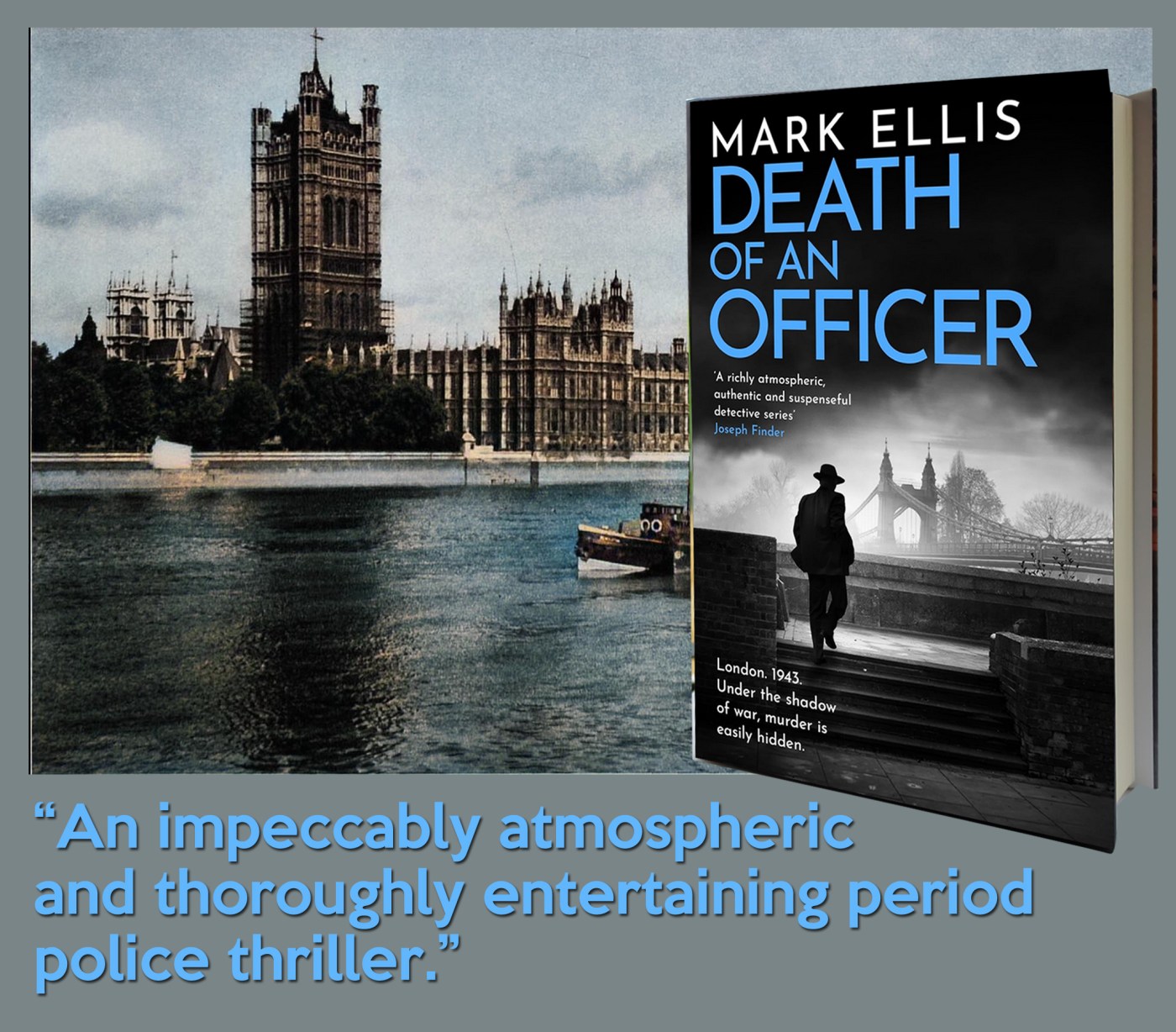
Detective Chief Inspector Frank (christened Francisco) Merlin is a thoroughly likeable and convincing central character in this murder mystery, set in 1943 London. As in all good police novels, there is more than one murder. The first we are privy to is that of a seemingly inoffensive consultant surgeon, Mr Dev Sinha, found dead in his bedroom, apparently bludgeoned with a hefty statue of Ganesha, the Hindu elephant god. Sinha’s wife has been diagnosed with a serious mental illness, and has been packed off to an institution near Coventry ( no jokes please) but when she is interviewed she is more lucid than those around her have been led to believe.

Added to Merlin’s list of corpses is that of south London scrap dealer called  Reg Mayhew, apparently victim of the delayed detonation of a German bomb. Unfortunately for the investigators, the word ‘corpse’, suggesting an intact body, is misleading. Mayhew’s proximity to the blast has given the lie to the old adage about someone’s inability to be in two places at once.

Clumsily concealed beneath bomb site rubble in the East End is the well-dressed (evening attire and dress shirt) remains of Andrew Corrigan, a Major in the US army. It seems he was a ‘friend’ of a rich and influential MP, Malcolm Trenton. 

Merlin’s investigations take him towards the contentious issue of Indian independence, and it seems that the murdered consultant was a member of a committee comprising prominent British Indians who support Subhas Chandra Bose, a firebrand nationalist who is seeking support from Nazi Germany and Japan, in the belief that they would win the war, and then look favourably on an independent India.

Like all good historical novelists, Mark Ellis has done his homework to make sure we feel we are in the London of spring 1943. We are aware of the recent Bethnal Green Tube disaster, that Mr Attlee is a key member of Churchill’s coalition government, and that a Dulwich College alumni has just had his latest novel, The Lady in the Lake, published. We also know that the Americans are in town. As Caruso sang in 1917, the boys are definitely ‘Over There!‘Among the 1943 intake is Bernie Goldberg, a grizzled American cop, now attached to Eisenhower’s London staff.

I am old, but not so ancient that I can remember WW2 London. Many fine writers, including Evelyn Waugh in his Sword of Honour trilogy, and John Lawton with his Fred Troy novels, have set the scene and established the atmosphere of those times, and Mark Ellis treads in very worthy footsteps. There is the dismal food, the ever present danger of air raids, the sheer density of the evening darkness and the constant reminder of sons, brothers and husbands risking their lives hundreds of miles away. Ellis also reminds us that for most decent people, the war was a time to pull together, tighten the belt, shrug the shoulders and get on with things. Others, the petty and not so petty criminals, saw the chance to exploit the situation, and get rich quickly.

Central to the plot is ‘the love that dare not speak its name‘ in the shape of an exclusive club organised by Maltese gangsters. Mark Ellis reminds us that there were no rainbow pedestrian crossings or Pride flags flying over public buildings in 1943, and that there was an ever-present danger that men in public life were susceptible to blackmail on account of their sexual preferences. With a mixture of good detective work and a bit of Lady Luck, Merlin and his team solve the murders. The book’s title is ambiguous, in that Major Andrew Corrigan certainly fits the bill, but there is one other officer casualty – I will leave you to find out for yourself his identity by reading this impeccably atmospheric and thoroughly entertaining period police thriller. It will be published by Headline Accent on 29th May.

THE DARKEST WINTER . . . Between the covers

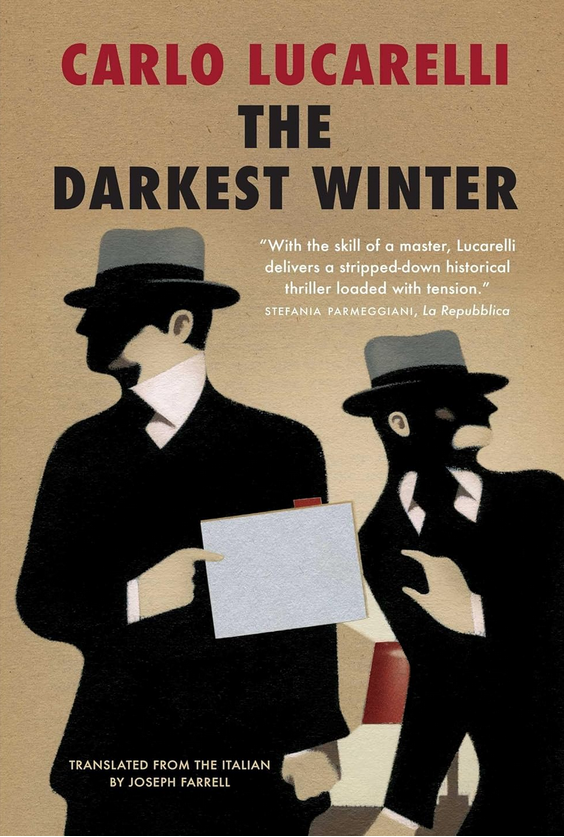
Bologna, northern Italy, November 1944. The introduction to this excellent novel explains the political situation in more detail but, in a nutshell, Italy is divided. The provisional ‘free’ government has surrendered to the Allies who are, painfully, fighting their way north up the spine of the country. Most of Italy – including Bologna – is still under German control. The city, with its ancient churches, porticos and squares, now resembles a giant farmyard. Rural villages around the city have now moved in, bringing livestock and farm carts full of straw and root vegetables.

Bolognese copper Comandante De Luca has three murders to investigate. The three dead men giving De Luca a headache are: Francesco Tagliaferri, in life an engineer, in death just a corpse with a shattered head, slumped against the column of a portico in Via Senzanome; Professor Franco Maria Brullo, of the city’s Faculty of Medicine, shot dead through the eye; most problematic, given the Germans’ penchant for violent retribution, is the corrupted body of a minor SS functionary, Rottenführer Weber, found floating in a flooded cellar. The latter is key, as if De Luca doesn’t solve the killing of the SS corporal the Nazi authorities will execute ten random Italian prisoners pour encourager les autres {or its equivalent in Italian.

As Caliban said, “The isle is full of noises,” and among the ‘noises’ to disrupt the lives of Bologna’s citizens are The Black Brigades (ultra violent fascist volunteers), the Bodogliani (left wing partisans loyal to the the King) and activists with all manners of allegiances in between. Rather like Philip Kerr’s immortal Bernie Gunther, De Luca tries to be a decent copper with his left hand tied behind his back and the fingers of his right holding his nose against the stench of corruption.

Parts of Bologna resemble a nightmare visualised in a Bosch painting. A young man in a derelict theatre – where shattered families are trying to rebuild their lives in the boxes once patronised by wealthy theatre-goers,  faces Deluca. When challenged for his identity, he says,

“What do you want to see? My military rank? My exemption from labor?” He beat his hand on his shoulder and grimaced because he must have hurt himself. “Here are my documents. This,” he shook the empty sleeve, “I left in Russia. And what I am wearing,” he held the flap of his coat, “is all I have left.”

The Bologna winter is certainly dark, but Lucarelli’s prose renders the shattered city with the inky blackness of a genuine Noir novel.

“There was in the air the scent of old smoke, ashes and wet filth which Bologna always had during that year and a half of war. Damp and sticky in summer, dry and biting in winter. The stench of boiled cabbage and burnt oil, of urine and excrement, sweat and dust, cold and coarse like rusted iron.”

While reading this, my mind strayed to Joseph Heller’s Catch 22. Not only was Bologna the target for Yossarian’s squadron but, towards the end of the book, a cold wind blows away the buffoonery, and we are left with the blacked out streets, and the grim murder of the maid Michaela, by the psychopathic navigator, ‘Aarfy’ Aardvark.

Lucarelli gives us a labyrinthine plot and a reassuringly fallible central character, who makes many mistakes and wrong calls as he searches for the truth. Reassuringly, there is also a full glossary explaining the multitude of different factions and splinter groups which made up the Italian political landscape in 1944. Bizarre though it sounds given their brutality, the Wehrmacht and the SS give a sense of relative unity to what was, otherwise, chaos.

This novel follows on from three earlier books, known as the De Luca trilogy, consistg of  Carte Blanche (it: Carta bianca, 1990), The Damned Season (it: L’estate torbida, 1991), and Goose Street (it: Via Delle Oche, 1996). The Darkest Winter, translated by Joseph Farrell, is published by Open Borders Press/Orenda Books, and will be available on 22nd May. For an Englishman’s view of a very different Italy, a few months earlier than Lucarelli’s story, you should read There’s No Home by Alexander Baron, where we join a British unit in the south of the peninsula, not long after the Germans had retreated to their defence lines further north.

INNOCENT GUILT . . . Between the covers

The book begins with one of those ‘impossible’ events beloved of crime writers since the 19th century. It is a mystery involving not a locked room but a locked mind. A woman, later identified as Fiona Garvey, presents herself at a London police station covered in blood. Carrying a baseball bat. She is catatonic. Silent. Somewhere else altogether. Then, a body is found, battered to death in a London Park. It appears to be the mortal remains of Alistair Cowan, Fiona Garvey’s employer.

Investigating detective Leah Hutch has problems of her own. The woman who brought her up, Margaretta, has just died. Margaretta solicitor reveals to Leah that her actual father, who she neither knew nor ever met, was Eli Carson, Margaretta’s son and a former police officer. And Eli is serving two life terms for murdering his wife and the man he suspected was cuckolding him. The author then  deepens the mystery with two further revelations. First, the blood on the baseball bat isn’t that of Alistair Cowan, but that on Garvey’s hands and body is. Just to set our minds spinning yet more feverishly, DNA tests on the body in the park do not match that of Alistair Cowan. But hang on … Chapter Four is a description of Alistair Cowan, lying somewhere, grievously injured, fighting for life so, as some people say, “what the actual ….?”

As if things were not complicated enough for DI Hutch, we have Odie Reid muddying the waters. She is – or was – an top investigative journalist for a tabloid newspaper. As print newspaper sales plummet, Odie’s career takes a parallel course. She knows Leah Hutch, as they were once both aspiring news hounds. Now, Leah bats for the opposition, and Odie needs to create the story that will save her career. The man police assumed was Alistair Cowan is identified, Cowan is found – just about –  alive and after the forensic evidence leads the police to accuse Fiona Garvey of his murder she is remanded in custody.

Then, a third man, Jake Munro is attacked, this time fatally. He was a successful businessman who had bought up several firms, with consequent redundancies, so was he killed by a vengeful former employee? One such man, Eddie Adeola, had committed suicide after failing to get another job, and his wife – a strange and violent woman called Temi, after attacking police sent to interview her, has gone into hiding. Leah Hutch discovers a strange link between Temi and Fiona Garvey, and it is their attendance at events put on by a man called Brendan Klee. When Hutch and her sergeant Ben Randle interview him they are unsure if he is a fraud, a mentalist, a lifestyle guru, a shaman – or a blend of all four.

The denouement reflects a phenomenon which runs through the book like a spine, albeit one warped by scoliosis; this phenomenon is the endless – and almost unsolvable –  mystery of what causes apparently decent people to commit acts of terrible evil, and whether or not those acts can be excused (or at least explained) by horrors inflicted on the perpetrators when they were much younger. Leah Hutch is a flawed – but credible heroine – with a past as steeped in horror as the worst of the crimes she has to investigate. Remi Kone is a British Nigerian Emmy-nominated producer; she has worked on a number of well-known television dramas, such as Killing Eve, Spooks and Lewis. She lives in London, and this is her first novel. Innocent Guilt is published by Quercus and will be on the shelves on 15th May.

A FATAL ASSUMPTION . . . Between the covers

These Bristol based Meredith & Hodge cold-case-crime novels are rather special. Their latest case seems unsolvable. For starters it’s over a decade old. Christine Hawker was making breakfast for the children with husband Mike was upstairs getting them ready for school. The smoke alarm goes off. Mike discovered it has been triggered by a pan of burned porridge. But where was Christine? Puzzled, he took the kids to school, but then he disappears, too. The case baffled everyone, and gradually slid further and further back down the “To Do” list.

Now, the case has been reopened, because Mike Hawker’s remains have been inadvertently exposed by the bucket of a digger preparing the ground for a new supermarket. Meredith & Hodge? DCI Meredith and his wife, fellow officer Patsy Hodge are the ideal husband and wife team. Except – at the moment – they’re not. Patsy is on extended sick leave after a case went horrifically awry and has fled to relatives in New Zealand. Meredith? He’s getting over jetlag in a budget Auckland hotel having flown in to try to save his marriage.

By any standard, this is a terrific police procedural novel. Yes, all the operational details are convincing and the plotting is cleverly done. For me, however, it is the dialogue that sparkles. Marcia Turner enlivens her characters by what they say, and the idioms they use. For example, an elderly man says that he is a bit ‘mutton’. Younger readers might be baffled, but Turner knows that people of this character’s generation would recognise the rhyming slang. Mutt ‘n’ Jeff were comic book characters back in the day. Mutt ‘n’ Jeff became rhyming slang for ‘deaf’ and this later evolved into ‘mutton’ – a double play on words.

Meredith’s peacemaking overture in New Zealand is favourably received, and the pair return to the UK and face the mysteries of the Hawker case. The extended family dynamic is complex, and throws up a number of grievances. In no particular order. Christine’s father died of cancer when she was in her early teens, and she had become embittered that her mother remarried so quickly, suspecting that the relationship may have been blossoming while her father was on his bed of death. Mike’s father is cantankerous and an awkward customer, and his peace of mind was not improved a few months before his son’s disappearance when a young man met him and introduced himself as his long-lost son, conceived in a youthful fling decades earlier.

Meredith’s team clutch at what seem to be increasingly flimsy straws of evidence and imperfect recollections. What about the mysterious white van seen near the Hawker’s house on the day of the abduction? It is of no help at all that several of the potential suspects worked in trades where the proverbial ‘white van’ was ubiquitous. As is probably the case in real life criminal investigations, forensic questioning unearths all manner of ill-concealed grievances and grudges within the extended family of Mike and Christine Hawker.

Despite the proverbial quote suggesting the opposite, it is inspiration rather than perspiration which finally lifts the veil for Meredith, and it comes by way of a pleasant couple of hours the detective spends with his baby grandchildren. The next day, he calls the investigative team together, and on the whiteboard writes one simple word. The culprit returns to the interview suite, confesses, and the cold case team can chalk up another success. What Marcia Turner does so well, in addition to the captivating dialogue, is to shine a light on the petty jealousies, perceived slights and debilitating grievances that plague so many families. She is spot on. We all know what she is writing about. Thankfully, it doesn’t make us all murderers, but – as they say – we have all been there. From 127 Publishing, this excellent police thriller is available now.

HER SISTER’S KILLER . . . Between the covers

All too often, opening pages of crime novels headed ‘Prologue’ are enigmatic flashbacks, and they leave the reader wondering what their relevance is to the emerging narrative. Not so here. It is short, brutal and and painfully obvious. A Tyneside detective has been called to a murder scene. The body is that of his teenage daughter. That was then.

Now. For some arcane reason, when police Sergeants are promoted to Inspector, they have to serve a term in uniform, away from their home station. So it is that Frances ‘Frankie’ Oliver – the younger sister of the girl whose murder is revealed in the prologue –  is sent away from the city hub of Newcastle to the relative backwater of Berwick – England’s last outpost before the Scottish border. Her first major call-out is a serious RTA – with fatalities. In the back of a wrecked van, Frankie finds a seriously injured child, his wrist secured to a stanchion with cable ties.

Meanwhile, DCI David Stone – Frankie’s on-off romantic interest, acting on loose talk overheard at a police social function, has reopened the investigation into the unsolved murder of Joanna Oliver. Frankie’s secondment to Berwick takes on a life of its own as, amid the wreckage beside the A1, evidence emerges that an organised crime gang has been hard at work trafficking children.

Mari Hannah has penned a classic ‘two plot’, novel, in that DI Frankie Oliver is heading up a multi-agency investigation into a Bulgarian people smuggling gang, while DCI David Stone is in charge of a covert cold-case operation into the murder of Frankie’s sister. Why covert? Stone believes that a serving policeman was her killer and, the law being what it is, any involvement by Frankie Oliver would mean the case would be thrown out of court.

I have meta-tagged this book as a police procedural which, on one level, it is. There is so much more, however. Mari Hannah’s ability to create vividly authentic characters is here for all to see. In no particular order, we have retired copper Frank Oliver, father of Frances, the murdered Joanna and older sister Rae; his torment at being called to a murder scene, only to find that the victim is his own daughter is lifelong; Frankie herself is a brilliant police officer, fearless but vulnerable, intuitive but analytical; David Stone is a ruthless career policeman but, like Frank Stone, the scar on his heart from when his former lover, Jane, was shot dead by an insane gunman, has never healed; I was also particularly taken with rookie PC Indira Sharma who, apart from his boss (Detective Superintendent Bright) is Stone’s only confidante. She is new to the job, but incisive, courageous and has a gimlet eye for detail.

The best crime novels have an authentic sense of place and location and, as with her Kate Daniels novels, Mari Hannah’s heart is never far from England’s north east and the contrast between the bright lights of ‘big city’ Newcastle, and the windswept horizons of rural Northumbria. There is so much to admire about this novel but I suspect, like me, you will be left breathless by David Stone’s ruthless and remorseless interview room demolition of Joanna Oliver’s killer at the end of the book. I don’t do checklists, but if I did, I would be ticking the boxes for brilliant thriller, credible characters, narrative verve, great sense of place and bloody good read. Her Sister’s Killer is published by Orion and is available now.

THE NEW COUPLE IN 5B . . . Between the covers

This is a classic example of what one critic, perhaps unkindly, called ‘anxiety porn.’ Rosie and Chad Lowan are a young New York couple, she a writer with a moderately successful first novel, but struggling with the second: he is an actor, yearning for the big break. Bit parts in commercials and the role of Third Witch in an adventurous off-Broadway production of The Scottish Play help with the bills, but the couple are just about solvent. Then, fortune seems to smile on them. They have been providing end-of-life care to an Ivan, an elderly journalist who owns an apartment in The Windermere, an exclusive and historic building – think The Dakota, and you are close.

When the old man dies and (ignoring his daughter) leaves the apartment to Rosie and Chad  it looks as if all their Christmases have come at once, but this is a psychological thriller, so we know things are going to turn nasty in short order. The apartment has, apparently, seen its shared of tragedies over the decades and, before long, strange things begin to happen.The Windermere has, shall we say, a lurid history. Built around the shell of a church destroyed by fire in 1920 (but retaining the gargoyles) it has been the scene of several tragedies. In 1932 its architect and builder, ruined by the Great Depression, dived to his death from a high window. Suicides by various methods and defenestrations, while neither regular nor frequent, have lent a certain ‘character’ to the building.

Inexplicable things start to happen to Rosie. She sees a strange little boy, presumably the spectre of a child who died in the elevator shaft; the imperturbable and ever-present doorman, Abi, although suavely polite, exudes menace; Rosie’s immediate neighbours, Charles and Ella seem kind and gentle, but what are they hiding? And why, on the residents’ internet forum, has the thread Ghosts of the Windermere been deleted by the admins?

When Ivan’s daughter, presumably still smarting at losing out on her inheritance, is found dead, hanging from a beam in her photography studio, la merde frappe le ventilateur, as the French probably don’t say. It doesn’t help that Rosie and her editor, Max, are the ones to find the corpse. Apart from a few chapters which are narrated by a woman who lived in the apartment now occupied by Rosie and Chad, Rosie is the principal narrator. and CriFi convention means that if this is still the case half way through the book, then it is highly unlikely that Rosie is a wrong ‘un. So who are the bad guys? Cui bono?

Frequent readers of this kind of psychological thriller will know that only one thing is certain, and that is that most of the supporting actors are either not who they say they are, or have evil intent towards the central character. So it is here, but you can make your own deductions as the pages fly by. I confess that I have a ‘view’ of modern American CriFi. I am a huge fan of, to name but two, Harlan Coben and Jonathan Kellerman. Each book is polished like a gemstone, slickly plotted and with authentic dialogue. Formulaic? Yes, but – like the ‘secret’ recipes of Coca Cola and Kentucky Fried, it works. Every single time. This novel fits that bill perfectly. What we have here is a readable and engaging thriller with surprises lurking at every bend in the road. If it sticks to the rules of the game, then I am not complaining. It is published by Park Row Books and is available now.

SANCTUARY . . . Classics revisited

I have come to the novels of William Faulkner (left) late in life. Perhaps that is just as well. I am not sure how, as a younger man, I would have dealt with his baleful accounts of one or two truly awful human beings. Having just read Sanctuary, my first reaction is a sense of having been exposed to the very worst of us. The psychotic little gangster Popeye is an embodiment of genuine evil. He is warped both physically and mentally but seems invulnerable, echoing Shakespeare’s description of Julius Caesar ‘Why man, he doth bestride the narrow world like a colossus’.

The novel was published in 1931, which in itself gives pause for thought. I can’t think of an earlier novel published as mainstream fiction which dealt with depravity in the same way. The version that made it into print was, however, a toned down version of Faulkner’s original manuscript. In one sense, Sanctuary embodies the way Shakespeare adapted Aeschylean tragedy. Yes, there are truly evil people at work here, but the main characters are fundamentally unremarkable folk who, through a toxic blend of circumstance and human frailty, are brought down.

The story is this. A humdrum lawyer, Horace Benbow, leaves his wife, and makes his way to the town of Jefferson, where he has a property, shared with his sister. On the way, he meets a Memphis gangster known as Popeye, who takes him to a semi-derelict plantation house, where a bootlegger called Lee Goodwin brews his moonshine. Perhaps the only thoroughly decent person in the book is Goodwin’s common-law wife, Ruby. She prostituted herself to raise money for lawyers when he was first tried for murder, stuck by him while he was away fighting in the The Great War, and brings up their sickly child in the most challenging of circumstances. By a trick of fate, 18 year-old college girl Temple Drake ends up at the property. She is assaulted by Popeye, while a simpleton called Tommy is shot dead. Temple is taken off by Popeye to a Memphis brothel run by a woman called Reba, where she meets another petty crook called Red. Goodwin is arrested for the murder of Tommy, and the story hinges on Goodwin’s murder trial, where he is defended by Benbow.

Faulkner’s narrative style in Sanctuary is much more conventional than in some of his other novels. While it is not quite the same as the “show or tell” option, one of his techniques here is for something to happen, but the exact details are only fully revealed to the reader some time after. Three examples: we don’t learn the grim details of what Popeye did to Temple in the corn store until Goodwin’s murder trial: although Temple hints at it very briefly; it is only when Reba and her lady friends are consoling themselves with gin after Red’s funeral that the details of the sordid relationship between Popeye, Temple and Red become clear. Likewise, it is only in the final pages of the novel, when Popeye is on trial for a murder he could not have committed (because he was miles away at the time, murdering someone else) that we learn of his tormented and traumatic childhood.

The courtroom drama has been a fiction staple for decades, and they range from the dry and interminable wrangling of Bleak House, via the comedic genius of Israel Zangwill in The Big Bow Mystery, to the smarts of Michael Connolly’s Micky Haller novels, but it is the trial of Lee Goodwin which becomes the pivotal moment of Sanctuary. The adversarial nature of American court rooms lends itself readily to dramatic fiction even when the court is in some sophisticated city like New York or Boston. When the court is in a febrile small Southern town, the novelist will lick his/her lips in anticipation.

The novel, even its bowdlerised state, had so much in it that was impossible to film at the time and, probably today, too (please don’t give Lars Von Trier any ideas) but in 1933 a cinema version of the story was made, called The Story of Temple Drake, with Miriam Hopkins in the title role. Despite its inevitably sanitised version of the novel, it is said to be one of the films that prompted the Hays Code, a self censuring set of rules by film executives that set out just what could and couldn’t be seen in mainstream films. They tried again in 1961, but this was an amalgamation of Sanctuary and its 1951 sequel Requiem For A Nun.  Faulkner, despite holding his nose at some of Hollywood’s excesses, was frequently employed by film makers, most notably as co-writer of the screenplay for Howard Hawks’s The Big Sleep. He still didn’t manage to resolve the question, “Who killed the chauffeur?”(For aficionados only)

Sanctuary concludes with two men dying for crimes they did not commit, and a young woman whose journey takes her through brutal rape, sexual decadence and perjury reaching a kind of limited restoration, but leaving behind her a trail of broken lives. Some commentators have decided the book is an allegory, and when people decide on this approach they inevitably disagree on what it is an allegory of, and choices range from the destruction of the Old South to middle-class apathy in the face of evil. For me it is, first and last, a very good crime novel. Faulkner was way ahead of the Noir game here, and although he openly admitted that the book was written to make money from those who like sensationally lurid stories, it remains a revealing glimpse into the darkness of the human soul.

HOLY CITY . . . Between the covers

Deputy Will Seems has returned to his home in rural South Virginia after working for ten years in the state capital, Richmond. He finds a place turned in on itself, a place of despair and senseless minor criminality. It’s name? Euphoria County. Will muses on what he sees:

“People around here seemed to live in a cloud of defeat, self-wrought and inherited. Whites had the lost cause, Blacks had slavery. It would seem they should be pitted against each other, but they were really dug in behind the same trench. And the rest of the state, the rest of the country was out there.”

Will attends a house fire he has seen while on patrol and, before the fire crew can get there, he pulls a man from the blaze. The man – Tom Janders – is already dead, but on closer investigation the cause of death is knife wounds. After recovering from smoke inhalation, and leaving the emergency services to do their job, Will finds a man apparently trying to leave the scene and, although he has a deep personal connection to the fugitive – Zeke Hathom – has no alternative but to arrest him. Will’s boss, Sheriff Mills is firmly convinced that Zeke Hathom is the killer, but Will is not certain. What he is certain of is that he must tread carefully. Unknown to anyone else, he is sheltering Sam Hathom, Zeke’s errant son. Sam is wanted for minor criminality, but he also has a drug addiction, and Will is trying to wean him off it. There is a blood bond between Sam and Will. Years ago, when they were in their teens, they were inseparable, but one night they were set upon by a gang of other youths. Sam was beaten within an inch of his life, sustaining permanent facial injuries, but Will was too terrified to help his friend.

Meanwhile, Zeke’s wife has hired a private investigator from Richmond to prove her husband is not the killer. Bennica Watts has been forced into the profession because she was sacked from Richmond police for illegal acquisition of evidence. When she arrives in Euphoria County she is introduced to Will, and he agrees to her posing as his new girlfriend from out out of town while she goes about her work.

Like many other novels set in the American South, in Holy City the past is never far away. It might be the relatively recent past like Will’s youthful friendship with Sam, but ever present, though, is the folk memory, the almost palpable sense of eternal division between Black and White. No matter how many Confederate statues are pulled down the perceived injustice of what happened after Appomattox in April 1865 lingers in the blood of ancestors of the people that erected them, and this is nowhere better described than in William Faulkner’s Intruder In The Dust (click link to read the passage) For Black people, the sense of gross injustice – historical and current – is like a bloodstain that no amount of scrubbing can remove. A quote from this novel, referring to the relationship between Will and Sam, could also refer to the broader cultures into which they were born:

“They were trapped in a shared past.”

A common feature of what has come to be known as Southern Noir is the way the landscape broods and mirrors the sense of loss and resentment felt by the humans who live and work in it. You can find it in novels by William Faulkner, James Lee Burke, Greg Iles and Wiley Cash, to name just four. Henry Wise clearly knows his southern Virginia, and he portrays a land that has history, but whose time has gone. Many former tobacco fields have been abandoned for more saleable crops; the once-abundant flocks of quail have either been shot out of existence or have moved elsewhere; out of town and dotting the dusty highways are houses that look abandoned but may well not be, at least by living humans.

“The trees they saw now seemed grown to die, honed for some miserable end.The occasional building, house, church, trailer, lay unbelievably ravaged by vine and dark growth against the wan green moonlight glinting off the uneven road.They passed a shroud of bubble wrap tangled against a tree.”

Thanks to an audacious gamble by Bennica Watts the murderer of Tom Janders is identified, but although this means Zeke Hathom is eventually exonerated, the case has left numerous casualties, both in the physical sense of blood being spilled but, even more dramatically, the skeletons of the past are, metaphorically, unearthed and their bones bear witness to deeds of utter evil and depravity. This is a beautifully written but dark and dystopian novel, seared by startling moments of genuine pain and sexual violence. There is a flicker of redemption for one group of characters in the novel, but for others, it is as if the past has thrust its withered hand from the grave and swept them down into the depths where it resides. Holy City is published by No Exit Press and is available now.

Blog at WordPress.com.

Up ↑