Search

fullybooked2017

Tag

murder

A RAGE OF SOULS . . . Between the covers

This begins as one of the most baffling and impenetrable of Simon Westow’s cases. We are in Leeds, 1826. He solves a case of fraud, the fraudster is sentence to hang, but reprieved. He then returns with his wife to shadow the man he originally tried to defraud. The man, who calls himself Fox, seems connected to his victim, a Mr Barton, via Barton’s wayward son, Andrew. Westow, like Ulysses in Tennyson’s great poem, no longer has “that strength which in old days Moved earth and heaven,” due to a serious wound sustained in a previous case, but his eyes, ears – and legs on the street are provided by his lethal young assistants Jane and Sally.

One of Nickson’s many skills as a writer is to point out the dramatic contrast between the industrial stink of Leeds and the uncorrupted countryside not many miles outside the city. Andrew Barton goes missing, so Jane and the boy’s anxious father make the journey in a chaise towards Tadcaster. Jane investigates the ancient church of St Mary, Lead, solitary and empty in a lonely field. Near the church runs the Cock Beck, which was reported to have run red with blood during the nearby Battle of Towton in 1461, and as she crosses the stream , she makes a terrible discovery.

Quietly, Nickson references the timeless joy of reading. Jane, once an illiterate street urchin, has been taught to read by Mrs Shields, the old lady who has become the mother she never had. Now, Jane spends her spare hours immersed in the novels of Sir Walter Scott and James Fenimore Cooper, borrowed from the circulating library. The printed words take Jane away from the perils and drudgery of her own existence to a world of daring, adventure and hope. In his own way. Nickson does precisely the same thing.

There is a deep sense of poetry in the book, not just in the words, but in the juxtaposition of images. The book begins with Jane witnessing the result of a horrifying industrial accident.  A young girl is being roughly carried to the surgeon, her leg mangled beyond repair. This haunts Jane throughout the book, but then, near the end, there is a kind of redemption. One of the regular characters who ekes out a living on Westow’s streets is Davy, the blind fiddler. Jane’s trauma is redeemed:

“Up by the market cross, Davy Cassidy was playing a sprightly tune that ended as she drew close. He gazed around with his sightless eyes and a girl appeared whispering a word into his ear. He lifted his bow and began to play again, low, mournful. Then the girl stepped forward and began to sing. Jane knew her face. She’d lived with it for months. She’d seen it contorted with pain as the girl was carried from the mill, her leg in shreds. Then when it returned night after night in her dreams. Now she was here, one-legged, supported by a crutch, a voice as unearthly sweet as a visitation as she sang about a girl who moved through the fair. She stood transfixed as a disbelief fragmented and disappeared. The pain she’d heard in the girl that day in February had become beauty. The small crowd was silent, caught in the words, the singing while the world receded around them. The last note ended, a stunned silence, then applause and people pushing forward to put coins into the hat on the ground.”

Eventually, by a mixture of judgment perseverance and good fortune, the mysterious Fox is run to ground in a bloodthirsty finale. A Rage of Souls is Chris Nickson at his best – complex, compelling and, above all. compassionate. It will be published by Severn House on 7th October. You can take a look at earlier Simon Westow books here.

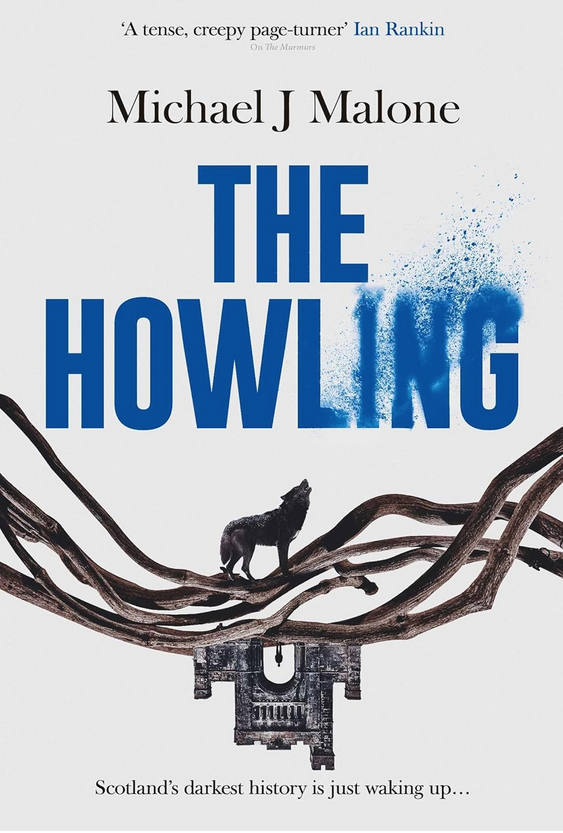
THE HOWLING . . . Between the covers

I reviewed an earlier novel in this series twelve months ago, and you can read what I thought of The Torments by clicking the link. Now, Annie Jackson (with her brother Lewis) returns in another mystery set in the evocative landscape of the Scottish Highlands. Annie’s USP, to be flippant for a moment, is that she has inherited a curse, passed down through female ancestors. She is subject to terrifying revelations that show how certain people she knows are going to meet their death. In the last book her vision was that of a young man from the local lifeboat crew being killed in a car accident. He duly was, and Annie suffered opprobrium for her perceived inability to issue a credible warning.

In that previous novel, she survived a life-and-death struggle with a satanic madwoman called Sylvia Lowry-Law. Lowry-Law is now a permanent resident of a secure mental hospital but, exercising her rights under the bizarrely liberal UK legal system, she requests a meeting with Annie. The prisoner offers to remove Annie’s familial curse, but asks, in return, that Annie searches for – and finds – Lowry-Law’s long lost son.

Annie is sent in the direction of Lowry-Law’s former solicitor in Edinburgh, but the office is now empty except for the former receptionist, an elderly woman called Joan Torrans. She reveals that her former boss took his own life some weeks earlier. Returning to the now deserted office a few days later, after Torrans suddenly dies, Annie and Lewis discover a mysterious room, its door concealed behind a bookcase. In the room is a sinister altar surmounted with a horned skull and spent candles. It seems that the solicitors were connected to a satanic cult known as The Order.

As Annie and Lewis discover that The Order dates back centuries, and is deeply embedded in Scottish history, they learn that its modern operations are financed by a poisonous web of blackmail aimed at some of the richest families in the land. Then, a shocking act of violence turns the narrative on its head.

The author reminds us that in some parts of Britain, the past lays a heavy hand on the shoulder of the present. Annie and Lewis face a struggle, not only against the present day black arts of Sylvia Lowry-Law, but against centuries of superstition, folk memory, and bloody deeds soaked into the very landscape. The finale is worthy (and this is for older readers) of something the cult director Roger Corman might have concocted for one of his Edgar Allan Poe adaptations.

The Howling is a gripping read, and mines into a deep seam of violence embedded in Scottish history and legend. The misty lochs, forbidding hillsides and bleak settlements are perfect settings for memories of witchcraft and lycanthropy. I am normally no fan of split time narratives, but that is just a personal gripe, and the device is skillfully used here to tell the story of a terrible wrong that was done centuries earlier. The Howling is published by Orenda Books and is available now.


THE BOOKSELLER . . . Between the covers

Detective Sergeant George Cross is unique among fictional British coppers in that he is autistic. This apparent disability gives him singular powers when investigating crimes. While totally unaware of social nuances, his analytical mind stores and organises information in a manner denied to more ‘normal’ colleagues within the Bristol police force. When questioning suspects or witness his completely literal mindset can be disconcerting to both guilty and innocent alike. Regular visitors to the site may remember that I reviewed two earlier novels in the series The Monk (2023) and The Teacher (2024) but, for new readers, this is the background. Cross is in his forties, balding, of medium height and, in appearance no-one’s idea of a policeman, fictional or otherwise. He lives alone in his flat, cycles to work, and likes to play the organ in a nearby Roman Catholic Church, where he is friends with the priest. George’s elderly father lives nearby, but his mother left the family home when George was five. At the time he was unaware that she left because Raymond Cross was homosexual. Now, Christine, has slowly reintroduced herself into the family group and George, reluctantly, has come to accept her presence.

This case begins when an elderly bookseller, Torquil Squire returns to his flat above the shop after a day out at an antiquarian book sale at Sothebys. He is horrified to find his son Ed, who is the day-to-day manager of the shop, dead on the floor, stabbed in the chest. George and his fellow DS Josie Ottey head up the investigation which is nominally led by their ineffectual boss DCI Ben Carson.P.The world of rare and ancient books does not immediately suggest itself to George as one where violent death is a common occurrence, but he soon learns that despite the artefacts being valued in mere millions rather than the billions involved in, say, corporate fraud, there are still jealousies, bitter rivalries and long running feuds. One such is the long running dispute between Ed Squire and a prestigious London firm Carnegies, who Ed believed were instrumental in creating a dealership ring, whereby prominent sellers formed a cartel to buy up all available first editions of important novels, thus being able to control – and inflate – prices to their mutual advantage.

Then there is the mysterious Russian oligarch, an avid collector of books and manuscripts, who paid Ed a sizeable commission to buy a set of fifteenth century letters written by Christopher Columbus, only for the oligarch to discover that the letters had, in fact, been stolen from an American museum. Could Oleg Dimitriev have resorted to Putinesque methods following the debacle?

Running parallel to the murder investigation is a crisis in George’s own life.  Raymond discovers that he has lung cancer, but it operable. During the operation, however, he suffers a stroke. When he is well enough to return home he faces a long and difficult period of recuperation and therapy for which George is ready  and able to organise. More of a problem for him, however, is the challenge to his limited emotional capacity to deal with the conventionally expected responses. Even before his father’s illness, George has been disconcerted to learn that Josie Ottey has been promoted to Detective Inspector, and he finds it difficult to adjust to what he perceives as a dramatic change in their relationship.

The killer of Ed Squire is, of course, identified and brought to justice, but not before we have been led down many a garden path by Tim Sullivan. The Bookseller is thoughtful and entertaining, with enough darker moments to lift it above the run-of-the-mill procedural. Published by Head of Zeus, it is available now.

THE DEVIL’S SMILE . . . Between the covers

This is the sequel to The Lollipop Man (read my review from earlier this year) and we are reunited with reluctant student investigator Adrian Brown, and his friend Sheila Hargreaves, a TV journalist and co-presenter of Yorkshire Crimetime, a regional TV show featuring local criminal activity.. Adrian’s social life is not exactly glittering, and consists largely of optimistic – but largely disappointing – trips to gay pubs and clubs in mid 1990s Leeds. A recent Yorkshire Crimetime featured the murder of a young gay man, a waiter at a local Italian bistro.

Thanks to a timely intervention by his housemate, Adrian has survived the consequences of one drunken pick-up too many, in the shape of an encounter with a predator called Edmund. Meanwhile, Sheila’s  co-presenter Tony Tranter has gone missing. He is a narcissistic drunk, and has a reputation for unreliability, but this time his absence seems more serious. Then, Tranter’s car is found abandoned under Leeds railway station, bearing signs of a violent struggle. Not long after, his body is found nearby, concealed beside one of the vast Dark Arches above which is the station, and below which the captive River Aire roars and foams. Sheila, fed information by her journalist friend Jeanette Dinsdale, know knows that a scandal was about to break. Tranter was a member of an exclusive and secretive club, where underage girls and boys were provided to provide ‘entertainment’.

The initial, and benevolent, reaction of the TV people is that Tony Tranter was killed in revenge for some criminal who had been brought down as a result of Yorkshire Crimetime’s actions. Sheila suspects differently, but goes along with the initial impetus to record a TV special which will enlist the help of tens of thousands of viewers to bring Tranter’s killer to justice. Adrian, meanwhile, has finally reported his assault to the largely uninterested West Yorkshire Police, concerned

I have tagged this novel as #historicalcrimefiction, but it just doesn’t seem that long ago. I was never an addicted viewer, but Crimewatch was, for a few years a major BBC show. Main presenter, the earnest and clean-cut Nick Ross, with his ‘glamorous assistant’ Sue Cook, purported to solve crimes by presenting re-enactions of crime scenes, and inviting viewers to telephone in with information. It seems bizarre that it lasted as long as it did, and is haunted by the supreme irony that the murder of one of its later presenters, Suzanne Dando, remains one of the great unsolved crimes in British history. Sheila Hargreaves’s show is something similar, and has a huge audience.

It is worth taking a moment to look at Leeds as a crime novel setting. In terms of output, the stories of Chris Nickson take some beating, and he has set his novels in different historical periods, my favourites being the Tom Harper books which follow the Leeds copper from the late Victorian era through to the end of The Great War. In terms of grim and grimy readabiity, the GrandDaddy has to be David Peace’s Red Riding Quartet, set from 1974 to 1983, which pretty much encompassed the era of ‘The Yorkshire Ripper’. My review of two of those books is here.

Back to this novel. Daniel Sellers has Sheila, Adrian, the police (and us) following a series of imaginatively crafted red herrings, until a thrilling finale reveals the truth. This enterprising and addictive thriller will be published by Allison & Busby on 21st August.

THE PRINCIPAL DAY . . . Between the covers

Fenland is, today, an area of Cambridgeshire and Norfolk that was once a primeval swamp, where people survived on tiny islands just high enough above the brackish water to provide shelter and sustenance. Now, the name survives as a District Council, but the waters have long since been drained and tamed. Three novelists have found the flatlands suitable for detective stories. The greatest remains Dorothy L Sayers, albeit through one book only. The Nine Tailors (1934) is a fiendishly complex murder mystery set after The Great War, although the thunderous power of barely restrained rivers is never far away. Jim Kelly’s Philip Dryden books tap in to a more sinister side of the landscape, typified by endless skies, church towers and unbroken horizons. He tells us of isolated communities, ancient jealousies and the heavy hand of history. I nominate Diane Calton Smith to complete the triumvirate. Her novels, set in Wisbech from the time of King John up to the 15th century, portray a landscape that changes little, but a social structure that has evolved.

The Principal Day, her latest,finds us in the town in 1423, with a rather splendid late medieval church (little changed today) but in a world that has changed much since the earlier novels. Local farm workers are no longer serfs and villeins, but – in the case of more skilled men – free agents who can seek employment with whoever is prepared to offer the best pay.

There is a school. Situated in a tiny room above the porch of the parish church, it is presided over by Dominus Peter Wysman, a decent enough man, but not greatly respected by one or two of his older pupils. One of the pupils, Rupert of Tilneye is a reluctant scholar, and is just days away from leaving school to go and help run his family manor at nearby Marshmeade. After several humiliations by by the teacher, he resolves to pay the man back by slipping a tiny quantity of ground up yew leaves into his drink. Yew is, of course, a deadly poison when consumed in quantity, but Rupert administers just enough to produce a violent laxative effect, much to the amusement of the scholars.

Much of the story centres on Wisbech’s Guild of The Holy Trinity, of which Peter Wysman is a member The Guilds have no modern equivalent save perhaps Freemasonry. To belong to the Guild, you had to be rich and influential, and its chief, the Alderman, was someone of great influence. They regularly dined on rich roasted meats washed down with wines imported from Europe. When, on The Principal Day (a significant day of celebration and ceremony, often centered around the feast day of the guild’s patron saint or a major religious holiday, in this case the Feast of The Holy Trinity) the Guild members gather for a lavish feast. Wysman is taken unwell, rushes outside into the Market Place, where he collapses and dies.

Rupert’s cruel prank on Wysman was widely known to the scholars. When they are questioned, Rupert is arrested for murder and thrown into the dungeons of Wisbech Castle. His mother, Lady Evelyn, is convinced that he is innocent, and travels to Ely, where she enlsists the help of Sir Henry Pelerin, the Bishop’s Seneschal. He agrees to investigate the case.

In one way, Diane Calton Smith has crafted an excellent medieval police procedural. Sir Henry Pelerin is, I suppose, the long suffering Detective Inspector, while the Constable’s Sergeant-at-arms is a bent copper worthy of modern novels. We even have a version of the stalwart of many a thriller, the brusque and abrupt police pathologist. In the end, we even have that Golden Age prerequisite, the denouement in the library. In this case, however, the principal suspects are assembled at a feast to celebrate St Thomas’s Day. If you will pardon the obvious comment, it is here that all doubt is removed from Pelerin’s mind as to who poisoned Magister Wysman.

Diane Calton Smith weaves her magic once again, and entrances us with a tale shot through with dark deeds, heartache, love and perseverance but – above all – an astonishing ability to roll away the centuries and bring the past to life. The Principal Day is published by New Generation Publishing and is available now. For more on Diane’s Wisbech books follow this link.
POWDER SMOKE . . . Between the covers

I absolutely adored Andrew Martin’s Jim Stringer novels from the word go. The Necropolis Railway was set around the actual railway line near Waterloo that took hearse carriages containing the coffins that would be buried in the relatively new Brookwood Cemetery in Surrey, and introduced Jim Stringer, a young railwayman who would join the Railway police, and solve many mysteries, including novels set during Jim’s wartime experience on The Somme, Mesopotamia, and post-war India.

Now, we are in 1925, and Jim is a Detective Inspector based in York. The story is based on a strange encounter Jim had at the York Summer Gala in the summer of that year. He meets his boss, who insists they go and watch one of the attractions – a Wild West Show. They see the usual antics – a fake Red Indian, a ‘gunslinger’ who throws knives at his provocatively dressed female partner, then shoots clay pipes out of her mouth. Both the woman, the Red Indian and the cowboy are about as American as Yorkshire Pudding, but in the audience is a genuine American (who acts as a stooge for the performers, and a celebrated couple in the entertainment business, celebrated film star Cynthia Lorne  and her producer husband, Tom Brooks.

The gunslinger, Jack ‘ Kid’ Durrant, is not only good with guns, but has ambitions to writer cowboy novels, rather after the celebrated author of Riders of The Purple Sage, Zane Grey (1872 – 1939) Not only that, the relationship between Lorne, Brooks and himself is, as they say, interesting. When Lorne is found dead, with Brooks and Durrant both missing, it is assumed that Durrant is the killer. Although it is not strictly a matter for the Railway Police, Jim feels personally involved, and visits the place where the three were last seen – the grounds of Bolton Abbey in Wharfedale. This allows Andrew Martin (left) to introduce us to what is known as one of the most dangerous rivers in Europe, The Strid. This natural phenomenon sees the River Wharfe forced through a narrow ravine, just a few feet wide. It has been described as the river ‘running sideways’, rather like a twisted ribbon and is believed to be prodigiously deep. No-one goes into it and ever comes out alive.

The best series are enlivened by recurring subsidiary characters, and one has been ever present in the Jim Stringer novels, in the shape of his wife Lydia. We met her when she was young Jim’s landlady in the first novel. Although understandably distant when Jim was on military duties in France, Mesopotamia and India, she has remained by his side. I am not sure how Martin does it but, without being in the least explicit, he makes her quite the most alluring copper’s wife in detective fiction, and their courtship in The Necropolis Railway was – and you’ll have to read the book to understand the contradiction – chastely erotic.

Central to the appeal is, of course, the heartbreaking descriptions of a railway that we once had, but threw away in various acts of criminal negligence and wrong-headedness. The magnificent smoke and almost animal fury of the engines, the cathedrals that were the stations, the legions of uniformed officials, and the fact that in 1925 you could take a train from almost anywhere to somewhere else with minimal discomfort. All now gone and, in the words of the hymn;

“They fly forgotten, as a dream
Dies at the opening day.”

Jim, of course, tries to get to the bottom of of the mystery, party because – in spite of his devotion to Lydia – he was slightly smitten by the deceased movie star. The melancholy denouement involves a London and North Eastern Railway locomotive,and a definite sense of closure – if not satisfaction – for our man. In one sense, none of this matters, as our total engagement with the pubs, hotels, railway world, social quirks of the 1920s, and the lingering legacy of The Great War has given us that comfortable sensation we feel after feeling sated after a delicious meal. Powder Smoke is published by Corsair and is available now.

ONE MAN DOWN . . . Between the covers

Crime fiction and comedy can sometimes make strange bedfellows, but in the right hands it can be beguiling. Back in time, The Big Bow Mystery by Israel Zangwill shared the same kind of subtle social comedy employed by George and Weedon Grossmith, while the Bryant and May novels by the late Christopher Fowler were full of excellent gags. So, how does One Man Down by Alex Pearl measure up?

For starters, this has to be tagged as historical crime fiction, as it is set in a 1984 London, in the strange (to me) world of advertising copywriters and their attempts to secure contracts to sell various products. It may only be forty years ago, but we are in the world of Filofaxes, Psion personal organisers and IBM golfball typewriters. The main thread of the plot involves two lads who are connoisseurs of the catch phrase and sorcerers of the strap-line. Brian and Angus become involved in a complex affair which includes a depressive photographer who is arrested for exposing himself to an elderly former GP on the seafront at Margate, and the attempt to blackmail a gay vicar. Incidentally, the Margate reference is interesting because in recent times the seaside town has been somewhat rehabilitated thanks to the patronage of Tracey Emin, but at the time when the book is set, it was certainly a very seedy place. Along with other decaying resorts like Deal, this part of the Kent coast was prominently featured in David Seabrook’s All The Devils Are Here.

When Brian and Angus find the photographer – Ben Bartlett – involved in blackmailing the vicar, dead in his studio, things take a macabre turn. This thread runs parallel to events that have a distinctly Evelyn Waugh flavour. The two ad-men are speculating about just how dire some of the industry’s efforts are, and Angus takes just four and a half minutes to dash off a spoof commercial for a chocolate bar campaign they know the agency has been booked to handle. Angus makes it as dreadful as he can. The pair go out for a drink, leaving the parody on the desk, forgetting they were due to meet one of the firm’s top men to talk about the real campaign. Annoyed to find them absent, the manager finds the sheet of A4, thinks it wonderful, and promptly takes it to the Cadbury top brass, who share his enthusiasm.

Alex Pearl (left) isn’t a reluctant name-dropper, and walk on parts for Julian Clary and Kenneth Clarke (in Ronnie Scott’s, naturally) set the period tone nicely. 1984 was certainly a memorable year. I remember driving through the August night to be at my dying dad’s bedside, and hearing on the radio that Richard Burton had died. Just a few weeks earlier we had been blown away by Farrokh Bulsara at Wembley, while Clive Lloyd and his men were doing something rather similar to the English cricket team.

Back to One Man Down. All’s well that ends well, and we have another murder, but one that saves the career and reputation of the blackmailed vicar. This is not a long book – just 183 pages – but I thoroughly enjoyed it. I am a sucker for anything that mentions cricket, and here the story more or less begins and ends on the cricket pitch. The solution to the murder(s) is elegant and subtle. The book is published by Roundfire Books and is available now.

HOME BEFORE DARK … Between the covers

November 1967, Iceland. Fourteen year-old Marsi has a secret pen pal, a boy who lives on the other side of the country – but she has been writing to him in her older sister’s name. Now, she is excited to meet him for the first time. But when the date arrives, Marsi is prevented from going, and during the night, her sister, Stina, goes missing. Her bloodstained anorak is later found at the place where Marsi and her pen pal had agreed to meet. No trace of Stina, dead or alive, is ever found.

The narrative jumps backwards and forwards  between 1967 and 1977, the 1967 voice being that of Stina and the 1977 voice belonging to Marsi.  Marsi receives a letter purporting to be from her pen pal of ten years earlier and, when a Danish au pair is found dead by the roadside (apparently from exposure) another letter addressed to Marsi is found on the body.

If you wanted an archetypal Nordic Noir novel, this certainly ticks all the boxes. The unrelenting climate and landscape dominate everything; angst, suspicion, nightmares, neuroses and dark thoughts combine to make a vast umbrella which keeps out anything remotely humorous or optimistic. Marsi dreams:

“Not long afterwards, I drifted off to sleep. For once, I dreamt about Dad. Dreamed he came and sat on my bed, stroked my cheek and gazed at me with staring, deep-set eyes.But every time he opened his mouth to speak, I heard the croaking of a raven.”

One of the problems the reader may face as regards working out what is going on, is that Marsi is, to put it mildly, a rather disturbed young woman. Some might say that she is as mad as a box of frogs, but how reliable a narrator is she? Is her memory warped by trauma? I should remind readers that the book consists of two first person accounts of events, that of Marsi and that of Stina. This, of course, raises the technical dilemma of Stina’s account. Because she is telling us what is happening in the winter 0f 1967, are we to assume that she is still alive? It is not quite such a conundrum as that of Schrödinger’s Cat but, outside the realm of supernatural fiction, the dead cannot speak.

Eva Björg Ægisdóttir (left) gives us few clues as to the fate of Stina until a violent denouement finally reveals the truth, but before that happens we are drawn into the mystery of a reform school for girls thought to be wayward – think of an Icelandic version of the Magdalene Laundries – and, in particular the fate of one young woman suspected of having a ‘special relationship’ with an American soldier. There is certainly an air of perpetual darkness about this book, which has all the aspects of a particularly unpleasant nightmare from which, despite your having reached out and turned on the bedside lamp, and no matter how many times you blink or shake your head, you simply cannot wake up and leave behind. Home Before Dark was translated by Victoria Cribb and was published by Orenda Books on 17th July.


HORROR AT THE CORN METRE . . . A double tragedy

The year of 1926 was not a particularly momentous one for Wisbech.The canal was officially closed, the first cricket match was played on the Harecroft Road ground, and greyhound racing came to South Brink. For one Wisbech family, the year would bring a trauma that would haunt them for the rest of their lives

The Corn Metre Inn, like dozens of other pubs from Wisbech’s history, is long gone. It had two entrances, one more or less opposite Nixon’s woodyard on North End, and the other facing the river on West Parade. The name? A Corn Metre was a very important person, back in the day. He was basically a weights and measures inspector employed by markets and auctioneers to ensure that no-one was cheating the customers.

In 1926, the landlord of the Corn Metre was Francis William Noble. He was not a Wisbech man, having been born in Shoreditch, London in 1885. He had met and married his wife Edith Elizabeth (née Bradley) in nearby West Ham in 1907. Noble volunteered for service in The Great War, and survived. By 1910 the couple had moved to Wisbech.

The 1921 census tells us that the family was living at 73 Cannon Street, that Noble was a warehouseman for Balding and Mansell, printers, and that living in the house were Edith Violet Noble (12), Phyllis Eleanor Noble (9) and Francis William Noble (6). Another daughter, Margaret Doris was born in 1923, and by 1926 the family had moved in as tenants of The Corn Metre Inn. A local newspaper reported on the events of Tuesday 15th June:

What they saw was truly horrendous. Propped up on the bed was Mrs Noble, covered in blood with terrible wounds to the throat. But beside the bed was something far worse. In a cot was little Peggy Noble. And her head had been almost severed from her body. She was quite clearly dead. The police were fetched, and then a doctor. Mrs Noble was still alive, and was rushed to the North Cambs Hospital, where she died on the Wednesday Evening.

I suppose that the treatment and awareness of mental health issues has advanced since 1926. It must have, mustn’t it? I am reminded of the tragic murder/suicide In Wimblington in 1896 (details here) when a distraught mother killed herself and her four children. Sadly, there are cases today where mental health treatment is frequently misguided and inadequate. In 2023 Nottingham killer Valdo Calocane was a patient of the local mental health trust. He killed three people in a psychotic attack. There was talk, in 1926, that Edith was ‘unwell’ and that neighbours had been looking in on her. The last note written by Edith is chilling, and is clearly the work of a woman in distress. It was in some ways, however, crystal clear, and written by someone who was aware of the consequences of what she was about to do.

So many unanswered questions. So many things we will never know. Why did she think that Peggy was too young to survive with husband Francis and the other children? It is also revealing that she referred to the 8 year-old boy as ‘Son’, rather than his given name, Francis.

For reasons that can be imagined Francis Noble had had enough of Wisbech, because records show that in February 1928 he remarried, in Rochester His bride was a widow, Beatrice Emily Gadd. In July of that same year, Beatrice gave birth to a son, Peter Eddie. As the Americans say, ‘do the math”.

It is not for me, or any modern commentator to cast blame. Three things stand out, however. Firstly, the three surviving children left Wisbech as soon as they were able, and each appeared to have led perfectly ordinary lives in other parts of the country. Second, Francis Noble, within months of the terrible event at The Corn Metre had left the town, and impregnated another woman who, to be fair, he then married. Thirdly – and this part of the story will haunt me for a long time – poor little Margaret ‘Peggy’ Noble was so savagely cut with the razor that her spinal cord was severed. The coroner, in measured words, recorded that her body bore signs of a violent struggle. What kind of anger, despair and rage fuelled the assault on that little girl? And what was the cause?


Blog at WordPress.com.

Up ↑