Search

fullybooked2017

Tag

Mississippi

AS I LAY DYING . . . Classics revisited

Firstly, I am not going to argue that this book by William Faulkner is a crime novel in the way that Intruder in the Dust, Sanctuary and several others are deeply rooted in crime and the justice system. The only illegal act in the book is when one of the characters, driven crazy by his own demons and recent events, commits arson.

We are in rural Mississippi, in the 1920s. The Bundren family are hard scrabble farmers who eke out a living growing cotton and selling lumber. Anse and Addie Bundren have five children. In order of age they are Cash, Darl, Jewel, Dewey Dell (the only girl) and Vardaman.
It is high summer, and Adddie Bundren is dying. The title of the novel, incidentally, comes from a translation of Homer’s Odyssey.
As I lay dying, the woman with the dog’s eyes would not close my eyes as I descended into Hades.”

We must assume
that Addie has cancer, as she is worn down to skin and bones. Two things here; any medical help is via Dr Peabody who is many miles away (and expensive); secondly, although Anse makes optimistic remarks about seeing his wife up and well again, it is obvious that the family (with the exception of Vardaman) know the truth. In a macabre touch, Cash – a skilled carpenter – is actually making his mother’s coffin outside in the yard just beyond her window. Addie breathes her last, and Anse reveals that he has made a promise to his wife that she will be buried near her own folks in Jefferson, many days away for a cart and mule team. It is from this point that the source of Faulkner’s title becomes apposite.

Stories told by multiple narrators were nothing new, even in the 1930s, but in my reading experience Faulkner is unique in that here, he uses fifteen different pairs of eyes – each given at least one chapter – to describe Addie Bundren’s last journey. We hear from the seven Bundrens including, perhaps from the afterlife, Addie herself. The eight other voices are neighbours and people who observe the fraught progress of Addie’s coffin to Jefferson.

The Bundren’s odyssey is a startling mixture of horror and the blackest of black comedy. Several vivid chapters describe their attempt to get across a river swollen by torrential rain. it is catastrophic, The mules are swept away and killed, Cash has his leg broken but – with great difficulty – Addie’s coffin is saved. The ghoulish comedy centres on the fact that the summer heat is having an unpleasant but inevitable effect on the unembalmed body of Addie Bundren. The people in settlements and homesteads where the cortege rests for the night are, understandably less than impressed, and each evening, as the sun sets, vultures descend from the heavens and perch near the coffin, sensing a meal.

The essence of the book is the skill with which Faulkner uses the journey (perhaps, on one level, an allegory) to describe the Bundren family. Darl has the most to say, and his thoughts reveal a deeply intelligent and perceptive individual, but one whose sensitivity could bring danger – which it does. Cash is stoical, courageous and unselfish, while young Vardaman’s bewilderment at the turn of events leads him to have strange flights of fancy. Seventeen year-old Dewey Dell is conscious of her own sexuality, and has a big secret – she is two months pregnant. Anse is a simple farmer and somewhat overwhelmed by his children. His determination to grant Addie her last wish in death is, perhaps, a result of being unable to bring her much in life.

Which leaves us with Jewel. He is very different from his siblings, possibly because he has a different father. This isn’t revealed until mid way through the novel, but it is significant. His father is Whitfield, a local hellfire preacher. To his half siblings Jewel seems permanently angry, and vexatious. Faulkner only gives Jewel one chapter, which rather confirms that he is not much given to introspection. Two actions show Jewel’s nobility of spirit. Having secretly worked at night for another farmer, he has saved enough money to buy a horse, which sets him apart from the others. When the mules are killed at the river, he allows his precious horse to be traded for a replacement team. In the same incident, when Cash and his precious tools are thrown into the river, with Cash lying badly injured and senseless on the bank, Jewel repeatedly dives into the turbulent water and, one by one, the tools are recovered.

The battered funeral party, minus Darl, whose obsessions have turned into apparent insanity, eventually bury what is left of Addie ‘alongside her own folks’, and it is left to Anse to provide two final moments of mordant humour. Books like Sanctuary and its sequel Requiem for a Nun certainly serve up plentiful reminders of the ‘evil that men do’, but As I Lay Dying is rather different. There is abundant misfortune and weakness, certainly, but apart from the lecherous pharmacist near the end who tries to take advantage of Dewey Dell, there’s little malice, many examples of human kindness, but – above all – an astonishing mixture of poetry, pathos, black humour and narrative skill. As I Lay Dying was first published by Random House in 1931.

SOUTHERN MAN . . . Between the covers

SM SPINE

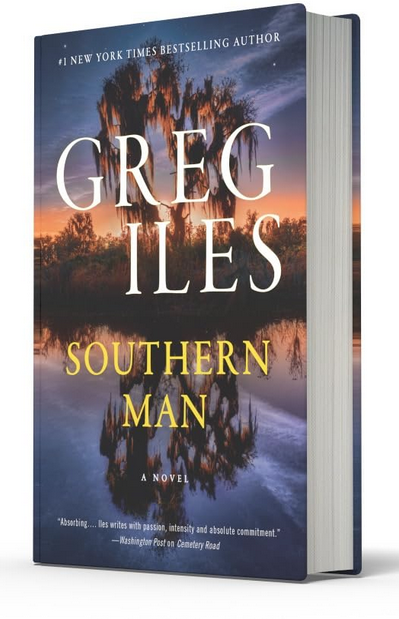
This is a massive book physically as it is over 900 pages long. Emotionally, it is huge, as it deals with suffering, death, revenge, remorse and corruption with relentless intensity. Politically it is intensely topical as it deals with the prospect of a Donald Trump second term as POTUS, and the mood of the voters who put him into the White House in the first place. Historically, it is deeply challenging, as it looks at the legacy of over two centuries of prejudice and cruelty in the southern states of America.

The title refers to a 1970 song by Neil Young where he excoriates the archetypal redneck southern male. The song may (or may not) have triggered a musical duel with Lynrd Skynrd, when their response was Sweet Home Alabama. The novel features Mississippi lawyer, politician and author, Penn Cage, who appeared in previous Greg Iles novels. Click the link for more information.

The back story here is complex, but in a rather large nutshell:

Penn Cage, has an obscure terminal cancer which is slowly killing his octogenarian mother.
Cage lost a leg beneath the knee in a road accident.
He is a civil liberties campaigner.
Dr Tom Cage, Penn’s father, a much respected physician, wrongly imprisoned, died in prison riot at Parchman Farm penitentiary.
Cage is a widower. His wife died of cancer and, much, later, his fiancée was murdered.
He has a twenty-something daughter called Annie, also a liberal minded lawyer.

The early narrative darts back and forth between current events and the days following Dr Tom Cage’s death in the prison riot. The reasons for Tom’s incarceration are complex, but Greg Iles spells it out with great clarity. Present day couldn’t be much more topical. Donald Trump is gathering momentum for a second bid for the presidency, but the almost unthinkable has happened. A charismatic war veteran called Robert Lee White is aiming to be the first independent candidate since Ross Perot in 1992, and he has a huge following via his Tik Tok videos and a very popular radio show. He came to national prominence when he led a special forces team searching for a notorious Taliban leader. They found him, and White administered the coup de Grace.

Present day. As Bobby White hones his media profile for TV audiences, he receives a boost. Attending a largely black music festival, he heroically rescues Annie Cage and several others, mostly black youngsters, who have serious bullet wounds after white Sheriff’s deputies open fire on the crowd after a shooting incident. However, Bobby White’s pitch for POTUS has a serious problem. He lacks the prerequisite adoring wife and clutch of tousle-haired children. Why? I can only direct you to the coded words at the end of many a Times obituary – “He never married.”

The deaths at the music festival have serious repercussions. Within days, a treasured pre Civil War mansion,  is burned to the ground. and there is a calling card from The Bastard Sons of The South, apparently a militant BLM organisation. Penn Cage, as a white man, is thrust onto the horns of a dilemma. He is white with serious influence in political circles, but he is also widely respected with the black community, both for his own integrity, and the legacy of his late father. Can he prevent a bloodbath, as the calls for revenge lead to a disastrous polarisation on the streets between black and white factions?

The conflict is not just between black and white people. America has a bewildering number of layers of law enforcement. At the apex is the FBI. Their remit extends across the nation, irrespective of state boundaries. Then we have Sheriffs, appointed by vote. They and their deputies rule the roost over large state subdivisions, known as Counties. Large towns and cities will have their own independent  police departments. Last, but by no means least, are the National Guard. They are volunteers, but basically members of the armed forces, and will usually have access to military standard weapons and vehicles. In Southern Man, each one of these agencies come head to head in the streets of Natchez, while the barge-trains and freighters battle against the Mississippi current, beneath the cliff top where thousands of black peace protestors stare in the muzzles of National Guard issue AR-15 rifles.

There is a substantive second story which emerges at different times in the novel. Penn Cage’s mother has been researching her family history, and has pretty much completed it. What it reveals is that Cage and his daughter are descendants of a woman who was the product of a union between a slave owner and one his female slaves. This document allows Greg Iles to explain the complex and often contradictory relationships between slaves (before and after emancipation), and their owners. He also makes the point that the members of the victorious Union army were all too often nothing like liberating saviours.

Cage’s declining health make him rather like Tennyson’s Ulysses:

Tho’ much is taken, much abides; and tho’
We are not now that strength which in old days
Moved earth and heaven, that which we are, we are;
One equal temper of heroic hearts,
Made weak by time and fate, but strong in will
To strive, to seek, to find, and not to yield.

With an increasing sense of frustration, he tries to get to the bottom of who seems to be manipulating the perilous situation on the streets, as rival groups – militant Black activists, peaceful protesters, far right militias, City police and Sheriff’s Deputies edge ever nearer to a cataclysmic explosion of violence.

Greg Iles just doesn’t take sides. He is scathing and abrasive about everything to do with the concept of the honourable South. He has little truck with historians like the late Shelby Foote, who, memorably, appeared several times in Ken Burns’ magisterial documentary The Civil War, and attempted to explain that a typical Southern Man of the Confederate era was not always a brutal redneck bent on raping and brutalising black people.

In several ways, Penn Cage mirrors the real life author.

Both lost part of a limb in a road accident.
Both had fathers who were doctors.
Both had mothers who died of cancer.
Both have a rare form of cancer.

This is a brilliant novel, for sure, which rolls a rock away, and exposes all manner of nasty creatures scurrying away from the light. Is there any room for nuance in the north v south controversy? Greg Iles doesn’t think so, and his superb writing underscores his argument. Me? I am on the fence, not because I approved of the concept of slavery, or the horrors meted out to its victims, but because when you severely punish a nation – which the South thought it was – there are unintended consequences, as The Treaty of Versailles proved in 1919. Post Appomattox 1865, a long lasting sense of grievance was born, and it has yet to die of old age. So-called White Guilt looms large in the novel, as my occasional visits to North Carolina suggest to me that it does in real life.

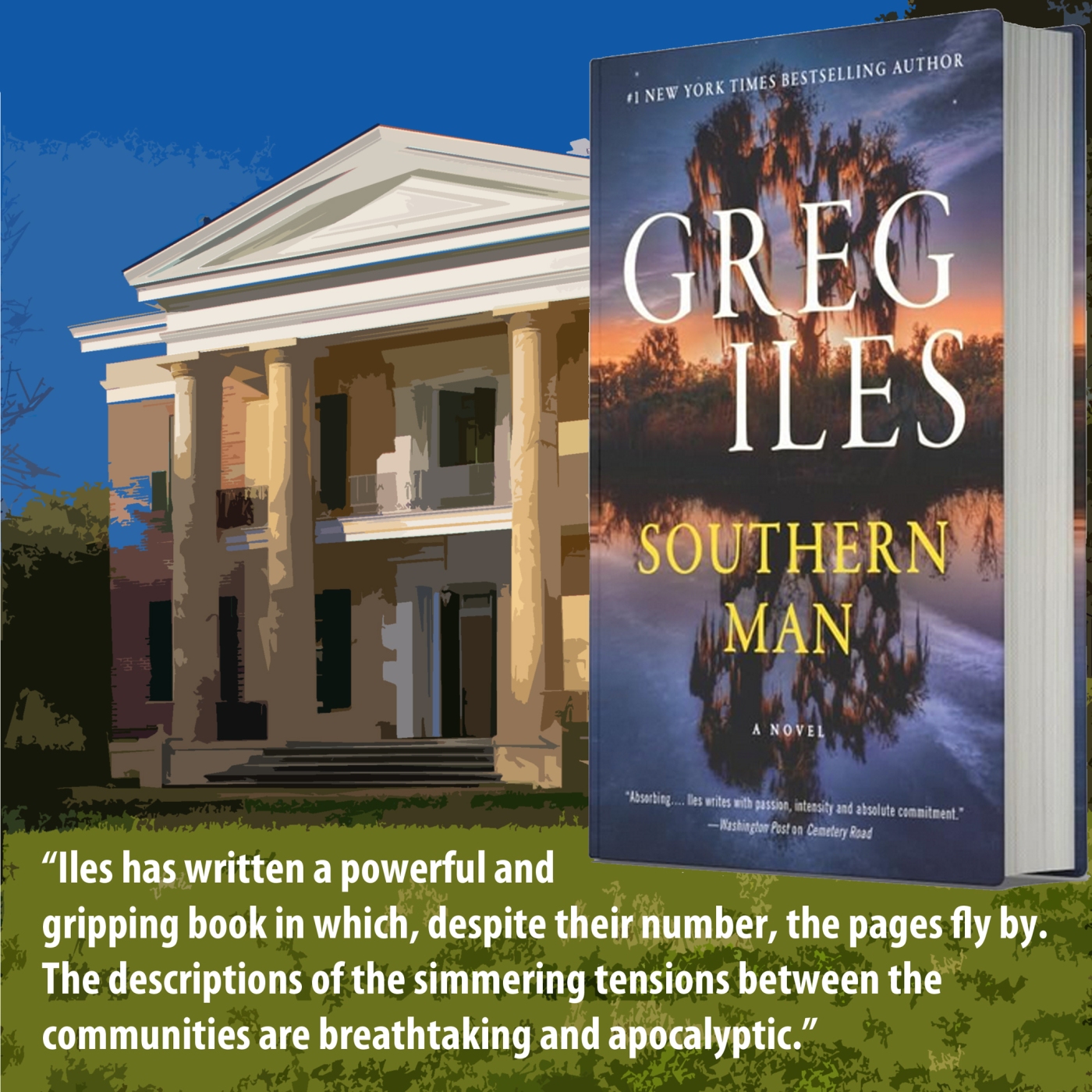
Aside from the politics, Iles has written a powerful and gripping book in which, despite their number, the pages fly by. The descriptions of the simmering tensions between the communities are breathtaking and apocalyptic. I only hope that in the months to come, they remain fictional. if they play out in real life, there will be a second War Between The States, and America will suffer grievously. Southern  Man is published by Hemlock Press and will be out on 6th June.

Screen Shot 2024-06-03 at 17.52.05

Blog at WordPress.com.

Up ↑