
Some critics have compared Anthony Rhodes (1916-2004) with his more illustrious near contemporary, Evelyn Waugh. They were both Roman Catholics, although Rhodes converted late in life. Both wrote novels, biographies and travel books. Both – and this is most relevant here – wrote fictionalised accounts of their service in WW2. Waugh’s Sword of Honour trilogy – Men at Arms, Officers and Gentlemen & Unconditional Surrender – was a much more substantial achievement, but both wrote from the view of public school educated men who had gone on to higher education, in Waugh’s case Oxford, and in Rhodes’s case Royal Military College Sandhurst. The latter, of course, makes Rhodes a professional soldier, but they both wrote with a certain sardonic detachment about the war and the soldiers who served in it.
Sword of Bone begins in the early autumn of 1939 when Rhodes becomes a liaison officer for his army division. He is a gifted linguist, and he is a member of the advance party sent to France. They assemble in Southampton, then:
“At three o’clock that afternoon we embarked on a miserable grimy little cross-channel boat called The Duchess of Atholl, which had been painted a dirty grey and which, except for what appeared to be an inexplicable pair of blue knickers drying on the bridge, had little enough connection with her eponymous aristocrat.”
 His party work their way at a leisurely pace from Brittany up to the grim and grey slag heaps and factory chimneys in the region of Lille, Lens and La Bassée. His role eventually settles into that of commissioning supplies of engineering materials – principally those needed to meet a sudden demand for concrete pill boxes.
It is worth spelling out at this stage what exactly was going on in the war in Western Europe. On 3rd September 1939, Britain and France declared war on Germany as a result of Hitler’s invasion of Poland. All through that autumn, until the winter became spring, there was little or no military action on the ground. In December, British warships had engaged the German Battleship Graf von Spee, and forced it to seek refuge in the neutral port of Montivideo, where it was eventually scuttled. Back in France, the French had the largest army in Europe, the best tanks, and were convinced that the complex of fortifications known as The Maginot Line made its eastern border with Germany impregnable.
Not so secure, as Rhodes finds when he is billeted near Lille, is the border with Belgium – little more than a few strands of barbed wire and sentry boxes manned by a handful of bored soldiers. The first half of the book is a series of entertaining encounters with village Mayors, profiteering restaurateurs, blimpish Colonels and the complex hierarchies that exist between different parts of the British Army. In Rhodes’s entourage are other officers, of contrasting temperament and character. There is Stimpson, intellectual, effete, almost, and politically rather ‘unsound’.
“When the last politician has been strangled with the entrails of the last general, then, and only then, shall we have peace“, he says one evening in the Mess.
The Padre is emphatically different. He is “a man whose views on the treatment of Indians did more credit to Kipling than to his cloth.“
Rhodes catches sight of his first German (through binoculars) when he and other officers visit a Maginot fort near Veckering, in the Moselle region. Rhodes’s Major wants action:
“Quick, ” said Major Cairns, turning to a Guardsman with a rifle, “Pick him off. Quickly, man.”
“Please, ” said the subaltern, without moving, “do no such thing. Our business is to obtain information. We want prisoners, not dead men. Besides, if we fire from here, it will only give our own position away. I am afraid I must ask you not to think of firing, sir. It will only mean an immediate reply from the Boche with mortar fire.”
Major Cairns sadly put down the rifle which he had taken from the Guardsman, and we all stood by the trees looking out over the valley.”
Of course, the fun has to end sometime, and after a foray into Norway, Hitler’s forces invade Holland Belgium and France on 10th May. The citizens of Louvain and Brussels, remembering the heroics of two decades earlier, are convinced that the ‘Tommies’ will, once again, give the Boche a bloody nose. As we all know, it was not to be. The Germans have ignored the Maginot Line and are storming down through Belgium. Arras falls, and the French army – on paper, numerically and technically superior – are in headlong retreat along with their British allies. It is very much a case of “our revels now are ended” for Rhodes and his colleagues.
Sword of Bone is a little masterpiece. As it follows the fortunes of a small group of British Army officers in the early days of WW2, it records their journey from champagne and lobster lunches and a seemingly absent enemy, to the terrifying and bloodstained beaches of Dunkirk. Rhodes writes with great charm, gentle satire, pinpoint observation but with total authenticity. The book is published by the Imperial War Museum and is out now.
You can read my reviews of the other books in this excellent series by clicking the image below.



 Years later
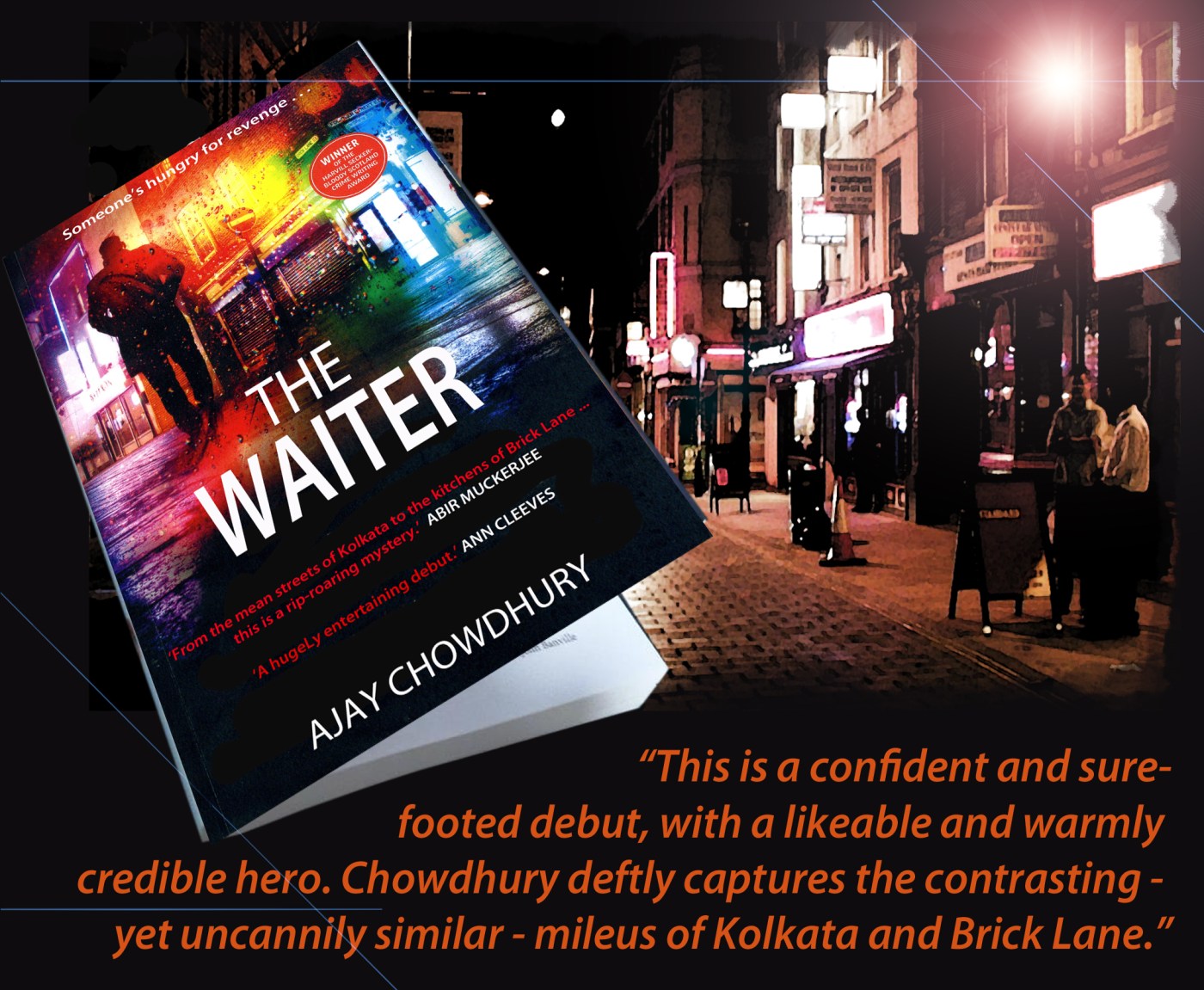

 The restaurant is run by his relatives Saibal and Maya, with help from their daughter Anjali. At this point is worth reminding people that families are the big thing in the sub-continent, and most of the characters in the book are related in one way or another. The story starts on the evening that the restaurant has been booked to provide the food for the lavish 60th birthday party of rich entrepreneur Rakesh Sharma. He and his new wife Neha – half his age – are installed in a lavish mansion on Billionaire’s Row near Hampstead Heath. It’s also worth mentioning at this point that Sharma’s first wife (and son by that union) are still very much on the scene.



 Satoshi ‘The Prince’ Oji is the darkest character of the five. He is utterly without compassion. Other human beings – school teachers, teenage friends, other adults – only have value to him in the sense that they can be used for his entertainment. He is highly intelligent, but one of the more malevolent fictional villains I have encountered in recent times. Everything is thought through and planned in the minutest detail, such as his grip on Kamura. The grizzled gangster could, physically, chew up Satoshi and spit out the bones, but the teenager convinces Kamura that he has an insider in the hospital where the man’s son is lying in a coma, and should Satoshi fail to answer periodic calls to his mobile ‘phone, then this insider will find a way to disconnect the little boy’s life support system.

 While reporting on the death and mutilation of a young rent boy, Russell is asked by a friend to take on another case, this time on behalf of a senior army officer whose daughter is missing. It is a delicate business, because there is a strong suspicion that Lili Zollitsch has run off with a boyfriend who is an active member of the Kommunistische Partei Deutschlands.


 fullybooked2017