

 Every schoolboy of my generation was taught the history of Britain’s great social reformers of the 19th century, and we were able to rattle off their names – Elizabeth Fry for prisons, Florence Nightingale for nursing, Cobbett for agriculture and Wilberforce for slavery. I have to confess that until I moved to Wisbech in the early 1990s, I hadn’t heard of Thomas Clarkson. Now, as I pass his imposing memorial every time I walk into town it is a constant reminder of a man who has been called ‘the moral steam engine’ of the movement to end Britain’s connection to the slave trade.
The slave trade from Britain was a brutally simple triangle. Ships left port carrying British made goods such as cloth, muskets, ball and powder, plus such humdrum items as pots and pans. The ships were mostly crewed by human flotsam and jetsam, men often forced to make the journey due to debt or coercion. They sailed to what was known as The Guinea Coast, as shown on this contemporary map.

Once docked in West Africa, the ships’ captains would trade with slavers, almost always Africans themselves, usually members of dominant tribes. Their currency was human lives, often captured in battle, or simply raided from villages. A typical trade might be one healthy man for two muskets. The slaves were then stowed in unspeakable conditions as the ships set sail for places like the American South or Jamaica. A captain’s ambition was to reach his destination with as many of his captives – sometimes in excess of three hundred – as saleable as possible. The surviving slaves would then be sold mostly for raw cotton, tobacco, loaf sugar and molasses – highly valued in the brewing trade and the burgeoning popularity of coffee houses – plus ça change, plus c’est la même chose.
The ship would then complete the third side of the triangle, sailing back, usually to Bristol or Liverpool, with a relatively smaller number returning to London or ports on the River Clyde.. The slaves were not the only victims. The journey back to Britain would only need a few crew members, and the fewer that were left on board as the ship entered home waters, the fewer that needed paying, thus increasing the profit for the investors who backed the enterprise.
Thomas Clarkson cuts a distinctive figure. A gangling man, over six feet tall, with a shock of unruly red hair he has the courage of a zealot. He begins gathering his evidence about the sheer inhumanity of the slave trade by visiting Bristol, where he speaks to men who have witnessed the barbarity of the triangular voyages. He makes the acquaintance of Dr Gardner, forced by fate and circumstance to enlist as physician on board the soon-to-depart ship, The Brothers.
Busy as Bristol is, it is nothing compared to Liverpool, where slave ships are moored row on row in the docks. Clarkson travels north, and goes about his fearless business despite death threats, and focuses his attention on one English sailor, Peter Green, whose death typifies the inhuman treatment of members of the ships’ crew. The irony is, of course, that the countless Africans who die on these voyages have no names. But Green was born and baptised an Englishman. He had kith and kin. His miserable death is a powerful weapon in Clarkson’s campaign.
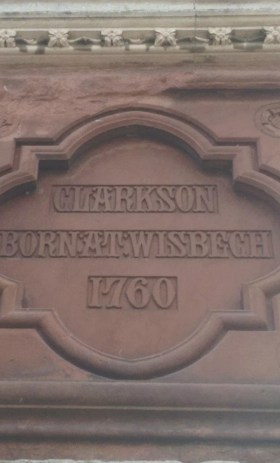 Clarkson narrowly avoids becoming the victim of a mob in Liverpool. Meanwhile, as readers, we are privy to Dr Gardner’s diary written during the voyage of The Brothers. The two narratives become parallel: at sea, once the slaves have been offloaded, the voyage of the vessel – in theory a relatively safe and simple return home – is blighted by what seems to be a malignant spirit at work in the depths of the ship. The crew members disappear, one by one, and the barbarous Captain Howlett is driven mad.
Back in England, we share the frustrations of Clarkson and fellow campaigner Granville Sharp, as – to stay with a nautical analogy – the good ship Abolition founders on the rocks of vested interests and parliamentary procedure. This story is set in the late 1780s and it wasn’t until 1807 that the British involvement in the slave trade was ended by parliamentary decree. For the record, Wilberforce’s part in the campaign was not inconsiderable but, as MP for Hull, he was able to fire the bullets that Clarkson had made for him.
Readers will glean a solid historical background to more recent events, like the statue-toppling in Bristol, and demands for reparations for the descendants of historical crimes. It is worth pointing out that the loan taken out by the British government to compensate those whose wealth was diminished by abolition, was only paid off in 2015.
The Brothers is a tale of an unspeakable and barbarous trade, and of the physical and moral courage of one man who fought to end it. The novel is available now.


 fullybooked2017