Search

fullybooked2017

Tag

Lincoln

THE WATER DOESN’T LIE . . . Between the covers

twdl spine022 copy

The story begins back in the day, in grisly fashion. A lad, in the so-called ‘care’ of a Roman Catholic children’s home in Scotland has been sexually abused to the extent that his self esteem is shattered and he sees no  reason to live. He hangs himself from a beam, using torn up bed-sheets. The police are eventually called, but the patriarchal attitude of the priests (and a handy golf club connection with a top copper) means that the death is just written off for what it was, a suicide, but the cause goes uninvestigated.

Cut to the present day and we are in the cathedral city of Lincoln. The location gave me a huge amount of pleasure, as one half of my ancestry is as Lincolnshire as haslet, Sincil Bank, Mablethorpe, the wonderful Wolds – and Lincoln’s imp itself. When a body is fished out of a local lake and eventually identified as a former Roman Catholic priest (and child abuser), DI Dalton and his oppo, DS Gibb, are drawn into a murder investigation that will take them away from their bailiwick to Glasgow, and the less than salubrious visitors’ rooms of HMP Barlinnie. Someone – maybe with an accomplice – scarred by their brutal days in church care has decided to take revenge, and the body count increases.

Dalton and Gibb follow one or two false trails before they are forced to face the fact that not only is their quarry extremely adept using modern technology, and suspiciously familiar with the way modern police work is done, but they are also something of a weapons expert. As a keen target shooter myself, I can vouch for the fact that a 7.62mm rifle with a decent scope is a formidable weapon in the hands of a sniper. I am not sure if KIm Booth has had the misfortune to fall foul of the deeply secretive and self-protective world of the Roman Catholic church, but the crimes he describes here sound grimly authentic.

The procedural aspects of the story are totally convincing as one might expect from a former police officer – after several jobs and a brush with the law Booth decided to join the Lincolnshire Police, where he served 35 years mainly in investigative roles. The attention to crime-scene detail, the awareness of sharp-eyed defence lawyers for any slight slip-up in the chain of evidence and the debilitating effect form-filling and box-ticking can have on investigators is described in detail. Perhaps the author (in my view) has taken something of a risk in the way he chooses to end the search for the children’s home avenger, but Dalton and Gibb have the potential to become an established CriFi partnership, and I hope that future books will let us know a little more about the men and what makes them tick as people.

Kim Booth was born in Lincolnshire. After leaving the police he worked as a Corporate Security Manager for a well know international holiday company for a number of years. Currently he has started to fulfill a long standing intention to write true crime and crime fiction books. He lives in the city of Lincoln. The Water Doesn’t Lie is available now.

‘A PALE FACE AMONG THE RUSHES’ . . . The death of Alfie Wright (part two)

Alfie header2

SO FAR: August 1895. Hannah Elizabeth Wright, 23, gave birth to a little boy, Alfred Edward, in November 1893. The boy’s father has disappeared, leaving Hannah to deal with the situation. Alfie has been in the care of a Miss Flear, who lives near Newark, but Hannah can no longer afford to give Miss Flear the money she requires, and has collected the little boy, and returned to Lincoln on the evening of 26th August. The following day, having not returned to their home in Alexandra Terrace the previous evening, she tells her brother and his wife that the boy is still in Newark, and is being put up for adoption.
Screen Shot 2023-09-14 at 13.36.13

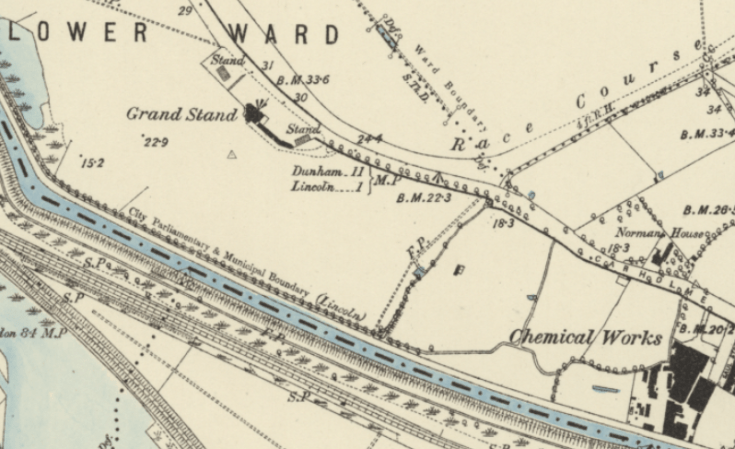
Foss Dyke is a canal that links Lincoln with the River Trent at Torksey. Some historians insist that it was built by the Romans, while others believe that it dates back to the 12th century. It was along the bank of this ancient waterway, between Jekyll’s Chemical chemical works and the back of the racecourse grandstand, that on the evening of Monday 26th August our story continues. A young man called James Fenton was sitting on a bench with a lady friend, when a woman passed them, walking in the direction of Pyewipe. She was carrying a bundle, but they heard a whimpering sound, and they realised that she was holding a child. It was, by this time almost dark, but when the woman passed them again, this time heading back towards the city, she was empty handed. Thinking this strange, Fenton followed the woman at a distance, but lost her somewhere in the vicinity of Alexandra Terrace. The following morning, Tuesday, a man on his way to work had an unpleasant surprise. He was later to tell the court:

Pale face

RecoveryJames Fenton had contacted the police with his suspicions, and the discovery of the body confirmed the police’s worst fears. It is not entirely clear how the police knew exactly where to find the mystery woman, but on the Tuesday, they paid several visits to the house at 25 Alexandra Terrace. Hannah Wright, however, was nowhere to be found. She had left that morning, telling her sister-in-law that she was going to visit friends. She did not return until the Wednesday morning, by which time the police had instituted a full scale murder investigation. Hannah confessed to Jane Wright, and a neighbour, Mrs Sarah Close. It was Mrs Close who accompanied Hannah to the police station, but the girl seemed to be under the bizarre misapprehension that if she told the truth she would get away with a ‘telling off’ or, at worst, a fine. She was not to be so fortunate:

Confession

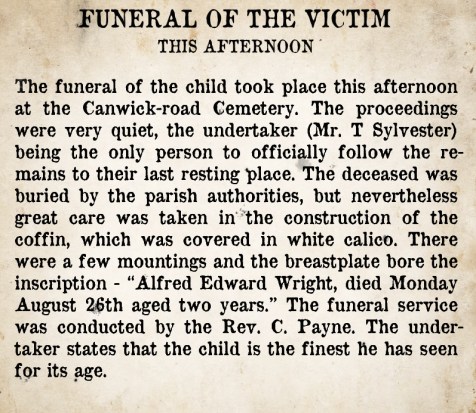
FuneralThe law took its inevitable course. There was a coroner’s inquest, then a magistrate’s hearing, both of which judged that Hannah Wright had murdered her little boy. As was customary, the magistrate passed the case on to be heard at next Assizes. Meanwhile Alfie’s body was laid to rest in a lonely ceremony at Canwick Road cemetery. It is pointless speculating about Hannah’s state of mind, but it is worth reminding ourselves that Alfie had known no father and  had seen very little of his mother during his brief sojourn – fewer than 300 days – on earth. If ever there were a case of ‘Suffer the little children’ this must be it.

Whatever the state of Hannah Wright’s mind when she drowned her son, and during her  long months before she came to trial, when she finally appeared before Mr Justice Day at the end of November she must have had a cold awakening as to what possibly lay ahead of her. Since September, there had been various intimations in the press that Hannah was, to use the vernacular, “not quite all there” but there was no medical evidence that she was weak minded or mentally deficient. Her defence barrister made a rather odd case, as was reported in The Lincolnshire Echo on Tuesday 26th November 1895:

“The Judge pointed out that the defence was rather an unusual one, namely of a two-fold character, one contention being that the prisoner never committed the crime all, and it she did do so that her mind was unhinged at the time. As to the plea of insanity he did not see that there was the slightest evidence to show that her mind was diseased. The jury retired to consider their verdict at 5.20, and returned into Court after an absence of twenty-seven minutes. They found the prisoner guilty, with a strong recommendation mercy. Prisoner made no reply to the question put to her by the Clerk whether she wished to say anything before sentence was passed. The Judge, who appeared be deeply affected, said the jury had simply discharged their duty, painful though undoubtedly was. With regard to the recommendation to mercy his Lordship said he would wish and beg her not to place undue reliance upon that recommendation. His Lordship then passed sentence of death in the usual manner. Prisoner fainted as she was being led down the dock steps.”

The general public in Lincoln and round about had become very involved in this tragic case, and even before Hannah collapsed on the steps of the dock, a petition was created and with thousands of names on it, presented to the Home Secretary, Sir Matthew White Ridley KCB. Within days, the threat of the hangman’s noose was lifted.

reprieve

Peter Spence, a distant relative of Hannah, and to whom I am indebted for sharing his research, suggests that this story has something of Thomas Hardy about it, but we would do well to remember that poor Tess (of the D’Urbervilles) is hanged for her crime. Not only did Hannah survive, but she was released from prison in Aylsbury, apparently going straight to London to work as a servant.

Screen Shot 2023-09-14 at 19.01.38

Strangely, that is where the story ends. Peter Spence, and that eminent compiler of Lincolnshire crime stories Mick Lake, like me, have found no trace of what became of Hannah. This is unusual, given the amount of information available on modern genealogy websites, but it it is what it is. There are a couple of inconclusive mentions in the 1939 register, but no evidence that these people are ‘our’ Hannah. There is this, but is it feasible that a servant girl could have eventually returned to Lincolnshire and died at the age of 89, leaving the sum of £2552 10s – nearly £47,000 in today’s money? Perhaps that is a mystery for another day.

Hannah will

I have been researching and writing about historic Lincolnshire murders for some years,and those wishing to find out more about our county’s macabre past should click this link

‘A PALE FACE AMONG THE RUSHES’ . . . The death of Alfie Wright (part one)

Alfie header1

Hannah Elizabeth Wright was born on 25 August 1872 to John Wright, an agricultural labourer, and Mary Anne Key in 
Kirkby la Thorpe,  a tiny village a few miles east of Sleaford. The 1881 census recorded 256 souls.

1881 KLT

ewerby

Hannah was the youngest of five 
children, two boys and three girls. Sadly, her mother died when she was four. Her father remarried so she 
was brought up by her stepmother. There were few options for young women ‘of humble birth’ in rural communities in those days. It was either work on the land, or go into service – meaning a live-in position with some wealthy family, either as a cook or a general maid. The census in 1891 shows us that Hannah was working in The Manor House at Ewerby, less than two miles from Kirkby. Her employer was Mr William Andrews, a farmer. The Manor House (left) still stands.

By 1893, she had moved further away to the village of Weston, near Newark. It was here that she began a relationship with a local lad and became pregnant. Alfred Edward Wright was born on 3rd November 1893. He was, by all accounts, a healthy child, but his father quickly disappeared from the scene, and became engaged to another woman. This left Hannah in a dire situation. With no other means of support other than her own work, how was she going to bring up Alfie? A solution – of a kind – was found when a Weston woman called Jane Flear offered to take the boy in – for a price.

We know that by 1895 Hannah was working for a family in Branston, south of Lincoln, and had begun another relationship, with a young man called William Spurr, but she kept Alfie’s existence from him. Hannah had already fallen into arrears with her payments for Alfie, but her problems became worse when she received word from Miss Flear that the price for looking after the little boy was to be raised to three shillings and sixpence each week. Using the Bank of England inflation calculator, that would be nearly £38 In modern money, probably more than Hannah earned each week, given that her food and housing would come with the job.

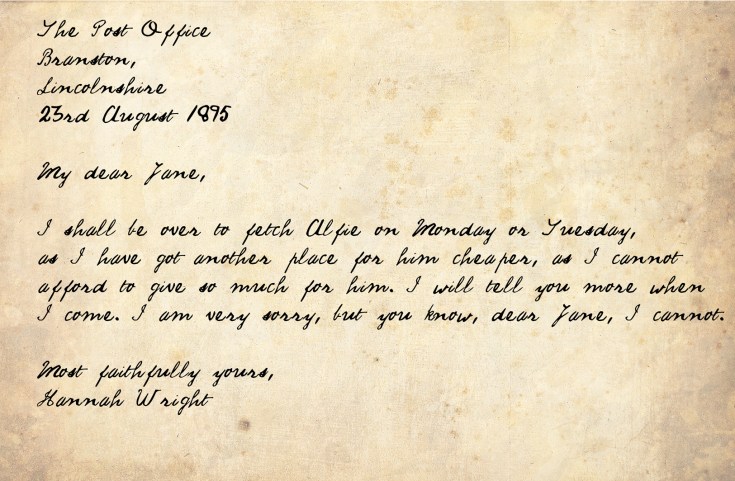
Jane Flear received this letter (facsimile) from Hannah:

Letter

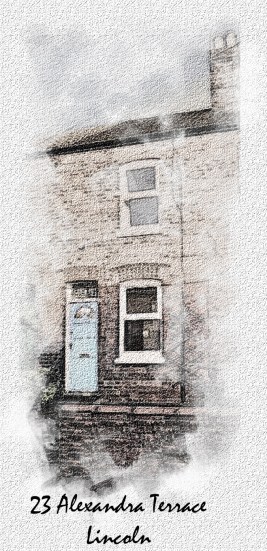
23AlexHaving traveled to Lincoln on the afternoon of 23rd August, Hannah visited her brother and his wife at their house, 23 Alexandra Terrace. All appeared to well, and on the Sunday evening Hannah even brought her young man, William Spurr, round for tea.
Hannah Wright arrived in Weston on the afternoon of Monday 26th August to collect Alfie. Miss Flear had misgivings about handing over the little boy, and thought that Hannah was in something of a disturbed state. When she went to collect the rest of Alfie’s clothes, Hannah said she didn’t want to take them. The three of them, Jane Flear wheeling Alfie in his pram, set off to walk the two miles to Crow Park station, just outside Sutton on Trent. Hannah and Alfie caught the 6.15 train to Retford. Jane Flear never saw Alfie alive again. Hannah eventually returned to the little terraced house in Alexandra Terrace late on the Monday evening,and explained to Jane and William Wright that her little boy was still in Weston, but she had arranged for someone to adopt him permanently. Jane Wright asked her sister in law if she had discussed the situation with William Spurr, but despite Jane telling her that it was wrong to keep back something so important, Hannah was adamant that he was not to be told. They all retired to bed at 11.30 pm. The next morning, at about 9.30 am, Hannah announced that she was going to visit some friends, and would return later.

IN PART TWO

A CONFESSION
A TRIAL
THE BLACK CAP

MARY ANN GARNER . . . A life and death (2)

Mary Ann header

SO FAR: March 1891. Mary Ann Garner, a 32 year-old widow, is living with her three children and teenage step son in a tiny end-of-terrace cottage in Stanley Place, Lincoln. She has been in a relationship with Arthur Spencer, a 22 year-old pork butcher. He has asked her to marry him, but she has refused. Spencer has not taken kindly to the snub.

On the evening of Monday 30th March Arthur Spencer arrived at 19 Stanley Place. He knocked at the door, and Mary Ann’s step son, John Henry Garner answered the knock. The subsequent conversation was later reported in court:
Mary Ann said, “Who’s there?”
“It’s me,” answered Spencer. (Earlier, Spencer had threatened to shoot Mary Ann and then himself if she wouldn’t marry him. She had not taken him seriously.)
She called out, “Have you got that pop-gun?”
Spencer replied, “No.”
Mary Ann said, “Let him in, John.”

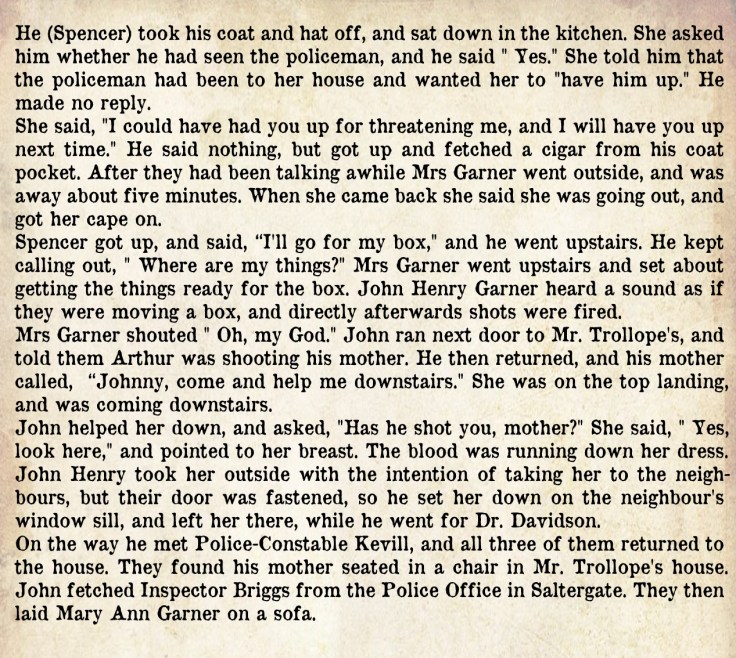
At a court hearing, it was revealed that Mary Ann, despite appearing not to take Spencer’s threat seriously had thought of contacting the police. Spencer had previously lodged at the house, and she assumed that the young man had come back to collect his clothes and belongings. The sequence of events that followed was reported in a newspaper.

The shooting

Mary Ann was, sadly, beyond medical help, and she died in the small hours of the Tuesday morning. Spencer had been true to his word, and turned the gun on himself. It is debatable whether he exhibited the same fatal intent, however, as although he was taken to hospital, he was well enough to appear in court within a few days, charged with the murder of Mary Ann Garner.

At the subsequent coroner’s inquest, the effect of Spencer’s bullets was revealed:

“There is not much to add to the details published yesterday of the dreadful tragedy at Lincoln, except perhaps that later information only tends to intensify the horror which was felt at the cold-blooded premeditation of the murderer, for it was found at the post-mortem examination held on the body of the unfortunate victim that her assailant had fired four shots at her from the revolver. Two of these did no injury beyond causing superficial wounds on the woman’s body, but one fired into her breast and another at her back were both serious wounds. Either of them would have proved fatal.”

The melancholy sequence of events that follows a murder took their course. Mary Ann Garner was buried in Canwick Road cemetery on 3rd April, 1891. Arthur Spencer was brought before a coroner’s inquest, then the magistrates’ court, and finally the Assizes Court at Lincoln in July, where he appeared before Mr Justice Roland Vaughan Williams (below left), an uncle of the celebrated composer. The conclusion was inevitable, and on Tuesday 28th July, Arthur Spencer paid the ultimate price for killing Mary Ann Garner. The hangman was James Berry (below right)

Execution

VW_Berry

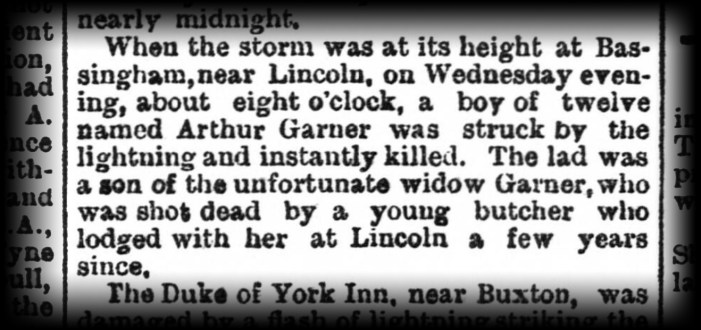
The Gods of Misfortune had not finished their business with Mary Ann’s family, however. On Friday 28th June 1895, a newspaper ran this story:

Lightning

It is a sad reflection on life that most murderers are men, and their victims are frequently women. The women should not be forgotten in Lincolnshire or anywhere else. Click the names below to read the stories of Lincolnshire women who met their deaths at the hands of men. By doing so, you will not bring them back to life, but at least they will not be forgotten. They are in chronological order according to when they were killed.

Louisa Hodgson
Louisa Hay
Mary Ann Garner
Harriet Rushby
Mary Eliza Bell
Ellen Kirk
Lucy Lingard
Sarah Ann Smith
Catherine Gear
Ivy Dora Prentice
Minnie Eleanor Kirby
Janice Holmes

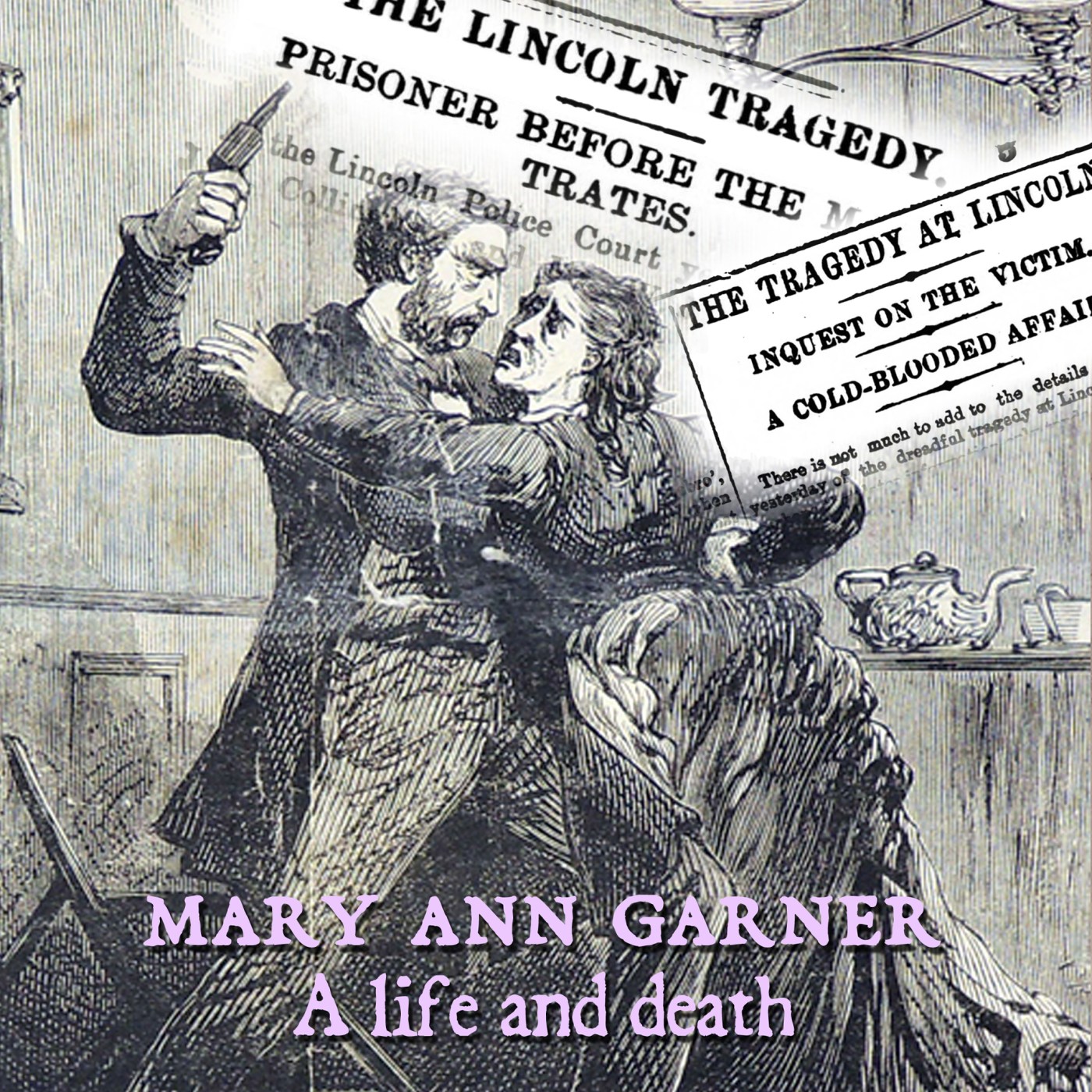
MARY ANN GARNER . . . A life and death (1)

Mary Ann header

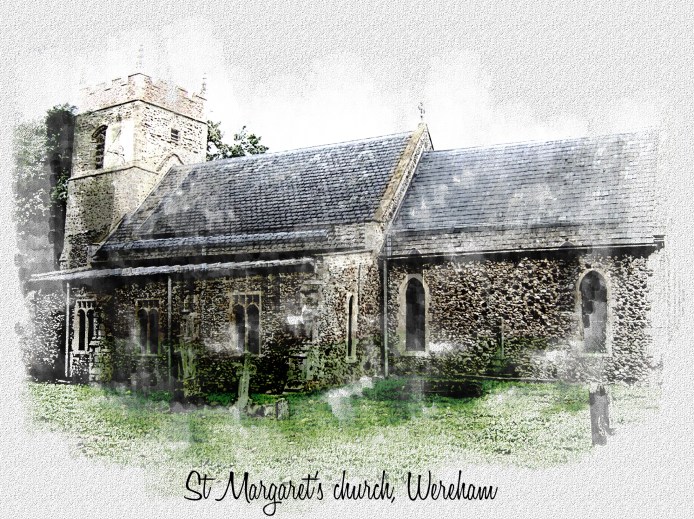
Mary Ann Elizabeth Witrick (or Witterick) was born in Wereham, Norfolk in 1857. Her baptism (above) is recorded in the village church (below) as taking place in 1859. Her parents, John and Ann (née Rust) were poor, hard-working and, like so many other families across the land, produced children on a regular basis. There was no contraception other than abstinence, and child mortality tended to keep a lid on the birth-rate.

St Margarets Wereham

Her life was to end, violently, in a Lincoln terraced house on the evening of 31st March 1891. We know that the family were still in Wereham in 1861, but the remainder of her youth  – and where she spent it – remains something of a mystery. We do know that in 1880, she married a Lincoln widower, Henry Garner. Garner’s wife Charlotte (née Foster) had died in 1879. They had one son, John Henry, who had been born on 23rd April 1875. Mary Ann and Henry went on to have three children, Arthur Garner (b1882) Ernest Witterick Garner (b1883) and Ada Florence Garner (b1886).

Bracebridge

What was to be a run of misfortune for Mary Ann Garner began in 1889, with the death of her husband. He died on 19th August 1889, in Lincoln Lunatic Asylum, Bracebridge (above). ‘Bracebridge’ was a potent word in Lincolnshire, certainly when I was growing up. I spent many hours being looked after by my grandmother in Louth, and when I played her up (which was frequently) she didn’t mince her words. “You’ll have me in Bracebridge, you little bugger!”

Henry Garner had just turned 40.  I can only speculate on his cause of death. One possibility might be, given his age, was what was euphemised as GPI (General Paralysis of the Insane) or Paresis. When researching family history one has to be prepared for unpleasant surprises, as was the case with my great grandfather. He died in an asylum, of Paresis. It is actually the final and fatal stages of syphilis. The disease could be contracted when young, but then the visible symptoms would disappear, only for the disease to return later in life, manifesting itself as delusions of grandeur, erratic behaviour, brain inflammation and, finally, death.

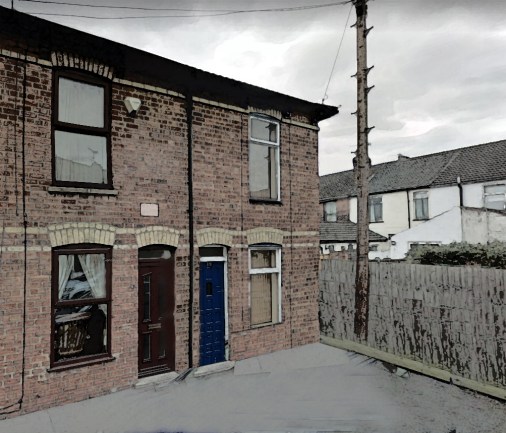
It is unlikely that Henry Garner left his widow very much by way of an inheritance. The early spring of 1891 found her in a tiny end-of-terrace, 19 Stanley Place, pictured below as it is now. To make ends meet, she was taking in washing and, according to a newspaper report, was also taking in lodgers. This is scarcely credible from a modern viewpoint, looking at the size of the house, but that was a very different time in terms of privacy and living space.

Stanley Place

At some point after the death of her husband, Mary Ann met a young man called Arthur Spencer. He was ten years her junior and came originally from Blyth in Nottinghamshire. His trade was pork butcher. For a time, he lodged at 19 Stanley Place, and one must assume that he shared Mary Ann’s bed. He asked her to marry him, but she refused, saying they were better off apart. After this, he left the house, and went back to live over the shop where he worked. Spencer was clearly besotted with Mary Ann, and on the evening of Sunday 29th March, he returned to Stanley Place and told her that if she wouldn’t marry him, he would shoot her and then turn the gun on himself. Mary Ann did not take him seriously, and sent him packing. The following evening, 30th March, Spencer came again to see Mary Ann. A newspaper reported, rather cryptically:

“They appear to have gone upstairs together, leaving the eldest child, a boy of 14, in the kitchen, the other children being in bed.”

What happened next was to send a shudder or revulsion through both the citizens of Lincoln, and cities, towns and villages across the land.

IN PART TWO
Gunshots
Trial and retribution

‘I WILL HAVE HER BEFORE THE NIGHT IS OUT” . . . A brutal murder in 1903 Lincoln (2)

Patchett header

SO FAR: Lincoln, May 1903. Sarah and Leonard Patchett have a troubled marriage. She works as a housekeeper in Lincoln, while he is a bricklayer in Gainsborough. At the end of May, he has traveled to Lincoln to see her. They have a daughter, Rachel, a few weeks short of her second birthday, and she lives with her mother at the house of John King in Spencer Street. Sarah is John King’s housekeeper. On the evening of Tuesday 26th May, Patchett has pleaded with his wife to come back to him, but she only agrees to walk with him to the railway station where he says he will catch a train back to Gainsborough.

After the evening of 26th May, Sarah Patchett is never seen alive again. The last sighting of her was recording in a court statement:

“Mr. J. H. Gadd, livery stable proprietor, stated that about seven o’clock on the night of Tuesday, May 26th, he was driving to his field in Boultham Lane in the company with one of his men. His man called his attention to a man and woman standing at the gate to the second field in Boultham Lane. The woman looked sad and distressed, and the man was in a leaning position with his foot on the lower bar of the gate. As he passed, the man turned round, and he caught full view of his face. On Saturday he identified the body the deceased as that of the woman saw the gate the previous evening.”

Sarah Patchett’s body was found in a field just west of the Boultham Park carriage road on the morning of 29th May. She had been strangled. When a coroner’s inquest was convened at Bracebridge, the details are still chilling over a century later:

medical report new

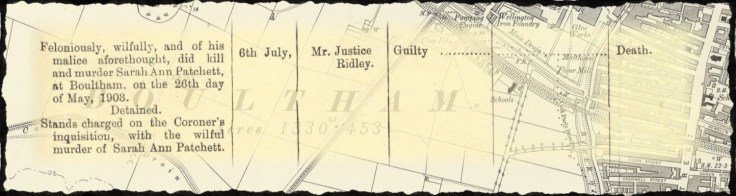
It might be of interest to show where Sarah Patchett was murdered. As far as I can tell, her body was found about 100 yards from the Boultham Board School on the west side of what was then the private carriage road leading to Boultham Hall. Now, of course, the ground where her body lay for three days (red circle) is long since built over. The graphic below may be helpful.

Then and now

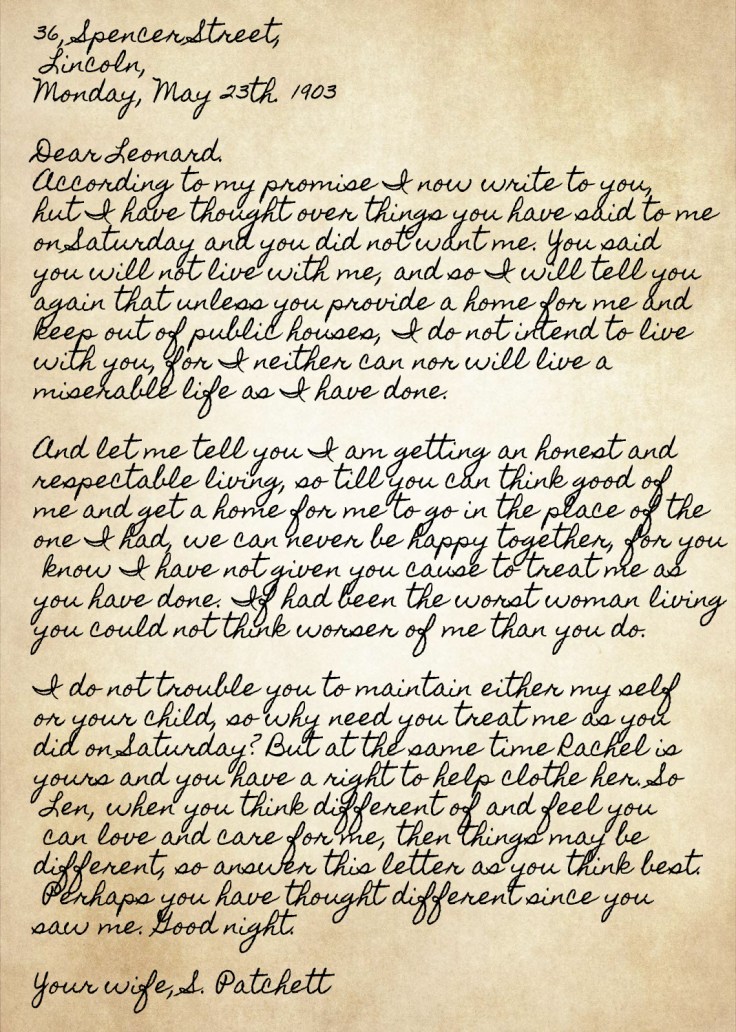
Leonard Patchett was arrested and held in custody. When he was searched, a letter from his wife was found in his jacket. I have made a facsimile (below)

Dear Leonard

At the coroner’s inquest, the magistrates’ court and the subsequent Assizes at Lincoln, Patchett insisted he was innocent and, to be fair, the evidence against him was purely circumstantial. Unguarded remarks he made after his wife’s death painted a very different picture, however. When asked, back at the Gainsborough building site, if he was going up to work on the scaffold, he said, “The next scaffold I will be on will be the scaffold at Lincoln with a rope around my neck.”

What did he mean when he said to Mrs Iremonger, “I will have her before the night is out”? Did he mean he would come and  take his daughter, Rachel, or was it a threat to the life of his wife ?

Screen Shot 2022-06-29 at 19.24.01

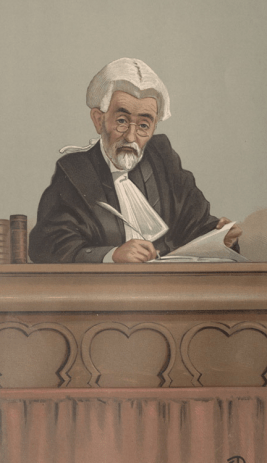
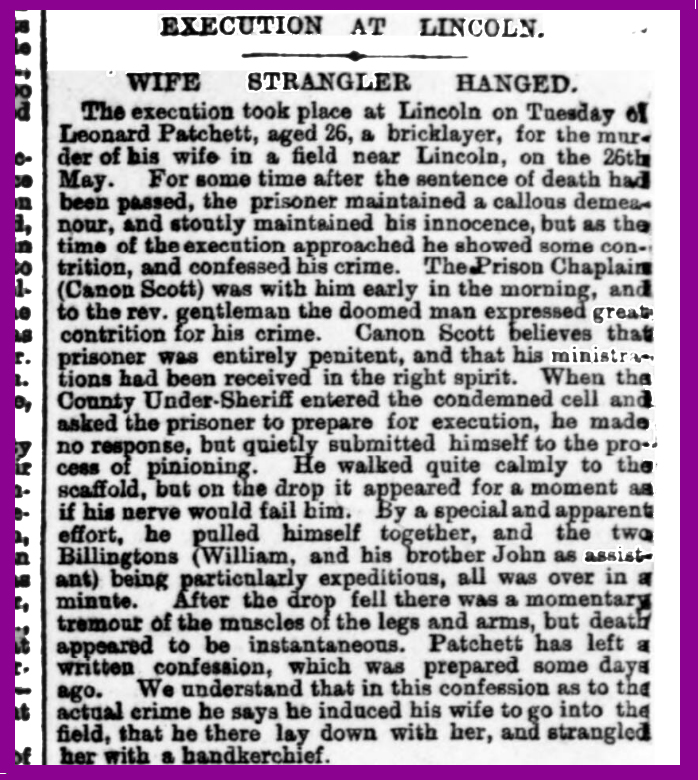
On Monday 6th July, Leonard Patchett was tried for murder at LIncoln, before Mr Justice Ridley (left). Patchett insisted he was innocent but the jury did not agree. The newspapers reported the inevitable conclusion:

“The jury took twelve minutes to consider their decision, and returned into Court with a verdict of “Guilty.” The prisoner heard the sentence apparently unmoved, and in reply to the question as to whether he had anything to say why sentence of death should not passed, replied firmly: “No, but I am perfectly innocent.” The Judge then put on the black cap and said he was bound to agree with the verdict the jury had given. It had been clearly established that the prisoner’s was the hand that strangled the unfortunate woman. The judge recommended him to try to make his peace with Almighty God during the few days of life that remained to him. Sentence of death was then passed. Prisoner received the solemn sentence without the slightest feeling, and then calmly turned round, and walked down the steps to the cells. His sister, who was in an adjoining room, fainted on hearing the sentence. The execution will take place in Lincoln Gaol.”

And so it did:

Execution

Screen Shot 2022-06-29 at 19.10.47

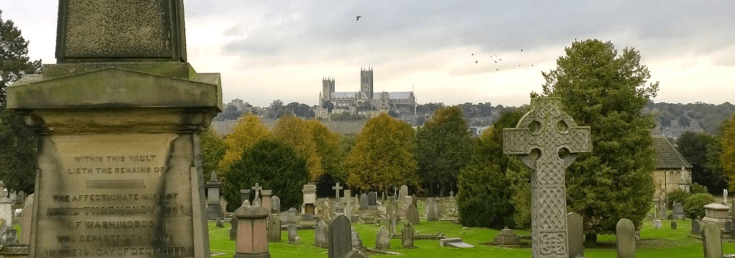
Sarah Ann Patchett was buried in Canwick Road cemetery, while the body of her husband joined those of other hanged murderers in the little graveyard within the walls of the Lucy Tower at Lincoln Castle. There is one link to this terrible tale which takes us into relatively recent times (albeit fifty years ago). Rachel Ceciia Patchett was raised in various children’s homes and, by then known as Rachel Patchett-Smith, married James Newman in 1934. She died in 1972, and was buried at St Peter’s, Pilning, Gloucestershire. My thank to Mandy Freeman for the information about Rachel.

FOR MORE LINCOLNSHIRE MURDER CASES, CLICK THE IMAGE BELOW

lincolns

‘I WILL HAVE HER BEFORE THE NIGHT IS OUT” . . . A brutal murder in 1903 Lincoln (1)

Patchett header

I have been researching and retelling the stories of historic murders for  a long time now, and the overwhelming majority of these cases involve a man murdering a woman. There is rarely what one might call a motive, in the sense that the killer planned his act with the intent to gain an advantage. Occasionally, as with the Spalding Poisoner, the man plans the killing because he has another lover, but all too often, as is the case here, the murder is an act of rage, jealousy, with the sub-text of “If I can’t have you, then no-one will.”

The life of Sarah Ann Smith seems to be punctuated with misfortunes. Thomas Hardy, in Tess of the D’Urbervilles memorably imagined that our lives were manipulated by some unseen hand, moving us around like chess pieces for their own amusement.

“.. and the President of the Immortals (in Aeschylean phrase) had ended his sport with Tess.

The 1881 census has 9 year-old Sarah Ann Smith living in Greetwell Gate, Lincoln, with her parents John and Ann, and her two brothers. In 1891 she was working as a domestic servant in  a house on what was then called Asylum Road. The census that year was taken on 5th April, and in the summer of that year Sarah married Henry Healey Fletcher. Seven years later, on 17th February 1898 their son, Harold Fletcher was born. Sarah’s joy was to be short lived, because with twelve months both baby Harold and husband Henry would be dead. Henry Fletcher, an ironstone miner, hanged himself when rumours began to circulate that Sarah was having an affair with their lodger.

As in the case of Tess, the President of the Immortals had one last cruel joke to play on Sarah. She met and was wooed by a young bricklayer called Leonard Patchett, and in January 1900 they married in St Andrew’s church in Lincoln (picture below). Demolished in 1968, it was one of many Gothic revival churches designed by the celebrated Louth architect James Fowler.

Screen Shot 2022-06-27 at 19.53.13

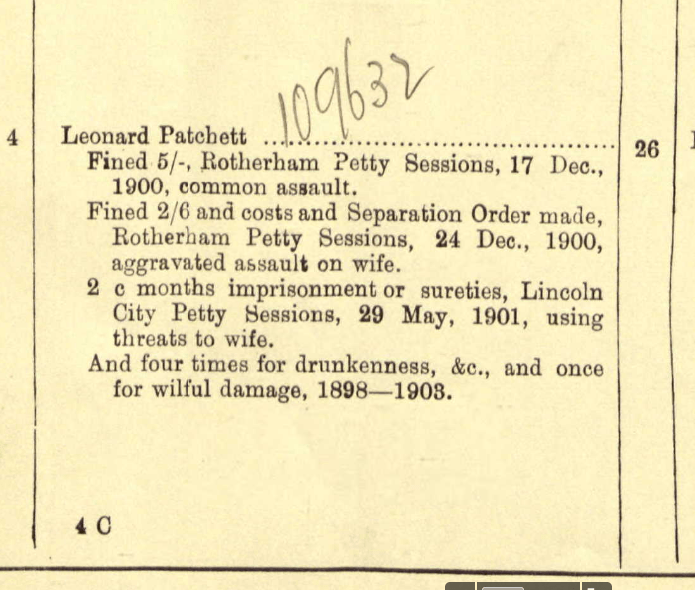
Leonard Pratchett was what used to be called ‘a wrong ‘un’. He was handy with his fists, especially with women, as his criminal record shows.

Criminal record

It wasn’t long before Sarah became fed up with Leonard’s casual brutality, and left him. There followed a sequence of uneasy reconciliations – and the birth of a daughter – Rachel Cecilia. The early summer of 1903 saw Sarah working as a housekeeper for a man named John King, a former military man who now worked as an insurance agent. He lived at 36 Spencer Street, Lincoln. Leonard, meanwhile was working in Gainsborough.

Towards the end of May, Leonard Pratchett took a train to Lincoln, with the intention of patching up his troubled marriage to Sarah. He sought her out at John King’s house, and on the evening of Tuesday 26th May, he asked her to walk with him to the station, from where he was going to catch the train back to Gainsborough. Earlier that evening, Sarah had been out when Patchett came looking for her, and he got into a conversation with a Mrs Emma Iremonger, next door neighbour to John King. It seems that Mrs Iremonger was looking after Rachel, who was a couple of months short of her second birthday. The exchange was reported in the press sometime later:

Emma Iremonger

John King later testified that he was uneasy about Sarah going off with her husband that evening, and asked her not to go, but she declined to take his advice. He waited up until 11.00pm that night, and when she still hadn’t returned by morning he contacted the police. Wednesday and Thursday passed without any sighting of Sarah Patchett.

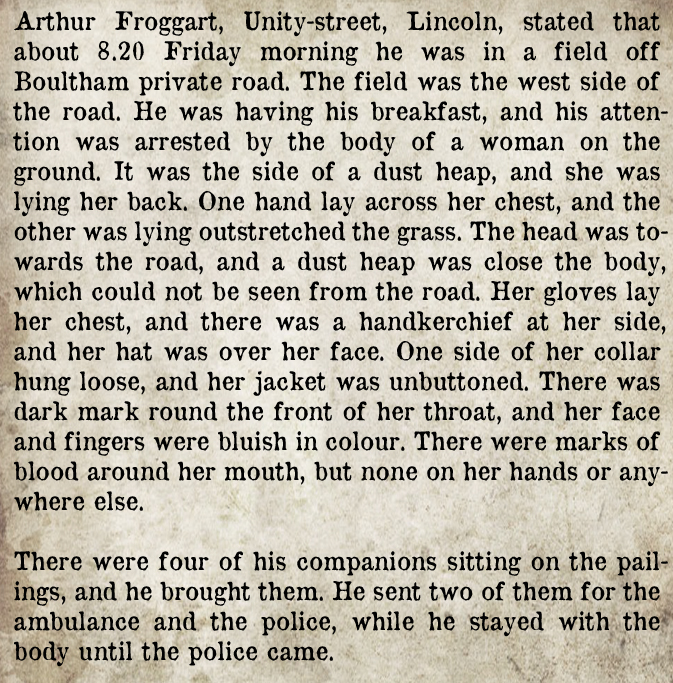
The next events in this tale unfold in a part of Lincoln that is completely unrecognisable today, and it is only by looking at maps side by side that we can get some sense of the landscape in 1903. What is now Boultham Park Road was, in 1903, a private carriage road leading to Boultham Hall, and on either side there were open fields. North of the drain in 1903 was the Wellington Iron Foundry, where some of the first WW1 tanks were built. One of the employees at the foundry was a young man called Arthur Froggatt. They worked long shifts in those days, starting early and finishing late. The men were allowed a break for breakfast around 8.00 am, and on the morning of Friday 29th May, Arthur had walked across the footbridge over the drain to breath some fresh air after the intense heat and fumes of the foundry. He had only walked a little way down the carriage drive, when he saw something untoward. Again this is from a newspaper report taken down verbatim at a court hearing:

Discovery

IN PART TWO
Arrest
A revealing letter
Trial and execution

Blog at WordPress.com.

Up ↑