Search

fullybooked2017

Tag

Leonard Patchett

‘I WILL HAVE HER BEFORE THE NIGHT IS OUT” . . . A brutal murder in 1903 Lincoln (2)

Patchett header

SO FAR: Lincoln, May 1903. Sarah and Leonard Patchett have a troubled marriage. She works as a housekeeper in Lincoln, while he is a bricklayer in Gainsborough. At the end of May, he has traveled to Lincoln to see her. They have a daughter, Rachel, a few weeks short of her second birthday, and she lives with her mother at the house of John King in Spencer Street. Sarah is John King’s housekeeper. On the evening of Tuesday 26th May, Patchett has pleaded with his wife to come back to him, but she only agrees to walk with him to the railway station where he says he will catch a train back to Gainsborough.

After the evening of 26th May, Sarah Patchett is never seen alive again. The last sighting of her was recording in a court statement:

“Mr. J. H. Gadd, livery stable proprietor, stated that about seven o’clock on the night of Tuesday, May 26th, he was driving to his field in Boultham Lane in the company with one of his men. His man called his attention to a man and woman standing at the gate to the second field in Boultham Lane. The woman looked sad and distressed, and the man was in a leaning position with his foot on the lower bar of the gate. As he passed, the man turned round, and he caught full view of his face. On Saturday he identified the body the deceased as that of the woman saw the gate the previous evening.”

Sarah Patchett’s body was found in a field just west of the Boultham Park carriage road on the morning of 29th May. She had been strangled. When a coroner’s inquest was convened at Bracebridge, the details are still chilling over a century later:

medical report new

It might be of interest to show where Sarah Patchett was murdered. As far as I can tell, her body was found about 100 yards from the Boultham Board School on the west side of what was then the private carriage road leading to Boultham Hall. Now, of course, the ground where her body lay for three days (red circle) is long since built over. The graphic below may be helpful.

Then and now

Leonard Patchett was arrested and held in custody. When he was searched, a letter from his wife was found in his jacket. I have made a facsimile (below)
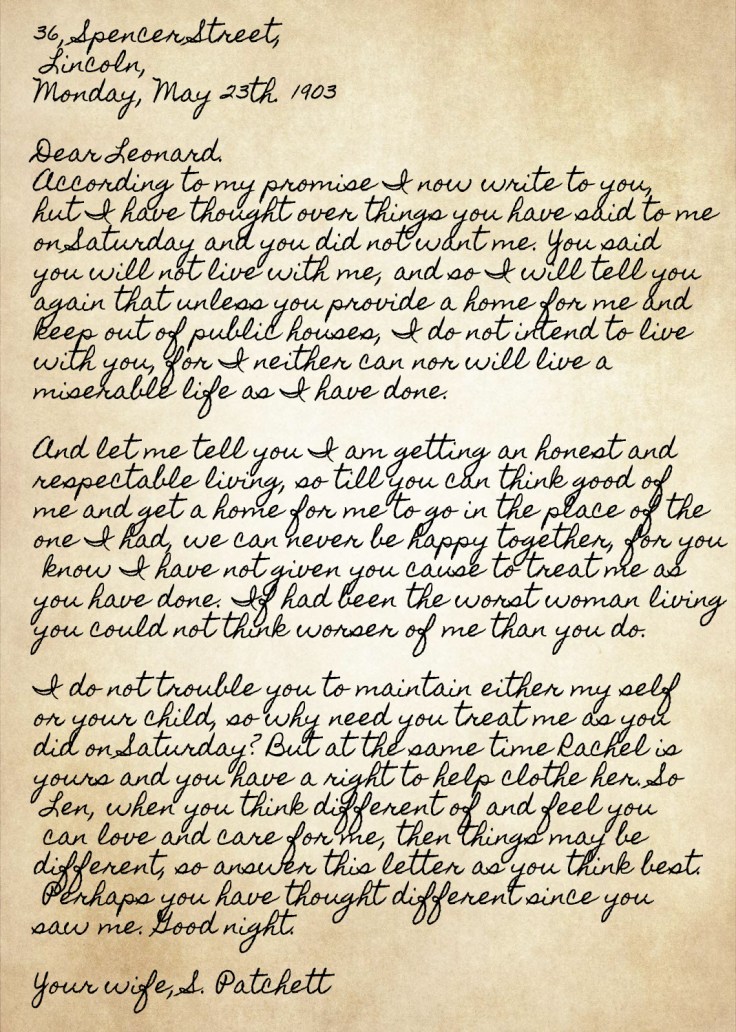
Dear Leonard

At the coroner’s inquest, the magistrates’ court and the subsequent Assizes at Lincoln, Patchett insisted he was innocent and, to be fair, the evidence against him was purely circumstantial. Unguarded remarks he made after his wife’s death painted a very different picture, however. When asked, back at the Gainsborough building site, if he was going up to work on the scaffold, he said, “The next scaffold I will be on will be the scaffold at Lincoln with a rope around my neck.”

What did he mean when he said to Mrs Iremonger, “I will have her before the night is out”? Did he mean he would come and  take his daughter, Rachel, or was it a threat to the life of his wife ?
Screen Shot 2022-06-29 at 19.24.01

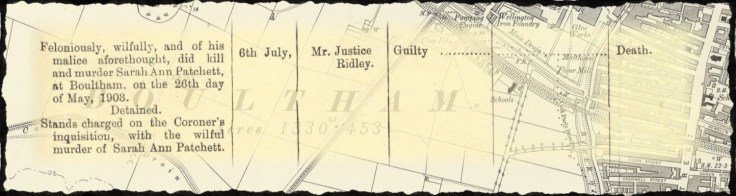
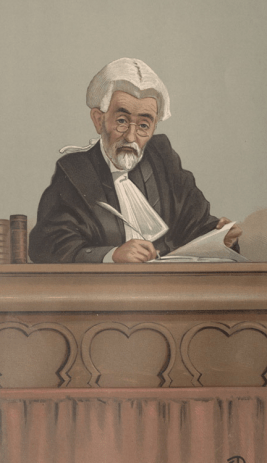
On Monday 6th July, Leonard Patchett was tried for murder at LIncoln, before Mr Justice Ridley (left). Patchett insisted he was innocent but the jury did not agree. The newspapers reported the inevitable conclusion:

“The jury took twelve minutes to consider their decision, and returned into Court with a verdict of “Guilty.” The prisoner heard the sentence apparently unmoved, and in reply to the question as to whether he had anything to say why sentence of death should not passed, replied firmly: “No, but I am perfectly innocent.” The Judge then put on the black cap and said he was bound to agree with the verdict the jury had given. It had been clearly established that the prisoner’s was the hand that strangled the unfortunate woman. The judge recommended him to try to make his peace with Almighty God during the few days of life that remained to him. Sentence of death was then passed. Prisoner received the solemn sentence without the slightest feeling, and then calmly turned round, and walked down the steps to the cells. His sister, who was in an adjoining room, fainted on hearing the sentence. The execution will take place in Lincoln Gaol.”

And so it did:
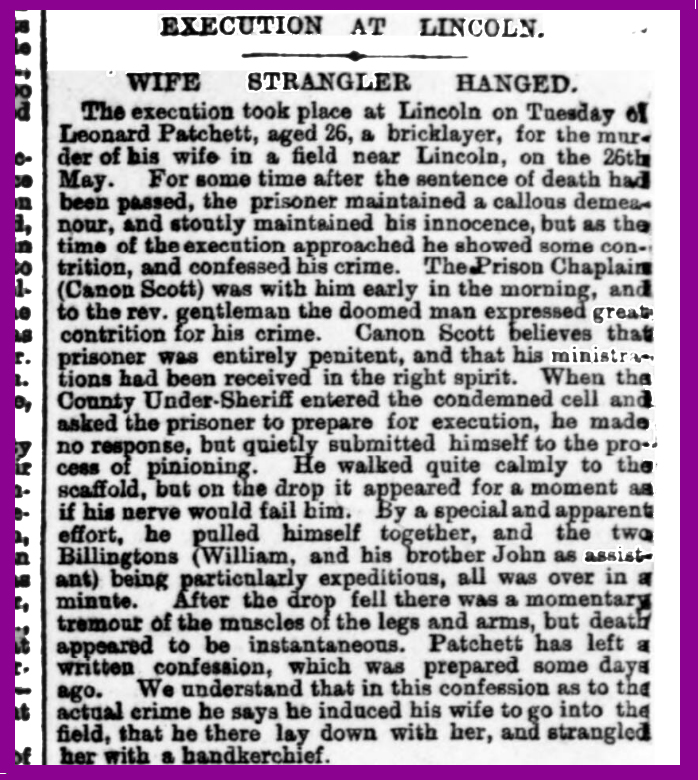
Execution

Screen Shot 2022-06-29 at 19.10.47

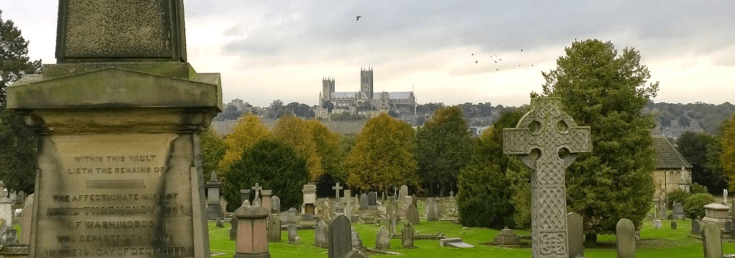
Sarah Ann Patchett was buried in Canwick Road cemetery, while the body of her husband joined those of other hanged murderers in the little graveyard within the walls of the Lucy Tower at Lincoln Castle. There is one link to this terrible tale which takes us into relatively recent times (albeit fifty years ago). Rachel Ceciia Patchett was raised in various children’s homes and, by then known as Rachel Patchett-Smith, married James Newman in 1934. She died in 1972, and was buried at St Peter’s, Pilning, Gloucestershire. My thank to Mandy Freeman for the information about Rachel.

FOR MORE LINCOLNSHIRE MURDER CASES, CLICK THE IMAGE BELOW

lincolns

‘I WILL HAVE HER BEFORE THE NIGHT IS OUT” . . . A brutal murder in 1903 Lincoln (1)

Patchett header

I have been researching and retelling the stories of historic murders for  a long time now, and the overwhelming majority of these cases involve a man murdering a woman. There is rarely what one might call a motive, in the sense that the killer planned his act with the intent to gain an advantage. Occasionally, as with the Spalding Poisoner, the man plans the killing because he has another lover, but all too often, as is the case here, the murder is an act of rage, jealousy, with the sub-text of “If I can’t have you, then no-one will.”

The life of Sarah Ann Smith seems to be punctuated with misfortunes. Thomas Hardy, in Tess of the D’Urbervilles memorably imagined that our lives were manipulated by some unseen hand, moving us around like chess pieces for their own amusement.

“.. and the President of the Immortals (in Aeschylean phrase) had ended his sport with Tess.

The 1881 census has 9 year-old Sarah Ann Smith living in Greetwell Gate, Lincoln, with her parents John and Ann, and her two brothers. In 1891 she was working as a domestic servant in  a house on what was then called Asylum Road. The census that year was taken on 5th April, and in the summer of that year Sarah married Henry Healey Fletcher. Seven years later, on 17th February 1898 their son, Harold Fletcher was born. Sarah’s joy was to be short lived, because with twelve months both baby Harold and husband Henry would be dead. Henry Fletcher, an ironstone miner, hanged himself when rumours began to circulate that Sarah was having an affair with their lodger.

As in the case of Tess, the President of the Immortals had one last cruel joke to play on Sarah. She met and was wooed by a young bricklayer called Leonard Patchett, and in January 1900 they married in St Andrew’s church in Lincoln (picture below). Demolished in 1968, it was one of many Gothic revival churches designed by the celebrated Louth architect James Fowler.

Screen Shot 2022-06-27 at 19.53.13

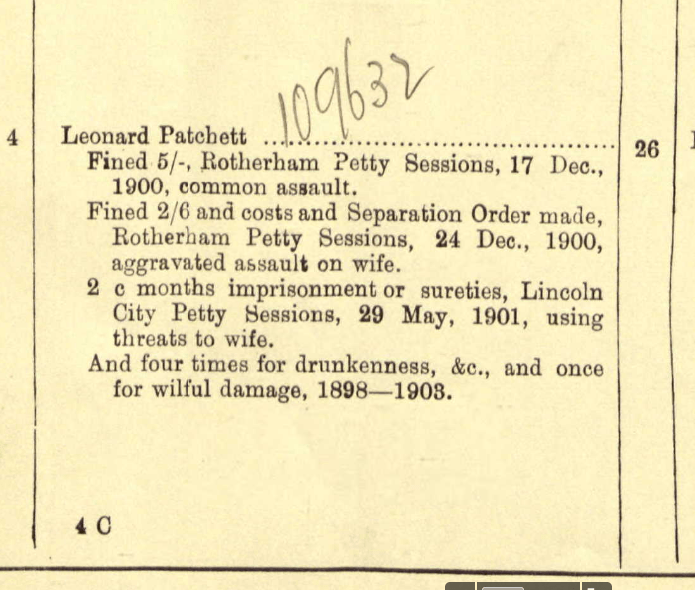
Leonard Pratchett was what used to be called ‘a wrong ‘un’. He was handy with his fists, especially with women, as his criminal record shows.

Criminal record

It wasn’t long before Sarah became fed up with Leonard’s casual brutality, and left him. There followed a sequence of uneasy reconciliations – and the birth of a daughter – Rachel Cecilia. The early summer of 1903 saw Sarah working as a housekeeper for a man named John King, a former military man who now worked as an insurance agent. He lived at 36 Spencer Street, Lincoln. Leonard, meanwhile was working in Gainsborough.

Towards the end of May, Leonard Pratchett took a train to Lincoln, with the intention of patching up his troubled marriage to Sarah. He sought her out at John King’s house, and on the evening of Tuesday 26th May, he asked her to walk with him to the station, from where he was going to catch the train back to Gainsborough. Earlier that evening, Sarah had been out when Patchett came looking for her, and he got into a conversation with a Mrs Emma Iremonger, next door neighbour to John King. It seems that Mrs Iremonger was looking after Rachel, who was a couple of months short of her second birthday. The exchange was reported in the press sometime later:

Emma Iremonger

John King later testified that he was uneasy about Sarah going off with her husband that evening, and asked her not to go, but she declined to take his advice. He waited up until 11.00pm that night, and when she still hadn’t returned by morning he contacted the police. Wednesday and Thursday passed without any sighting of Sarah Patchett.

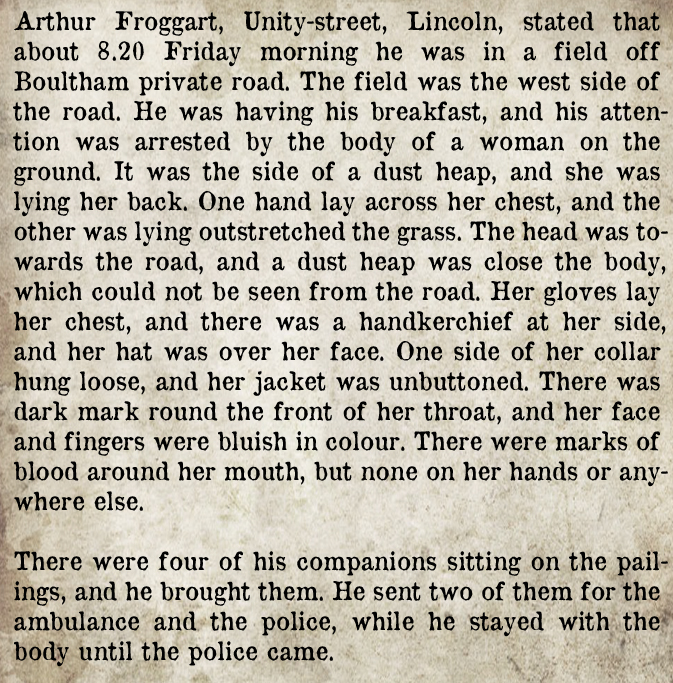
The next events in this tale unfold in a part of Lincoln that is completely unrecognisable today, and it is only by looking at maps side by side that we can get some sense of the landscape in 1903. What is now Boultham Park Road was, in 1903, a private carriage road leading to Boultham Hall, and on either side there were open fields. North of the drain in 1903 was the Wellington Iron Foundry, where some of the first WW1 tanks were built. One of the employees at the foundry was a young man called Arthur Froggatt. They worked long shifts in those days, starting early and finishing late. The men were allowed a break for breakfast around 8.00 am, and on the morning of Friday 29th May, Arthur had walked across the footbridge over the drain to breath some fresh air after the intense heat and fumes of the foundry. He had only walked a little way down the carriage drive, when he saw something untoward. Again this is from a newspaper report taken down verbatim at a court hearing:

Discovery

IN PART TWO
Arrest
A revealing letter
Trial and execution

Blog at WordPress.com.

Up ↑