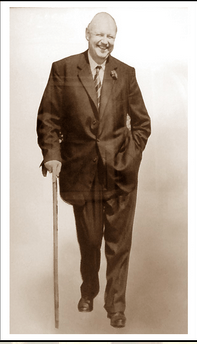
 A lifetime ago, when I was a pupil (remember that word? These days they are ‘students’ or ‘learners’) at Warwick School, I remember a gentleman coming to speak to us in the assembly hall we knew as Big School. He was Mr Guy Nelson, and we knew nothing of him, but it transpires he was the current head of a family which had been a major industrial presence in Warwick for generations. The Nelsons had a variety of interests, including gelatine manufacture and meat shipping, but the time we were assembled to listen to him, the firm had been absorbed by bigger competitors.
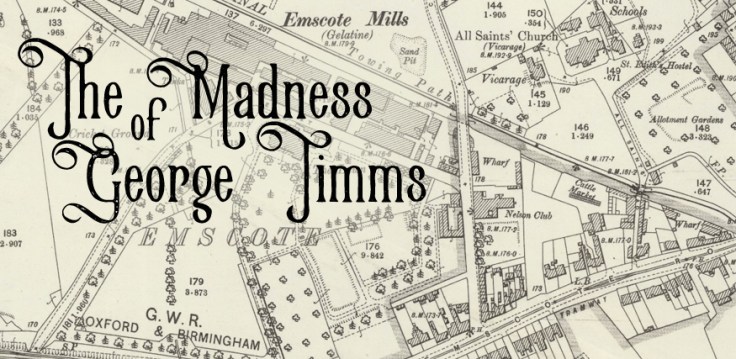
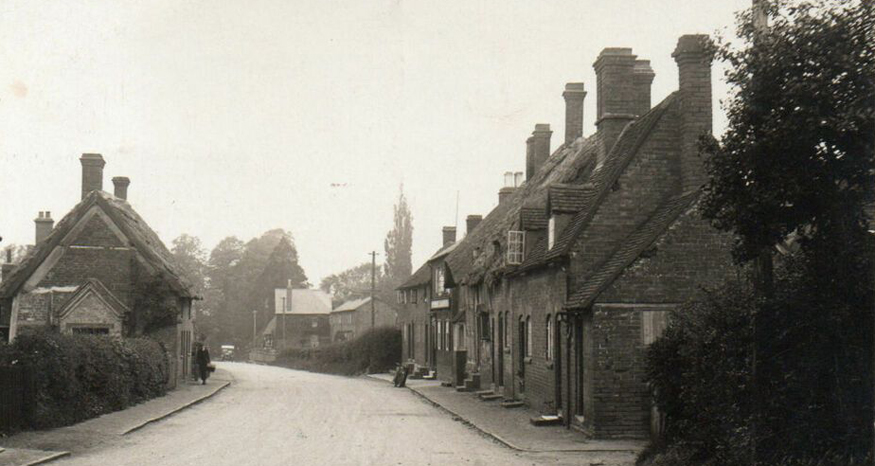
What the Nelsons stood for, however, was rather special. They were enlightened employers who took a philanthropic view of the relationship between worker and master. They built houses and social clubs for their workforce and, for some time, the area around their factory in Emscote was known as Nelson’s Village. Central to this was Charles Street, and this is where we come to the True Crime aspect of this feature.
At a few minutes past one o’clock in the morning, on 19th January 1888, Police Constable Salt was stamping his feet and trying to keep warm as he stood on duty at the far end of Smith Street, Warwick. The silence of the night was broken by a man’s voice in the near distance, shouting and calling out. Walking towards the disturbance, Salt shone his bulls-eye lantern into the dimly lit street, and he saw a figure come staggering towards him, lurching from one side of the road to the other, still shouting and moaning incomprehensibly.
With his free hand, Salt caught hold of the distressed man, and immediately noticed that his hands seem to be covered in blood. In a hoarse voice, the man cried out:
“I’ve murdered my wife; the Devil has tempted me to do it.”
“Where do you live?” asked Salt, but received no answer.
“Have you been home?” At this, the man replied,
“Yes – I’ve been to bed and got up again.”
A man called Henry Harris, who was the night-watchman at the nearby fire station, attracted by the fracas, joined the pair, and between them, he and PC Salt managed to march the man to the police station, which then stood at the top end of Northgate Street. manning the front desk was Police Constable Lewis. Salt informed Lewis what the man had told him, and Lewis asked for his name:
“My name is George Timms. I live at No. 1 Charles Street and, yes, I have murdered my wife. You will find her there. I have left the back door open.”
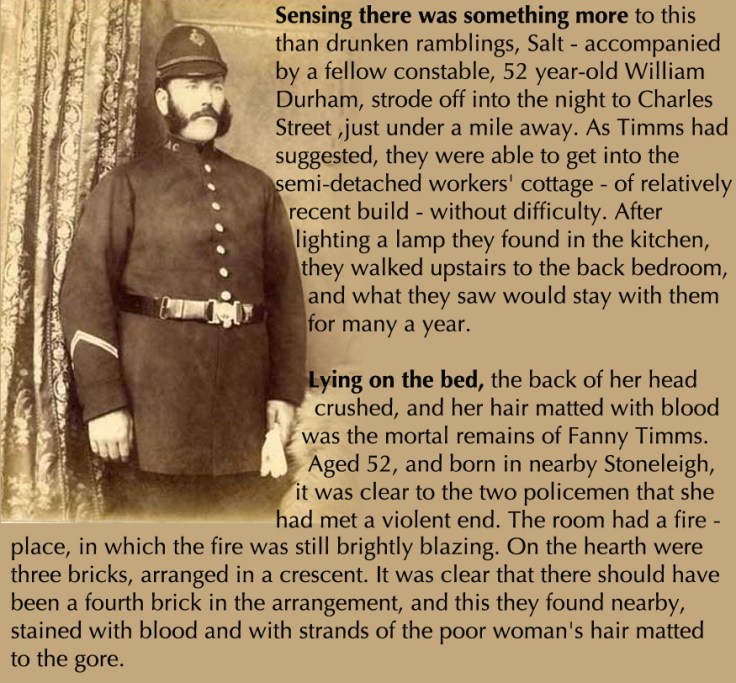
From here, the pace of events quickened. The two constables, realising that this was something way above their pay grade, wasted little time in summoning the help of their senior officers. Dr. Guthrie Rankin of 23 Jury Street was called to the scene. What he found was later reported in the press as follows:
“On going into the bedroom he saw the woman lying on the bed, halfway across, and quite dead. Her face was lying in a pool blood. There was no evidence that any struggle had taken place. From a superficial examination, he found some wounds on the back of the scalp, from which the blood had evidently come. Death had only recently taken place. He made a post mortem examination some hours later. There were four scalp wounds, one of them very large, and the bone underlying the wounds was fractured in several places. Two the fractures penetrated to the brain. There was a large bruise over the back of the neck, and the back of the left shoulder was also discoloured. All these wounds were, undoubtedly, such as might be caused by blows from a brick.”
In Part Two of The Madness of George Timms
A FUNERAL
WARWICK ASSIZES
A NEW CAREER AS A SHOEMAKER



 fullybooked2017