
We are in a wintry London in 1963. Older readers will recall that it started snowing on Boxing Day 1962, and it barely relented for weeks, with temperatures plummeting across the country. Susanna Gero is just one of the many thousands of Hungarians who fled to the west just 6 years earlier, after Russia had put down an uprising with its trademark brutality. She works at a shabby literary agency called Baánáti & Clay. Mr Clay never existed, and Laszlo Baánáti is missing. As part of a scheme of retribution devised by the Kremlin, agents have been despatched to the West to kill people who had the effrontery to leave the Soviet Union and its vassal states. One such is Miki Bortnik, and his target is Baánáti . Between the airport and Baánáti’s office Bortnik has a kind of epiphany, and meekly surrenders to the British authorities.
Baánáti’s disappearance is brought to the attention of the British intelligence service, and for old Le Carré buffs, we are back in the familiar world of The Circus, alongside Control, Connie Sachs, Percy Alleline, Bill Haydon, Toby Esterhase and – of course – George Smiley. Our man has taken early retirement of sorts in the wake of his involvement in the death of double agent Alec Leamas on the Berlin Wall (The Spy Who Came In From The Cold, Richard Burton in the film). Smiley is persuaded to make a temporary return to work in order to trace Baánáti, who is actually a Soviet agent called Ferenzc Róka. There is mention of the ominous sounding Thirteenth Directorate. This was basically a KGB hit squad, set up to deliver Moscow’s summary justice to former citizens across the world who had irritated Stalin.
Smiley discovers the reason for Róka’s disappearance. He has a son, now in his early twenties. Léo is young man of much promise, something of a gilded youth, but prone to upsetting local communist party officials. The lad has now been taken into custody. Róka has abandoned the pretence that he is a mild-mannered London literary agent, and via a series of false passports is on his way to central Europe to save his son. It is with some inevitability that Control sends Smiley off to Berlin, to rescue Róka and his son from the Ministerium für Staatssicherheit (Stasi). Smiley hopes that assistance will be given by Hans-Dieter Mundt, nominally leader of the East German Secret Service, the Abteilung. Mundt is actually a double agent who works for the British.
The book’s title, by the way, refers to the man who leads The Thirteenth Directorate. In the three books known as The Karla Trilogy, Le Carre provides an extensive biography of the agent, but we never meet him in person. The BBC cast Patrick Stewart in the role for TV, but he was glimpsed only briefly.
Control complicates matters by sending Susanna off to Berlin in the belief that her presence may help to smoke out Róka. The ploy does not work, as Susanna goes ‘rogue’ on her Circus companions, and things come to a head with a dramatic encounter on the streets of Budapest
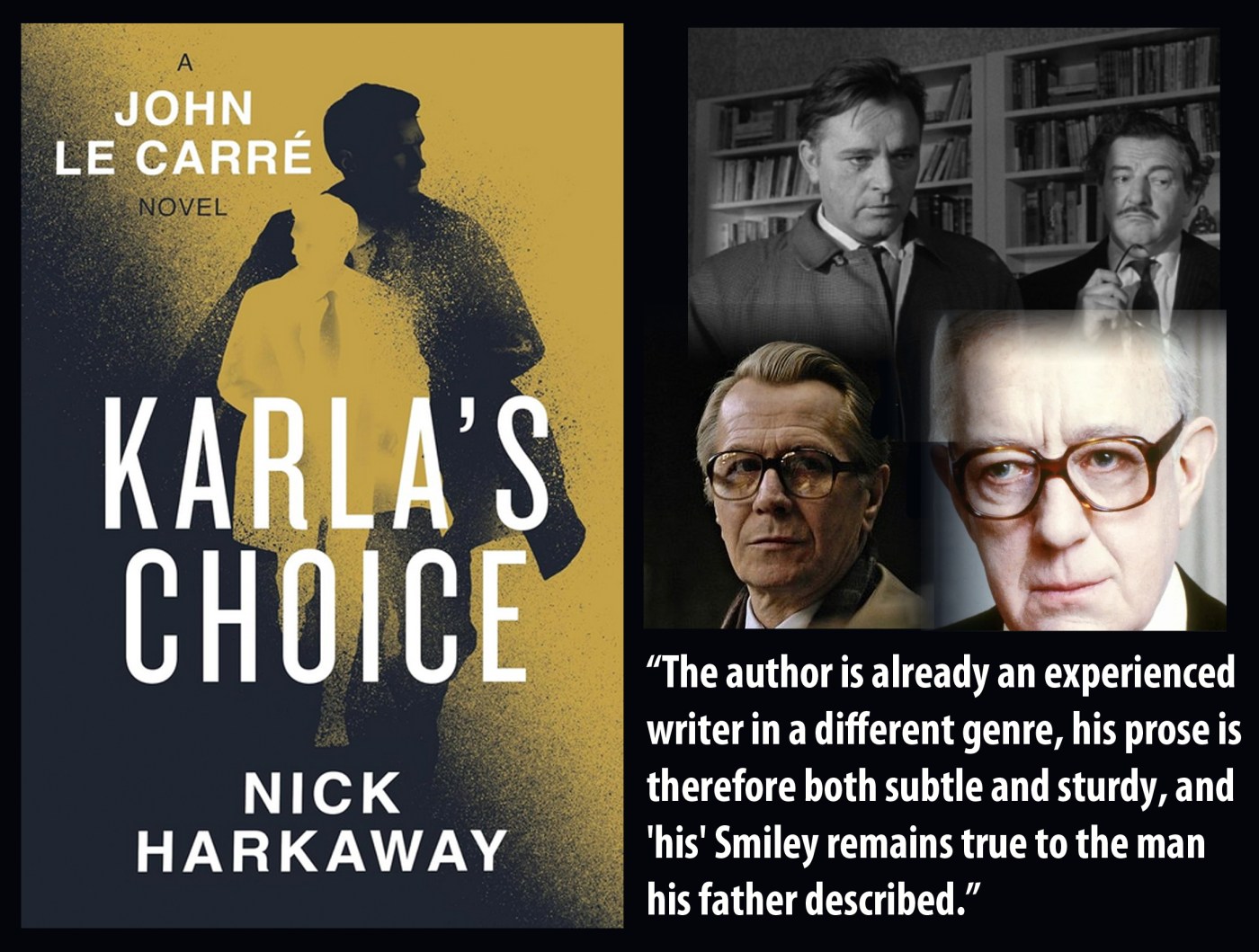
How does it feel to be back among old friends? To be honest, it is such a long time since I read the original books or watched any adaptations, that I had to use Google to remind me of some of the characters, but the chill of the Cold War remains inescapable. Harkaway cannot be aiming purely at aficionados of his father’s books, so what will younger readers make of it, coming as they do to the Le Carré ensemble for the first time? The author is already an experienced writer in a different genre, his prose is therefore both subtle and sturdy, and ‘his’ Smiley remains true to the man his father described.
George Smiley remains one of fiction’s most enduring but enigmatic characters. He is not, however, a fragile Ming vase too delicate to be handled. Here, he not only survives, but is given fresh shape and form in a vivid reminder of how espionage was done in the dark ages before the digital revolution. Karla’s Choice is published by Viking/Penguin and is available now.


 fullybooked2017