

 Jim Eldridge (left) and his aristocratic Detective Chief Inspector Edgar Saxe-Coburg are working their way around the best hotels in 1940s London, investigating murder We have had The Ritz (click for my review), The Savoy, and now Claridges. Setting a murder against a grand backdrop is a simple but agreeable formula which Eldridge has employed in his ‘museum series’, which are set in late Victorian England. The action takes place in October 1940, with Londoners under the hammer from Hitler’s bombers each and every night.
The concept which underpins the plot is similar to the one used in Murder at The Ritz. In the late 1930s, there were still countries in Europe ruled by what we might dismiss as ‘minor monarchies’. Albania, Yugoslavia and Romania all had ruling families, and some of them decamped to London, along with their coffers of gold. Also in London, which adds spice to the plot, were less fortunate people, some of them with a political agenda. One such, a Romanian kitchen hand at Claridges, is found garotted outside on the pavement. Saxe-Coburg’s boss calls hands him the murder investigation. The reason he wants Edgar on the case is touchingly naive. He thinks that when peace returns, and the ruling families of the Balkans resume their thrones, they will remember fondly the discretion and tact used by an English detective. The garotter then finds another victim, but what possible connection does a young woman working for the Free French headquarters in London have the unfortunate Romanian?
 Lurking in the background of this tale is a man who is less than noble, but with more power than all the kings and queens sheltering in London’s best hotel suites. Henry ‘Hooky’ Morton is a London gangster who is building his empire on black market scams, the most profitable of which is his manipulation of the petrol market. We think of fuel supply – or lack of it – as a very modern problem, but in 1940, having fuel to put in your car was crucial to many organisations. Hooky Morton has a problem, though. Someone has infiltrated his gang, and is making him look stupid. Then, Hooky does something really, really stupid and, no nearer identifying the garotte killer or their motives, Saxe-Coburg becomes involved in investigating what is, for any copper, the worst crime of all.
Saxe-Coburg’s wife Rosa, a popular pianist and singer does her bit for morale in concert halls and hotels in the evening, but her day job is more exacting and brings her face to face with the havoc raining down on London from the sky – she drives an ambulance. Her assistant is killed when a bombed building collapses on him, and a little while later, when Rosa goes to visit his widow. she is horrified to find the woman dead on the kitchen floor, killed with the same method used to despatch the Romanian kitchen hand and the young Frenchwoman.
I suppose Murder at Claridges is, if genres mean anything, on the fringe of cosy crime, but is a genuine page-turner. Despite the grimly authentic background of London being battered by the Luftwaffe, it gives us larger-than-life characters and, of course, it allows us to peep into a world which only the truly rich inhabit. The suave Saxe-Coburg is a timely antidote to the damaged, troubled and – frankly – disturbing world of so many fictional Detective Inspectors who inhabit our contemporary world. Eldridge is a fine writer and never has escapism been so elegantly penned. This book is published by Allison & Busby, and will be out in Kindle and hardback on 21st April, with a paperback edition due in the autumn. To read my reviews of two of Jim Eldridge’s ‘museum series’, click the links below.
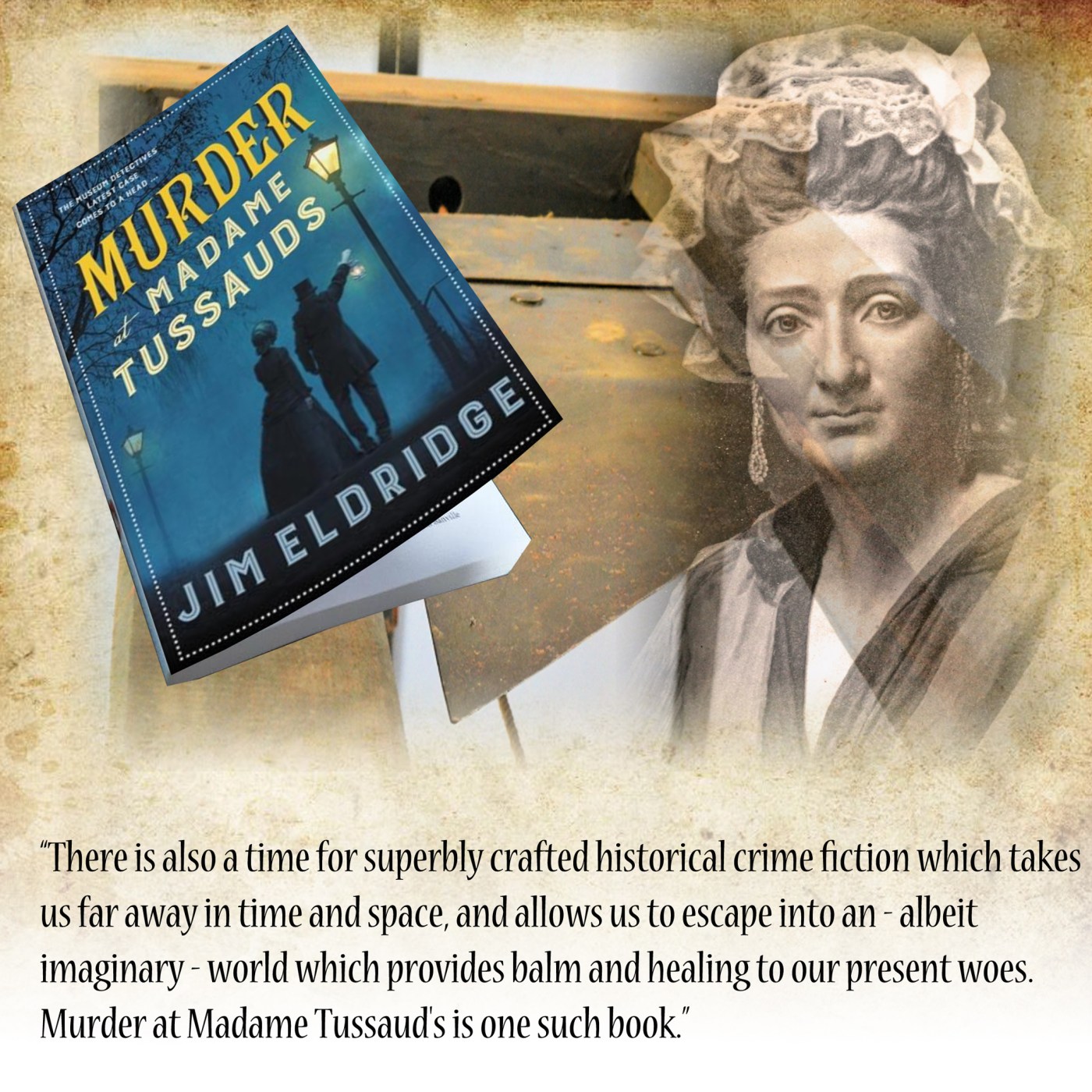
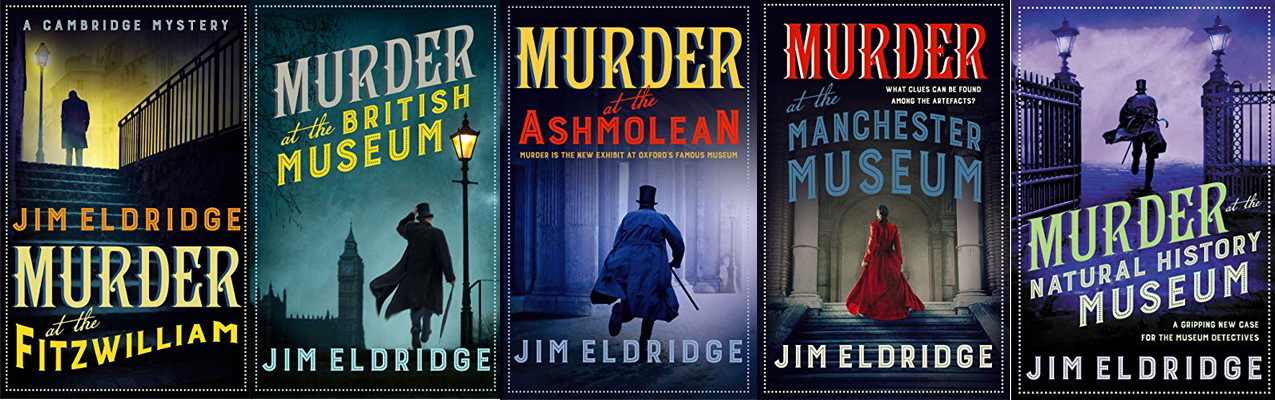
 This shouldn’t be dismissed as ‘comfort reading’. Yes, we know what we are going to get – the atmospheric late Victorian setting, the warm human chemistry between Daniel and Abigail, the absence of moral ambiguity and the certainty that good will prevail. Any genuine reader of fiction – and in particular, crime fiction – will know that, rather in the manner of Ecclesiastes chapter III , there is a time for everything; there is a time for the dark despair of Derek Raymond, there is a time for the intense psychological dramas of Lisa Jewell, and a time for workaday police procedurals by writers like Peter James and Mark Billingham. There is also a time for superbly crafted historical crime fiction which takes us far away in time and space, and allows us to escape into an – albeit imaginary – world which provides balm and healing to our present woes. Murder at Madame Tussaud’s is one such book. It is published by Allison & Busby and is
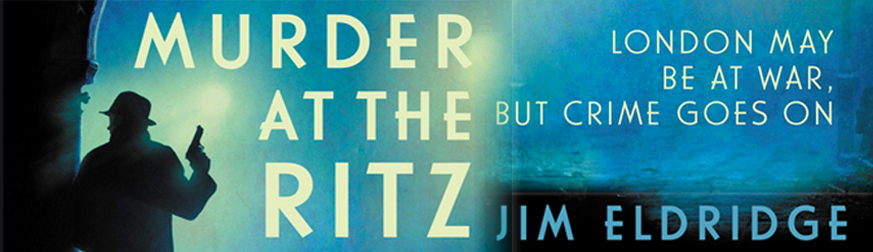
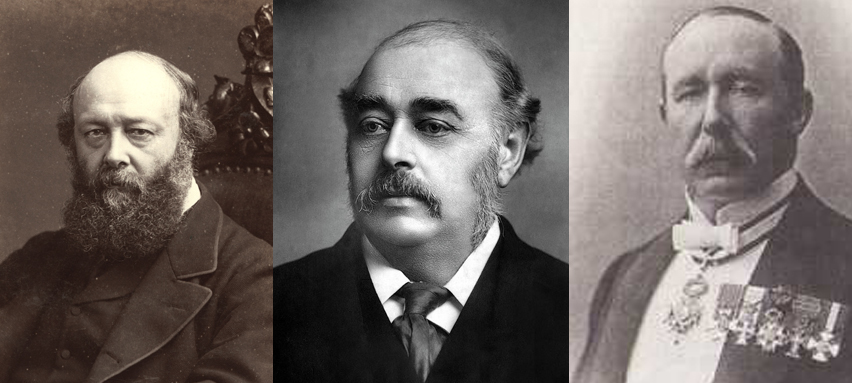
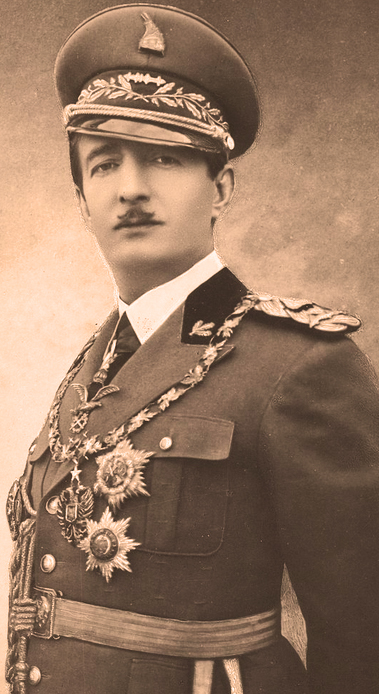 Any novel which features – in no particular order – Commander Ian Fleming, King Zog of Albania, a dodgy lawyer called Pentangle Underhill, and a Detective Chief Inspector named The Hon. Edgar Walter Septimus Saxe-Coburg promises to be a great deal of fun, and Murder At The Ritz by Jim Eldridge didn’t disappoint. It is set in London in August 1940, and Ahmet Muhtar Zogolli, better known as King Zog of Albania (left) has been smuggled out of his homeland after its invasion by Mussolini’s Italy, and he has now taken over the entire third floor of London’s Ritz Hotel, complete with various retainers and bodyguards – as well as a tidy sum in gold bullion.
  Back to the story, and when a corpse is discovered in one of the King’s suites, Coburg is called in to investigate. The attempt to relieve the Albanian monarch of his treasure sparks off a turf war between two London gangs who, rather like the Krays and the Richardsons in the 1960s, occupy territories ‘norf’ and ‘sarf’ of the river. After several more dead bodies and an entertaining sub-plot featuring Coburg’s romance with Rosa Weeks, a beautiful and talented young singer, there is a dramatic finale involving a shoot-out near the Russian Embassy. This is a highly enjoyable book that occupies the same territory as John Lawton’s
 London. 1894. The British Museum has become a crime scene. A distinguished academic and author has been brutally stabbed to death. Not in the hushed corridors, not in the dusty silence of The Reading Room, and not even in one of the stately exhibition halls, under the stony gaze of Assyrian gods and Greek athletes. No, Professor Lance Pickering has been found in the distinctly less grand cubicle of one of the museum’s … ahem …. conveniences, the door locked from inside, and the unfortunate professor slumped over the porcelain.
 This is a highly readable mystery with two engaging central characters, a convincing late Victorian London setting, and a plot which takes us this way and that before Daniel and Abigail uncover the tragic truth behind the murders. Jim Eldridge (right) is a veteran writer for radio, television and film as well as being the author of historical fiction, children’s novels and educational books. Murder At The British Museum is published by Allison & Busby,


 fullybooked2017