

December 1930. Henry Johnstone, a former Detective Chief Inspector with the Metropolitan Police, has been forced to resign due to a debilitating injury. Now, he ekes out a solitary existence in a crumbling Brighton house, empty except for a large library assembled by the former owner, the late Sir Eamon Barry. Johnstone’s task – one given to him by a friend, concerned about his mental state – is to catalogue the thousands of books in the library. He is convinced he is being stalked, perhaps by someone linked to an old case. Then, he disappears. We know how – if not why – but his friends, among them his sister Cynthia and his former Sergeant Mickey Hitchens, are left with few clues, but one – left behind by Johnstone – suggests there is a link to a mysterious death and disappearance five years earlier.
When Johnstone is eventually found, he has been beaten within an inch of his life by a criminal gang, and is in no fit state to help the investigation into what seems to be a brutal and very well organised smuggling cartel. England’s south coast has been the backdrop for smuggling for centuries. I am reminded of the romantic lines of Kipling:
“If you wake at midnight, and hear a horse’s feet,
Don’t go drawing back the blind, or looking in the street,
Them that ask no questions isn’t told a lie. Watch the wall my darling while the Gentlemen go by.
Five and twenty ponies,
Trotting through the dark –
Brandy for the Parson, ‘Baccy for the Clerk.
Laces for a lady; letters for a spy,
And watch the wall my darling while the Gentlemen go by!”
These days, sadly, the smugglers don’t tend to deal in the traditional commodities of brandy and tobacco, but in the more profitable contraband of human lives. I would like to think that back in the day, the profiteers were not aided and abetted by the historical equivalent of the RNLI and the Border Force, but that is a debate for another day As Henry Johnstone slowly recovers his strength, Hitchens – and his slightly odd (but learning something new every day) Sergeant Tibbs – eventually get to the root of the mystery, but not before more lives are lost.
As is only right and proper in novels set in the 1930s, Jane A Adams makes us aware that most of her protagonists have a shared history – that of The Great War. Those over the age of 35 will have either fought in that conflict or lost husbands and sons: Younger people will have fathers they will never see again, with only a marble gravestone somewhere in France as a far-away reminder of what they have lost.
The period details in The Room With Eight Windows are impressive and convincing, as are the quirks and foibles of the main characters. This excellent and atmospheric thriller will be published by Severn House on 4th July.


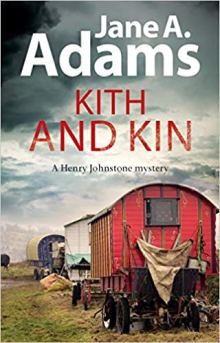 Coming across a very, very good book by an author one has never encountered before and then realising that she has been around for a while is a shock to the system, and if the downside is that the experience further highlights one’s own ignorance, then the blessing is that as a reviewer and blogger, there is something new to shout about. Jane A Adams made her debut with The Greenway back in 1995, and has been writing crime fiction ever since, notably with four-well established mystery series featuring Mike Croft, Ray Flowers, Naomi Blake and Rina Martin. She began the saga of London coppers Henry Johnstone and Micky Hitchens in 2016, with The Murder Book. Their latest case is Kith and Kin.
 The period is set to perfection, and Adams (right) skilfully combines past, present and future. The past? There can scarcely have been a man, woman or child who escaped the malign effects of what politicians swore would be the war to end wars. The present? 1928 saw devastating flooding on the banks of the River Thames, a book called Decline And Fall was published, and in Beckenham, not a million miles away from where this novel plays out, Robert ‘Bob’ Monkhouse was born. The future? Johnstone’s sister, who has married into money, has a head on her shoulders, and senses that in the financial world, a dam is about to break – with devastating effects.


 fullybooked2017