

I wasn’t sure if I should tag this review as ‘historical crime fiction.’ The novel certainly takes us back to a 1991 England of Ford Sierras, four-star petrol, Spurs being managed by Terry Venables and captained by Gary Mabbutt. Perma-press slacks from C&A and – on the telly – the brief wonder that was BSKYB. We are in and around the town of Colchester in Essex, and we are in one of those winters where it always used to snow. I am sure that there is a doctorate waiting to be written on why Essex is perceived to Britain’s Crime Central. Perhaps it might be to do with the White House Farm murders in Tolleshunt D’Arcy, the ‘Essex Boys’ murder at Rettendon, or the exploits of double murderer James Fairweather in Colchester.
In The Winter Visitor, James Henry echoes his love of ornithology by using the term used for birds who fly to Britain during the winter – among them Redwings, Fieldfares, and both Bewick’s and Whooper Swans. I reviewed an earlier James Henry novel with an avian title, Whitethroat, back in 2020, and you can read the review here.
Two birds of very different feather are Detective Sergeants Daniel Kenton and Julian Brazier, based in Colchester. Kenton is married, bespectacled and fairly civilised:
“Daniel Kenton stared blankly into the hairdresser’s mirror. He did not care to see himself as others surely would: a a weary man, with murky red eyes, closing in on thirty five but aged beyond his years.”
Brazier, however, is frequently uncouth, ostensibly insensitive, and with the dress sense of someone preening himself in a Southend pound shop.
“Brazier was in a green bomber jacket and baggy black trousers like Charlie Chaplin, with white trainers poking out the bottom of them. Pegged trousers with turn-ups as well – on such short a leg as Brazier’s they were not at all flattering.”
As a pair, though, they are extremely effective. They need to be. James Henry has presented us with an extremely complex murder case.
Bruce Hopkins, an Essex criminal – not a major gangster, but more of a conman who dabbled in the drugs business – returns from the Spanish hideaway he shares with many other dodgy British expats, but it is a huge mistake. He is kidnapped, shoved into the boot of a Sierra (what else) which is rolled into a reservoir. When the car and body are discovered Kenton and Brazier are assigned to the case, and it is a complex one.
Hopkins did not have a criminal history likely to provoke Mafia-style revenge, so there seems to be no point in rounding up ‘the usual suspects’. Even so, Kenton is despatched to Marbella to interview former Essex bad boys, but he returns literally clueless. There is also a current investigation into an arson attack on a local church, and it is that Kenton and Brazier get the first hint of a breakthrough when they begin to suspect that Hopkins’s death may be linked to a small preparatory school called Bryde Park and some of its former staff and pupils.
James Henry is a very good writer. He captures the period perfectly, and his appreciation of the nature of Essex’s relationship with London is acute:
“Billericay, South Essex. Home of the East Ender made good. Traders, jobbers, grafters on the stock market. Leave school in May at fifteen, straight on the train into Liverpool Street towards plum jobs with brokers in the city, pulling in wedge before their smarter ‘O’ Level classmates finish in the exam hall.”
Kenton and Brazier have to visit an old fashioned mental hospital in the course of the investigation, and Henry captures its menace:
“…the institution itself had teetered on the fringe of an archaic medical world best forgotten. At the forefront of experimental medicine in the fifties, the place was synonymous with lobotomies, padded cells, terrifying screams, and all the nightmares associated with the restraint of insanity.”
We are lead this way and that as we share the detectives’ struggles to make sense of the death of Bruce Hopkins. The solution is as unexpected as it is elegant, and this is superior crime fiction. Published by Riverrun/Quercus, it is available now.


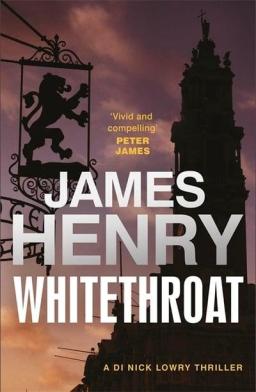 Essex has become something of a trigger word in recent years, conjuring up images such as lavish mansions owned by London gangsters and dumb bottle-blondes with their perma-tanned, medallioned boyfriends. James Henry, however, takes us back forty years to the 1980s. DI Nick Lowry and his boss, Chief Superintendent Sparks, inhabit a police HQ which leaks, has rotten floorboards, and is maybe only months away from the demolishers’ wrecking ball. Sparks contemplates his desk:
 The plot is the least important part of this fine novel, but it unfolds gradually. The woman whose favours are being fought over by the duellists is not a woman at all, but a fifteen year-old schoolgirl, the daughter of a local businessman. He, in turn, has unfinished business with a local enrepreneur, and business that dates back to a racial attack three decades earlier. We are in a world of simmering resentment born out of old slights, and the result? The proverbial dish that is best served cold.


 fullybooked2017