Search

fullybooked2017

Tag

Imperial War Museum

THE HUMAN KIND . . . Between the covers

thk spine045 copy

This is the third novel in Alexander Baron’s WW2 trilogy, and it is rather different to the previous books, although there are obvious links. From The City, From The Plough tells the story of a group of soldiers preparing for, and then taking part in, the invasion of Normandy in 1944, while in There’s No Home the focus is on just a few weeks where an army company takes up residence in the Sicilian town of Catania in 1943. The titles are hyperlinked to my reviews of the novels.

The Human Kind is a sequence of short stories or vignettes, presented as being mainly autobiographical, and they reflect a wide variety of incidents and experiences involving men at arms. I use that phrase intentionally. I an surely not the first person to compare Baron’s trilogy with Evelyn Waugh’s magisterial Sword of Honour trilogy, which comprised Men at Arms, Officers and Gentlemen and Unconditional Surrender. There are stark differences, obviously, in that Waugh’s novels saw soldiering through the eyes of middle class officers. The central character, Guy Crouchback, is from a minor-aristocratic Roman Catholic family, while Baron was a Jewish man from London’s East End. What connects the two trilogies, however, is keen social observation, repeated ironies of circumstance and – most importantly – the fact that for many men the war and military life became central to their very being, despite the obvious hazards and unpleasantness. Baron – a communist in his youth –  himself probably despised Waugh’s upper-middle-class reactionary views but he admired his writing, saying it was, “a magnificent illumination of a whole complex of human problems.”

Each of the stories except one, which I will return to, references the military campaigns – Italy, Normandy and Belgium – described in the earlier books. The one that affected me most was Mrs Grocott’s Boy. Raymond Grocott comes from The Potteries, where he lives with his widowed mother. He is, to use an old word, gormless. Nowadays, I suppose, he would have been long since diagnosed with ‘special needs’, and he has failed the basic intelligence test required to be admitted to the army. Having persuaded those in authority to let him join, he takes part in the invasion of Sicily. Contracting malaria, he is invalided out, but is desperate to rejoin his unit which, with some degree of innate cunning, he does. In a stroke of irony that Thomas Hardy would have loved, his company is selected to be shipped home to prepare for the Normandy landings. Out of a misplaced sense of kindness, Raymond’s fellow soldiers cover for him and try to keep him on the straight and narrow paths but, as the landing craft approaches the French beach it finally dawns on him that he could be killed, and he pleads to be sent to the rear for medical attention. It is too late. Somehow, he survives, having been driven on by an NCO. But when what remains of the platoon finally bivouacs in a relatively safe place, he is handed a written order transferring him away from danger and into the care of the medics. As he trudges away, he has a solitary flash of self awareness and he curses the well-meaning men who have delivered him to a place of shame. His parting words to his colleagues are, “I hope you die. I hope you all die.”

Screen Shot 2024-04-17 at 21.05.26There is black humour in some of the stories, as well as a dark awareness of sexuality. In Chicolino, the soldiers in Baron’s platoon ‘adopt’ a homeless Sicilian boy, just into his teens. They share rations with him and treat him kindly, but are shocked to the core when he assumes that they will want to have sex with him in return for their kindness. He would have been quite happy to oblige, and is hurt and humiliated by their rejection. In The Indian, Baron retells the story from There’s No Home of how Sergeant Craddock comes to sleep with the beautiful Graziela. It is the appearance of a drunk but harmless Indian soldier that brings them into each other’s arms. Readers who, like me, are long in the tooth, will remember watching a 1963 movie called The Victors, directed by Carl Foreman. Alexander Baron was the screenwriter, and the story Everybody Loves a Dog, which relates the unfortunate consequences of a friendless and inarticulate Yorkshire soldier befriending a stray dog, was one of many memorable scenes in the film.

One of Baron’s colleagues is an intelligent and educated man called Frank Chase. In The Venus Bar, we read of his liaison with a beautiful but ruthless Ostend brothel owner.  but in Victory Night, the war has taken its toll and Chase is shipped home, psychologically broken. He is hospitalised, but can make no sense of his situation.

“He was too bewildered to fight against his loneliness. He did not visit London. It was only to the immediate past, to us, that his memory was able to reach. Peace time had passed out of his life. He was afraid to go to London in search of the ends of long-broken threads. He wondered about in a days, hardly aware of anything that happened except the arrival of letters from his old comrades. He hugged these to him, for they were the raw material of dreams, daydreams that burst inside him like magnesium flares, illuminating with brief, ghostly intensity the supreme experiences he had to live through.”

When victory in Europe is finally declared, Chase is horrified by the drunken celebrations in an English village.

“The faces streamed past him, faces for a Bruegel, red and ugly with drink, the fat faces of alewives glistening with the distant firelight, the suet- lump faces of men who had not been judged young or intelligent enough to die, the vacuous whore-faces, pathetically greedy for pleasure, of little village girls. They squealed and shrieked, filled the night with graceless laughter, bawled idiot songs, coughed, screamed, yelled and belched.”

There are twenty five stories in all in The Human Kind, and all but two are reflections on Baron’s war service. The last one, An Epilogue, is a brief story of something that happened in the Korean War, by which time Baron had been in ‘civvy street’ for some time, but Strangers To Death, the first tale in the book, recounts an incident from Baron’s childhood. He says he was sixteen at the time, so this would place the events in the summer of 1933. He is the proud owner of a new sports bicycle, and he joins a group of local youngsters who cycle out from their East End homes to nearby countryside to camp on the banks of the River Lea. Here, they swim, smoke, cook meals and relish the fresh air, but when one of their number is trapped in the silk-weed growing from the river bed, and drowns, the atmosphere becomes sombre. It was probably Baron’s first intimate encounter with death, but with the insouciance of youth, he and his mates are soon back in the river, daring each other to play tug-of-war with the silk-weed and trying to get as close to the treacherous currents of a weir as they dare. On the way home, Baron comes even closer to death when, his spectacles blurred by rain, he collides with a tram. Miraculously, he is thrown clear, unharmed apart from a graze, and even his precious ‘Silver Wing’ bicycle is undamaged. He would of course, come to stare death in the face all too frequently just ten years later.

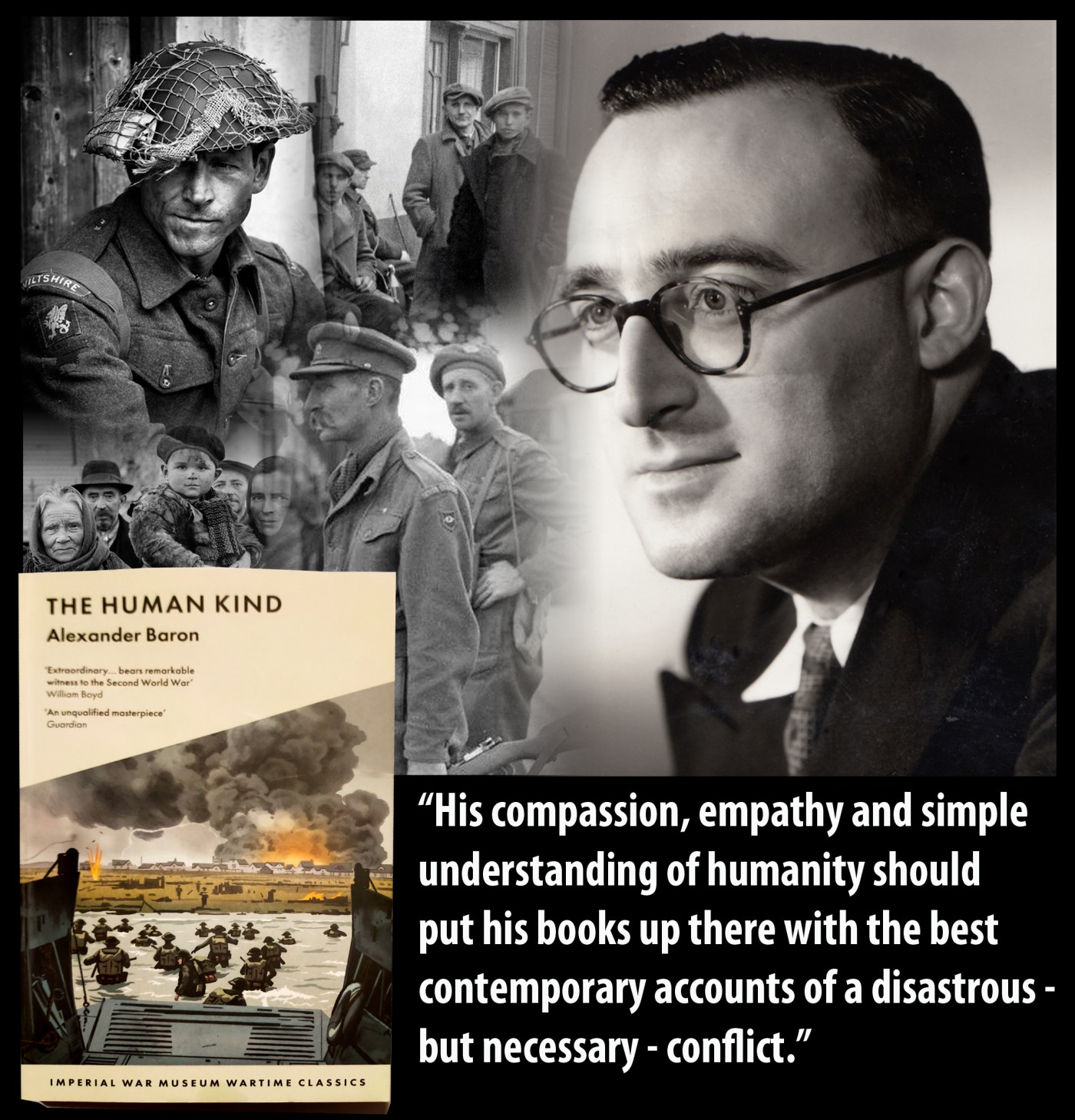
It would be inaccurate to say that Baron is a ‘forgotten’ writer, but his name would not be included in most people’s list of great English writers of the final decades of the twentieth century. Many of his other novels, often set in the Jewish London of his youth, are still in print, but his take on what war does to men, women and children is astonishing. His compassion, empathy and simple understanding of humanity should put his books up there with the best contemporary accounts of a disastrous – but necessary – conflict. The Human Kind is republished by The Imperial War Museums,and is available now.

THERE’S NO HOME . . . Between the covers

Tnh SPINE042

Sicily, 1943. A company of British soldiers, serving with the Eighth Army, has arrived in Catania, an ancient port that sits at the foot of Mt Etna. A full size army company would have numbered around 150 men, but this unit is much reduced in size. Although they have experienced battle in North Africa, by the time they get to Sicily, the war has moved on, as the Germans are engaged in a fighting retreat towards the Straits of Messina, where they will hope to cross – with as many men and as much materiel as possible – to the mainland. The Italian army is no longer a viable force,and it would officially surrender in September.

Screen Shot 2024-04-10 at 19.40.23

In Alexander Baron’s book – part of a trilogy based on his own war service – the British soldiers are not engaged directly with the enemy. Instead, they arrive in Catania and are assigned billets in the Via Martiri. For both themselves and the residents, it is something of a shock:

“They studied each other with a hostile curiosity. Each group looked the same to the other: filthy, exhausted, more animal than human, the soldiers swaying over their rifles, the civilians at bay before their houses. Each was looking at ‘the enemy’. There across the road (on which ever side one stood)were the people responsible for these last three weeks of suffering. The roadway was wide-miles wide, it seemed at this moment-sunlit and empty. A baby squalled and the children began to creep out from amongst their elders. The people looked at their children with a dullness that was worse than a visible agony. The distress that came into the soldiers eyes was the first human feeling they had betrayed since their arrival. The children all had the same appearance; heads that seemed monstrous on their shrunken bodies; big, appealing eyes; twisted, scabby little legs; and flesh whose colour, beneath the dirt, was a deathly toadstool whiteness.”

As in most of the rest of Catania, there are (with a couple of exceptions) no men in the Via Martiri. All are gone for soldiers. Many are now dead, and the rest are prisoners of the Allies. This creates an unusual problem for the officer in command of the company, Captain Rumbold. He is puzzled when, after a few days, many of his men are unofficially ‘adopted by various women in the street. Publicly, he says nothing, but he views his clerk as something of a confessor: To Piggott, however, who was his confidant as well as his clerk, he was indignantly eloquent.

“Would you have believed it? Chaps out of decent homes! You’d have thought wild horses wouldn’t have dragged them into the kind of pigsties that these people live in. Dark, dirty, smelly, bloody holes – that’s all they are – holes in the wall-full of flies and bugs and fleas. People in rags, scratching themselves day and night, look as if they’ve never had a bath in their lives! I can’t imagine what’s got into the chaps.”

One such soldier is Sergeant Joe Craddock. He has a wife and young child at home but, as the book’s title ominously suggests, ‘home’ has become a foreign concept for many men. They are where they are, with little or no expectation of being reconciled with their families. All they can do is adapt to what the ‘here and now’ offers. In Craddock’s case this takes the shape of a beautiful woman called Graziella. Her husband has gone away to fight, and she has no idea if he is living or dead. After a brief tussle with her conscience, she enthusiastically embraces – in every sense of the word – what Craddock has to offer.

Many of the company have been ‘adopted’ by women in the street. It is a symbiotic process; the men have their washing done, get a break from the abrasive all male life in the billet; not all of the men are claiming conjugal rights, but they can provide basic army rations, and their pay can buy luxuries from the shops and market stalls gradually re-opening after the fighting which caused the  departure of the Germans. Inevitably the orders eventually come for the company to move out, and for Graziella and Craddock this is traumatic. She begs him to stay, but the thought of desertion appalls him.

As William Tecumseh Sherman once said, “War is all hell, boys”, but despite the privations and the real chance of serious injury or death, for many men, the army provides a structure, imposes boundaries, and obviates the need to make decisions or wrestle with moral problems. As the weeks of casual life end and the company prepares to move on, the army reasserts itself:

“Pride returned at the sight of the company forming up, the shuffling ranks closing into a neat, solid block of khaki that filled the whole length of the street; the straight lines of helmets swathed in dun sacking, the straight lines of rifles, the straight lines of packs, the straight lines of red faces. It was a single organism into which all individualities and all worries vanished, self sufficient and aloof from the untidy throng of civilians who surged around it as a tall ship is from the sea through which it cleaves.”

Baron’s writing is immensely powerful, and his understanding of fighting men is deep and thorough. In another time and place, he might have been a poet. As the company boards the train taking them who knows where, it is the end of something for the people of the Via Martiri.

“The train gathered speed and passed round the bend. Now there was only the blank end of the rear truck. Now it was gone. The sun’s glare, pitiless, blanched the blue sky, glittered on the deep blue sea, reflected, dazzling, from the walls of the tumbled white houses and drew an oven heat from the bleached pavements. The last tremor died from the rails. Now there was no sound in the blinding white sunlight; no sound but the weeping of women.”

First published in 1950, There’s No Home is republished by The Imperial War Museums, and is available now. For other titles in this superb series, click the link below.

Screen Shot 2024-04-17 at 20.32.14

MAILED FIST . . . Between the covers

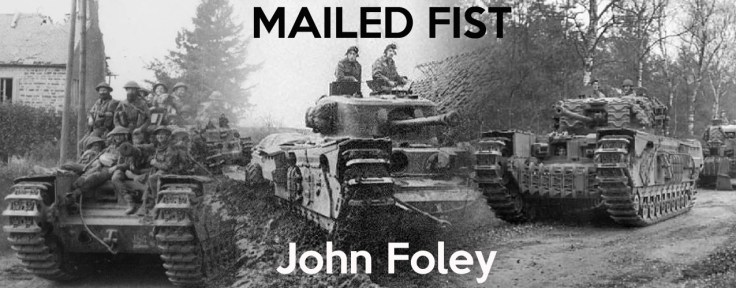
MF header

The superb Wartime Classics series from the Imperial War Museum includes stories from the home front, such as Plenty Under The Counter, To All The Living, and Mr Bunting at War. Eight Hours From England took us to the undercover war in Albania, Patrol was set in the North Africa campaign, and in Trial by Battle, we sweated along with the men fighting in the Malayan jungle. The battle in the air was covered by Pathfinders and Squadron Airborne. Now, in the twelfth of the series, Mailed Fist joins Warriors For The Working Day and Sword of Bone with an account of the fighting in mainland Europe.

Cedric John Foley MBE (7 March 1917 – 8 November 1974) was a British Army officer, author, broadcaster, and public relations specialist. A regular soldier between 1936 and 1954, he was made MBE for his services to the Royal Armoured Corps during WW2. A man of wide interests, he was also known as a broadcaster and scriptwriter, and was military advisor to the popular ITV comedy show, The Army Game.

Cover

This is perhaps the least fictionalised of all the books in the series. Foley faithfully records his own experience after being commissioned into the Royal Armoured Corps in 1943. He was to command Five Troop – a trio of Churchill tanks named Avenger, Alert, and Angler. Foley follows the progress of the Allied forces through Normandy, the Ardennes and eventually – after bitter and brutal fighting against German forces – across the Rhine into Germany itself.

Earlier editions of the book had a very gung-ho blurb on the front but it is worth  pointing out that although Foley is, as one might expect, intensely loyal to the Churchill tank, it was widely regarded as being something of a lame duck in the tank world. The massed-produced American Shermans, the devastating Panthers and Tigers of the Panzerkorps, and the Russian T34s were all probably superior in overall performance.

MF previous

The book is markedly different from Warriors For The Working Day, another account which included a description of  a tank regiment advancing through Normandy. Peter Elstob’s writing is much more, for want of a better word, poetic, while Foley’s words have more the feel of a diary. He also concentrates more on the mechanics of the war, rather than the emotions of the men fighting it. That isn’t to say that Mailed Fist isn’t well written, and there are some memorable passages, such as this description of a column of German prisoners:

“One cheerful imp-faced man – obviously the platoon jester –  gave a Nazi salute grinned broadly as he turned it into a mime of pulling a lavatory chain. At the end of the column came a boy, he looked about thirteen years old and as he stumbled past he used the sleeve of his greatcoat to wipe the tears from his eyes.”

If you hadn’t worked it out from the featured illustration, the book’s title refers to the cap badge of the Royal Armoured Corps. Mailed Fist is a highly readable and authentic account of a crucial stage during WW2. It is published by the Imperial War Museum, and will be available on 21st April.

GLOSSARY OF SOME MILITARY TERMS USED IN THE BOOK

BESA British version of a Czech machine gun, frequently mounted in WW2 British tanks. Fired 7.92 Mauser rounds.
BOCAGE Countryside in Normandy typified by small fields, dense hedgerows and sunken roads. Difficult country for offensive warfare but ideal for defenders.
CHURCHILL British tank, well armoured, but lacking the firepower of its German adversaries. Still in use in the 1950s.
ENSA Entertainments National Service Organisation – dedicated to bringing light entertainment to serving military units.
LST Landing Ship, Tank. American boat used to transport tankson D-Day
PANTHER German tank considered one of the best of the war in terms of fire power, protection and mobility.
SHERMAN The ubiquitous Allied tank of WW2. American designed and built, easy to run and maintain, produced in huge numbers.
SPANDAU German machine gun, firing up to 1200 rounds a minute/Known to the Allies as ‘Hitler’s Buzzsaw’.
TELLERMINE Literally ‘Plate Mine’ – German anti-tank mine.
TIGER Probably the supreme tank of WW2, at least in theory. Fast, manoeuvrable, with a powerful gun and formidable armour, it was, difficult to repair and too highly engineered to be produced in sufficient numbers.

MR BUNTING AT WAR . . . Between the covers

Bunting header

This is another in the superb series of republished novels set in the Second World War. As author Wiliiam Boyd remarked:

“If poetry was the supreme literary form of the First World War the, as if in riposte, in the Second World War, the English novel comes of age. This wonderful series is an exemplary reminder of that fact.”

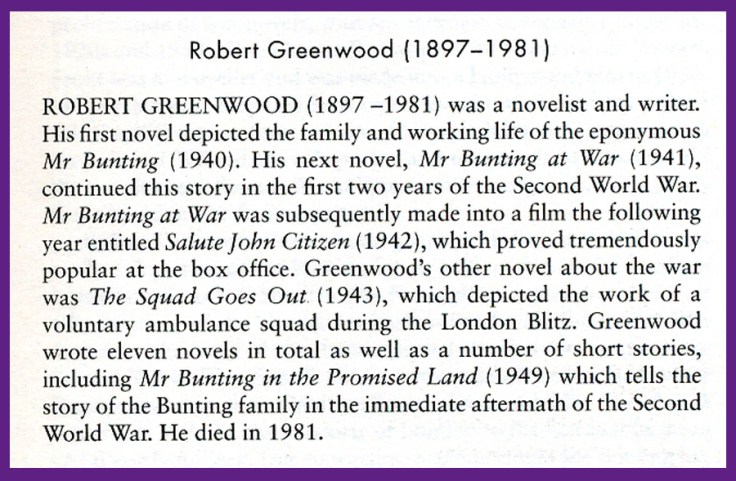
Robert Greenwood introduced Mr Bunting to the world in the book of the same title, published in 1940. He is something of a ‘stuffed shirt’, but entirely without malice, and he lives with his family in Essex, but within commuting distance of his work at an ironmongers in London. This is set in 1941, with London under siege from the skies, but by the end of the book the strategically unimportant district where the Buntings live is feeling the full wrath of the Luftwaffe.

George Bunting and his wife Mary have three grown up children, Chris, Ernest and Julie. Chris is, it could be said, George’s favourite son. He is practical, endlessly optimistic and cheerful, while Ernest is more introspective – and a gifted pianist. Both young men are trying hard to make a go of their respective careers, while Julie is something of a dreamer, and looking for suitable work.

The day to day world that Robert Greenwood describes would have been completely familiar to thousands of readers in 1941. So many elements of life then, however, are almost unimaginable to us now: the sheer terror of being under regular attack from the skies, the dread of receiving a telegram from the armed forces, the privations and shortages of food and the heavy hand of a wartime government laid on every aspect of normal life.

I was initially tempted to compare Mr Bunting with another  gentleman from an earlier generation, Charles Pooter. Mr Pooter (the creation of George and Weedon Grossmith in Diary of A Nobody) lived closer to ‘town’,  in Holloway. His house was called The Laurels, while Mr Bunting lives at Laburnum Villa. While the Grossmiths wanted us to laugh at Mr Pooter, Robert Greenwood takes a very different approach. He invites us, perhaps, to smile and raise an eyebrow at Mr Bunting’s rigid view of the world and his own place in it, but he never mocks. Bunting is a man of simple pleasures:

“There was nothing Mr Bunting liked better than to escape from the war and listen to his wife and daughter-in-law discuss the technicality of ‘turning the heel’ or report on experiments with recipes recommended by the Ministry of Food. To sit placidly smoking and listening to these discussions was to realise one had a home and a wife who was a jewel. If there was anything better in life, Mr Bunting wanted to know what it was.”

Through Mr Bunting, as he travels into London each day on his morning train, we see the carnage being wrought on the city. As he walks from the station to Brockleys, things almost become too much for him:

“Through the devastation he walked, stepping over hoses, skirting the edge of craters, threading his way past grimed and bloodshot firemen, single-mindedly pursuing his own particular business. There were gruesome sights, too, sensed rather than seen, tarpaulins stretched over what he knew were human forms. Once, a lock of a girl’s hair fluttered brightly as the wind ruffled her crude shroud. He bit his lip, and looked away.”

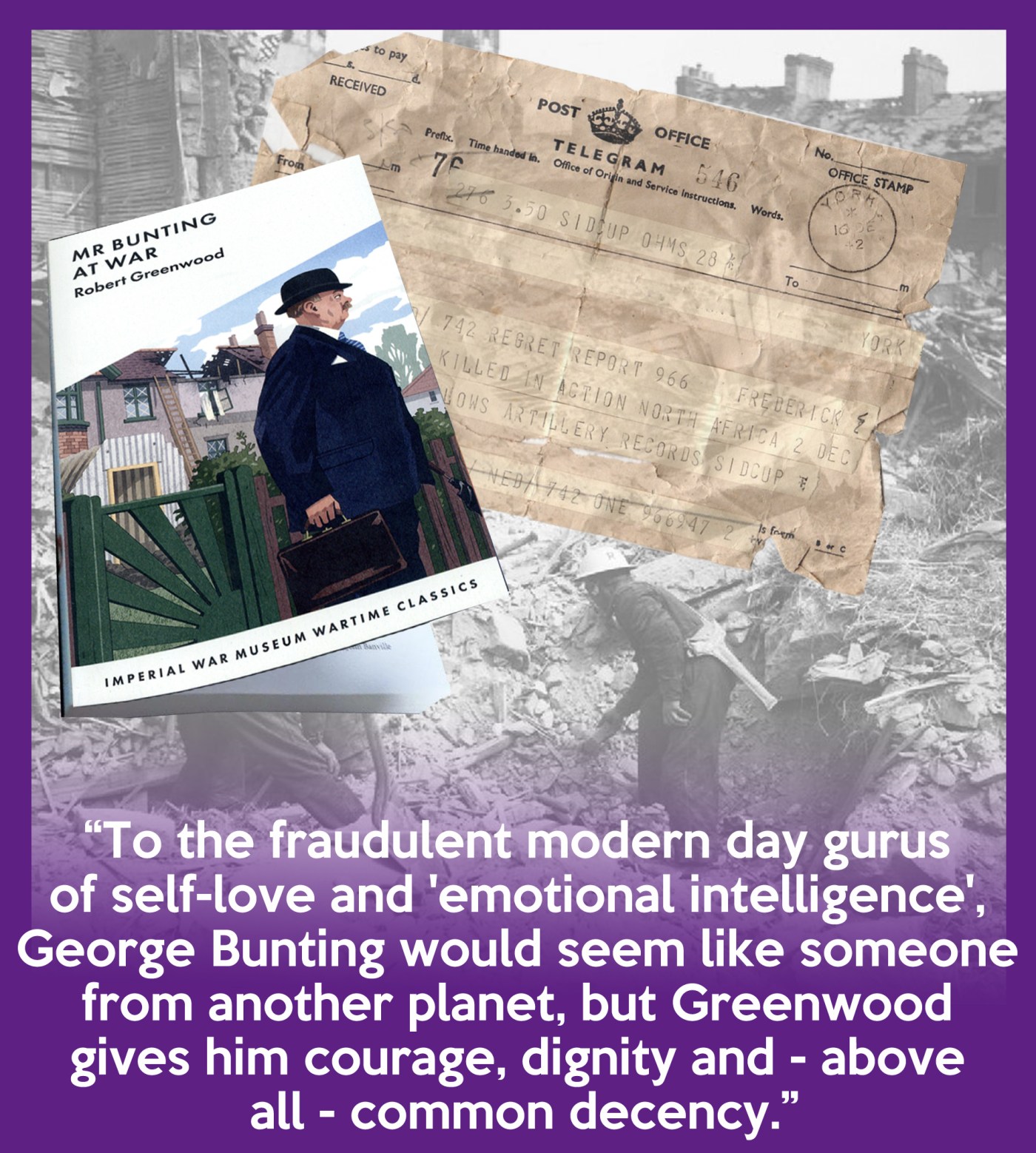
In George Bunting, Robert Greenwood created a character who is ordinary in the extreme, socially gauche, but from a generation of people who simply ‘got on with things’ when the darker side of life – in this case, a world war – threatened to overwhelm them. When tragedy strikes the family, he is devastated, but breaking down is simply something that was ‘not on’ in those days. To the fraudulent modern day gurus of self-love and ’emotional intelligence’, George Bunting would seem like someone from another planet, but Greenwood gives him courage, dignity and – above all – common decency. Mr Bunting at War is an Imperial War Museum Classic, and will be out on 21st April.

Greenwood

For reviews of other IWM Classics, click the link below.

IMPERIAL WAR MUSEUM CLASSICS

SWORD OF BONE . . . Between the covers

SOB header

Some critics have compared Anthony Rhodes (1916-2004) with his more illustrious near contemporary, Evelyn Waugh. They were both Roman Catholics, although Rhodes converted late in life. Both wrote novels, biographies and travel books. Both – and this is most relevant here – wrote fictionalised accounts of their service in WW2. Waugh’s Sword of Honour trilogy – Men at Arms, Officers and Gentlemen & Unconditional Surrender – was a much more substantial achievement, but both wrote from the view of public school educated men who had gone on to higher education, in Waugh’s case Oxford, and in Rhodes’s case Royal Military College Sandhurst. The latter, of course, makes Rhodes a professional soldier, but they both wrote with a certain sardonic detachment about the war and the soldiers who served in it.

Sword of Bone begins in the early autumn of 1939 when Rhodes becomes a liaison officer for his army division. He is a gifted linguist, and he is a member of the advance party sent to France. They assemble in Southampton, then:

At three o’clock that afternoon we embarked on a miserable grimy little cross-channel boat called The Duchess of Atholl, which had been painted a dirty grey and which, except for what appeared to be an inexplicable pair of blue knickers drying on the bridge, had little enough connection with her eponymous aristocrat.”

SOB cover014His party work their way at a leisurely pace from Brittany up to the grim and grey slag heaps and factory chimneys in the region of Lille, Lens and  La Bassée. His role eventually settles into that of commissioning supplies of engineering materials – principally those needed to meet a sudden demand for concrete pill boxes.

It is worth spelling out at this stage what exactly was going on in the war in Western Europe. On 3rd September 1939, Britain and France declared war on Germany as a result of Hitler’s invasion of Poland. All through that autumn, until the winter became spring, there was little or no military action on the ground. In December, British warships had engaged the German Battleship Graf von Spee, and forced it to seek refuge in the neutral port of Montivideo, where it was eventually scuttled. Back in France, the French had the largest army in Europe, the best tanks, and were convinced that the complex of fortifications known as The Maginot Line made its eastern border with Germany impregnable.

Not so secure, as Rhodes finds when he is billeted near Lille, is the border with Belgium – little more than a few strands of barbed wire and sentry boxes manned by a handful of bored soldiers. The first half of the book is a series of entertaining encounters with village Mayors, profiteering restaurateurs, blimpish Colonels and the complex hierarchies that exist between different parts of the British Army. In Rhodes’s entourage are other officers, of contrasting temperament and character. There is Stimpson, intellectual, effete, almost, and politically rather ‘unsound’.

When the last politician has been strangled with the entrails of the last general, then, and only then, shall we have peace“, he says one evening in the Mess.

The Padre is emphatically different. He is “a man whose views on the treatment of Indians did more credit to Kipling than to his cloth.

Rhodes catches sight of his first German (through binoculars) when he and other officers visit a Maginot fort near Veckering, in the Moselle region. Rhodes’s Major wants action:

Quick, ” said Major Cairns, turning to a Guardsman with a rifle, “Pick him off. Quickly, man.
Please, ” said the subaltern, without moving, “do no such thing. Our business is to obtain information. We want prisoners, not dead men. Besides, if we fire from here, it will only give our own position away. I am afraid I must ask you not to think of firing, sir. It will only mean an immediate reply from the Boche with mortar fire.
Major Cairns sadly put down the rifle which he had taken from the Guardsman, and we all stood by the trees looking out over the valley.”

Of course, the fun has to end sometime, and after a foray into Norway, Hitler’s forces invade Holland Belgium and France on 10th May. The citizens of Louvain and Brussels, remembering the heroics of two decades earlier, are convinced that the ‘Tommies’ will, once again, give the Boche a bloody nose. As we all know, it was not to be. The Germans have ignored the Maginot Line and are storming down through Belgium. Arras falls, and the French army – on paper, numerically and technically superior – are in headlong retreat along with their British allies. It is very much a case of “our revels now are ended” for Rhodes and his colleagues.

Sword of Bone is a little masterpiece. As it follows the fortunes of a small group of British Army officers in the early days of WW2, it records their journey from champagne and lobster lunches and a seemingly absent enemy, to the terrifying and bloodstained beaches of Dunkirk. Rhodes writes with great charm, gentle satire, pinpoint observation but with total authenticity. The book is published by the Imperial War Museum and is out now.

You can read my reviews of the other books in this excellent series by clicking the image below.

Print

PATHFINDERS . . . Between the covers

Wellington
I can’t think of a publishing event
over the last few years which has been more impressive than the republishing of WW2 novels by the Imperial War Museum. It has become an axiom that The Great War was identified with the poets, but what was the literary legacy of the war against Hitler? This series has confirmed that the dreadful six years of global conflict inspired some superb novels. I was born just after the war ended. My father served in the British Army throughout, and had many a tale to tell but, until recently, I had no idea of the breadth of novels written by men and women who took part in the conflict. Yes, I had read Waugh’s superb Sword of Honour trilogy and Len Deighton’s magisterial Bomber, but beyond those, very little. I have reviewed all the previous books in this series, and you can find my thoughts by clicking this link. The latest in the series is Pathfinders, first published in 1944.

screen-shot-2021-05-10-at-10.46.53Cecil Lewis (left) was a combat pilot in the Great War, but returned to the colours as both an instructor and an active flier in WW2. Pathfinders tells the tale of the crew of a Wellington aircraft. Perhaps unjustly, the Wellington has not captured the public imagination as much as its big sister, the Lancaster, but the Wellington was a durable workhorse that played a vital role in the work of Bomber Command. The six men who flew the aircraft in this novel each have a specific job as the aircraft goes in ahead of a bombing raid to drop incendiary flares on the ground targets so that the following planes can see when and where to unload their bombs.

A Pathfinder crew comprised pilot, co-pilot, navigator, wireless operator, front gunner and rear-gunner. Lewis structures his book around a detailed examination of each of these men, and tells us what kind of people they are. He shows us their backgrounds, their history, their loves, their losses – and their relationship to one another. Relatively little of the text deals with the actual raid the men are involved in. Instead, we have six chapters which deal with, in turn:

Screen Shot 2021-05-10 at 10.45.35Peter Morelli, co-pilot. The American-Italian is suave, debonnaire, but is aware of the struggles and prejudice faced by immigrants in a new country.

Sam Dollar, front gunner. Raised in the brutish and fundamental wilderness of the Canadian forests, Dollar has little to say, but is determined and resolute.

Benjy Lukin, wireless operator. From a Jewish family, Lukin is well-read and erudite, In a former life he was a well-respected theatre critic.

Tom Cookson
, navigator. Born into a disfunctional English family, he was sent to live with relatives in New Zealand. In his late teens he built a sea-going yacht with his best friend, and survived hurricanes while sailing Dolphin from New Zealand to Suva.

‘Nobby’ Bligh, tail gunner. A London lad, he resolve to fight back against the Nazis after a Luftwaffe bomb demolished his father’s bakery, trapping and killing the older man beneath tons of collapsed masonry. At home, his wife is dying of leukemia.

Hugh Thornly, pilot. An Oxbridge man of genteel birth, he was determined to become either a philosopher or a politician, but then the war intervened. His wife Helen – the daughter of a distinguished General, is expecting their second child.

Pathfinders spine

After the biographies, though, Lewis returns – with devastating effect – to the matter in hand. The night raid on Kiel starts well, but then the German defences on the ground and in the air take their toll, and the final stages of the Wellington’s mission are as terrifying a description of the price of war as you will ever read.

Many will have read Lewis’s Sagittarius Rising, his classic account of the war in the air between 1914 and 1918. This wasn’t published until 1936, so there had been a considerable time lapse between his experiences and the book’s publication. Pathfinders is, by contrast, nearly contemporary. How do the two books compare? Does the unusual narrative structure of the later book work? I have to say that for the sheer white knuckle terror of flying flimsy and totally vulnerable aircraft, nothing could beat Sagittarius Rising for its sense of immediacy. As for the structure of Pathfinders, military history buffs may find the central section a rather long diversion from the matter in hand. Personally, I stuck with it, and felt that knowing the six men in person, as it were, made the eventual outcome even more poignant.

In the bitterest of ironies, the military part of Pathfinders begins and ends not in the air or on the runway from which P for Pathfinder took off and landed, but in the sea. To say more would be a spoiler, but I can say that this is a deeply moving and memorable account of brave men having to find a resolution between the horrific carnage their weapons were creating – and the greater long-term good. The only consolation, in human terms, that one can draw from this book, is that in the last few pages, we have a reversal of the solemn words of the Anglican burial sentences:

“In the midst of death we are in life”

Pathfinders is published by the Imperial War Museum and is out now.

feature

Green Hands is the tale of a young woman – Barbara Whitton – who signs up with a chum, Anne, to work with the Women’s Land Army, replacing male farm hands of fighting age who have been called up into the forces. The action sees them first on a bleak and windswept Scottish farm in the hardest of winters, where they do daily battle trying to make mangold wurzels part company with the frozen soil. The accommodation is Spartan, the rations are meagre, and the social life is non-existent. It is all too much for Anne, however, and she departs for the softer life in The Home Counties.

Anne is replaced by Pauline, who Barbara knew – and hated – at school, but Pauline’s eccentric ways and appealing naivity about the world bring a touch of humour to the narrative. Thankfully for their childblains and frozen limbs, Bee (Barbara) and Pauline are transferred to the slightly less brutal world of a farm in Northumberland.

Readers looking for wartime tragedy, sudden death or other moments of high drama will find nothing here to their taste. Instead, there is the steady rhythm of rural life across the changing seasons, and in describing this visceral connection of the the farming people to the land they live and work on, Barbara Whitton echoes such writers as Thomas Hardy, Flora Thompson and Laurie Lee.

51qCNOa5WYL._SX321_BO1,204,203,200_

Green Hands was first published in 1943 and so, unlike most of the other reprints in this IWM series which were published after the war, there was still a war going on, and public morale to be taken into consideration. This accounts for the largely upbeat and positive tone of the story, but should not be taken as a negative criticism.had the book been filmed, it would have been in black and white, but it is to Barbara Whitton’s credit that her landscape is full of colour and nuance.

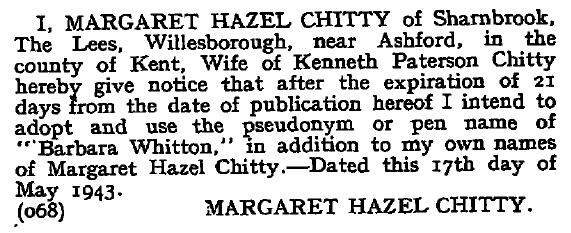
Barbara Whitton (real name Margaret Watson) was born in Newcastle-upon-Tyne in 1921. Due to study Art in Paris, her training was curtailed by the outbreak of the Second World War. Having volunteered for the Women’s Land Army (WLA) in 1939, she worked as a Land Girl for around a year before moving to the First Aid Nursing Yeomanry (FANY) and later joining the Auxiliary Territorial Service (ATS) as a driver, where she remained for the duration of the war. During her time with the ATS she met her husband Pat Chitty and they were married in 1941. After the war, she wrote a number of accounts of her wartime experience and retained an interest in art, literature and horticulture throughout her life. She died in 2016. I found this curiosity on the internet.

Most of the IWM Classics have been stories of men at arms. Plenty Under The Counter by Kathleen Hewitt (click for review) took a quizzical look at some of the less salubrious aspects of life on The Home Front, but Green Hands delivers a tale of hardship, humour and – above all – the humanity of those who kept the country going during the dark years of wartime. It is published by The Imperial War Museums and is out now.

WARRIORS FOR THE WORKING DAY . . . Between the covers (click for full page)

WFTWD header

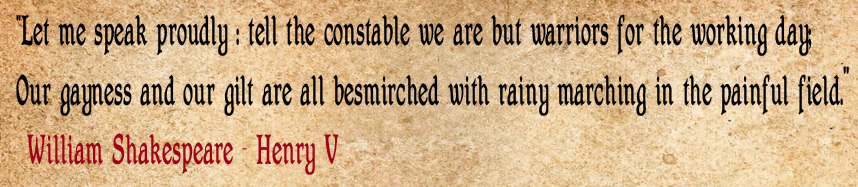
Shakespeare’s words have an uncanny relevance to this novel. First published by Jonathan Cape in 1960, it is the story of another “band of brothers” who, like Henry V’s army six centuries earlier, were fighting in the fields of France. This time, the “happy few” are the crew of a British tank, fighting their way inland from the beaches of Normandy.

Elstob

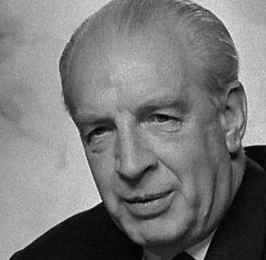
Like most of the other novels in this excellent Imperial War Museum series of republications (see the end of this review) Warriors For The Working Day is semi-autobiographical. Peter Elstob (left) was a tank commander as part of the 11th Armoured Division. His own service closely mirrors that of Michael Brook, the central character in the novel.


Elstob
vividly captures the intense claustrophobia of being part of a tank crew, and the awareness that they were sitting inside a potential bomb:

“Uncertainty and a preoccupation with defence ran through the troop like a shiver and reminded them that they were imprisoned in large, slow moving steel boxes full of explosive and gallons of readily inflammable petrol.”

Brook and his comrades are fighting an enemy who is frequently invisible and most probably using a better machine than theirs. An understanding the technology of tank warfare in 1944 is crucial to getting closer to the mindset of the men in the novel.


For the greater part of the book, Brook and his crew are in a Sherman tank. These were American, produced in vast numbers, and relatively easy to repair and maintain. The main danger came from the 8.8cm Flak artillery piece, originally designed as an anti-aircraft weapon, but utterly lethal when used as an anti-tank gun, particularly when firing armour-piercing rounds, which would cut into a Sherman like a knife through butter. The enemy tanks – Panzers – would have included the formidable Tiger, with its hugely superior firepower and armour plate. Luckily for the Allies, the German tanks were fewer in number and probably over-engineered, making repairs in the field very difficult.

WFTWD013
The relentless movement
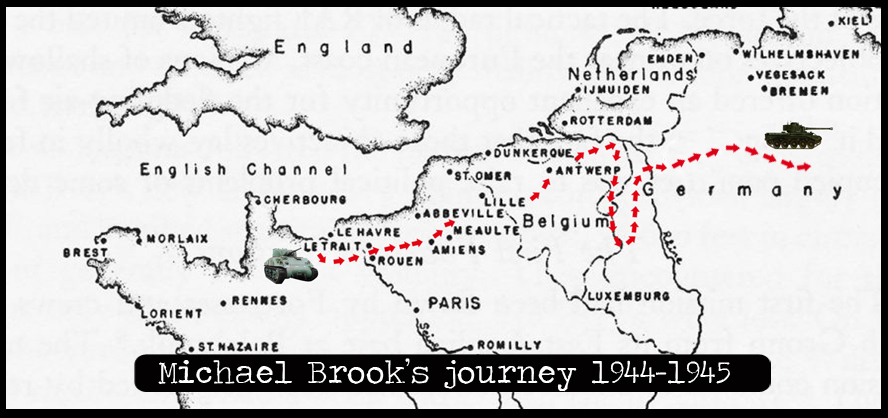
of the narrative follows the tanks as they break out of Normandy and head north-east towards the old battle grounds of the Great War, through the debacle of Operation Market Garden and then, in the depths of winter, to face what was Hitler’s last throw of the dice in what became known as The Battle of The Bulge. The final episode of the saga sees Brook and his weary colleagues crossing The Rhine and fighting the Germans on their own soil.


Along the way
, Brook gains new friends but loses old ones, while learning something about the nature of battle fatigue:

“Most of them were unaware that anything much was wrong with them, for they were uncomplicated men not given to introspection. They knew they were frightened, but they knew that everyone else was frightened too, and had come to realise that wars are fought by a few frightened men facing each other – the sharp end of the sword …’


Violent death is ubiquitous and frequent, but has to be dealt with:

“‘I’ve just been talking to the Q – Tim Cadey’s dead.’
He told them because he had to tell them. They said the conventional things for a minute or two and then changed the subject. It was not the time to recall the small details of Tim Cadey, or ‘Tich’ Wilson, his driver, or Owen and his singing. It was best to try and forget them all immediately.”


In their progress into Germany
, Brook and his crew pass a mysterious wired enclosure surrounded by tall watchtowers:

‘They certainly don’t intend to let their prisoners escape,’ said Bentley. ‘What’s the name of this place, Brookie?’
Brook reached for the map on top of the wireless and found their route. ‘That village the Tiger was in front of was called Walle … and the town up ahead is Bergen, so this must be …Belsen. Yes, that’s right, it’s called Belsen.’

‘Never ‘eard of it, ‘ said Geordie, jokingly. ‘But I wouldn’t want to live ‘ere.'”


Warriors For The Working Day
is a deeply compassionate and moving account of men at war, simply told, but without bitterness or rancour; it is the work of a man who was there, and knew the tears, the laughter, the bravery – and the human frailty.


Brook journey


To read my reviews of other books in this series, click on the image below.
Warriors footer

PATROL . . . Between the covers (click for full page)

Patrol header

Fred Majdalany was born in Manchester in 1913. During the war he fought in North Africa, Sicily and Italy, was wounded and was awarded the M.C. In addition to his novels, he also wrote accounts of the battles for Cassino in the Italian campaign, and the pivotal Battle of El Alamein. Patrol was first published in 1953, and has been reprinted many times, selling hundreds of thousands of copies.

Patrol follows the fortunes of a young army officer, Major Tim Sheldon, in the 1943 North Africa campaign. Sheldon is posted with his battalion in a forward outpost somewhere in the vast desert. The disconnect between these soldiers and the planners and analysts hundreds of miles away, is obvious from the start.

Quote1

Although the Germans are not far away, the biggest enemy of Sheldon and his men is the ever-present desire of those in comfortable far-off HQs to be seen to be “doing something”. Endless – and pointless – patrols have worn the men down; nerves are shredded; morale is sapped. Sheldon knows the true nature of bravery:

Quote4

When it is decided that a patrol is required to investigate White Farm, which may – or may not – be in enemy hands, Sheldon has to gather a patrol together, but he is all too well aware of the futility of what they are being asked to do.

Quote2

The novel is beautifully structured. The beginning and end of the story deal with the genesis and outcome of the patrol, while the central section recounts Sheldon’s experiences while being treated for a wound sustained earlier in the campaign. He experiences the complex and often cumbersome machine that clanks away in the background. He reflects on the contrasts between the world of fighting men and that ‘somewhere else’ that seems so distant and unattainable.

telegram corrected

This is almost a novella at just 143 pages, but it is brutal, and shot through with a bitter poetry. Majdalany was no stranger to battle, nor to the concept of unavoidable sacrifice, but the last words of the book make uncomfortable reading:

“In a club in St James’s Street, London, an old man opened his newspaper and querulously read the communique from Algiers. It said, simply,
‘Nothing to report. Patrol activity.’ “

For reviews of the other books in this excellent series, click the image below

Patrol footer

Blog at WordPress.com.

Up ↑