Search

fullybooked2017

Tag

Icelandic Noir

BLACK AS DEATH . . . Between the covers

This novel is the final episode in an Icelandic CriFi saga and, as ever, I am late to the party. Long story short, An Áróra’s sister Ísafold was being abused by her partner Björn, and when Ísafold went missing, with her body found much later, it was assumed that Björn was the killer. When his body is then found at the same site, the investigation is blown wide apart. An Áróra is in a relationship with Daníel, a detective, and when he finally reveals the chilling fact that Ísafold’s body has had the heart ripped from it, this grisly twist sets the stage for a thrilling and addictive narrative.

For series newcomers like me it takes a page or three to discover what An Áróra actually does for a living. She is a freelance forensic accountant, employed by various agencies – some government owned, some private – to mine down into the financial affairs of companies who seem to be doing rather too well.

Flashbacks tell us about Ísafold’s relationship with Björn, and they make painful reading, typifying everything we think we know about women who are dependent on abusive boyfriends or husbands. Björn was a minor cog in a drug empire run by a man called Sturla Larsen. Daníel has asked An Áróra to investigate the affairs of a coffee house chain called Kaffikó. They seem small and insignificant compared to the big international players, so why are they making a huge profit? An Áróra learns that Kaffikó have an influential private investor  who owns half of the company stock.

It is then ‘answers on a postcard’ time as it appears that someone is using Kaffikó as money laundering scheme, and there are no prizes for anyone making the connection between the two apparently unconnected cases. It is easy to see why the five book series has been an outstanding success. The writing has tremendous pace, and verve, with An Áróra a striking and convincing central character. LIke most English readers my knowledge of the original language is absolute zero, but the translation by Lorenza Garcia seems both fluid and fluent.

My only criticism is that the ending was rather downbeat, but then who I am I to expect happy endings from the Icelandic Noir genre! Black as Death is ingeniously plotted, taut, and, occasionally, very bloodthirsty.  It is out today, 23rd October, and published by Orenda Books.

SNOWBLIND . . . Between the covers

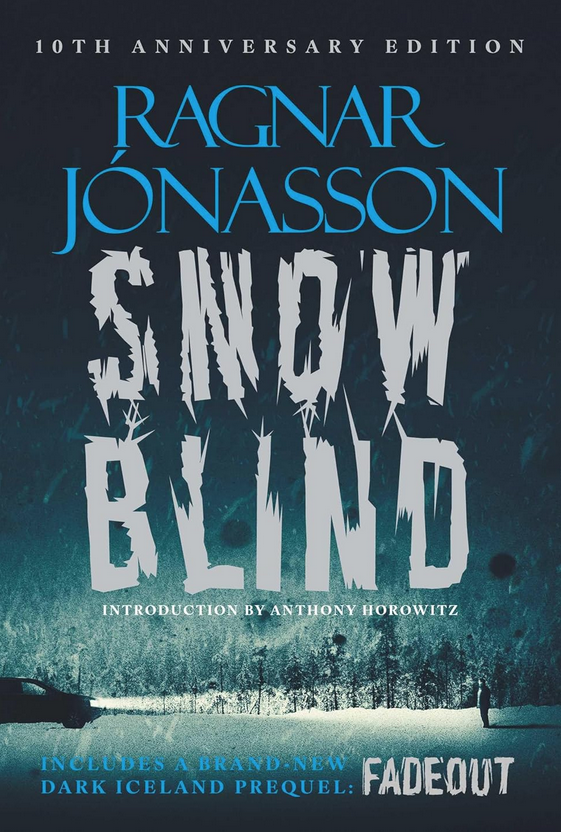
Orenda books published Snowblind  in 2015 (original Icelandic publication in 2010) and it was an instant success. Here, we have the tenth anniversary edition with a bonus – Jónasson’s first novel, Fadeout. Such was the international success of Snowblind that Fadeout was rather left behind. It is described as a prequel but, to be pedantic, Snowblind is, at least in the order of events depicted, the sequel. This review focuses entirely on Snowblind, but I will return to the earlier novel at a later date.

The initial narrative is not particularly straightforward, as there are flashbacks and flashforwards. The latter is a horrible word, but the alternative is prolepsis which sounds rather like an uncomfortable medical condition. The bottom line is that Ari Thór Arason, a newly qualified police officer has left his girlfriend behind in Reykjavik, and taken up a job as assistant copper in the remote northern village of Siglufjörður. His boss, Tómas assures him that the only crimes committed locally are drink driving and the occasional bar punch-up. When Hrólfur Kristjánsson the village’s only celebrity resident, is found dead at the foot of a staircase in the local theatre, Ari Thór is under huge pressure to sign the death off as an accident.

Hrólfur was a celebrated author, but lived in rather superior isolation in his home town, basking in his former celebrity. Meanwhile, Ari Thór feels largely ignored by his girlfriend, but has been charmed by another young woman, Ugla, who is teaching him to play piano.While Ari Thór and Tómas brood over Kristjánsson’s fatal fall, the ‘crime-free’ fishing village faces another shock, brilliantly described in one of the many astonishing passages of prose in the book. A little boy is allowed out by his parents to play in the freshly fallen pristine snow.

“He revelled in the snow; it was in his blood. The darkness was comfortable and snug. The sight of the angel, a beautiful snow angel, didn’t frighten him. He knew the woman. He had played often enough in her garden that he even remembered her name. What he couldn’t understand was why she was lying so still, and why she wasn’t wearing a jumper. In his eyes, the blood red snow that formed a halo around her was beautiful, a vivid embellishment to the rest of the pearl white garden. He didn’t want to disturb her and with one last glance at the wondrous sight, made his way home, stopping just once on the way to make a snowball.”

The woman is Linda, wife of Karl, a stalwart of the am-dram group and, incidentally, an addicted (and serially unsuccessful) poker player.Jonasson uses a clever double metaphor for the (2010) situation in Iceland. Younger citizens are still reeling from the spectacular collapse of the country’s banking system, but for older people there is a more potent symbol. The humble herring was once a dietary staple across Europe, but overfishing meant a catastrophic decline in stocks. “You should have been here when there was herring”, one old lady tells Ari Thór.

As the investigation into the attack on Linda and Kristjánsson’s death appears to be going nowhere fast, Jonasson deploys the time honoured device of a community isolated. Agatha Christie and others preferred islands cut off by stormy seas; the Icelandic equivalent is, naturally enough, an avalanche which closes the only road in and out of Siglufjörður. The eventual solution to the crimes is elegant and thoughtful, even if Ari Thór‘s personal situation is about to become even more complicated. This anniversary edition of Snowblind will be published by Orenda Books on 23rd October.

Blog at WordPress.com.

Up ↑