
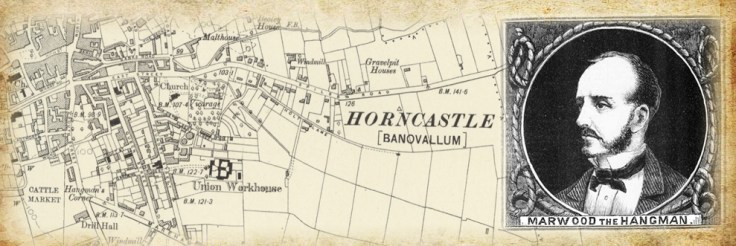
Inevitably, Marwood’s profession brought him face to face with some of the most notorious criminals of the second half of the 19th century. One of these was Charles Peace. Seldom can a man’s surname have been so inappropriate. Peace,after killing a policeman in Manchester, fled to his native Sheffield, where he became obsessed with his neighbour’s wife, eventually shooting her husband dead. Settling in London, he carried out multiple burglaries before being caught in the prosperous suburb of Blackheath, wounding the policeman who arrested him. He was linked to the Sheffield murder, and tried at Leeds Assizes. Found guilty, he was hanged by Marwood at Armley Prison on 25th February 1879.

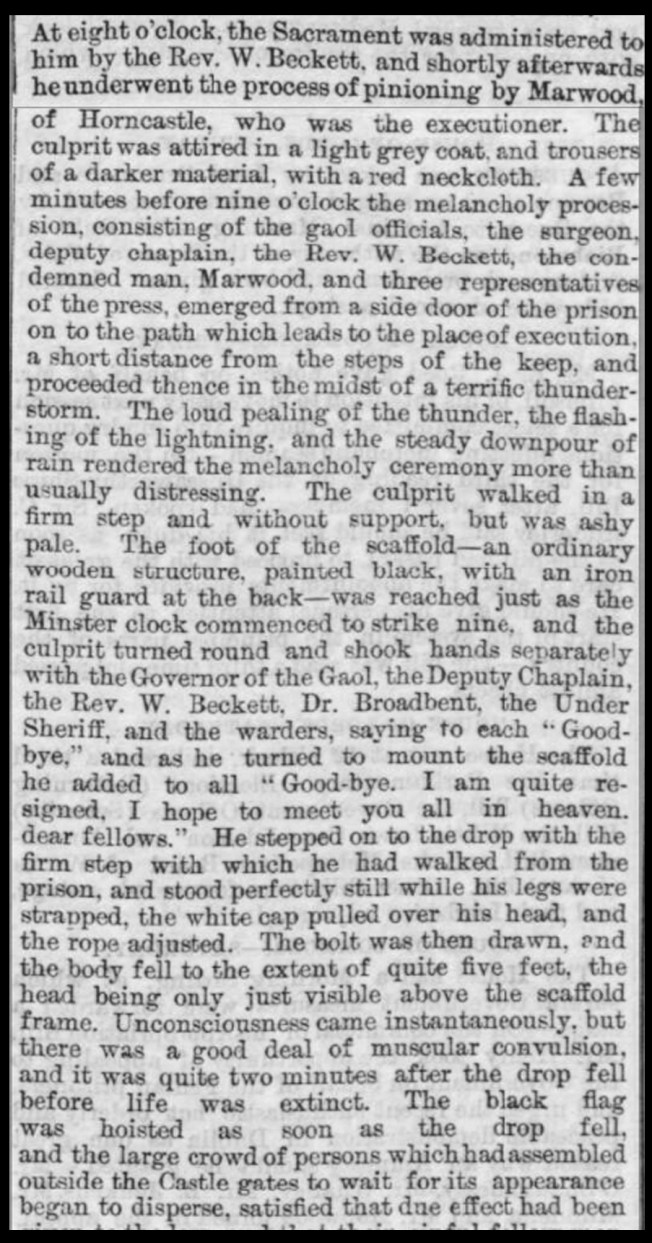
One of Marwood’s jobs involved the despatch of someone who was, quite literally, ‘close to home’. In August 1875 he presided over the execution of a young man from Louth, Peter Blanchard, who had savagely murdered his girlfriend in a fit of jealous madness. I have written about the case elsewhere on this website, and if you click this link, it will take you to the feature. Blanchard’s death was described in the Lincolnshire Chronicle.
Perhaps the most controversial period of Marwood’s career as hangman was as a result of rising tensions in Ireland in the 1880s. The Irish nationalists, in particular the group known as The Irish National Invincibles, were determined to inflict damage on what they saw as British imperialism, and on 6th May 1882, two high profile British officials, Thomas H Burke and Lord Frederick Cavendish were murdered while walking in Dublin’s Phoenix Park. In Kilmainham Jail, Dublin, on 14th May 1883, Marwood hanged the five men found guilty of the murder. In the previous year, 15th December, Marwood had hanged Maolra Seoighe for his part in the murder of a local family in Maamtrasna in County Mayo. The five ‘invincibles’ are pictured below:

Such was the animosity between the Irish republicans and anyone thought to be an agent of the British state that when Marwood died – officially of pneumonia and jaundice – in September 1883, there was speculation that he had been assassinated by the Fenians. This was from the Leeds Times:
The Irish lnvincibles sent him a threatening missive, warning him that if he set foot upon Irish soil he would not depart alive. Marwood was carefully protected while in Ireland and the threats against his life prove to be inoperative. Rumours having gained currency that the Irish Invincibles were in someway responsible for the illness and death of .Marwood, it was deemed advisable to inform the coroner. Arrangements were-made for the interment of the body, but pending the coroner’s decision the funeral was delayed. The inquest was held on Thursday. The coroner remarked that deceased’s death was not unexpected. Two medical men attended him. Sarah Moody, who had nursed deceased, was not aware that anything of an unfair kind was administered to him. Mrs. Marwood, wife of deceased, said her husband went to Lincoln on Friday week. He had not been well since. She asked him on Sunday if anything of an injurious kind was given to him. He said “no” and made light of the matter. She did not believe he had received any threatening letters since one published a year ago. He had no fear or expectation of violence at the hands of the Irish. Dr. Hadden and Mr. Jelland, surgeon, who had attended deceased, said that their patient died from natural causes, and a verdict to that effect was returned. The remains of Marwood were afterwards interred in Trinity Churchyard.
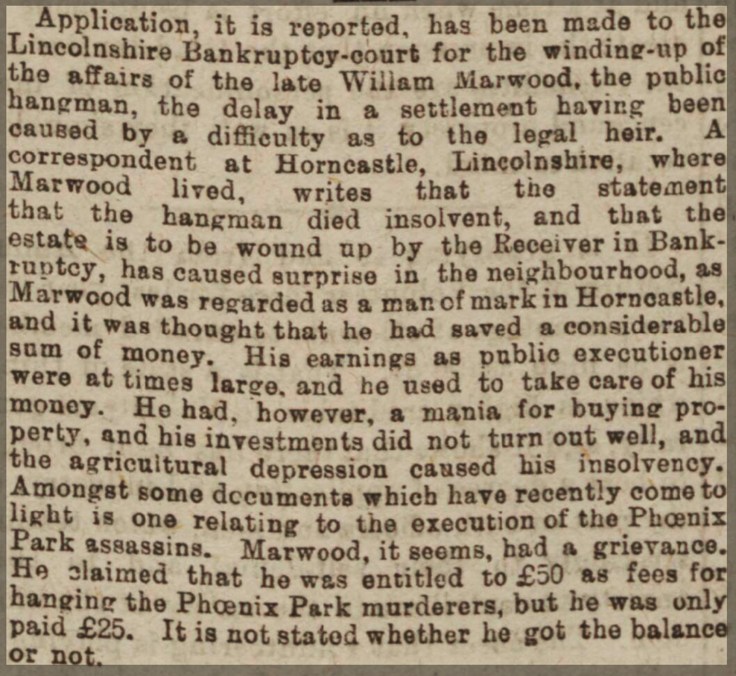
A sad postscript to the life of William Marwood was that, despite his quite prodigious earnings from his job, he had mismanaged his affairs. Some years after his death, this was the report in The Manchester Courier and Lancashire General Advertiser:


 “During my stay in Horncastle I got to know that Marwood had been doing duty as a hangman some time before his neighbours knew of the circumstance. And it would have been a secret for some time longer, but that a Horncastle man happened to be present at an execution which took place at some distant town, and, on seeing the operator, recognised his fellow-townsman. The news spread like wildfire at Horncastle, and when Marwood arrived home he found himself the object of a few attentions which were more demonstrative than nice. And for some time after, when he started for, or came back from, an execution, he was followed about by people who showed no displeasure by hooting him, and by beating tin kettles, pots, and pans. This grew to be a veritable nuisance, so bad that Marwood was compelled to write to the Home Secretary claiming protection. After he had done this the head of Horncastle police was communicated with, and since that time Marwood has been permitted to depart from, and return to this town without molestation; in fact, he walks about the place without attracting any special attention. I noticed that his fellow townsmen greeted him in an unmarked but friendly manner, and he appeared to be on good terms with everybody. He keeps a shoemaker’s shop, and is comfortably off, owning several houses in Horncastle.”


 fullybooked2017