Search

fullybooked2017

Tag

Historical Crime Fiction

STOP PRESS MURDER …Between the covers

SPM GraphicSome historical crime fiction takes us back to times way, way before our own memories could have any validity. Then there are stories set in periods that many of us could reasonably have experienced at first hand. With the former, it is simply the author’s research versus the depth – or lack of – our own historical knowledge. The latter is a much more tricky enterprise, as someone who sets their book in the 1960s, for example, can be exposed to a more searching light – that of readers who actually lived through the years in question.

Peter Bartram’s mileu of choice is the early 1960s. We are in Brighton, the celebrated seaside town on England’s south coast. Its days of fame as the Gay capital of Western Europe, and infamy as the first large local authority to be mismanaged by the Green Party were yet to come, but the seeds of eccentricity have already been sown. Our guide through the Sussex town is Colin Crampton, the scoop-hungry reporter for The Evening Chronicle – a Brighton newspaper. He is a thoroughly engaging character with a quick wit, and it isn’t too fanciful to imagine that he might resemble the author in his younger days. If you read Bartram’s biography, you will be forgiven for thinking that if Crampton is not Bartram, then he is someone who the author knew very well in his early days as a journalist.

The basic plot is that we have a long-retired star of What The Butler Saw machines – Marie Richmond – who dies in a mysterious road accident. Then, a machine featuring her in her prime is broken into, and the revealing footage is stolen. The man who should have been guarding the pier is found bludgeoned to death – with a coconut. Crampton/Bartram introduces us to some memorable characters, including a camp, overdressed theatre critic and a toupéed old thespian, both of whom are crying out for the much-missed talents of John Inman and Charles Hawtry to bring them to life.

As Crampton attempts to unravel the mystery of why the ample charms of a silent movie star should have given someone cause for murder, there are some delightful period references and jokes which made me laugh out loud, although younger readers might not get the gags unless they are students of British popular culture in the second half of the 20th century.

There may well be readers who, by this point, have been receiving ‘cosy’ messages on their genre radar. All well and good, as there are elements of cosy crime here. We have an unambiguously likeable central character, a familiar and lovingly-painted background, and a cast which includes several amiably odd characters. We reviewers love our genres, and some readers may even share this obsession, so I’ll pop Stop Press Murder into the Cosy pigeonhole, with one or two caveats. Although the tone is generally as gentle and as light as a Brighton breeze, Bartram finds enough dark corners in the seaside town to keep the interest of those who like their crime fiction with a harder edge. The style of the book reminds me very much of the sharply humorous writing of Colin Watson and his Flaxborough novels, which also delight in the dafter aspects of English life, as well as boasting a collection of folk with similarly improbable surnames

Crampton is convinced that there is a link between the odd events on the pier, and discovers that Richmond – or to use her real name, Sybil Clackett – has a twin sister who is no lesser personage than the Dowager Marchioness of Piddinghoe. The local police and the Chronicle’s rival newspapers are seeing the case differently, however, and Mr Figgis, Crampton’s boss, is becoming increasingly twitchy as he fears for his sales figures.

Peter Bartram explores all possibilities inherent in the twin sisters storyline, and delivers an excellent novel, full of twists and turns, plenty of action scenes, crackling dialogue – and a great sense of fun. I’m looking forward to yet more encounters with the Evening Chronicle’s star turn. You can find a copy of Stop Press Murder by following the link.

SPM Graphic2

CHARCOAL JOE … Between The Covers

Mosley


“This money is from me, Easy. I’m the one hirin’ you”
“Cheddar or blue?” I asked, taking the cash.
“Say what?”
“I just wanna know what kind of cheese is in this trap.”

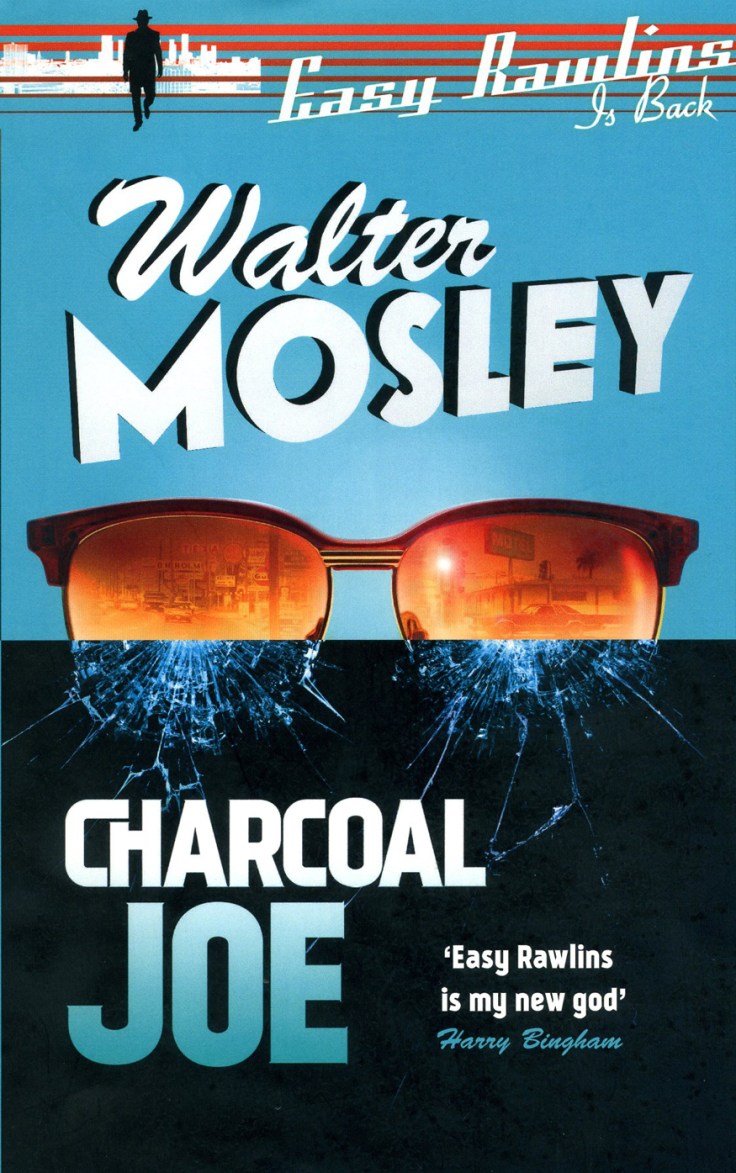
Thus Walter Mosley’s Los Angeles PI Ezekiel ‘Easy’ Rawlins takes a thick wad of cash from his long term buddy Raymond ‘Mouse’ Alexander, as a down payment on his latest case, to extricate 25 year-old Dr – of physics – Seymour Brathwaite from a murder rap. The fact that Easy, like a huge number of fellow Angelinos, could never say “no” to Mouse, is one thing; Mouse may well be the most dangerous man in the city, but the legendary Charcoal Joe is probably next in line. And it’s Joe who had called in a favour of Mouse.

Seymour Brathwaite has been found at a murder scene in Malibu beach with two corpses lying on the floor. When LAPD’s finest catch a black man at the scene of a shooting, that’s normally case closed, give or take a few minutes of paperwork, but this is different. Brathwaite has no connection with either the corpses or crime in general, and he seems to have a very powerful friend in underworld fixer, arranger of violent death and generally lethal string puller Rufus Tyler – better known as Charcoal Joe.

Joe is currently residing in one of LA’s more relaxed and well appointed correctional facilities, serving a short sentence for some minor infraction. Easy pays him a visit to learn more about why young Dr Brathwaite was in the wrong place at the wrong time, and finds Joe attended by his minders and gophers. He asks why Joe is so convinced of Seymour’ innocence.

“The young man is a doctor of science,” Rufus Tyler the prodigy intoned. “He’s teachin’ at UCLA right this semester while he finishes his postgraduate work. Now how’s a man like that gonna be some kinda niggah like the people you and me consort with?”
I could think of a dozen ways. The universities in the late sixties were hotbeds of bombers, Liberation bank robbers and stone-cold killers.

Despite his misgivings, Easy sets about his work. At this point, it may be the moment to bring people new to the series up to speed with the who, what and why of the world of Easy Rawlins. Our man fought for Uncle Sam in WW2, and returned to an America where the yoke of oppression may have been lifted in Western Europe, but not in hometown USA. Battling everyday racism, put-downs and casual affronts, he has survived death on several occasions by the thickness of a cigarette paper, managed to earn the grudging respect of certain members of the LAPD, and has raised a family – albeit an unconventional one. Conscious that his work is always attracting new readers Mosley – like the weaver of dreams he is – fills in the biography with the deftest of touches, as he goes along.

Inevitably, Easy is being lied to by pretty much everyone involved in the case of the naïve Dr Brathwaite. The body count is spectacular, and even as he mourns the loss of his best love, Easy manages to squeeze in a couple of ‘romantic encounters’. The euphemism is mine. One of Mosley’s skills is to dance his way deftly through the minefield that faces writers who tackle sex scenes. Where many tread too heavily and die, Mosley escapes unscathed.

Mosley009The plot, as they say, thickens – to the point where you may need to skip back a few pages just to be sure that you are certain who has done what to whom. To me, this is neither here nor there. Sometimes cliches are unavoidable because they tell a simple truth, and with any Easy Rawlins novel it is all about the journey rather than the destination. An Easy Rawlins tale is what you get when a poet writes crime fiction. If Raymond Chandler were a deity, then I would worship him, but I would be hard pressed to summarise the detailed plots of Philip Marlow’s cases. I could, however, rattle off a dozen one-liners and brilliant descriptions which have made Chandler immortal. So it is with Mosley.
Easy goes to an illegal club called The Black Door Bar, and is reunited with an old flame.

“Hey, Easy,” Louise Lash said.
She was maybe forty with a face that would be beautiful twenty years after her death. Her skin was black and flawless. Even when she wasn’t talking her mouth seemed to be saying something elusive.

Read this book, and cherish it. Mosley is not an old man by today’s standards, but there will come a time when there will be no more Easy Rawlins, and the world will be a poorer place for his passing.

Follow the link to get your copy of Charcoal Joe.

Mosley010.jpg


WW2 HISTORICAL CRIME FICTION (1) A Lily of the Field

EVERYONE LOVES A GOOD LIST, and I’m no exception. To kick off a series of features on historical crime fiction, I am starting with my own favourite period – World War 2. I just missed it, by a couple of years, but both my mother and father served, as did my wife’s parents, and so ‘The War’, as it was always known in our house was – and remains – very much part of my consciousness. My selection is subjective, and there is no order of merit, but each of the five is a cracking read.

ALOTFA LILY OF THE FIELD by John Lawton

Lawton is a master of historical fiction set in and around the war. His central character is Fred Troy, a policeman of Russian descent. His emigré father is what used to be called a ‘Press Baron’. Fred’s brother Rod will go on to become a Labour Party MP in the 1960s, but is interned during the war. His sisters are bit players, but memorable for their sexual voracity. Neither man nor woman is safe from their advances.

Apart from being an elegant and sharp-tongued writer, Lawton’s great skill is to people his books with real personalities of the period. Sometimes they are thinly disguised, but more often than not they play themselves. Across the spread of Fred Troy novels, we meet, in no particular order, Nikita Kruschev, the entire Labour Shadow Cabinet, Winston Churchill’s gunmaker and an American presidential candidate.

Fred becomes one of London’s top coppers, but to categorise the novels as police procedurals is accurate only in as far as that there are policemen in the books, and they occasionally have procedures. All this being said, Troy is in the background during much of A Lily of the Field. We follow the life of teenager Méret Voytek, a brilliant young Viennese cellist. Through her own naivete and a tragic act of fate, she is caught holding a bundle of anti-Nazi leaflets while traveling on the tram. She is taken by the SS and ends up in Auschwitz. Meanwhile, her parents have been likewise detained, and their family home ransacked.

In the bitterest of paradoxes, the Auschwitz commandant, has a musical ear, and so he puts together an orchestra made up of the many skilled inmates. One of their bizarre duties is to play beautiful music as their less talented companions trudge off to work in the morning. Méret plays for her life, literally. The physical privations she undergoes are heart-breaking, but still she plays, still she clings on to what is left of life.

In January 1945, with the Russians approaching from the east, and the British and Americans from the west, the Germans realise that the game is up. Auschwitz inmates who are too infirm to walk are shot, and the remainder are sent out, under guard, to start the infamous Death March. In the freezing conditions few survive, but just as Meret is about to succumb, their column is overtaken by a Russian detachment. Salvation? Hardly. The first instinct of the Russian soldiers is to rape the women. Méret is saved by a no-nonsense officer. At this point, Fred Troy aficionados will recognise Major Larissa Tosca, Fred’s one-time lover. She has, in her time, spied for both America and for Russia, but here her cap bears the Red Star.

Long-time Lawton readers will know that he leaps about between the years with a sometimes bewildering agility. True to form, the climax of this book is played out in post war London and Paris. Méret’s rescue by the Russians has come at a price, and we find her tangled up in the spy ‘games’ which characterised much of the Cold War period. Lawton is much too clever a writer just to tell this one tale, however gripping it may be. Woven into the fabric is another thread which involves an interned Hungarian physicist, Dr. Karel Szabo, who ends up as a key figure in the American efforts to build and test the first atomic bomb.

One of the key figures from the spy ring of which Méret is a part is murdered in London, and it is then that Frec Troy becomes involved. For all his many qualities, Troy is an inveterate womaniser, but he is not a sexual beast, and the late scenes where he spends time with the fragile Méret, still beautiful but old before her time, are haunting in their compassion.

‘Troy had never heard her laugh. It was like that moment in Ninotchka when Garbo laughs on-screen for the first time. It is not merely that she laughs, but that she laughs so long and so loud.

As the laughter subsided she was grasping at words and not managing to get a sentence out.

“Oh, Troy ….oh, Troy..this is….this is a farce. Don’t you see? Viktor taught us the same part.”
“We’re two left-handed women trying to dance backward. Neither of us knows the man’s part.”

She reached up her sleeve for a handkerchief to dab her tears and found none. Troy gave her his, a huge square of Irish linen with an overfancy  ‘f’ in one corner.

Being drunk did not make her loquacious. In that, she was like Troy. At two in the morning Voytek was deeply asleep in front of the fire. Troy picked her up, astonished at how little she weighed, carried her upstairs and slid her into the spare bed. She did not wake. He went to his own bed.’

A Lily of the Field is far from being a dry history novel where the factual details are more important than the plot and the dialogue. It is tense, funny, occasionally very violent, and written with a style and fluency which leaves lesser authors struggling in Lawton’s wake. A final little gem, which I only noticed recently. If you look closely at the cover, you can see Méret Voytek, in her red coat, moving away from us. With her cello slung over her shoulder, she walks into history.

A Lily of the Field is available in all formats, and John Lawton has his own Amazon page
and website.


Blog at WordPress.com.

Up ↑