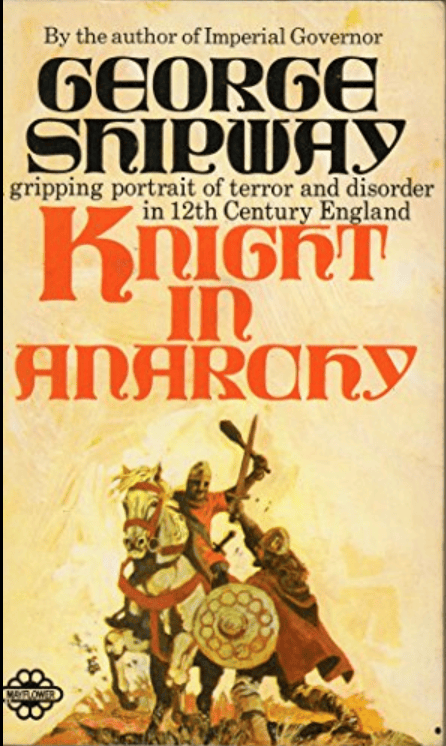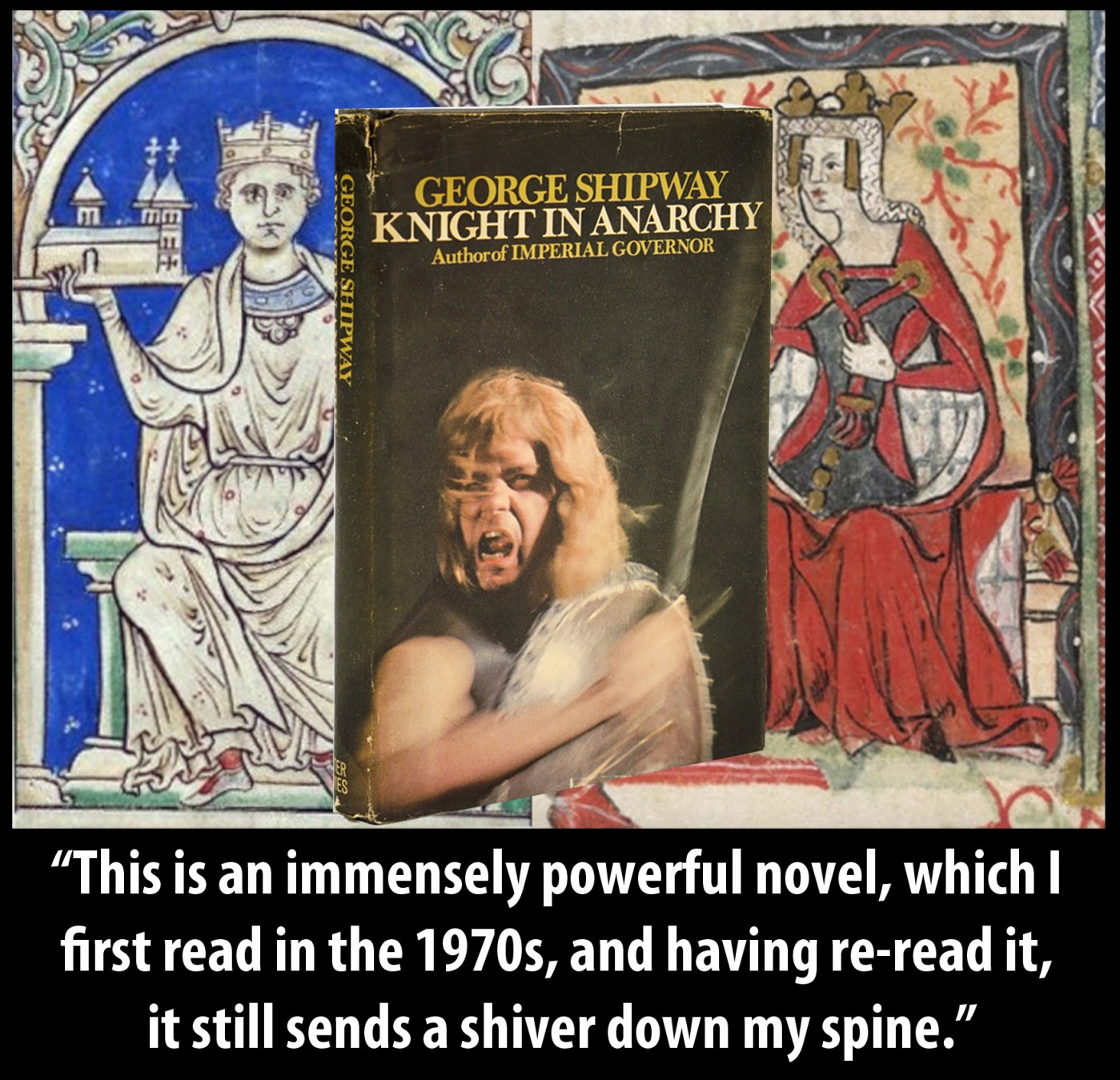

I’ll start this review with a quiz question. What is the connection between this novel and King Charles III, monarch of The United Kingdom and fourteen Commonwealth countries? Read the full review, and you will find the answer. I’m not sure that this book quite qualifies as a classic, even though it was published in 1969, so I will simply tag it in the review section.
The ‘Anarchy’ of the title refers to a period of British history, the mid twelfth century, which the words of WB Yeats, written centuries later, sum up perfectly.
“Turning and turning in the widening gyre
The falcon cannot hear the falconer.
Things fall apart; the centre cannot hold;
Mere anarchy is loosed upon the world,
The blood-dimmed tide is loosed, and everywhere
The ceremony of innocence is drowned;
The best lack all conviction, while the worst
Are full of passionate intensity.”
The politics of this turmoil are not simple, but they are stark. William Rufus, son of the Conqueror, was succeeded by Henry I. When he died in 1135, the succession was disputed between Stephen of Blois, grandson of the Conqueror, and Matilda, daughter of Henry I. The great and good of the land, from Barons to Bishops, took sides, swapped sides and fought a civil war, sometimes intermittent, but long and bitter. The struggle only ended with Stephen’s death in 1154 when, as agreed between the factions in The Treaty of Wallingford the previous year, Matilda’s son, Henry, became King.
This novel follows the fortunes of a young man called Humphrey de Visdelou, son of minor Norman aristocracy in Berkshire. One of the immediate effects of The Anarchy was that the rule of law, vigorously applied in the days of The Conqueror, disintegrated. Thus, Humphrey’s father and his older brother are killed in dispute over a relatively minor piece of land, Humphrey is partially gelded (“just take one”) was the command, and he, landless and virtually friendless, only survives thanks to the ministrations of Saxon foresters in the Forest of Savernake.
He survives and – eventually – prospers, and becomes a knight at the court of Geoffrey de Mandeville, a powerful baron whose instruction, in the ruins of the Visdelou manor, saved half of his manhood. I am a great admirer of the Bradecote novels by Sarah Hawkswood, which are also set during The Anarchy. There, 12th century Worcester, while aware of events elsewhere, is blissfully unaffected by the mayhem playing out elsewhere. Shipway’s account is, however, visceral. Even the wealthy are infested with lice. In combat, men are disembowelled and left to die, cradling their own intestines.
George Shipway was, by profession, a soldier. More precisely he was a cavalry man, and he served with the army in India for many years. Retiring as Lieutenant Colonel, he then took up school mastering, and taught at Cheam, the exclusive prep school in Berkshire. He had a formidable grasp of history, but his depiction of the internecine thuggery does leave gaps for the uninitiated. Particularly confusing is the fact that there were two Matildas. It seems that the names Matilda and Maud were interchangeable. Matilda of Anjou was Stephen’s rival to the throne, but his wife, also Matilda/Maud took up arms on his behalf while he was imprisoned after The Battle of Lincoln.
Humphrey’s allegiance to de Mandeville is central to the story, and it brings about both his rise and his fall. Geoffrey de Mandeville, like many other characters in this book, was a central character in the real story of The Anarchy. He sided with first Stephen and then Matilda, keeping both parties guessing, and seeking to keep the scales forever balanced. In the end, he over-reached himself, and died of wounds in Essex in 1144. The country, meanwhile, was laid waste:
“This was the season of ploughing and sowing, but you could easily go a day’s journey without finding a village inhabited or a field cultivated. The people starved. Their granaries were ransacked, empty, even the seed corn taken. Their breeding stock, cattle, sheep and pigs was gone. No oxen remained to draw ploughs for a space of thirty miles from Ramsey. Neither ox nor plough was to be seen. Emaciated corpses, torn by wolves, lay unburied in fields. Nor, lacking physical subsistence, could they gain spiritual comfort. The churches, burnt and broken, gaped ruthless to the skies. Men said openly, in those days, that Christ and his saints slept.”
This is an immensely powerful novel, which I first read in the 1970s and having re-read it, it still sends a shiver down my spine. As for the little conundrum I set at the beginning of this review, remember I said that Shipway taught at Cheam? One of the intake at the school in September 1957 was none other than the eight year-old heir to the throne, the future King Charles III, whose history teacher was to be none other than the author of this novel. Copies of Knight in Anarchy are available from second hand dealers, but be warned – they are not cheap.