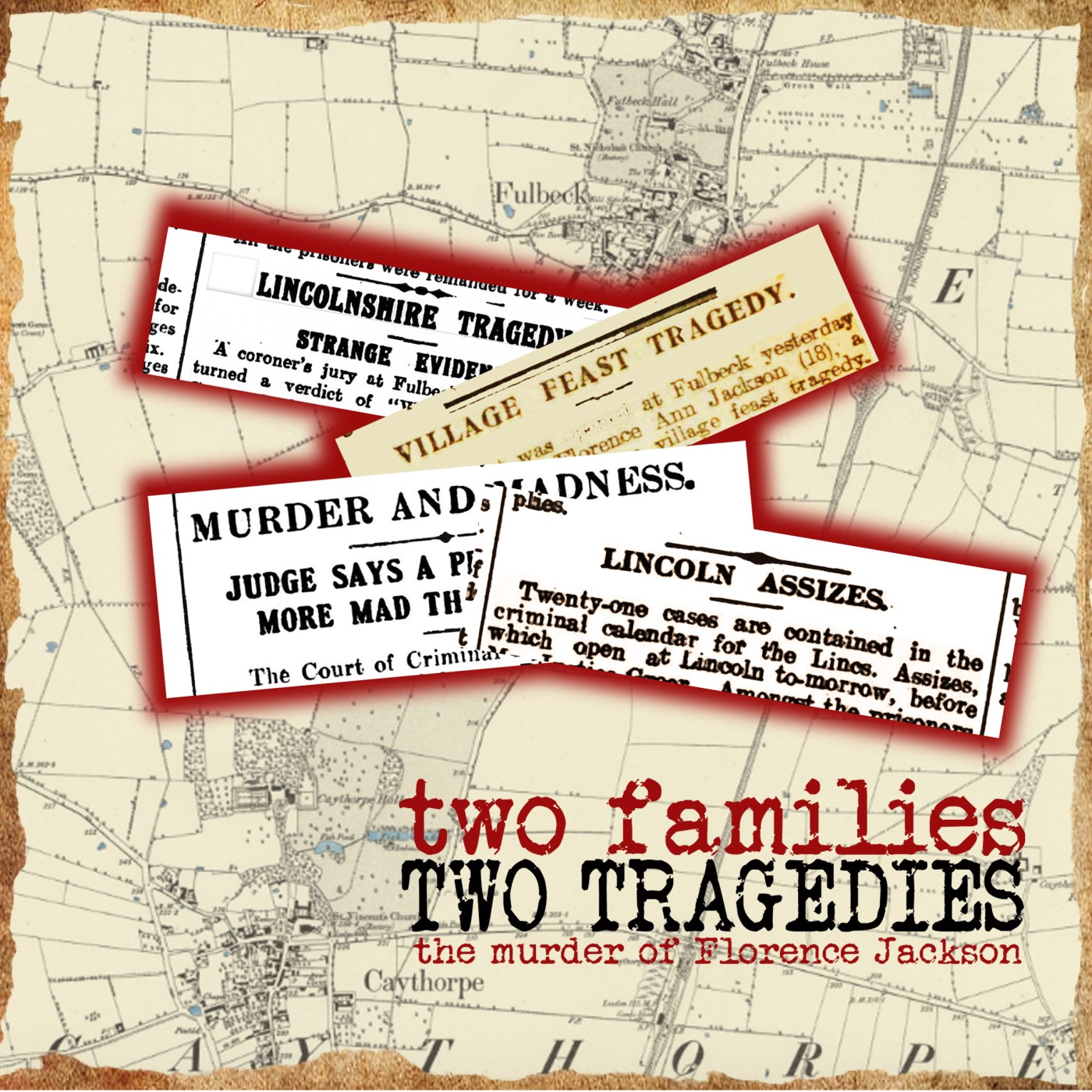
SO FAR: Grantham man Dick Rowland had seen action in the trenches from 1915 until 1918. Unlike his two brothers, he survived, but was wounded and gassed. Spring 1919 found him back in Grantham, aged 29, just another ex-soldier. He had, however, met and fallen for a Fulbeck girl, Florence Jackson. She was ten years his junior and there, I think, lay the problem. She was pretty, fun-loving and with no shortage of local suitors, not to mention dashing officer types from what was to become Royal Air Force College Cranwell. Florence’s mother thought Dick Rowland too old for her daughter, but she could never have envisaged the events of 31st May 1919. It was the day of Caythorpe Feast, an annual event always held on the last Sunday in May. Dick and Florence were there, with hundreds of other local people both young and old. Dick Rowland had become insanely jealous, and every smile or wave Florence gave to some other young man cut him to the quick. He was particularly vexed when Florence decided to share a fairground ride – the wooden swing-boats with some other chaps.

Sometime around 10.00pm, Dick and Florence decided to walk home to Fulbeck. That road, now the A607, was known as the Lincoln Road. Many other people were on that road, but they would have been spread out and it was very dark. I have no idea if there was a moon that night, but one man heard something in the darkness as he rode his bicycle up to Fulbeck. He was later to give evidence at a Coroner’s inquest. This a verbatim report from a local newspaper:
Richard James Nelson, dairyman, Welbourn, spoke of visiting Caythorpe feast on Saturday night last. He saw the deceased girl in the swing boats with a man called Edward Knights. He left the feast about 1045. When he had reached Gascoigne’s gate in the parish of Fulbeck a man called out to him:
“Chummy, stop!”
He stopped, and man who was a stranger asked him to fetch a motorcar from the top as there had been a nasty accident. Witness asked him what it was, and he said:
“A girl has tried to cut my throat and now she has cut her own.”
He noticed the man’s throat was cut and bleeding and he also saw the body of the girl lying on the ground just inside the gateway. Witness attempted to go through the gateway towards the girl. but the man pushed him away and told him to get on his bicycle and fetch a motor car. He then rode off for the police.
There is a horrible irony in that the next people to arrive at the scene were none other than Florence’s older sister and her young man.
Laura Emma Jackson, the deceased’s sister, a land worker employed at Fulbeck Heath, said on Saturday night she was at Caythorpe feast where she saw deceased with Dick Rowland who was courting her. They seemed alright together. Witness left the feast at 10:15 and walked towards home with Percy Graves, a friend. When they got to Gascoigne’s gate she saw a man standing there. He said,
“Mr, Mr, come and look what I have done.”
She told Graves not to go as the man was drunk, but the man came towards them holding out his hands and said,
“Is that Laura?”
Witness replied,
“Yes.”
And he then said,
“I am Dick – I have killed your Flo. Another man wanted her. I have tried to kill myself but could not. Go and tell them at home.”
Witness noticed that Roland had blood down the front of his clothing and was bleeding from the throat. She did not notice her sister. She went home and reported the matter to Mr Palethorpe. Rowland was not drunk but seemed to be rather excited. Witness was at the Grantham statute fair on 17th May with her sister and Rowland. Flo went to speak to some soldiers and Roland asked her to keep an eye on her and watch that she did not go with the soldiers. She told him not to be so silly and that she would not go. Rowland shook his head and remarked,
“Flo’s alright. If I don’t have her I will see no one else does.”
Flo was with the soldiers three or four minutes and then she rejoined Rowland and witness.
The Fulbeck Doctor also gave evidence at the inquest:

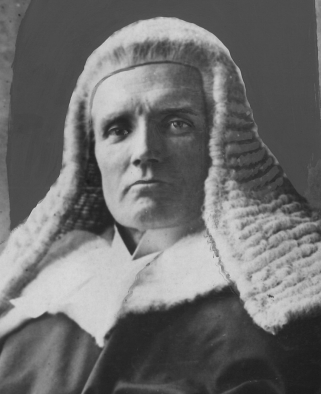
Dick Rowland was arrested for the murder of Florence Ann Jackson. The Coroner recommended that he be charged with murder and the case was sent to the Sleaford Magistrates who agreed, and arranged for Rowland to appear at the Summer Assizes in Lincoln. Rowland’s bizarre defence that somehow Florence had received her fatal wounds in some kind of struggle for the razor was abandoned, and his legal team asked for a postponement of the trial so that further investigations could be carried out into the man’s mental health. This delay was granted, and so it was that Dick Rowland appeared before the Lincoln jurors and judge Mr Justice Greer (left) in November 1919. He was found guilty and sentenced to death despite the jury recommending a merciful punishment. There was an immediate appeal against the death penalty, but that was thrown out, with the appeal judge famously opining that Rowland was no more mad than Othello,(the newspaper managing to mis-spell the village name, and relocate it to Essex}
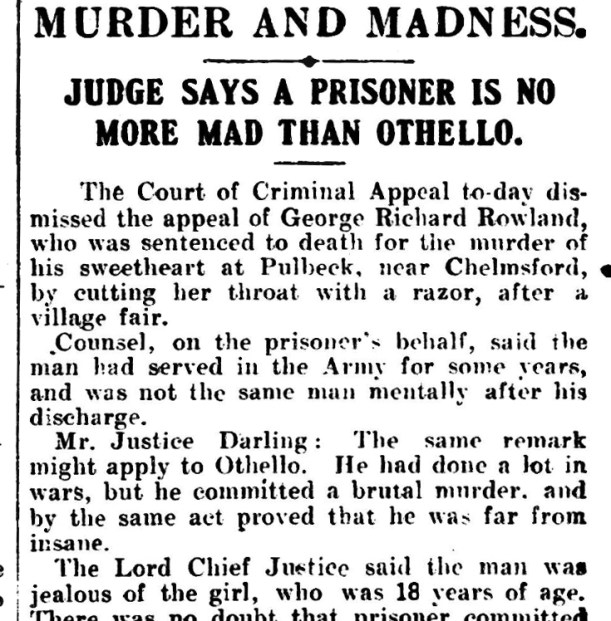
So, Dick Rowland sat in his condemned cell awaiting his fate, probably unaware that he had been compared to one of Shakespeare’s greatest tragic characters. Othello, of course, racked with guilt, stabs himself, which is precisely what Rowland claimed he had tried to do on that fateful evening back in May, but he was to have better luck than the Moor.

In the event, it appears that Dick Rowland was released in April 1935. He married, and the records tell us that he died in Cleethorpes in 1954. Had he become unhinged by his wartime service, a victim of what we now call PTSD? Or had his own chilling words – ” If I don’t have her I will see no one else does.” become a dreadful deed? You must make up your own minds. Incidentally, the fatal spot where Florence died is still there for anyone wishing to stand and contemplate.

Incidentally, a local man, Jonathan Wilkinson has written a novel based on the events I have described. It is very well written, and focuses on what the author believes happened in the months and weeks leading up to Florence’s death. It is available from the Fulbeck Craft Centre (07410 968333)

I have been researching and writing about historic Lincolnshire murders for some years,and those wishing to find out more about our county’s macabre past should click this link
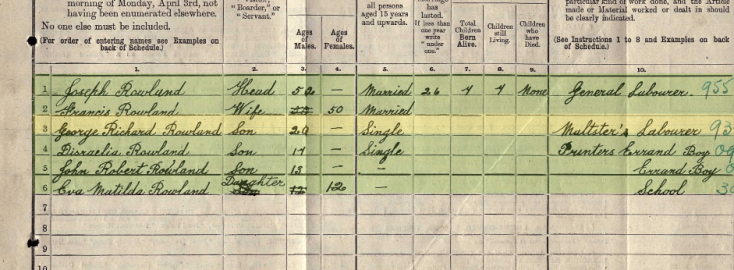


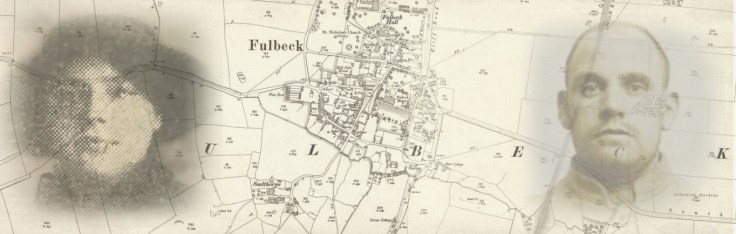
 Now, though, we must return to Fulbeck. Only a grainy newspaper image of Florence Jackson remains, but it doesn’t take a great leap of imagination to picture a pretty, round-faced girl with a confident gaze for the camera. Once again, the 1911 census is of service. She lived in Fulbeck with her family. Florence would not live to be noted in the 1921 survey. Opportunities for young women of humble birth in rural communities in those days were limited to farm work, or domestic service. There are suggestions that Florence has been in service at Barkston, or had returned to Fulstow in anticipation of a similar post. At some point she met Dick Rowland, and he was smitten, considering himself deeply in love. He was now 29, with a lifetime of horrors condensed into four years of hell on the Western Front, Florence was just 19, pretty, vibrant and untouched by the death and misery of The Great War.


 fullybooked2017