
Search

fullybooked2017

Tag

Espionage

MURDER IN PARIS . . . Between the covers

It is April 1945, and we are in Paris. The fighting has long since moved east, but the consequences of the previous four years are very evident. Charles de Gaulle has marched at the head of his victory parade, convincing some (but not all) that he had liberated France entirely on his own. Across the country, collaborators are being executed, and the women who consorted too freely with Germans are being roughly dealt with. In the gaol at Fresnes are several women who have been liberated from Ravensbruck. They all claim to be victims of the Nazis, but are some of them not who they say they are?

Frederick Rowlands has been brought to Paris by Iris Barnes, an MI6 officer, to confirm – or refute – the identity of a woman he once knew in the days before he lost his sight. He meets Clara Metzner. She is skin and bone, after her incarceration in Ravensbruck, and he is uncertain. The next day, she is found dead in her cell, apparently haven taken her own life.

Fictional detectives seem to be perfectly able to do their jobs despite various physical and mental conditions which might be regarded as disabilities. Nero Wolfe was too obese to leave his apartment, Lincoln Rhyme is quadriplegic, Fiona Griffiths has Cotard’s syndrome, while George Cross is autistic. Christina Koning’s Frederick Rowlands isn’t the first blind detective, of course, as Ernest Bramah’s Max Carrados stories entranced readers over a century ago.

The febrile atmosphere and often uneasy ‘peace’ in Paris is vividly described, and we even have some thinly disguised real life characters with walk-on parts, such as Ernest Hemingway, Martha Gellhorn, Pablo Picasso, Edith Piaf, Samuel Beckett, Gertrude Stein and Wyndham Lewis.

As Rowlands and Barnes seem to be clutching at straws as they try to identify the girl who was murdered – a shock induced heart failure, according to the autopsy – the plot spins off at a tangent. Lady Celia, a member of the Irish aristocracy, asks Rowlands to trace a young man, Sebastian Gogarty, a former employee, who was last heard of as a POW in Silesia. He agrees, and as he and Major Cochrane, one of Lady Celia’s admirers head off on their search, they drive through a very different France. Paris, largely untouched by street fighting or bombs, is in stark contrast to the countryside further east, devastated by the retreating Germans. Gogarty has been living with a group of Maquis, but he returns to Paris after telling Rowlands and Cochrane about the execution of four female resistance members in his camp.

There is an interlude, tenderly described when, after failing to resolve issues in France, Rowlands returns to England. During the elation of VE Day, he recalls a more sombre occasion.

“He remembered standing in a crowd in Trafalgar Square as large as this one. It had been on Armistice Day, 1919. That had been a silent crowd, all the more impressive because of its silence. There had been no cheers, no flag waving as there was now. When the maroon sounded, the transformation was immediate. The roar of traffic died. All the men removed their hats. Men and women stood with heads bowed, unmoving. For fully two minutes the silence was maintained then and across the country. Everyone and everything stopped. Buses, trains, trams, and horse-drawn vehicles halted. Factories ceased working, as did offices, shops, hospitals and banks. Schools became silent. Court proceedings came to a standstill. Prisoners stood to attention in their cells. Only the sound of a muffled bell tolling the hour of eleven broke the silence.”

Rowlands and his family reconcile themselves to leaving their temporary home in Brighton for their bomb damaged home in London, but there is much work to be done. When not involved in investigations, Rowlands has worked with St Dunstan’s, the charity set up to employ blind veterans. Now, with tens of thousands of able-bodied military people being demobbed, will there still be work for them?

The action reverts to Paris, wth Rowlands returning, accompanied by young Jewish man, Clara Meltzner’s brother. It becomes increasingly obvious that some organisation is determined to prevent the true identity of the young woman murdered in Fresnes gaol being revealed. Rowland’s problem is that, despite the Germans no longer being physically present, everyone is at each other’s throats – the rival Résistance groups, Gaullists, communists, Nazi sympathisers – each has much to lose, and violence has become a way of life.

Christina Koning’s spirited account of a Paris springtime takes in so many evocative locations – Le cimetière du Père-Lachaise, the sinister depths of the Catacombs, the newly bustling shops fragrant with fresh baked bread and ripe fromage – that we are transported into another world. Murder in Paris will be published by Allison & Busby on 20th November.


APPOINTMENT IN PARIS . . . Between the covers

London, spring 1940. The ailing Neville Chamberlain is still Prime Minister, Hitler has rampaged through Poland and Czechoslovakia, and Winston Churchill is First Lord of The Admiralty, licking his wounds after his attempt to thwart the Nazi occupation of Norway.

Former intelligence agent Stella Fry is working in a quiet backwater of the war effort, a documentary film unit. She is headhunted by MI5 after a German  prisoner of war named Fassbinder is murdered in a high security interrogation unit. Why Stella? The main suspect in the killing is Robert Handel,  Stella’s erstwhile colleague at Oxford. Also working “off the books” for MI5 is a rumpled but effective former colleague of Stella’s, Harry Fox, now scratching a living as a private investigator. He and Stella’s earlier encounter can be found in Midnight in Vienna (2024).

The powers that be believe that Handel has fled to Paris, where his sister runs a bookshop. Stella is despatched to find him, and this allows Jane Thynne to pen a few evocative pages describing the French capital on the brink of a national disaster, but still behaving with its customary panache and insouciance. After a brief meeting with a certain Noel Coward, secretly working for British Intelligence, Stella, rather than finding Handel, is found by him, as he is now deeply embedded with the fledgling French resistance movement, already organising itself for the inevitable arrival of the Nazis. He denies any responsibility for Fassbinder’s murder and, after a passionate evening in Handel’s room, the couple awake to the news that Hitler has invaded Belgium, Luxemburg and Holland. Handel bundles Stella onto a crowded train bound for the Channel, and amid crowds of terrified refugees, she eventually arrives in Dover.

Meanwhile, Harry Fox has become entangled with a classic femme fatale who calls herself Lisselotte Edelman. It could be said that Harry is not a perfect gentleman for, while Lisselotte is gently snoring in his bed after a passionate encounter, he investigates her handbag, where, beneath the usual feminine fripperies, he finds a handgun, an Enfield No.3 MK1 .38 calibre, the same gun that shot Harry is also a veteran of The Great War, and sometimes his dreams are shot through with the horrors that his eighteen-year-old self endured at Mametz Wood.

I must declare an interest here. I am a sucker for novels set during WW2 and, all the more so if they are grounded in London. I ‘missed’ the war by a considerable distance, being born in 1947, but my childhood was shot through with reminders. I recall playing with old ration books and remember my father being laid low with occasional bouts of the malaria he had contracted in North Africa. In my teens I admired the old soldiers who had survived the Great War. They are all long since gone, as are all but a few of the men of my father’s generation. Jane Thynne captures the uncertain times of the early 1940s with uncanny accuracy, and she can stand shoulder to shoulder with fellow contemporary writers like John Lawton who have brought those troubled times so vividly to life.

Jane Thynne weaves a complex web of assumed identities, the dark arts of espionage and complex international politics, in particular the ambiguous relationship between Britain and the United States. She still finds space for some Brief Encounter-style romance, and some delightful cultural references, my favourite being the reference to a quiet Cotswold railway station (think a poet who died at Arras in 1917) Appointment in Paris is a delightful and complex journey into a fascinating period of our history. It was published by Quercus on 4th September.

CLASSICS REVISITED . . . Journey Into Fear

Eric Ambler (1909 – 1998) was one of the finest story-tellers of the middle years of the 20thC, and he had a profound influence on later writers of the espionage thriller, such as Le Carré, Fleming and Deighton. When I revisited The Mask of Dimitrios (1939) I remarked that in those days, Istanbul still carried the aura of the exotic but dangerous place where east-meets-west. Central character Mr Graham is an engineer who works for a British armaments corporation, and has been sent to Istanbul on a business deal. The trip has been successful, but on the evening before his return to England his host insists on taking him to a nightclub. You could pick virtually any paragraph from the book as an example of Ambler’s skill, but I liked this particular description of a suspicious customer at the club:

“He was a short, thin man with a stupid face, very bony with large nostrils, prominent cheekbones and full lips pressed together as if he had sore gums or were trying to keep his temper. He was intensely pale and his small deep-set eyes and thinning curly hair seemed in consequence darker than they were. The hair was plastered in streaks across his skull. He wore a crumpled brown suit with lumpy padded shoulders, a soft shirt with an almost invisible collar and a new grey tie.”

Returning to his hotel in the small hours, Graham unlocks his room. Mayhem ensues. Three shots ring out, one of which takes a chunk out of his hand. The gunman escapes, and in the fallout from the incident, Graham is taken to meet the sinister chief of Istanbul’s secret police. He is told that this wasn’t a robbery gone wrong, but an attempt on his life. Why is he so important? As an expert in the ballistics of naval guns, he has information that Germany would prefer not to be spread further, and so if his knowledge dies with him, then so be it. Historical note: despite its alliance with Germany in the Great War, Turkey remained resolutely neutral in WW2, despite a token declaration of war against the Axis in February 1945.

Graham’s planned return journey by rail is aborted, and he is put on an Italian cargo ship bound for Genoa, on the grounds that he will be safe there. After a brief stop in Athens, Graham is appalled to see the the Sestri Levante has a new passenger – the man from the Istanbul nightclub and, presumably, the person who tried to kill him.

The real threat to Graham comes not from the nightclub man but from an elderly archaeologist called Haller, whose long winded monologues about Sumerian funerary rites have made meal times such a bore for the other passengers. Haller is, in fact, a Nazi agent called Moeller, who has been trying – to use chess metaphor – to wipe Graham’s knight off the board for several weeks. This is one of those novels, all too easily parodied, where no-one is who they claim to be. It is from what was, in some ways, a simpler age, where storytellers just told the story, with no ‘special effects’ like multiple time frames and constant changes of narrator.

The book is quintessentially English. We are left pretty much to our own devices to decide what Graham even looked like. We don’t even know his Christian name, but neither do we need to. The novel was filmed in 1943, but Americanised. It had a decent cast, with Joseph Cotton as Graham, but by then, America had been at war for two years, and the whole political and diplomatic background had shifted. It may – or may not – be a decent film but, looking at the plot online, I probably will not bother. Back to the book. Graham, until the last few pages ponders his fate and, like a twentieth century Hamlet, he ‘suffers the slings and arrows of outrageous fortune.’ When he does take decisive action it is violent, and he certainly does ‘take arms against a sea of troubles.’ This Penguin edition was published in 2023.

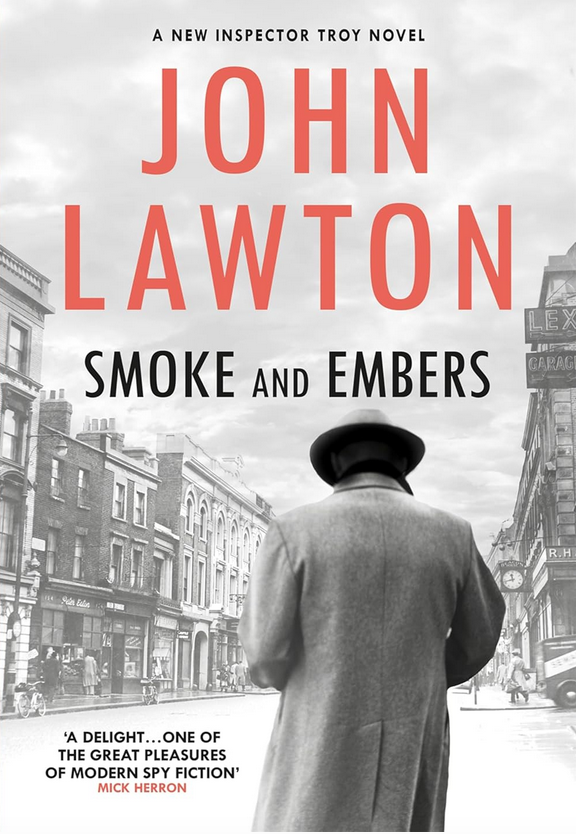
SMOKE AND EMBERS . . . Between the covers

Fans of John Lawton’s wonderful Fred Troy books, which began with Blackout (1995) will be delighted that the enigmatic London copper, with his intuitive skills and shameless womanising, makes an appearance here. Throughout the series Troy, son of an exiled Russian aristocrat and media baron, subsequently crosses the paths of all manner of real life characters including, memorably, Nikita Kruschev. For those interested in Troy’s back-story, this link Fred Troy may be of interest. He is not, however, central to this story. We rub shoulders with him, for sure, and also with his brother Rod, a Labour MP who serves in Clement Attlee’s postwar government. We are also reminded of characters from the previous novels – Russian soldier and spy Larissa Tosca, and the doomed Auschwitz cellist Meret Voytek. The book begins with sheer delight.

“Brompton Cemetery was full of dead toffs. Just now Troy was standing next to a live one. John Ernest Stanhope FitzClarence Ormond Brack, 11th Marquis of Fermanagh, eligible bachelor, man-about-town, and total piss artist.”

As ever in Lawton’s novels, the timeframe shifts. He takes us to 1945, the year of Hitler’s final annihilation, and to 1960 and the capture of Adolf Eichmann. Central to story is the fate of Europe’s Jews, their destruction at the hands of the Nazis, and then their almost complete rejection by Poland, Palestine, Britain, America and Russia after what was, for them, a hollow victory in 1945. Lawton’s story hinges on the lives of three young men. First is Sam Fabian, a German Jew, a mathematician and physicist who is saved from Auschwitz by a misfiring SS Luger and a compassionate Red Army officer. Then we have Jay Heller, a gifted English Jew who, immediately after joining up in 1940, is head hunted into the British intelligence services. Finally, we have Klaus LInz von Niegutt, minor member of what remains of the German aristocracy, who finds his way – or is led – into the SS. He is, however, not a violent man, and only does the bare minimum to remain ‘one of the chosen’. His significance in the novel is that he was one of the scores of staff – cooks, clerks and secretaries – who were in Hitler’s bunker in those fateful days at the end of April 1945.

With an audacious plot twist, Lawton gets Sam Fabian to England, where he finds work with a millionaire German Jew called Otto Ohnherz whose empire while not overtly criminal, is founded on the success of ventures that, while not quite illegal, are extremely profitable. He can afford to employ the best professionals. This is his barrister:

It was said of Jago that by the time he’d finished a cross-examination, the witness would be swearing Tom, Tom, the Piper’s son had been nowhere near the pig and had in fact been eating curds and whey with Miss Muffet at the time.”

When Ohnerz dies, Jay takes over the empire, and becomes involved with maintaining Ohnerz’s rental property business. While making sure the money still rolls in, he sets out to improve the houses, particularly those rented by tenants recently arrived from the Caribbean. It is when Jay’s broken body is found on the pavement below his headquarters that the story seemingly takes a turn towards the impossible. What Troy and the pathologist discover certainly had me scratching my head for a while. Lawton’s use of separate narratives and times allows him to set a seemingly unsolvable conundrum regarding the ultimate fates of  Jay, Sam and Klaus. To be fair, he provides clues, using a rather clever literary device. I won’t reveal what it is, but when you reach the last section of the book, you may need to revisit earlier pages. Smoke and Embers shows a profound understanding of the dark realpolitik that followed the end of the war in Europe, and is full of Lawton’s customary wit and wizardry. It is published by Grove Press UK and is available now.


NO PRECIOUS TRUTH . . . Between the covers

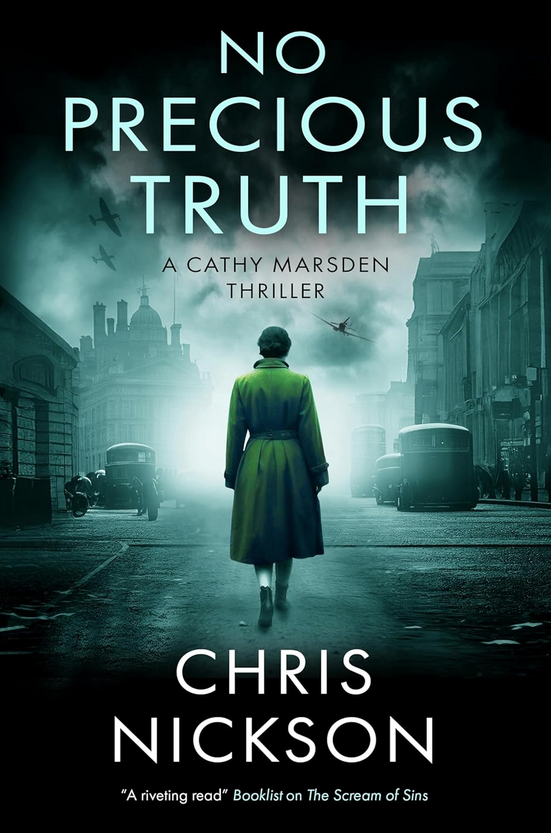
In my reading experience, there is no living writer so closely associated with one place than Chris Nickson. Phil Rickson had his Welsh Marches, Robert B Parker had his Boston, Colin Dexter had his Oxford and Christopher Fowler had his (peculiar) London. Sadly, Time has borne those four sons away, but Nickson’s Leeds is now rediscovered in the first of a new series.

It is February 1941. Cathy Marsden is a Sergeant in the Leeds police, but has been seconded to the Special Investigations Bureau, a unit recently set up to investigate black marketeers and other criminals looking to make money out of the war. She is astonished when her older brother, Daniel, turns up at the office. As far as she was aware he was humdrum civil servant in London, pushing pens and folders of documents from one desk to another. Like her, however, he has been seconded, but to another top secret intelligence service, and he is in Leeds to track down a dangerous Dutch double agent called Jan Minuit.

Although I have read and enjoyed them all, Nickson’s Leeds novels tend to have a similar plot, which is basically a manhunt. This enables the author’s creations from Simon Westow to Tom Harper (who gets a brief mention here) to pound the streets of the city in search of a villain. The technical aspect of this is not complicated, as it enables Nickson to put his unparalleled knowledge of the topography to good use. He is clearly in tune with a kind of of geopsychology, which enables readers to follow the footsteps of his characters across the decades, so that thoroughfares like Briggate, The Headrow and Kirkgate become as familiar as our own back yards.

If Minuit is bent on sabotage, Leeds has two prime targets for an agent of The Third Reich. One is pretty much in the open. The Kirkstall iron foundry has been producing components for military vehicles since WW1 and is hard to disguise. The Avro factory at Yeadon, however has been covered in camouflage and disguised – from the air – as open country. This ‘shadow factory’ is working day and night to produce Lancaster bombers, as well as the less celebrated (but equally vital) Anson.

Nickson has a well-established style. It is propulsive. Short sentences. A sense of urgency. Genuine narrative drive.

“Cathy turned off the ring road and started up Wheatwood Lane.The daylight was lasting longer, barely a stretch of dusk on the horizon. Ahead of her, the hill rose steeply, fields on either side, farmland.No chance to go more than a few yards.The road was filled with police cars, a pair of ambulances and the black coroner’s van.,”

“Monday dawned sour with threatening clouds, the colour of old bruises. The air was thick and damp. Yesterday’s promise of spring had vanished like a magician’s illusion. Instead, the rain felt that it like might begin at any time. At least it would deter the Luftwaffe.”

There is a thrilling conclusion to the team’s pursuit of Jan Minuit, and it is Cathy’s resilience and strength which eventually brings the spy/saboteur to his knees. Chris Nickson’s skill lies in his ability to convince us that we are standing beside his characters and sharing their world. In this case, it is Cathy Marsden’s wartime Leeds, with its rationing and privation, its fear that clear nighttime skies will be a gift to the Luftwaffe, and the ever present fear in the hearts of local women that their father, husband, brother, son or boyfriend will be the next name on the mounting list of casualties.

Nickson also reminds us that the horrors of WW1 cast a long shadow. Cathy’s father, once a strapping Yorkshire lad, was gassed in the trenches, and over thirty years later is a wreckage of a man, struggling with the essentials of existence – such as breathing. No Precious Truth will be published by Severn House on 1st April.

KARLA’S CHOICE . . . Between the covers

kc086 copy

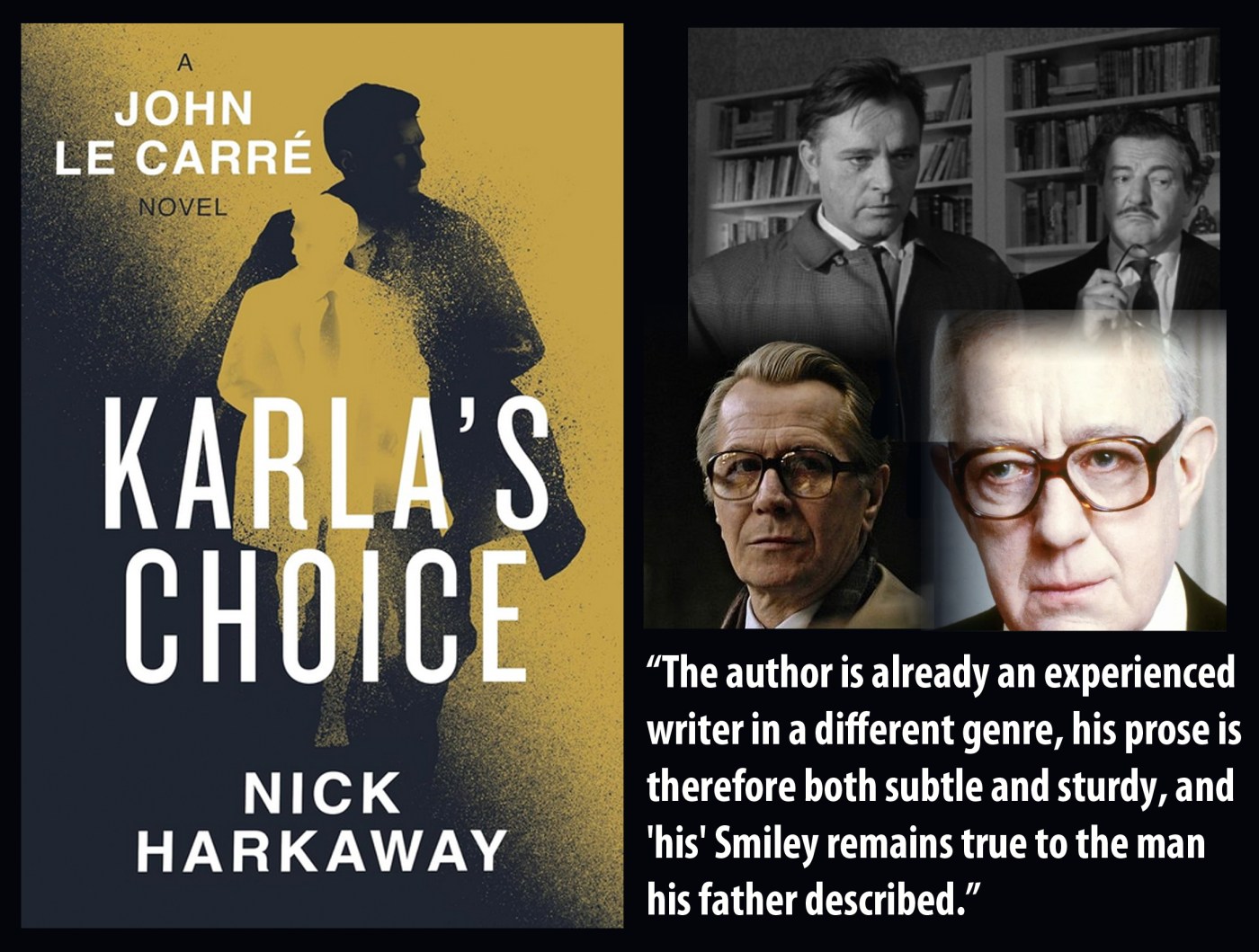
We are in a wintry London in 1963. Older readers will recall that it started snowing on Boxing Day 1962, and it barely relented for weeks, with temperatures plummeting across the country. Susanna Gero is just one of the many thousands of Hungarians who fled to the west just 6 years earlier, after Russia had put down an uprising with its trademark brutality. She works at a shabby literary agency called Baánáti & Clay. Mr Clay never existed, and Laszlo Baánáti is missing. As part of a scheme of retribution devised by the Kremlin, agents have been despatched to the West to kill people who had the effrontery to leave the Soviet Union and its vassal states. One such is Miki Bortnik, and his target is Baánáti . Between the airport and Baánáti’s office Bortnik has a kind of epiphany, and meekly surrenders to the British authorities.

Baánáti’s disappearance is brought to the attention of the British intelligence service, and for old Le Carré buffs, we are back in the familiar world of The Circus, alongside Control, Connie Sachs, Percy Alleline, Bill Haydon, Toby Esterhase and – of course – George Smiley. Our man has taken early retirement of sorts in the wake of his involvement in the death of double agent Alec Leamas on the Berlin Wall (The Spy Who Came In From The Cold, Richard Burton in the film). Smiley is persuaded to make a temporary return to work in order to trace Baánáti, who is actually a Soviet agent called Ferenzc Róka. There is mention of the ominous sounding Thirteenth Directorate. This was basically a KGB hit squad, set up to deliver Moscow’s summary justice to former citizens across the world who had irritated Stalin.

Smiley discovers the reason for Róka’s disappearance. He has a son, now in his early twenties. Léo is young man of much promise, something of a gilded youth, but prone to upsetting local communist party officials. The lad has now been taken into custody. Róka has abandoned the pretence that he is a mild-mannered London literary agent, and via a series of false passports is on his way to central Europe to save his son. It is with  some inevitability that Control sends Smiley off to Berlin, to rescue Róka and his son from the Ministerium für Staatssicherheit (Stasi).  Smiley hopes that assistance will be given by Hans-Dieter Mundt, nominally leader of the East German Secret Service, the Abteilung. Mundt is actually a double agent who works for the British.

The book’s title, by the way, refers to the man who leads The Thirteenth Directorate. In the three books known as The Karla Trilogy, Le Carre provides an extensive biography of the agent, but we never meet him in person. The BBC cast Patrick Stewart in the role for TV, but he was glimpsed only briefly.

Control complicates matters by sending Susanna off to Berlin in the belief that her presence may help to smoke out Róka. The ploy does not work, as Susanna goes ‘rogue’ on her Circus companions, and things come to a head with a dramatic encounter on the streets of Budapest

How does it feel to be back among old friends? To be honest, it is such a long time since I read the original books or watched any adaptations, that I had to use Google to remind me of some of the characters, but the chill of the Cold War remains inescapable. Harkaway cannot be aiming purely at aficionados of his father’s books, so what will younger readers make of it, coming as they do to the Le Carré ensemble for the first time? The author is already an experienced writer in a different genre, his prose is therefore both subtle and sturdy, and ‘his’ Smiley remains true to the man his father described.

George Smiley remains one of fiction’s most enduring but enigmatic characters. He is not, however, a fragile Ming vase too delicate to be handled. Here, he not only survives, but is given fresh shape and form in a vivid reminder of how espionage was done in the dark ages before the digital revolution. Karla’s Choice is published by Viking/Penguin and is available now.

Screen Shot 2024-10-03 at 19.54.12

THE GRAND ILLUSION . . . Between the covers

TGU spine036 copy

London. The early summer of 1940. British military leaders, politicians and the general public are wondering quite what to make of Dunkirk. Yes, over three hundred thousand allied servicemen have been rescued from the jaws of Hitler’s Blitzkrieg, but they have left behind them their weapons, millions of rounds of ammunition and countless thousands of gallons of fuel. The British Expeditionary Force might still exist, but it has few rifles, artillery pieces or tanks (even if their were any fuel to propel them).

Against this gloomy backdrop, we meet Daphne Devine and Jonty Trevelyan. They are busy entertaining audiences at London theatres with their conjuring act. Daphne is, of course, the archetypal ‘glamorous assistant’, flashing her shapely legs before the climax of their act, where she apparently gets sawn in half by The Grand Mystique. In much more secret places than the Metropolitan Edgware Road, intelligence officers are wondering just how they can remove the gloves from the British establishment who don’t yet realise that their Nazi opponents have torn up the rules of war and are fighting a very dirty fight. Just as Daphne and Jonty are enlisted as unlikely secret weapons, news comes that the  SS Arandora Star, taking hundreds of internees and prisoners of war to Canada has been  torpedoed and sunk by a German U-boat with the loss of more than 800 lives. Daphne’s Italian uncle is one of those lost.

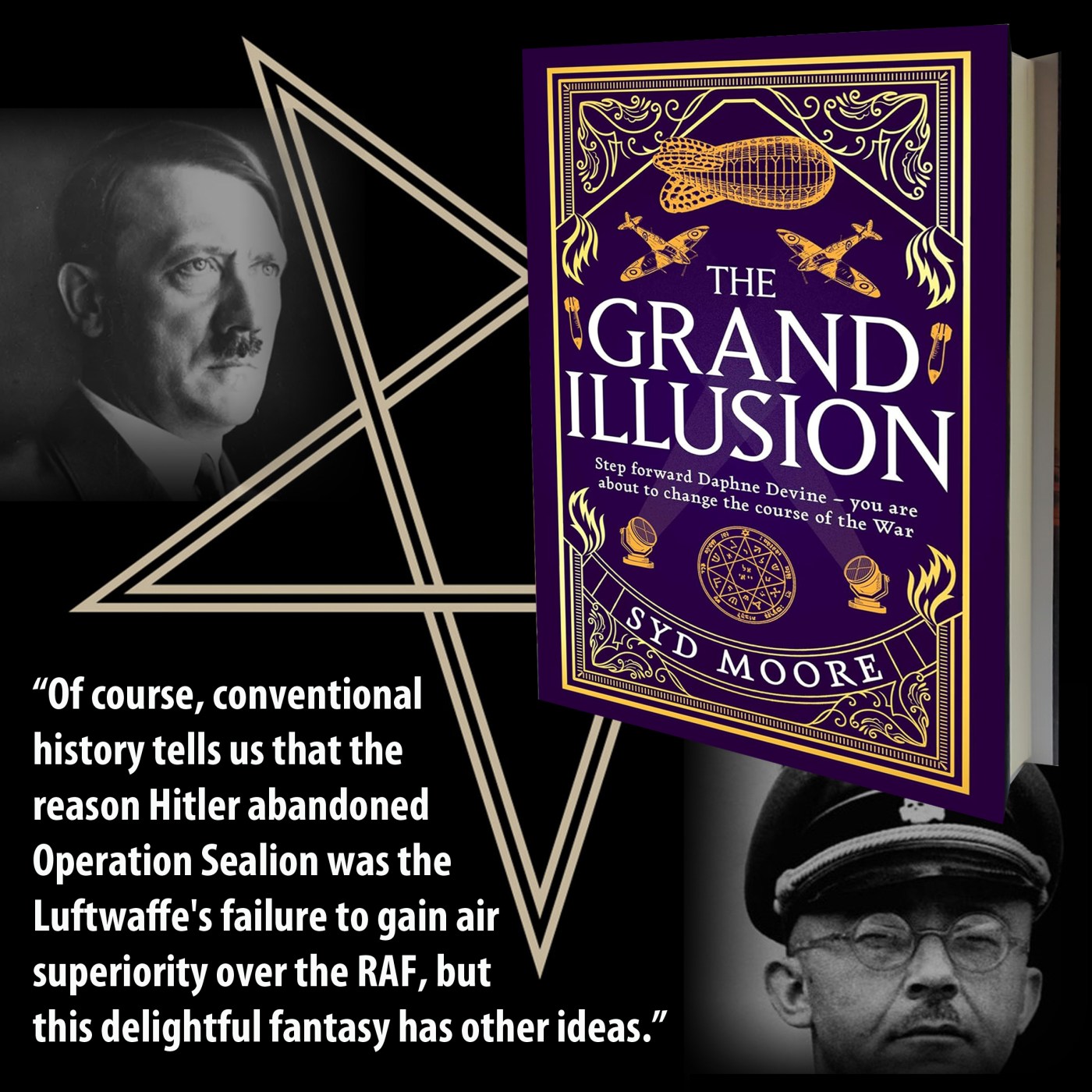
Unsure of what is to be asked of them, Daphne and Jonty say goodbye to normal life, and are whisked off to a high security unit which seems to specialise in camouflage, pretence and making German aircraft make as many mistakes as possible in identifying targets on the ground. Then, events make another lurch in the direction of the unexpected. The ‘behind-the-scenes’ directors of this unlikely drama have become aware that the Nazi high command are, to a man, deeply susceptible to the occult and the power of astrology.  This is the list. The initials are fairly obvious, although I admit to wondering what Reinhardt Heydrich was doing their, as this was only 1940. Then I remembered Hitler’s deputy, that strange who flew a plane to Scotland, and spent the last years of his life in Spandau Prison.

TGI quote

Then, Syd Moore introduces us to the delightful fulcrum on which the rest of the novel pivots. In a briefing Daphne and Jonty are astonished to learn that they are required not just to create an illusion of some astral phenomenon which will deter Hitler and his cohort from invading Britain, but to actually dabble in the Black Arts and recreate the demonic force which – so they are told – wreaked hell and destruction on The Spanish Armada in 1588, thus enabling Sir Francis Drake to continue his game of bowls, safe in the knowledge that the spell has already been cast.

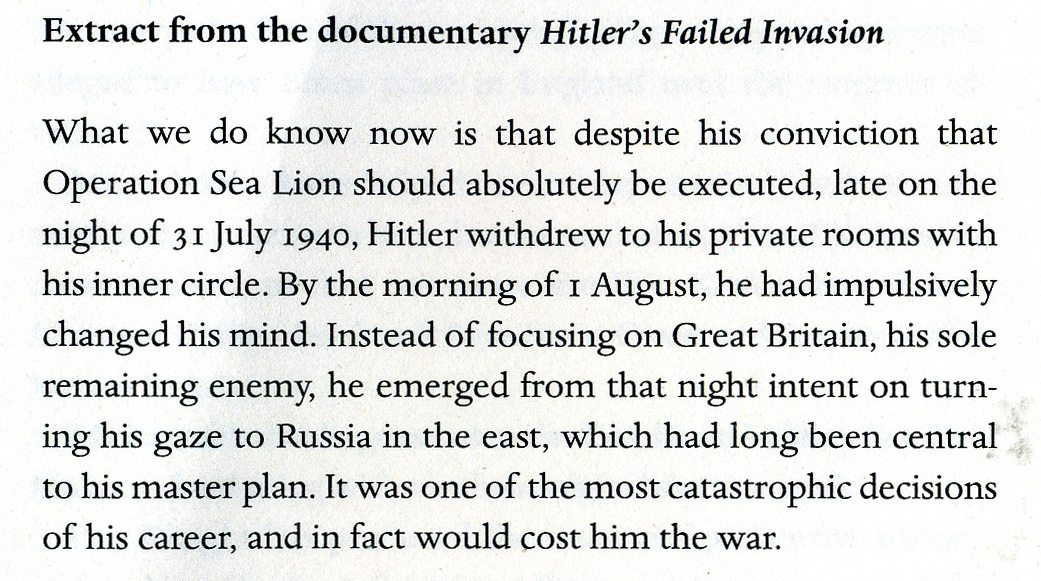
On 31st July 1940, In the full knowledge that there are German spies nearby, observing their every move, Daphne and the other specialists create an elaborate and dramatic psychic event. It is a spectacular illusion. Or is it just an illusion? That is the enigma with which Syd Moore leaves us. Of course, conventional history tells us that the reason Hitler abandoned Operation Sealion was the Luftwaffe’s failure to gain air superiority over the RAF, but this delightful fantasy has other ideas.

TGU quote038 copy

The Grand Illusion is published by Magpie Books and is available now.

THE SHADOW NETWORK . . . Between the covers

tsn spine014 copy

Suspected war criminal Hannibal Strauss, a mercenary suspected of war crimes in Libya, Cambodia and elsewhere, is in custody near The Hague awaiting trial before the International *Criminal Court. The wheels of international war crimes justice grind extremely slowly, and as lawyers jostle for position, there is a terrorist outrage in the Netherlands capital. Gunmen open fire on a crowded square, the Grote Markt, killing not only individuals connected with the impending court case, but dozens of random civilians, too. One man involved in the Strauss case, Kon Frankowski, escapes and goes on the run.

*Factual note: the International Criminal Court (ICC) is separate and different from the International Court of Justice (ICJ). The ICJ is part of the United Nations, and investigates countries. The ICC investigates individuals, and is recognised by some – but not all – countries, a notable exception being Russia. Very few people have been convicted and jailed by the ICC, one being Charles Taylor, the former leader of Liberia. A third and unconnected organisation, the International Criminal Tribunal for the Former Yugoslavia, did convict and jail Radovan Karadžić and Ratko Mladić, while Slobodan Milošević died while his trial was in progress.

The mastermind behind the slaughter is an International terrorist known only as The Monk. His organisation has its roots in a pro-Tsarist resistance movement known as the Mladorossi. It has evolved over the decades, but remains a massive threat to international security.

Answering the call to investigate the Grote Markt massacre are Joe Dempsey, and agent with the (fictional) International Security Bureau, and his partner, criminal barrister Michael Devlin. They seem an unlikely pairing, to be honest. Dempsey is Special Forces trained, has killed many men in the course of his job, while Devlin is undoubtedly clever, but I’m not sure what his interlocutory skill brings to the table outside of the interview room. Hey ho, though, it’s a novel,  so let’s run with it.

The reason why Frankowski is at the centre of this is that he was money-launderer-in-chief to Hannibal Strauss, and the Hungarian mercenary has entrusted Frankowski with a list of all Russian  Mladorossi agents and how they are embedded across the world. This list – in the right/wrong – hands would almost certainly be the end for The Monk and his machinations. Joe Dempsey, however, has a rather delicate personal connection to Frankowski. Frankowski’s wife Maria is the former lover of Dempsey, who reluctantly ended the relationship because of the danger his work would bring to them if they became a family.

While Dempsey and Devlin are on the ground in the Netherlands, Agent Eden Grace – Dempsey’s ISB protégé, is handling things in America, and it is there that Maria Frankowski and her children have gone into hiding, as they have become an pawns in the violent chess game which seeks to find Kon Frankowski and the fatal list.

In all good spy thrillers, we must never take the author’s word that people are who we are told they are, and The Shadow Network is no exception.The Monk is hiding in plain sight, and neither we – nor Dempsey and Devlin – have a clue as to who he really is. This is a thoroughly entertaining thriller with fight scenes so real that just reading them may necessitate a visit to A & E with sympathetic wounds and trauma. It is published by Elliot and Thompson and will available on 15th February. Tony Kent, by the way, is that most unusual of pairings – a criminal barrister and heavyweight boxer. Cross him at your peril!

THE SPY COAST . . . Between the covers

tsc spine007 copy

Have you ever wondered were CIA spooks go when they are pensioned off? Tess Gerritsen tells us that a number of them have settled down in the tiny Maine harbour town of Purity. Among them is Maggie Bird, once a stone cold killer for the Company, but now just a chicken farmer with the common ailments – such as aching joints –  shared by all senior citizens. Her neighbours are mostly of a similar age and background – particularly Ben Diamond, Declan Rose and the elderly couple Lloyd and Ingrid Slocum.

When Maggie is visited by a current CIA operative, a young woman who identifies herself only as Bianca, she is reminded of an unwelcome part of her past, in the shape of a fellow agent called Diana Ward. Ward is still active, but has gone missing, her bosses are concerned, and are offering to pay Maggie to help trace the missing woman. Maggie rejects the offer, saying she does not care if Ward is dead or alive.

Why the indifference? It is, as they say, complicated, and we learn that Ward and Maggie go back a long way, with the pivotal point in their professional relationship being an attempt, years earlier to take out a British wheeler-dealer – and international gangster – called Phillip Hardwicke. Long story short, the end result was a CIA sting that ended in disaster for Maggie. Her doctor husband, Danny, had been working as Hardwicke’s personal physician, and a private jet they were were traveling in left Malta, only to explode mid-air and crash into the sea with the  loss of all on board.

Back in present day Maine, Maggie is with her friends, discussing the mysterious visit of Bianca, when she hears that police have surrounded her house. Rushing home to investigate, she finds there is a corpse lying in the frozen snow of her driveway. It is the woman who called herself Bianca, and she has been tortured bt then professionally despatched with two bullets to the head.

Cocktails009

Maggie realises that the carnage is all about her and her past and so reluctantly she packs a few things, arranges some chicken-sitters, and goes back on the road to see if she can exorcise the ghosts of her past. Her travels take her into immediate and present danger, in Thailand and across Europe. My copy of the book came with a couple of cocktail recipes (above). The Spy Coast has all the hallmarks of a classic mainstream American thriller – taut as piano wire, danger round every corner and with convincing portraits of exotic locations.

T

Blog at WordPress.com.

Up ↑