Search

fullybooked2017

Tag

Eric Ambler

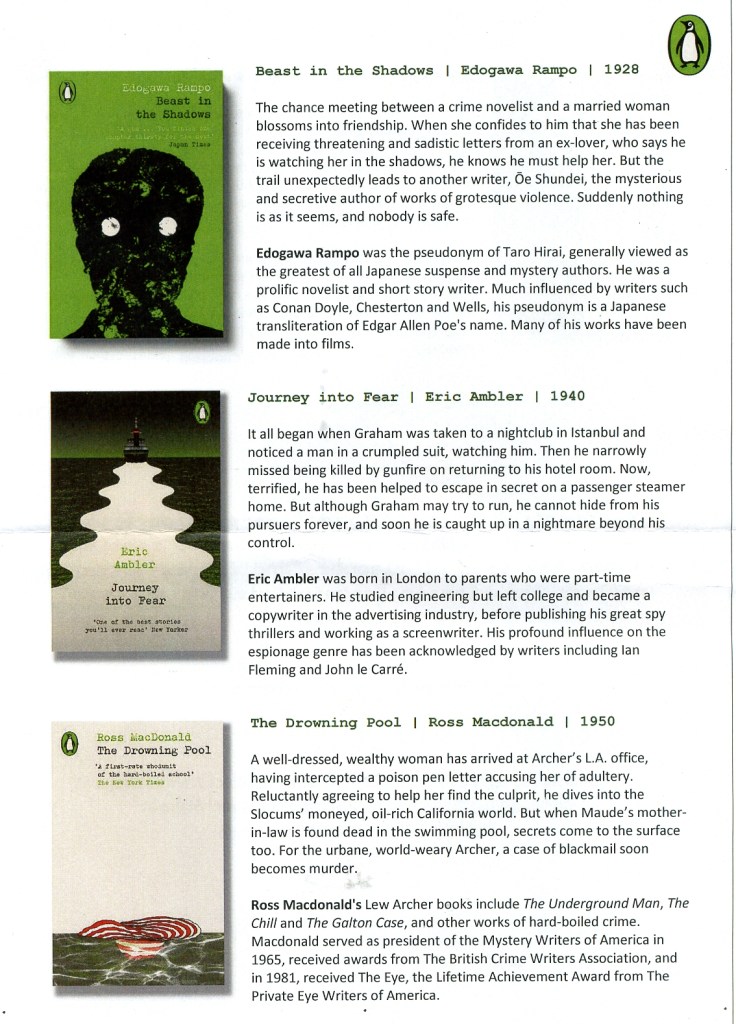
CLASSICS REVISITED . . . Journey Into Fear

Eric Ambler (1909 – 1998) was one of the finest story-tellers of the middle years of the 20thC, and he had a profound influence on later writers of the espionage thriller, such as Le Carré, Fleming and Deighton. When I revisited The Mask of Dimitrios (1939) I remarked that in those days, Istanbul still carried the aura of the exotic but dangerous place where east-meets-west. Central character Mr Graham is an engineer who works for a British armaments corporation, and has been sent to Istanbul on a business deal. The trip has been successful, but on the evening before his return to England his host insists on taking him to a nightclub. You could pick virtually any paragraph from the book as an example of Ambler’s skill, but I liked this particular description of a suspicious customer at the club:

“He was a short, thin man with a stupid face, very bony with large nostrils, prominent cheekbones and full lips pressed together as if he had sore gums or were trying to keep his temper. He was intensely pale and his small deep-set eyes and thinning curly hair seemed in consequence darker than they were. The hair was plastered in streaks across his skull. He wore a crumpled brown suit with lumpy padded shoulders, a soft shirt with an almost invisible collar and a new grey tie.”

Returning to his hotel in the small hours, Graham unlocks his room. Mayhem ensues. Three shots ring out, one of which takes a chunk out of his hand. The gunman escapes, and in the fallout from the incident, Graham is taken to meet the sinister chief of Istanbul’s secret police. He is told that this wasn’t a robbery gone wrong, but an attempt on his life. Why is he so important? As an expert in the ballistics of naval guns, he has information that Germany would prefer not to be spread further, and so if his knowledge dies with him, then so be it. Historical note: despite its alliance with Germany in the Great War, Turkey remained resolutely neutral in WW2, despite a token declaration of war against the Axis in February 1945.

Graham’s planned return journey by rail is aborted, and he is put on an Italian cargo ship bound for Genoa, on the grounds that he will be safe there. After a brief stop in Athens, Graham is appalled to see the the Sestri Levante has a new passenger – the man from the Istanbul nightclub and, presumably, the person who tried to kill him.

The real threat to Graham comes not from the nightclub man but from an elderly archaeologist called Haller, whose long winded monologues about Sumerian funerary rites have made meal times such a bore for the other passengers. Haller is, in fact, a Nazi agent called Moeller, who has been trying – to use chess metaphor – to wipe Graham’s knight off the board for several weeks. This is one of those novels, all too easily parodied, where no-one is who they claim to be. It is from what was, in some ways, a simpler age, where storytellers just told the story, with no ‘special effects’ like multiple time frames and constant changes of narrator.

The book is quintessentially English. We are left pretty much to our own devices to decide what Graham even looked like. We don’t even know his Christian name, but neither do we need to. The novel was filmed in 1943, but Americanised. It had a decent cast, with Joseph Cotton as Graham, but by then, America had been at war for two years, and the whole political and diplomatic background had shifted. It may – or may not – be a decent film but, looking at the plot online, I probably will not bother. Back to the book. Graham, until the last few pages ponders his fate and, like a twentieth century Hamlet, he ‘suffers the slings and arrows of outrageous fortune.’ When he does take decisive action it is violent, and he certainly does ‘take arms against a sea of troubles.’ This Penguin edition was published in 2023.

CLASSICS REVISITED . . . The Mask of Dimitrios

MOD header

The opening part of this book, in geo-political terms, is gloriously old fashioned. Istambul, with its reputation as being the place where east meets west, home of mysterious Levantine traders and treacherous stateless misfits has long since been pensioned off, at least in the world of crime and espionage fiction. It is worth remembering, though, that it was the starting point for Bond’s adventures in From Russia With Love when it was published in 1957, and was still thought to have a suitable ambience when the film was released in 1963.

Charles Latimer is an English academic who has found that writing thrillers is much more to his liking (and that of his bank manager) than lengthy tracts on political and economic trends in nineteenth century Europe. While in Istanbul he is invited to a house party where he meets Colonel Haki, an officer in some un-named sinister police force. Improbably, Haki is a fan of Latimer’s novels and, when they become better acquainted, Haki reveals a current real-life mystery he is investigating. The corpse of a man known only as Dimitrios – once a big player in the espionage world of the Levant and The Balkans –  is fished out of the sea. Having attended the post mortem, Latimer decides to investigate just who Dimitrios was, and how he came to end up as he did.

Published on the eve of world war two, when previous atrocities would be dwarfed in scale, the novel reminds us of the horrors which took place in the region after the Armistice. The brutal civil war between Turkey and Greece, with the destruction of Smyrna in 1922, the Armenian genocide, and a succession of coups d’états in Bulgaria had left the region rife with intrigue and foreign meddling. By the late 1930s, Europe was desperately ill at ease with itself. Latimer observes:

“So many years. Europe in labour had through its pain seen for an instant a new glory, and then had collapsed to welter again in the agonies of war and fear. Governments had risen and fallen: men and women had worked, had starved, had made speeches, had thought, had been tortured and died. Hope had come and gone, a fugitive in the scented bosom of illusion.”

As he criss-crosses Europe via Athens, Sofia, Geneva, Paris – by train, naturally – Latimer is drawn into the world of a mysterious man known only as Mr Peters, memorably described thus:

“Then Latimer saw his face and forgot about the trousers. There was the sort of sallow shapelessness about it that derives from simultaneous overeating and under sleeping. From above two heavy satchels of flesh peered a pair of blue, bloodshot eyes that seemed to the permanently weeping. The nose was rubbery and indeterminate. It was the mouth that gave the face expression. The lips were pallid and undefined, seeming  thicker than they really were. Pressed together over unnaturally white and regular false teeth, they were set permanently in a saccharine smile.”

The 1944 film of the book took many liberties with the story and, bizarrely, changed the clean-living, rather prim Charles Latimer into a Dutch novelist named Cornelius Leyden, and then compounded the felony by casting Peter Lorre in the role. What they didn’t get wrong, however, was in re-imagining Mr Peters. Check the quote above, and if it isn’t Sydney Greenstreet to the proverbial ‘T’, then I will change my will and donate my worldly wealth to The Jeremy Corbyn Appreciation Society. In his travels, Latimer also meets a rather down-at-heel nightclub manager called La Prevesa:

“The mouth was firm and good-humoured in the loose, raddled flesh about it, but the eyes were humid with sleep and the carelessness of sleep. They made you think of things you had forgotten, of clumsy gilt hotel chairs strewn with discarded clothes and of grey dawn light slanting through closed shutters, of attar of roses and of the musty smell of heavy curtains on brass rings, of the sound of the warm, slow breathing of a sleeper against the ticking of a clock in the darkness”

Quite near the end of the book, Ambler drops a plot bombshell which not only damages Latimer’s own sense of being able to spot a lie when he sees one, but puts him next in line for a drug-dealer’s bullet. He is in Paris, but this is not the city as envisaged by, apparently, Victor Hugo:

“Breathe Paris in. It nourishes the soul.”

Latimer sees a rather different city:

“As his taxi crossed the bridge back to Île de la Cité,
he saw for a moment a panorama of low, black clouds moving quickly in the chill, dusty wind. The long facade of the houses on the Quai de Corse was still and secretive. It was as if each window concealed a watcher. There seemed to be few people about. Paris, in the late autumn afternoon, had the macabre formality of a steel engraving.”

With this book, Ambler created the anvil on which the great spy novels of the final decades of the Twentieth Century were beaten out. As good as they were, neither Le Carré nor Deighton bettered his use of language, and in this relatively short novel, just 264 pages, Ambler set the Gold Standard. This latest edition of the novel is published by Penguin and is available now.

THE GREEN PENGUIN RETURNS

PENGREEN HEADER

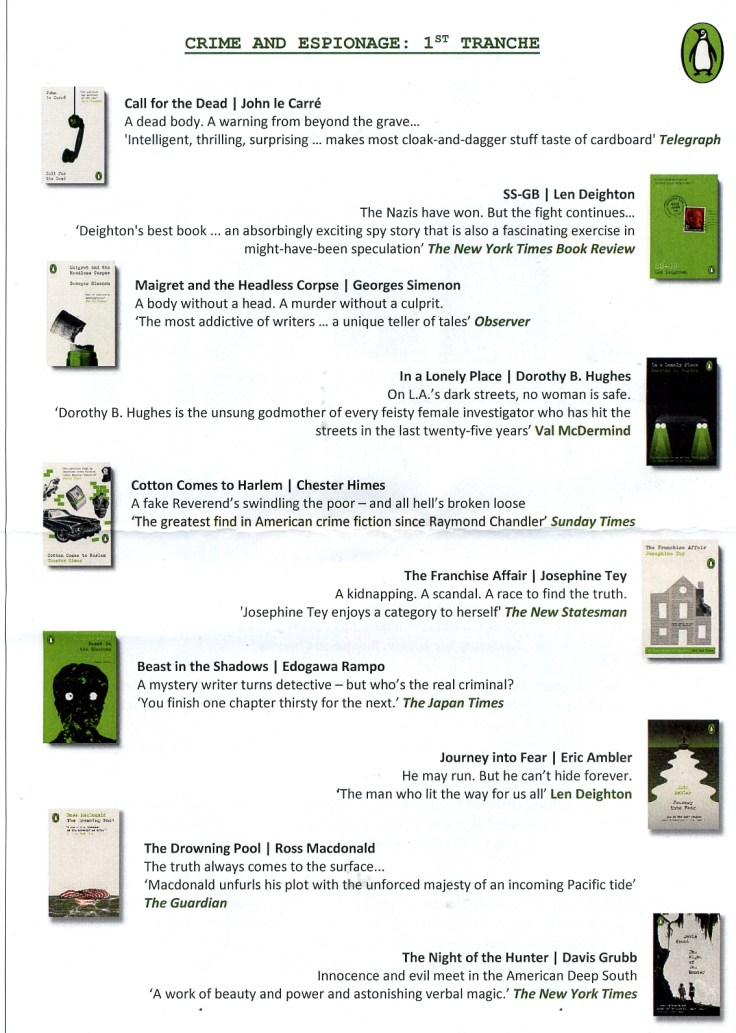
Great news for classic crime fans – the people at Penguin are giving us brand new editions of some of the greatest crime and espionage novels ever written, and all under the banner of that distinguished green penguin. Yes, I know most of us have read these books, maybe, as in my case, decades ago, but what a joy it will be to revisit them. The reissues begin on 13th July.

Pengreen001

Pengreen002

Pengreen003

Pengreen004

Pengreen005

Pengreen006

Blog at WordPress.com.

Up ↑