Search

fullybooked2017

Tag

English Crime Fiction

THE RAGING STORM . . . Between the covers

RS spine

Ann Cleeves introduced us to Detective Matthew Venn in The Long Call (2019). Police officers in crime fiction are ten-a-penny, so writers strive to make their creations a bit different, or to have what marketing people call a USP. Venn is married to a creative arts chap called Jonathan. This is, to say the least, an unusual circumstance in the rugged North Devon fishing village of Greystone, where he goes to investigate the mysterious death of a media-savvy – and much televised –  adventurer and sailor called Jem Rosco. Venn is, however, no stranger to Greystone. It is where he was brought up as a member of an exclusive group of evangelical Christians called The Barum Brethren.

Rosco has turned up in Greystone, more or less out of nowhere, although the villagers have seen him often enough on their TV screens. After a few weeks of holding court in the village pub – The Maiden’s Prayer –  Rosco disappears, but is then found dead in a little boat anchored just off-shore, in a violent storm. The local RNLI bring his body back, and then his demise becomes a case for Matthew Venn, based in Barnstaple, the largest town in the area.

This is certainly not one of those ‘murder comes to seaside idyll’ stories. Greystone is a grim little village which is frequently battered by the weather. For Its residents life is something of a struggle; there are few amenities, and employment is hard to come by. With all the skill she displays in her other  novels set by the sea, Ann Cleeves allows the village to develop a rather forbidding character all of its own.

There are several well-drawn local characters, all of whom Venn is forced to consider as he tries to answer the age old question about a mysterious death – “Cui Bono?“. Pub landlord Harry Carter may be every bit of the jovial ‘mine host’ he appears to be, but do shady financial dealings in his past bring him into the web of suspects? Mary Ford is the first woman to be skipper of the local lifeboat, but her life is shot through with anxiety over the future of her son who suffers from a degenerative disease. As a teenager, she had an unrequited passion for Jem Rosco, so has his re-emergence in the village triggered an act of revenge for past slights? Barty Lawson, alcoholic Commodore of the nearby Morrisham Yacht Club,  has bitter memories of the days when Rosco – irreverent, mocking and disrespectful – used his celebrity to belittle him. The hint of an old romance between Rosco and Lawson’s wife Eleanor has further soured the man’s mind but, in a rare sober moment, was he capable of engineering the complex piece of theatre which appears to have framed the discovery of the sailor’s body?

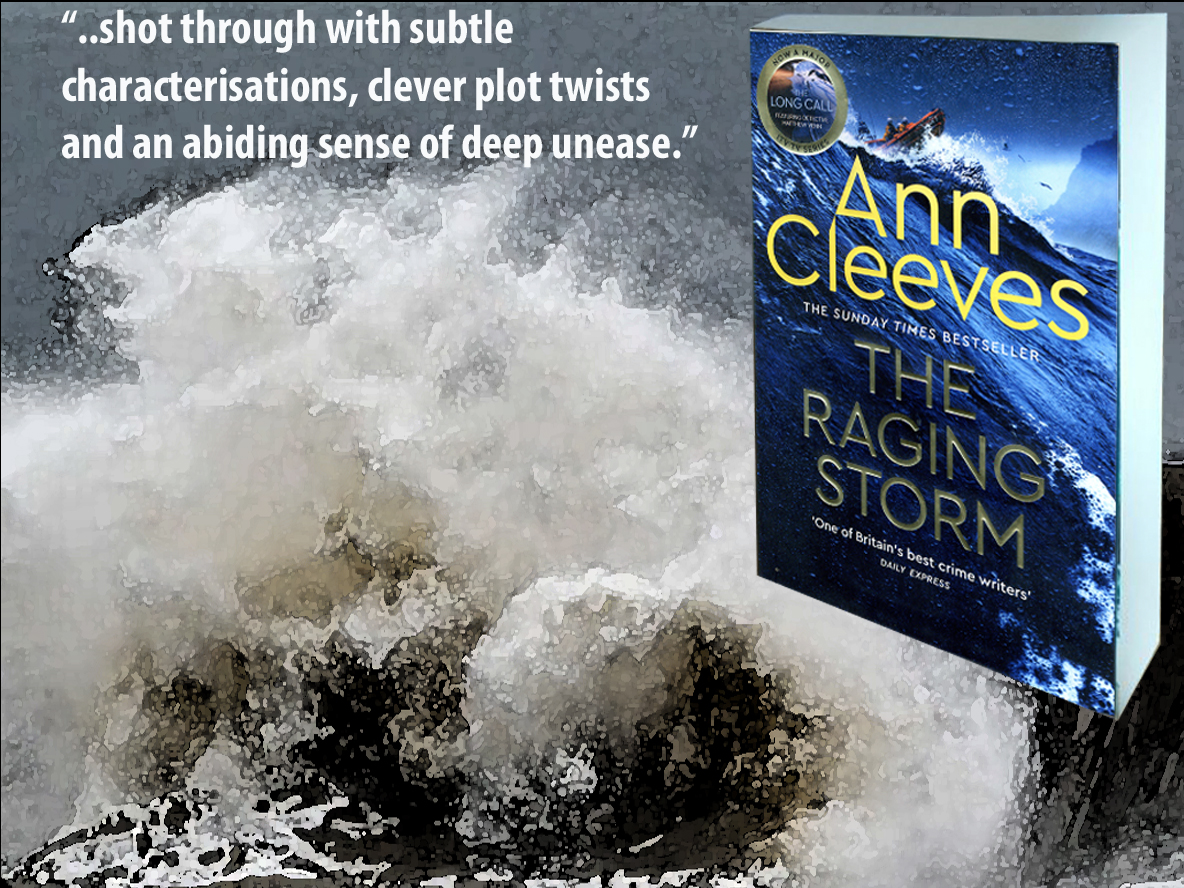
When Lawson’s body is later found shattered at the foot of a towering cliff, Venn wonders if this was the final act of a guilty man, but Ann Cleeve provides a solution to the mystery that is much more elegant – and unexpected.  The Raging Storm is, on one level, a standard whodunnit, and sticks to the standard framework of a police procedural novel, but it is shot through with subtle characterisations, clever plot twists and an abiding sense of deep unease. Published by MacMillan, the book is available now.

DIG TW0 GRAVES . . . Between the covers

DTG spine007 copy

I thoroughly enjoyed an earlier book in the series, and you can click the image below for the link.

Temenos

I mention this, because Dig Two Graves begins literally as the final scene of The Temenos Remains fades out. We are in Norfolk and crime fiction buffs will know that this is no rural idyll; readers of Jim Kelly’s Peter Shaw series – and the excellent Ruth Galloway novels by Elly Griffiths – will be well aware that away from the “Chelsea-On-Sea” second homes of North Norfolk and the gentle downlands beyond Sandringham, Norwich and Great Yarmouth provide, to adapt the immortal words of Ben Obi-Wan Kenobi, as wretched a hive of scum and villainy as one could wish to experience.

The “scum and villainy” in this case are provided by the brutal Lithuanian gangsters Constantin Gabrys and his psychopathic son Mica. As a local, Heather Peck will be only too cogniscant of the fact that Freedom of Movement in the dark days of EU membership brought tens of thousands of Eastern Europeans to the area to pick and process the food crops on which we all rely; like many others, she will also know that with the decent folk came gangsters, drug barons and people-traffickers, and this is the background to this novel.

DCI Greg Geldard and his team have found a Romanian woman – Madame Trieste, real name Adrianne Laurientiu – brutally murdered. The killers, in no particular order, have crucified the nail-bar owner, cut her throat, and made her swallow her own eyeballs The first police officer on the scene, DI Sarah Laurence has been abducted by the killers. The search for Sarah Laurence and the determination to bring her captors to justice drives the police on, and provides us with an excellent read.

I finished this excellent novel in just two sessions, and that should tell you that it is a genuine page-turner. My rather weather-beaten maxim for judging crime novels is in the shape of a question – do we care about the principal characters in the novel? Here, I can deliver a resounding ‘Yes!”. Geldard is thoroughly human and believable, and it doesn’t hurt that he his “significant other” is colleague DS Chris Matthews. Heather Peck doesn’t make a meal of this relationship, but she makes us aware that the police top brass are not entirely in favour. Peck resolves the problem, rather delightfully, in the last few paragraphs.

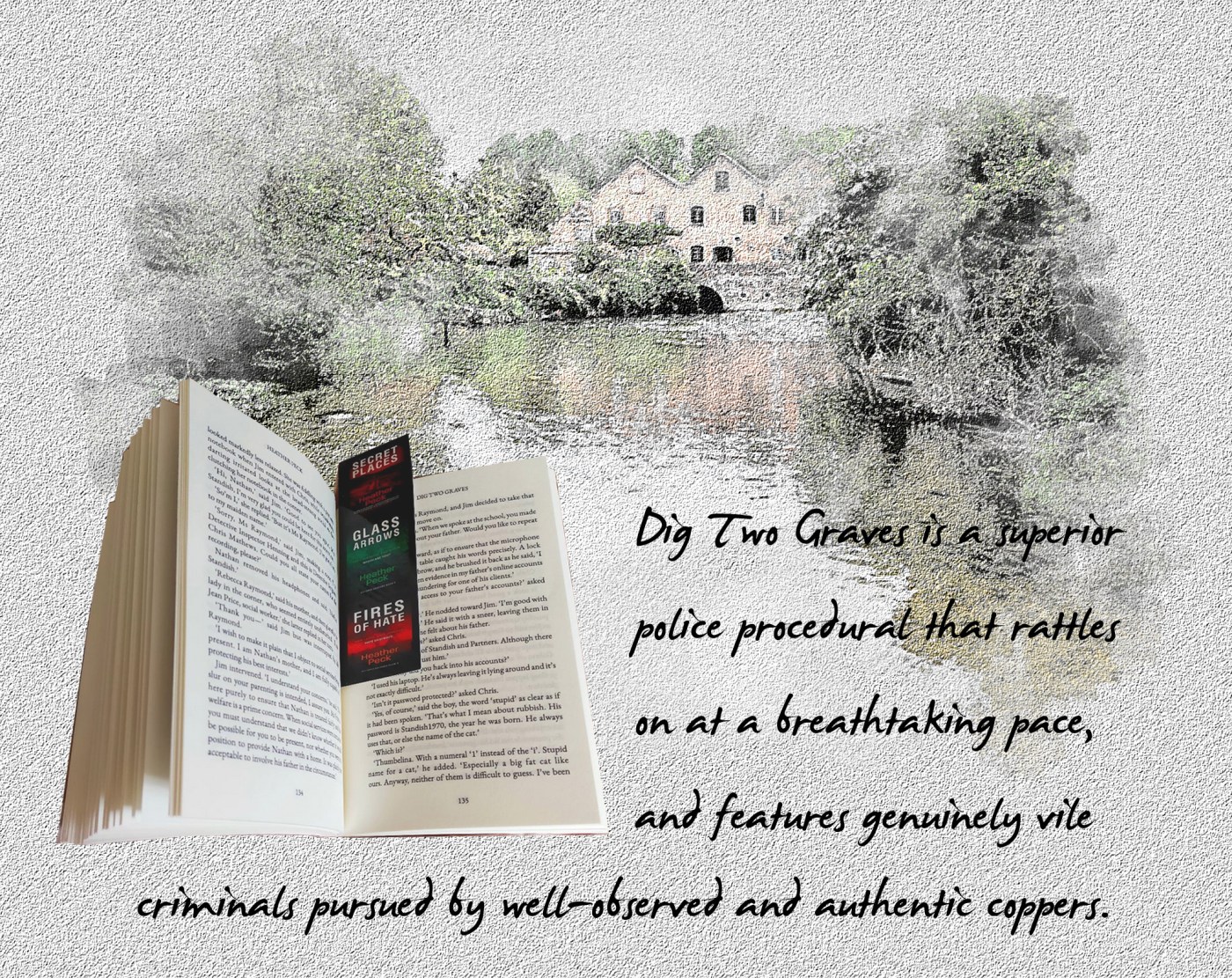
Dig Two Graves is a superior police procedural that rattles on at a breathtaking pace, and features genuinely vile criminals pursued by well-observed and authentic coppers. It was published by Ormesby Publishing on 28th June.

THE GENIUS KILLER . . . Between the covers

TGKspine011

The central character of this novel is Karl Jackson. He has survived a brutal upbringing punctuated with savage beatings by his drunken father, and sexual abuse from his uncle Charlie. Karl has a twin, Nathan,  but he never faced the same storm of violent rage. Karl Jackson is described in the cover blurb as a sociopath. I am no psychologist, but Jackson’s steady job as a chemistry teacher and his scrupulous and well-planned crimes make me think he is more psychopathic, but it does not matter. He is a genuinely awful human being. His spree of undetected killings started in his childhood when, merely for the fun of it, he pushed a young boy – fishing in the lake where they played – down into the water, and then watched with amusement as the lad struggled, choked, and then bobbed about on the surface as lifeless as the float attached to his fishing line.

Jackson’s genius (hence the title of the book) is to organise killings in such a way that no possible evidence can link the deaths to him. While Jackson was working as a student in Australia, one of his murders involved the ingenious combination of a sleeping bag, a sedative injection and a deadly Brown Snake on a hiking trail in the Blue Mountain region of New South Wales. Jackson exacts an elaborate – and some may say justified – revenge on his father by causing the old man’s death in hospital with a very clever use of cyanide and the sharpened end of a coat hanger.

The background to this novel is the atmospheric landscape of the English Lake District, where Jackson carries out another long delayed act of retribution on his abusive uncle Charlie by faking an accidental climbing death. When Charlie is found dead at the bottom of a solo climb, his head shattered like a melon hit with a hammer, no one believes it is anything other than an unfortunate error of judgement.

Thus far, Jackson has been clever enough to avoid any attention from the police but, inevitably, he meets his nemesis. Theodore “Tex” Deacon is a late career – but distinguished – detective slowly recovering from the trauma caused by the protracted death of his wife. As is the way with institutions these days, he is temporarily sidelined and identified as a vulnerable person in need of psychological help and treatment by the ubiquitous counselling profession. However, his many successes in tracking down murderers brings him to the attention of Debbie Pilkington, an ambitious young reporter with a local Lakeland newspaper. She alerts him to the many coincidences surrounding deaths in the Jackson family, and so he goes off piste to investigate the case.

Black humour is never very far away in this book, despite the body count. Here, Karl Jackson describes the man who is having an affair with his wife.

“Richard Turkington’s graying Beatle cut had a bald spot on top giving him the appearance of a rock star monk. A fleshy roll wobbled over the top of his chinos. Turkington had clearly ignored warning signs of middle age and had lived a pudgy existence preferring a world of pints and puddings. Quite a contrast to the sleek wire framed fell runners surrounded by them at a function like this. Richard looked like Mr Blobby.”

The Genius Killer rattles along at great pace and is sometimes darkly comic, but in Jackson, the author has created a genuine larger-than-life monster. The book ends rather enigmatically, but as it is described as No.1 in the Tex Deacon series, I suspect the Cumbrian copper will be back soon with another case. Mark Robson is a sports journalist and this is his debut novel. It is published by Orla Kelly Publishing and available now.

THE ROOM WITH EIGHT WINDOWS . . . Between the covers

8windows header

December 1930. Henry Johnstone, a former Detective Chief Inspector with the Metropolitan Police, has been forced to resign due to a debilitating injury. Now, he ekes out a solitary existence in a crumbling Brighton house, empty except for a large library assembled by the former owner, the late Sir Eamon Barry. Johnstone’s task – one given to him by a friend, concerned about his mental state – is to catalogue the thousands of books in the library. He is convinced he is being stalked, perhaps by someone linked to an old case. Then, he disappears. We know how – if not why – but his friends, among them his sister Cynthia and his former Sergeant Mickey Hitchens, are left with few clues, but one – left behind by Johnstone – suggests there is a link to a mysterious death and disappearance five years earlier.

When Johnstone is eventually found, he has been beaten within an inch of his life by a criminal gang, and is in no fit state to help the investigation into what seems to be a brutal and very well organised smuggling cartel. England’s south coast has been the backdrop for smuggling for centuries. I am reminded of the romantic lines of Kipling:

“If you wake at midnight, and hear a horse’s feet,
Don’t go drawing back the blind, or looking in the street,
Them that ask no questions isn’t told a lie. Watch the wall my darling while the Gentlemen go by.
Five and twenty ponies,
Trotting through the dark –
Brandy for the Parson, ‘Baccy for the Clerk.
Laces for a lady; letters for a spy,
And watch the wall my darling while the Gentlemen go by!”

These days, sadly, the smugglers don’t tend to deal in the traditional commodities of brandy and tobacco, but in the more profitable contraband of human lives. I would like to think that back in the day, the profiteers were not aided and abetted by the historical equivalent of the RNLI and the Border Force, but that is a debate for another day As Henry Johnstone slowly recovers his strength, Hitchens – and his slightly odd (but learning something new every day) Sergeant Tibbs – eventually get to the root of the mystery, but not before more lives are lost.

As is only right and proper in novels set in the 1930s, Jane A Adams makes us aware that most of her protagonists have a shared history – that of The Great War. Those over the age of 35 will have either fought in that conflict or lost husbands and sons: Younger people will have fathers they will never see again, with only a marble gravestone somewhere in France as a far-away reminder of what they have lost.

The period details in The Room With Eight Windows are impressive and convincing, as are the quirks and foibles of the main characters. This excellent and atmospheric thriller will be published by Severn House on 4th July.

FLESH AND BLOOD . . . Between the covers

FABheader

This is book number eleven in the series, so a quick heads-up for new readers.
Time: the present
Place: Humberside
Main characters: Detective Inspector (recently promoted from DS) Aector McAvoy. He is a Scot, huge and bear-like, a gentle soul but a formidable copper. His wife Roisin; she is of Irish Gypsy stock, romantic but fiercely protective of Aector and their children – Fin and Lilah. Detective Superintendent Patricia ‘Trish’ Pharoah, thirty years in the force, and as tough as nails. Trish and Aector worship each other, but it is a purely platonic relationship. McAvoy is on holiday with his family in the Lake District, living in a traditional Romany Vardo.

In this book:
Reuben Hollow, a serial killer, serving several life sentences for murdering people he judged as having escaped justice. He was captured by McAvoy. Detective Chief Superintendent George Earl. Promoted because Trish Pharoah turned down the job. Earl is the very model of a modern media friendly senior police officer:

Trish is not immune to the pleasures of the flesh, and she is in bed with an Icelandic copper she met on a course. Their post coital bliss is disturbed by Trish’s car alarm going off, and Thor Ingolfsson runs downstairs to investigate. He is attacked with an adze and left for dead. Thor happens to be a dead ringer for Aector, and when the local police arrive to find the man face down in the road, they put two and two together, and make seventeen. Aector is very much alive and well, however and, despite being told to stay well away by Earl, he is determined to find out what is going on. David Mark’s description of Earl will ring horribly true to anyone who has experienced senior management in corporate services in recent years:

“George Earl is a tall, slim, straight-backed careerist who exudes the gentle earnestness and Anglican-priest sincerity of a Tony Blair. He has a habit of clasping his hands together when he talks, and makes a great show of telling his staff that his door is always open, and there’s no such thing as a stupid question.”

David Mark spent years as a crime reporter for a regional newspaper, and so he is well aware of the depths of villainy which are regularly plumbed by apparently ordinary and innocuous men and women. He also knows that – despite graduate entry – some of the people who are accepted as police officers are not “the brightest and best of the sons of the morning.” (Activists – please feel free to substitute the gender of your choice)

“The three uniformed constables milling around at the rear….he’s noticed that none of them seem to be able to breathe through their nose. All in their twenties and look as though they would be more comfortable working in a phone shop or flogging gloriously chavtastic trainers in a sports shop.”

What follows is pure mayhem. A former police colleague of Trish Pharoah meets an elaborate death by wood-carving chisels, McAvoy narrowly escapes death by hanging, in an execution house probably last used by Albert Pierrepoint, the chaos of Trish Pharoah’s previous life is laid bare to the world, and our man emerges – not unscathed – but able to fight another day.

Flesh and Blood veers violently between the darkest noir imaginable and a simple – but affecting – poetry. It is published by Severn House and will be available on 6th June. The final sentence sums up this brilliant series:

“And inside McAvoy’s head, another voice joins the chorus of the dead.”

https://fullybooked2017.com/tag/david-mark/

THE FALL . . . Between the covers

FALL spine035

The Lancaut peninsula is a real place. It was created back in geological time when the River Wye made a spectacular loop on its way south to merge with the Severn. On the eastern bank is Gloucestershire, and to the west lies Monmouthshire and Wales. Gilly Macmillan has taken taken this rather special and ancient place, and used it as a backdrop for this intriguing thriller. The houses she describes – The Manor and The Barn –  do not exist, but the beautiful landscape certainly does.

Screen Shot 2023-05-22 at 19.59.40

The Barn is an ultra-modern glass and steel construction, something from a modern architect’s wildest dream. Rarely do building designers have a free reign, but when Tom and Nicole Booth won millions on the lottery, they were happy for the brutalist architects to let rip. In contrast, a couple of fields away, is The Manor. A crumbling jumble of genuine styles dating back to Tudor times, it is owned by Olly Palmer and his partner Sasha Dempsey. Olly is an aspiring novelist, perhaps the next literary ‘big thing’, while Sasha runs yoga classes in the The Manor’s former Great Hall. Aspiring (and perspiring) middle-class ladies are happy to pay over the odds to work on their Asana, Bandha and Chakra in such a historic environment.

Nicole returns to The Barn after a day out at a local agricultural show to find Tom dead, floating in their creatively designed swimming pool. The police are called, and Nicole seeks temporary refuge with Olly and Sasha while the emergency services do their thing. The obvious question is, ‘Who killed Tom Booth?”, but the answer to that is saved until very late in the book. Meanwhile we enjoy the frisson of each of the central characters unraveling, one strand at a time.

In addition to all the lies and gaslighting going on between the occupants of The Barn and The Manor, the modern house takes on a demonic life of its own, as Tom and Nicole were persuaded to install a complex AI system where everything – windows, doors, blinds, the sound system and security – all operate by voice command. Except (of course) they don’t, and this allows Gilly Macmillan licence to create all manner of horrors for Nicole, who is very much low-tech.

As with all good psychological thrillers set in domestic situations, no-one – save the two investigating coppers Hal Steen and Jen Walsh – is quite who they appear to be, particularly The Manor’s much put upon housekeeper Kitty, aka – well, that’s for you to discover, but her real identity is central to the story. I have to be honest and say that when I turn a page and see the chapter heading ‘Five Years Earlier’, I am tempted to throw the book down and consign it to the charity shop. I hate split time narratives, but I confess that Gilly Macmillan makes it work here, probably because she uses the device sparingly.

There are enough ironic twists in this story of deception and violent death to earn a benevolent smile from Thomas Hardy as he gazes down from his seat with The Immortals, and I particularly liked the way the pesky voice controlled system in The Barn is used to commit a rather clever murder. The Fall is published by Century and is out on 25th May.

PAST TIMES – OLD CRIMES . . . 1974 and 1977 by David Peace

Screen Shot 2023-05-09 at 17.45.25

This occasional series of retrospective reviews seeks to ask and – hopefully – answer a few simple questions about crime novels from the past. Those questions include:
How was the book received at the time?
How does it read now, decades after publication?

OTOC header

Screen Shot 2023-05-09 at 20.02.45

I have departed from the usual format by examining two books, published in 1999 and 2000 by Serpents Tail. They were the first two in a quartet of novels by David Peace (left), which have come to be known as the Red Riding Quartet. The books are set in West Yorkshire, and each references real criminal events of the time

1974 is set in a bleak December in Leeds. Edward Dunford is the crime correspondent for a local paper which publishes daily morning and evening editions. He is keen to make his mark, but is overshadowed by his more experienced predecessor, Jack Whitehead. Mourning the recent death of his father, Dunford covers the abduction of a schoolgirl, Clare Kemplay, whose body is later found sexually assaulted and horrifically mutilated. Wings, torn from a swan in a local park, have been been crudely stitched to the little girl’s back. Dunford is convinced that the killing is connected to earlier missing children, but then his search for answers becomes tangled up with crooked property dealers, blackmail, corrupt politicians and a dystopian police force. Dunford receives several graphically described beatings, there is violent, joyless sex and, in almost constant rain, the neon-lit motorways and carriageways around Leeds and Wakefield take on a baleful presence of their own.

Screen Shot 2023-05-09 at 20.04.301974 was praised at the time – and still is – for its coruscating honesty and brutal depiction of a corrupt police force, bent businessmen who have, via brown envelopes, local councillors at their beck and call in a city riven by prostitution, racism and casual violence. In a nod to a real life case David Peace has a man called Michael Myshkin, clearly with mental difficulties, arrested for the Clare’s murder. It is obvious that this refers to the ordeal of Stefan Kiszko (right)  – arrested, tried and convicted for the murder of Lesley Molseed in 1975. He remained in prison until 1992, but was then acquitted and released after the case was re-examined.

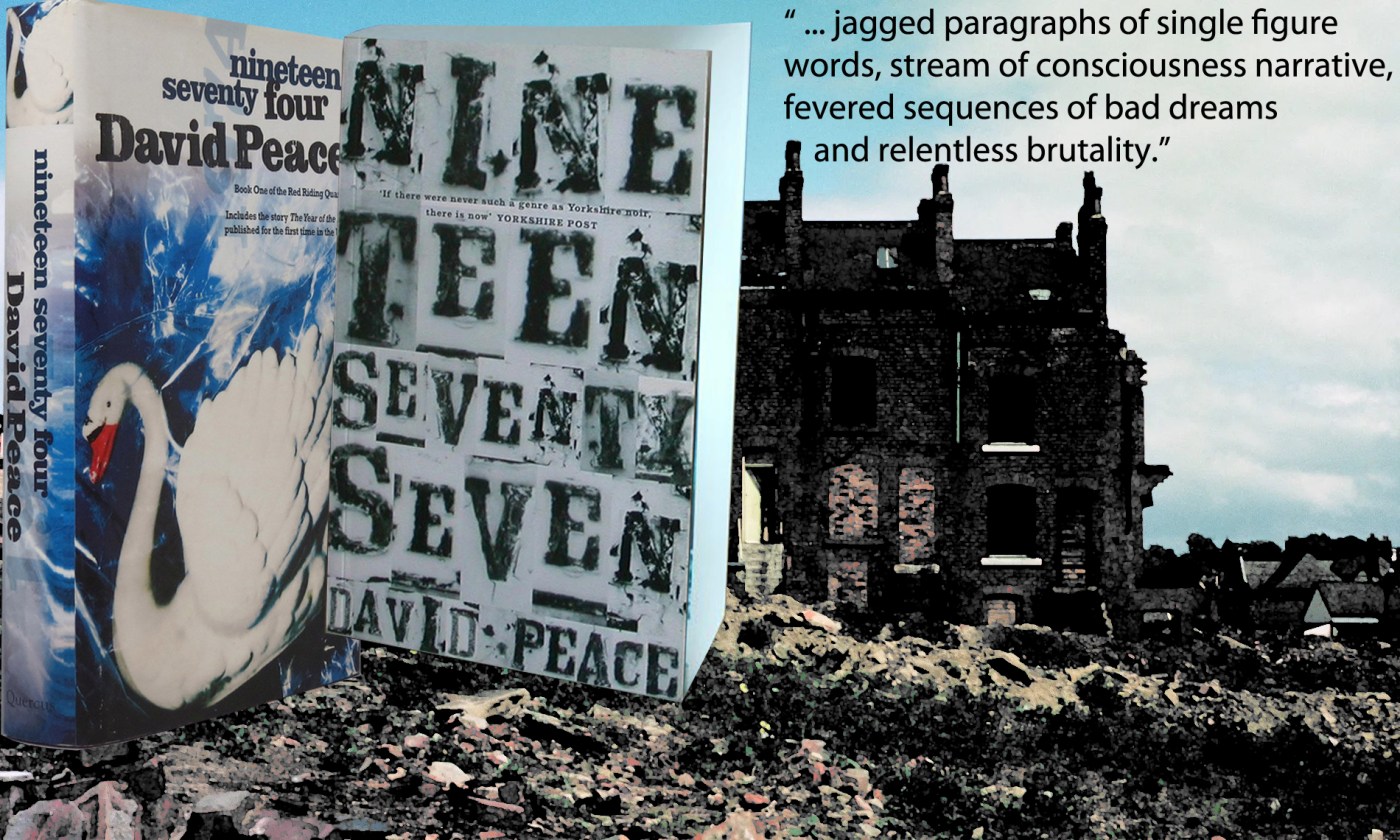
1977 is a re-imagining of the how the Yorkshire Ripper murders began to imprint themselves on the public’s imagination, and baffle police for many years. It is the early summer and we are reunited with many characters from 1974, including Jack Whitehead, DS Bob Fraser and several of the senior police officers who made Eddie Dunford’s life a misery. Apart from the obvious mark of Peace’s style – jagged paragraphs of single figure words, stream of consciousness narrative, fevered sequences of bad dreams and relentless brutality, there are other thematic links. Eddie Dunford’s father has just died, shriveled to a husk by cancer; Bob Fraser’s father in law is just days away from death from the same disease. Both  Whitehead and Frazer have their sexual demons, and in Fraser’s case it is a prostitute called Janice who he first arrested, and then became transfixed by. She is murdered, and he is arrested.

When straightforward narrative clarity is abandoned in favour of literary special effects, the downside is that it is sometimes hard work to know who is imaging what. Someone in 1977 is referencing the Whitechapel murders of 1888 and, in particular, the destruction of Mary Jane Kelly in Millers Court. Likewise, someone is using the slightly artificial jollity of the Queen’s Silver Jubilee as a sour counterpoint to the carnage being inflicted on the back streets of Leeds. The novel ends inconclusively, but it seems that both Whitehead and Fraser become the victims of their obsessions.

Screen Shot 2023-05-11 at 21.08.47

It is worth looking at the chronology of what I call ‘brutalist’ crime fiction (aka British Noir). The grand-daddy of them all is probably Jack’s Return Home, (1970) later re-imagined as Get Carter, and featuring corrupt businessmen, although there is little or nopolice involvement. This was Ted Lewis’s breakthrough novel, but aficionados will argue that his GBH – a decade later – is even better. 1974 and 1977 are explicit, bleak and visceral, but we would do well to remember that I Was Dora Suarez, the most horrific of Derek Raymond’s Factory novels, was published in 1990, and featured a similar leitmotif to 1974 – that of wounds, pain and suffering. To revisit IWDS click the link below.

https://fullybooked2017.com/tag/i-was-dora-suarez/

Screen Shot 2023-05-11 at 21.11.52

As compelling as these two novels are, David Peace wasn’t exploring ground unvisited by earlier writers. Tastes and descriptions in crime fiction are all relative. Val McDermid’s excellent Tony Hill/Carol Jordan novels were lauded as visiting dark places where other writers had feared to tread, but they were relatively mild, at least in terms of gore and viscera. Great stories, yes, from a fine writer, but not exactly pushing boundaries. Given the free use of vernacular words to describe ethnicity and sexual preferences, had Peace’s novels been submitted by an unknown writer in 2023, it is improbable that the books would see the light of day, given the cultural eggshells on which mainstream publishers seem to tiptoe.

Final verdict? I’ll answer the two questions I posed at the top of this piece. Firstly, the contemporary reactions were pretty enthusiastic, and included, from Time Out (remember that?):
“The finest work of literature I’ve read this year – extraordinary and original”
The Independent on Sunday enthused:
“Vinnie Jones should buy the film rights fast!”
The Guardian offered:
“A compelling fiction – Jacobean in its intensity.”

They
are not wrong about the books, but I suspect that the soundbites were from reviewers who perhaps did not have a very great overview of what had gone before. As for how they read these days, I came to them new, via a Christmas present from my son, and they certainly grab you by the throat. I read both books in two days but did I care very much about what happened to Eddie Dunford, Jack Whitehead or Bob Fraser? Not much, to be honest. The Aeschylean/Shakespearean view of a tragic figure is that he/she is someone who is basically a decent person brought low by a combination of fate and accident. For me, Eddie, Jack and Bob might have appeared to tick the first box, but actually didn’t. The two later books in the quartet were published in 2001(1980) and 2002 (1983) so they fall outside this remit. As for Vinnie Jones buying the film rights, the books were filmed as a trilogy, more or less omitting 1977 altogether. They were broadcast in March 2009.
 

KILLING THE INVISIBLE . . . Between the covers

KTI header

KTI cover014 copyKeith Dixon’s Porthaven is a fictional town on England’s south coast. It doesn’t seem woke or disfunctional enough to be Brighton, maybe neither big nor rough enough to be Portsmouth or Southampton, so it’s maybe a mix of all three, seasoned with a dash of Newhaven and Peacehaven. Inspector Walter Watts is a Porthaven copper. He is middle-aged, deeply cynical, overweight, and a man certainly not at ease with himself – or many others – but a very good policeman. When a young woman, later identified as Cheryl Harris, is found murdered on a piece of waste ground, the only thing Watts accomplishes on his visit to the scene is that his sarcastic exchanges with a female CSI officer result in in an official complaint, and  him being moved off the case. From the sidelines, Watts knows that whoever killed the young woman was definitely trying to pass on a message. The woman’s face has been obliterated by a concrete slab, with her mobile ‘phone  jammed into what was left of her mouth.

His new job is to liaise with Porthaven council over the security aspects for a proposed housing development. This is where Keith Dixon throws in the first of several delightful plot devices. Superintendent Tony ‘Frog’ French is Watts’ boss and the man who gave the order for the sideways move. Watts happens to be having an affair with Frog’s wife Felicity – and guess who is the council executive in charge of the building project? None other than Felicity (using her maiden name) Gable.

When the officer brought in to head up the murder enquiry is himself sidelined (due to some clever calling-in of old favours by Watts) our man is back in business. He senses that the murder of Cheryl Harris is somehow connected to the business dealings of Kurt Swanpool, a millionaire property developer (with a criminal record) who is working with Porthaven Council on the housing development with which Watts was – briefly – involved.

Screen Shot 2023-04-23 at 19.30.47Watts was brought up by his father – and in boarding schools – after his mother left the home. There has been no contact with her from that day to this, until he receives a message from the desk sergeant at Porthaven ‘nick’ simply saying that his mother had ‘phoned, and would he call her back on the number provided. This thread provides an interesting and complex counterpoint to the police investigation into the killing of Cheryl Harris. It also allows Keith Dixon (right) to better define Watts as a person; on the one hand he is aloof, selfish, socially abrasive and enjoys showing his mental superiority; on the other, he is vulnerable, unsure, and shaped by a childhood lacking conventional affection.

Kurt Swanpool may be modeled on a real life notorious Sussex millionaire landlord and part-time criminal with connections to southern Africa. Who knows? Swanpool retains dirty connections, even as he tries to establish his philanthropic credentials. Did anyone – or anything – decent ever come out of the Balkans? The jury is out, and two villains name Milo and Drago appear in the story, and don’t advance the cause of Serbia or Montenegro being nominated for an international human rights award one little bit.

Watts gets his murderer. That’s not me being intentionally oblique, but a rather gentle suggestion that you read a famous 1911 poem by Rudyard Kipling, which begins:

“When the Himalayan peasant meets the he-bear in his pride,
He shouts to scare the monster, who will often turn aside. “

Killing The Invisible – the second in the Porthaven Trilogy – is superior crime fiction. By turn intense, dark, literate and sardonic, it is published by Spellbound Books, and is available now.

THE MONK . . . Between the covers

Monk header010

The idea of an investigating detective having what some people see as a disability is an interesting one. Jeffrey Deaver’s Lincoln Rhyme is a tetraplegic who, effectively, cannot do ‘normal detective things’; Nero Wolfe is morbidly obese and rarely leaves his apartment – his cases are solved by his brain power and Archie Goodwin‘s leg-work; more recently, Harry Bingham’s Fiona Griffiths suffers from Cotard’s Delusion, aka Walking Corpse Syndrome, which gives her telling insights into murder investigations. Tim Sullivan introduced us to Detective Sergeant George Cross in The Dentist (2021). Cross has Asperger’s Syndrome* I will say now that this was one of those rare book that I simply didn’t want to end. I noted the advance of my bookmark through the pages with definite sadness.

*Symptoms include an inability to understand figurative speech, obsession with detail, difficulty with recognising emotional responses and lack of social awareness and empathy.

Author Tim Sullivan, very cleverly, pairs George Cross with fellow DS Josie Ottey, a married woman who is as ‘normal’ as Cross is ‘odd’. She acts as a kind of buffer between Cross and the people he must question as part of the job. What Cross brings to the party, however, is a kind of cold objectivity which, to counteract his inability to read a facial expression or tone of voice, gives him a laser-like clarity regarding the truth and logic of what witnesses or suspects tell him. The Monk is set in the Bristol area, and a body is found in the intriguingly named Goblin Combe*, a rural beauty spot beloved of hikers and tourists.

*A small dry valley beneath a hill. Commonly used in southern and south western England.

The  body, brutally beaten, is found strapped to chair and abandoned in a ditch. It turns out to be that of a Benedictine monk, Brother Dominic, who had only recently been reported missing from a nearby monastic community, St Eustace’s Abbey. The victim was killed elsewhere and the corpse dumped. There only a dozen members of the order, all men who, for whatever reason, have chosen to reject the modern world in favour of a life of prayer and contemplation. George Cross rapidly sees that there are two obvious lines of enquiry; was Brother Dominic killed because of something that happened within the walls of the monastery, or did his murder relate to something in his previous life, where he was a very successful investment banker?

Screen Shot 2023-04-05 at 18.42.44Without giving the game away, it is in Brother Dominic’s previous life where the clues are to be found, but answers don’t come easy for Cross and Ottey. Although there was a very clever plot twist involving the identity of the killer, I was far more involved with George Cross as a person than wondering who murdered Brother Dominic.The relationship between Cross and his father, the discombobulating effect of the re-emergence of his mother – lost to him since she left the family home when he was five – and his attraction to the unambiguous world of order, silence and simplicity of Dominic’s fellow monks,  all contribute to the power of this compelling read.

The book is full of little treats and bonuses. Rather in the same way that The Nine Tailors doubled as a treatise on the arcane art of bell ringing, we learn that George Cross is an accomplished church organist, despite the concept of religious faith being totally alien to him. He spends his spare time by pushing the murder case to a corner compartment of his mind, and patiently dismantling the dysfunctional abbey pipe organ, then cleaning and re-assembling the separate parts so that the instrument can once again play a part in the liturgy. Sullivan (above left) also gives the staple of police procedural novels – the recorded interview – a new twist; Cross’s ‘disability’ is a blessing when it comes to his interview technique, as neither the suspect nor the duty lawyer can make head nor tail of his literal approach to everything that is said. Mistaking him for an idiot, however, becomes a serious error of judgment.

Sullivan’s experience as a film director and screenwriter gives the narrative an intensely visual feel, but he wisely lets us picture George Cross in our own way, providing little or no physical description of him.  The Monk is a brilliant police procedural with an engaging central character and a clever plot. Published by Head of Zeus, it will be out on 27th April.

Blog at WordPress.com.

Up ↑