
Search

fullybooked2017

Tag

English Crime Fiction

DEATH ON WOLF FELL . . . Between the covers

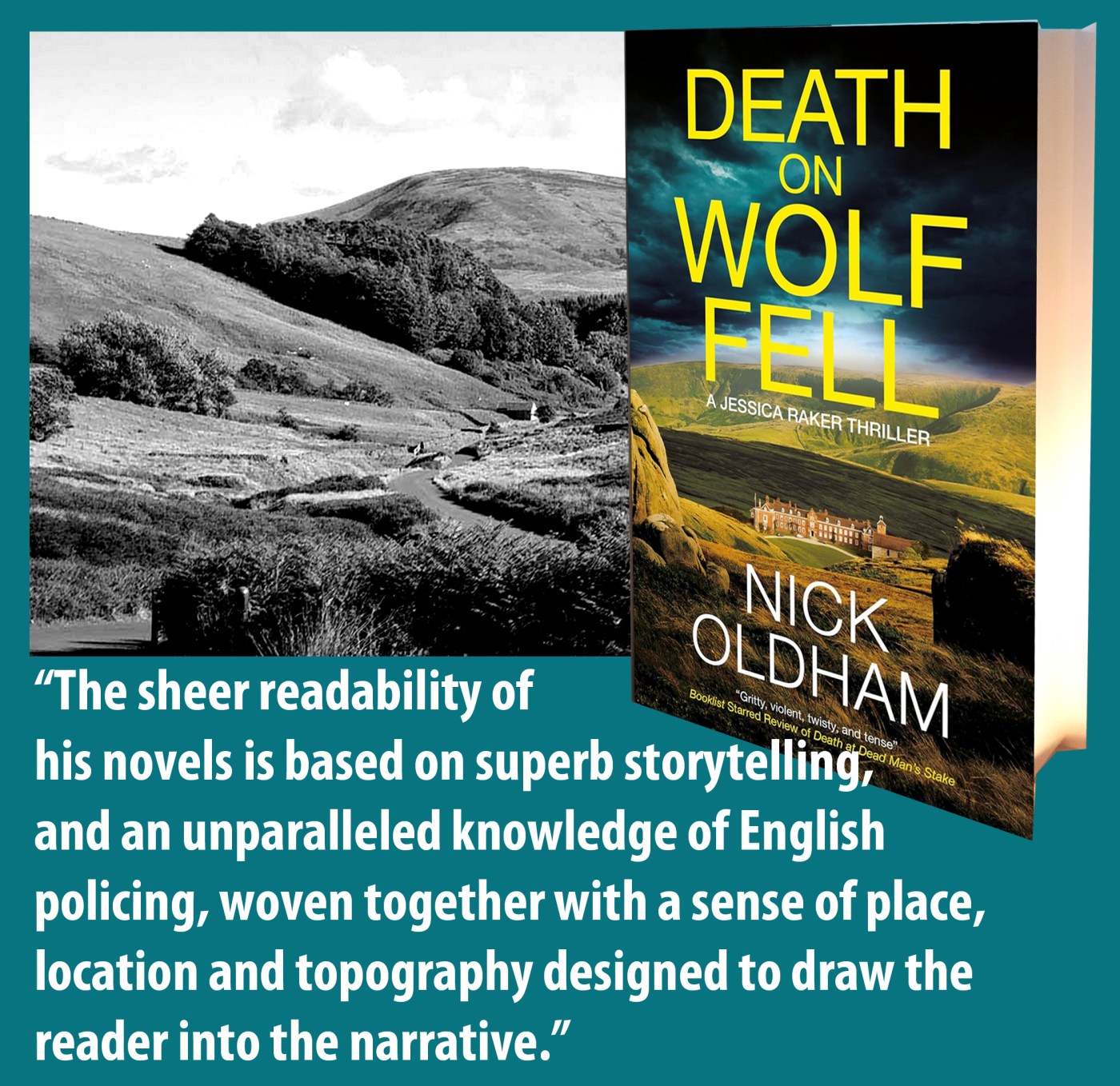
This is the next instalment of the career of Lancashire DS Jessica Raker, to whom we were introduced in “Death at Dead Man’s Stake”. Jess resumes her head-to-head battle with gang boss Maggie Horsefield, a ruthless and vindictive woman who is at the apex of the criminal fraternity, but someone who swims in the toxic waste in terms of human decency. It complicates matters that Jess’s daughter Lily and Maggie’s offspring Caitlin are BFFs at school.

It’s fair to say that Jessica Raker has something of a turbulent past. Born and bred in the district she now polices, she gravitated to London, where her career in the Metropolitan Police concluded dramatically with her shooting dead a feckless younger member of a serious crime gang. When a retaliatory contract was taken out on her life, she was relocated to Clitheroe. She has two children, but her relationship with husband Josh is, to say the least, threadbare, although they are still together.

This story starts with Lance Drake, a petty crook somewhere near the bottom of Maggie Horsefield’s barrel of criminal employees, facing his worst nightmare. He is being released on license from HMP Preston, where he has been quite happily spending the last few months, safe from the inevitable retribution which has awaited him since he shot his mouth off to the police, thus losing his boss tens of thousands of pounds in a drug shipment.

Inevitably, given that Horsefield has her employees embedded at every level of the criminal justice system, Drake is soon grabbed, and when the hood is taken from his head, he finds himself cable-tied to a chair sitting, ominously, on a large plastic sheet spread on the floor of a disused mill, with Horsefield sitting nearby, fondling a zombie knife. Jess Raker’s team have had their eyes on this mill for some time, rightly suspecting that is part of Horsefield’s drug distribution business and, happily for Lance Drake, they choose that moment for a raid.

Most of Horsefield’s goons get away, the mill plus an industrial quantity of ‘merchandise’ go up in flames, and the stage is set for a dramatic encounter as Horsefield and her lover, London gangster Tommy Moss, plan a multi-million pound raid on Wolf Fell Hall, an ancestral home which contains scores of priceless old master paintings. Along the way, we learn more about the team of officers around Jessica Raker. There is the intelligent and resourceful PCSO Samira Patel, who yearns to become a ‘proper’ copper. CID officer Dougie Doolan is one of Jessica’s mainstays, but she suspects he is hiding a grim secret. Her boss, Inspector Price, we strongly suspect may be a wrong ‘un, but is he actually feeding information to the dreadful Maggie Horsefield?

One thing you will not find in a Nick Oldham novel, thankfully, is the remotest trace of sympathetic hand-wringing for his villains. Yes they may come from awful families with dreadful parents but, like all of us, they have a choice. If they take the wrong road, then they have no-one to blame but themselves. For Oldham, once a working copper in hives of scum and villainy like Blackpool, they have made their choice and deserve everything they get. He has a direct, no-frills narrative style. The sheer readability of his novels is based on superb storytelling, and an unparalleled knowledge of English policing, woven together with a sense of place, location and topography designed to draw the reader into the narrative. Death on Wolf Fell will be published by Severn House on 6th May.

THE ANTIQUE HUNTER’S DEATH ON THE RED SEA . . . Between the covers

There’s a backstory to this engaging novel of skullduggery in the international antiques trade, but I’m going to be mean and direct you to my review of the debut novel in the series The Antique Hunter’s Guide To Murder. A few minutes read will explain everything! Now, Freya Lockwood and her eccentric Aunt Carole have inherited the antiques business owned by the late Arthur Crockleford in Little Meddington, Suffolk.

A quick peep at the author’s bio will tell you that she is lucky enough to live in Constable country. The action starts in that idyllic spot, but soon moves further afield. In pursuit of a stolen painting – and involves trying to solve a murder at a little maritime museum in Lowestoft, our two Noble Dames join a specialist antiques lovers cruise sailing from Greece to Jordan. Central to the plot is the existence (or not) of a mysterious antiques crime supremo known as The Collector. The legend has been around for 200 years, so we are not talking about a supernatural being, but more like a criminal version of The Pope, in that a new Collector is elected when the old one dies.

Back in the 1970s the now unjustly forgotten crime novelist Colin Watson wrote a book called Snobbery With Violence, in which he excoriated the Golden Age of crime fiction. The writers, he believed, portrayed a world which, if it ever existed, was totally removed from the humdrum lives acted out by most readers of the genre. As good a writer as he was, I think he missed the point. CL Miller is not setting out to emulated Sayers, Marsh, Allingham or Christie, but she does allow Freya and Caroline to achieve what, for most of us, would be ‘the impossible.’ Freya and Caroline desperately need to join the cruise, so crucial to the plot. In one paragraph, Carole beguiles the flunky at the other end of the phone to let them join the cruise and, with the next call, books flights to Cyprus so that she and Freya can be piped on board the ship. Implausible? Yes, of course it is, but entertaining? Absolutely.

Back to the plot. Freya and Carole blag their way aboard the MVGoldstar as it cruises sedately towards the Red Sea and the ancient ruins of Petra. There is a convention in this kinds of mystery that very few people are who they claim to be, and so it is on the decks and in the luxury restaurants of the ship. Much mayhem ensues, including gunfire echoing around the magnificent ruins of Petra, an FBI agent posing as a member of the ship’s crew, an enigmatic painting which may (or may not) contain a clue to the whereabouts of a priceless Ming vase, and all manner of villainy from people posing as respectable tourists. The book is, of course escapist, but thoroughly engaging, and just the thing to brighten up a drab day in the British winter. It is published by Macmillan, and is available now.

BURIED IN THE PAST . . . Between the covers

Heather Peck’s Greg Geldard books are, as far as I am aware, unique in that they operate almost as serials, with at least one case continuing from the previous novel, alongside a new investigation. The previous novel Beyond Closed Doors (click for more details) dealt with the troubling case of two children going missing, after their mother was murdered by their father. The book ended with Kate and Jake Mirren being held captive by a reclusive woman in a perfectly ordinary village bungalow. She feeds them well, and looks after them, but they are not free to leave the room in which are confined. The case weighs heavily on Geldard’s mind, as his boss and other senior officers having metaphorically, at least, ticked the box marked ‘missing, presumed dead’.

One of the plotlines here is centred on the vexatious pursuit of hare coursing. Far from the open fields of East Anglia, it has a long history, and in some countries it is regulated and controlled by official bodies, and is regarded as a sport for the gentry. Here, it is very different. It has been illegal since 2004, and is, at least in my backyard, largely carried out by those who, in polite speech, are known as ‘The Travelling Community.’ As I write this, villages not far from me are still reeling from the havoc caused a few days ago by a convoy of twenty five four-by-four vehicles, driven by balaclava clad men, cutting a swathe of destruction across fields and  property and leaving burnt out vehicles in their wake. In this novel, farmers who try to disrupt the activity become victims of violence and arson. When a farm worker dies from a blast caused by one of the arson attacks, this becomes a murder investigation.

While this carries on, hampered by Covid restrictions, Heather Peck focuses on the strange case of the Mirren children. We know they are still alive, but the mystery is why the woman who has, albeit benevolently, imprisoned them in the first place. The apparently inoffensive and ordinary bungalow becomes the scene of something much more dramatic towards the end of the book, when Heather Peck cleverly weaves in a story line which she introduced in the early pages, buy appeared to have no apparent connection with the events in East Anglia.

Like many readers, I always want my crime stories to have a definite and developed sense of place, and Heather Peck definitely doesn’t let us down. In my case, it helps that Greg Geldof’s stamping ground is not too far away from where I live, and I can appreciate the depth of knowledge and fondness for the fields and waterways of Norfolk and Suffolk which are embedded in the story. Buried In The Past is as enthralling and addictive a police thriller as you could wish to read. It is published by Ormesby Publishing, and is available now. Incidentally, the book ends, as all good serials should, by leaving us in suspense after Geldard suffers a harrowing few days, but I have blacked out the final words to avoid a spoiler!

GONE . . . Between the covers

gone spine011

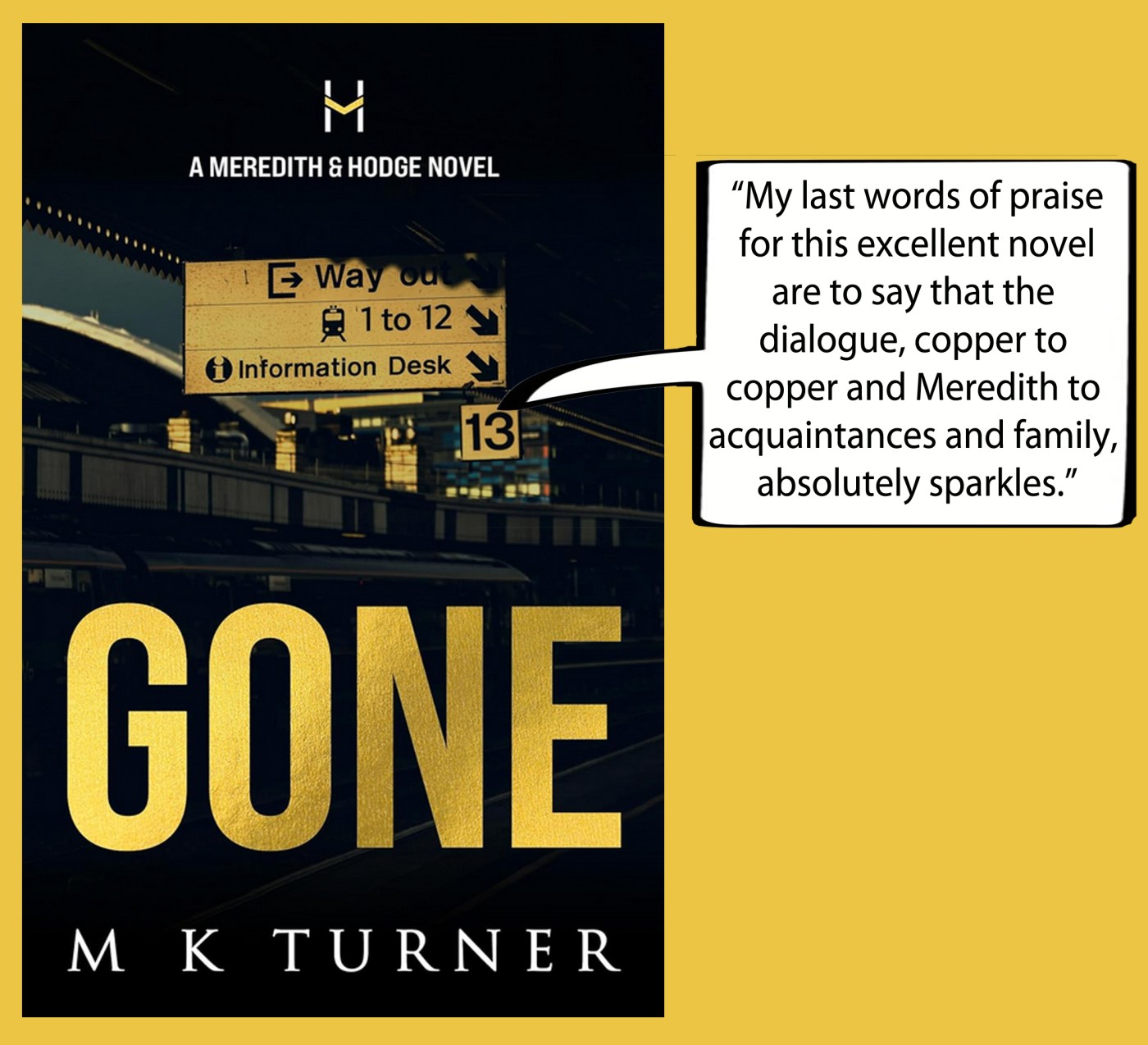
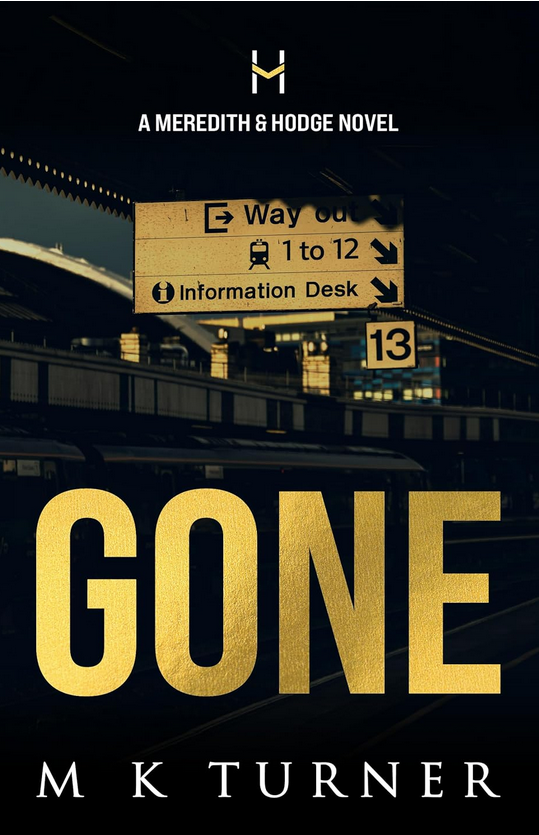
Bristol DCI John Meredith is not at peace with the world. His wife and fellow police officer Patsy Hodge was seriously injured when she came face to face with a serial killer. Her physical injuries are, albeit slowly, healing. Mentally, however, she is shattered. Her relationship with Meredith is now fraught, riven with anxiety and tension.

At work, Meredith is saddled with an exasperating pair of cold case crimes. Decades ago, two young women, unknown to each other and years apart, caught trains from Bristol to London. Neither reached their destination, and their bodies were eventually discovered in separate locations in farmland near Reading. What links the two cases is that the forensics indicate that the two young women were not killed when they first disappeared. It seems that they lived for years before being killed. But where? And with whom? Doing what,? The timeline suggests that the first girl, Jasmine was killed in 2008/9, while Louise disappeared in 2010. Could Louise have been Jasmine’s successor, a replacement of some kind? Jasmine Jones was given up by her mother, put in care and then fostered. She married a man called Carl, but the relationship disintegrated when he had a fling with another woman. Louise Marshall was another woman anxious for a fresh start and a new job, but she found only violence and an unmarked grave.

As is often the way in crime fiction, we know the answer to the puzzle facing the investigators long before they do. In this case, there is a decidedly weird and disfunctional farming family who have a disconcerting habit of employing women as a sinister mix of housekeeper and bed-mate – and then killing them.

As involving as this is, the real beating heart of the book is John Meredith’s personal life. The scene where he meets up with his first true love (after Patsy ups sticks and goes to stay with relations in New Zealand) is brilliantly written, and so, so poignant. They wine and dine, make it back to her hotel and …. I am not going to spoil it for you, but it is the most emotionally intuitive piece of writing I have read for a long time.

John Meredith is an engaging and complex man. Realising that Patsy is mentally damaged, he is bowed beneath her slights, physical indifference, and emotional instability, but he never buckles. He hopes (rather than believes) that somewhere ahead are the sunlit uplands of the days before Patsy was so badly wounded. He wants to believe what Philip Larkin once wrote. “What will survive of us is love.” It is, at the end of the day, all he has to offer.

The dark secrets of Brandon farm are eventually exposed to sunlight and justice – after a fashion – is served. What will remain with me about this book, however, is the wonderfully observed account of Meredith’s personal life. Yes, we know that most fictional police Inspectors have tangled lives away from the job. I could start with Tom Thorne, Alan Banks and John Rebus, but CriFi buffs do not need me to continue the list, as it would be a long one. My last words of praise for this excellent novel are to say that the dialogue, copper to copper and Meredith to acquaintances and family, absolutely sparkles. Gone is published by 127 Publishing and is available now.

Screen Shot 2024-12-19 at 17.25.50

DEATH AT DEAD MAN’S STAKE . . . Between the covers

DADMS HEADER

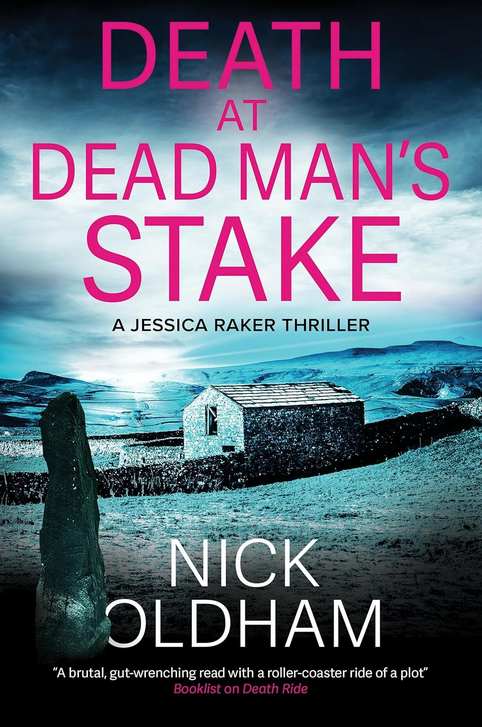
Death at Dead Man’s Stake sounds like something from the Wild West, but it is, in this new novel by former copper Nick Oldham, an incident at an isolated farm in Lancashire. With his veteran Henry Christie perhaps taking a well-deserved break at his (hopefully) rebuilt moorland pub, Oldham introduces Detective Sergeant Jessica Raker. After fatally shooting a London gangster following a botched raid on a jewellers’ in Greenwich, Raker has been moved to the North West – where she grew up – in an attempt to distance her from the dead man’s vengeful relatives.

Her first day is nothing if not eventful. She has barely unloaded her kit into the Sergeant’s office from her car, when she is called out to a crisis at Dead Man’s Stake. When the local fire brigade attends an unexplained fire in the derelict farmyard, one of the firefighters is grabbed and held hostage by the farmer, a drunken, mildly crazed man called Bill Ramsden. Jessica rescues the fireman after tazering Ramsden. Her day is not over, however. A cantankerous old man, resident of a local cafe home, is found dead, his corpse floating in a nearby reservoir. Raker, viewing the scene, suspects that a physical struggle lead to the old man ending up in the water.

Jessica Raker is a good copper, but she has been dealt a poor hand. At the Greenwich heist, who was one of the customers eying up an expensive item at the moment the robbers burst in? None other than her husband Josh, a high flying player in a City firm. And the piece of jewellery was intended not for Jessica, but for his secretary. Improbably, the marriage has survived, and Josh is now working in Manchester, but resentful at the move.

Meanwhile, we learn a little more about the man Jessica shot dead in Greenwich. He was the most ungovernable  of the sons of Billy Moss, a millionaire crook grown rich on the proceeds of all manner of criminaity, ranging from the inevitable drug trade to trafficking people. Goss wants revenge. He wants the hapless amateurs who lured Terry Moss into the doomed jewellery raid, but most of all, he wants Jessica. The problem is that the Met Police have done a very good job in smuggling her away to the Ribble Valley, and she has gone completely off the Moss radar. Nonetheless, a professional killer is hired to hunt her down and end her life. While on the school run, Jessica bumps into an old adversary. Years ago, when she was growing up in Clitheroe Jessica and Maggie Goss fell out over a mutually desired boyfriend, and Maggie, now boss of huge scrapyard empire, hasn’t forgotten the teenage slights. What is more important is that the scrapyard business is a million miles away from being strictly legit, and one of Maggie’s LinkedIn buddies is none other than Billy Moss.

It is not just Nick Oldham’s years of experience as a working copper that makes his books so good. Nor is it the loving and detailed sense of place, where he describes a beautiful and windswept rural Lancashire, blissful yet only an hour’s drive from pockets of deprivation and criminality like Blackpool. For me, what puts his novels up there on a pinnacle is his sense of dialogue – nothing flashy or pretentiously poetic – but an unerring version of how real people actually speak to each other.

As the Moss organisation moves against Jessica Raker, there is a satisfying symmetry to the main plot, as it ends where it began, out at Dead Man’s Stake. This is a firecracker of a police thriller, and Nick Oldham has established a cast of coppers, with Jess Raker at its heart, who will keep us entertained for many years to come. The novel is published by Severn House, and is available now.

Screen Shot 2024-09-25 at 19.40.39

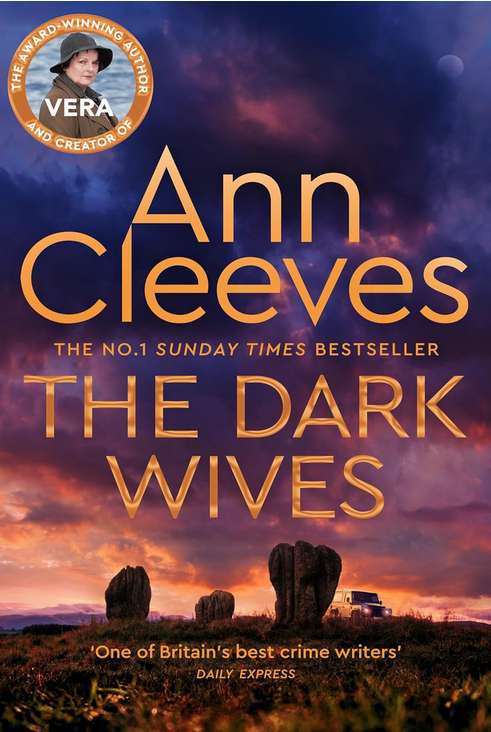
THE DARK WIVES . . . Between the covers

TDW SPINE072 copy

Readers who have also watched the successful TV series dramatising the Vera Stanhope novels will have their own views on how Brenda Blethyn’s Detective Inspector matches up to the woman on the printed page. I stopped watching TV versions of police procedurals years ago, with the demise of John Thaw, so my take is purely based on the book. Vera Stanhope is a dowdy, frumpish woman in her 50s, lonely and probably a social misfit. Brought up by an eccentric father, Hector, in a moorland cottage in Northumbria, denied (by premature death) a mother’s love, she is a formidably intelligent detective. She drives a battered Land Rover, has holes in her socks, and doesn’t suffer fools gladly.

Here, she is handed a complex case that has splintered into myriad issues. At its heart is the apparently motiveless murder, by hammer attack, of an undergraduate and part time social worker, Josh Woodburn. A teenage girl, Chloe Spence, who was a reluctant resident at Rosebank, where Josh worked shifts, has gone missing. Where is she, and why was film and media enthusiast Josh, unbeknown to his family, moonlighting with shifts at a children’s home?

Vera has the death of one of her team, a Detective Constable called Holly, on her conscience, but she takes a maternal interest in Holly’s replacement, Rosie Bell, a rather glamorous and fashion conscious young woman who is actually a very good copper. When another inmate of Rosebank, a young chancer called Bradley Russell is found dead in a remote hillside bothy, the case becomes more complex.Without, I hope, giving too much away, Vera’s hunch is that Josh Woodburn’s death is connected with what he was really doing at Rosebank. Josh was a decent, caring young man, and very good with the children, but that wasn’t the main reason he was there. When Vera, with the help of  fellow officer Charlie, joins the dots, the picture also explains why Brad also had to die.

Both the season and the mood of the book are distinctly autumnal. Vera’s work is her life, and there seems to be little outside the job. The depressing world of broken homes, absent fathers, and a society where children’s homes are run by shadowy corporations on a distinctly for profit basis does not improve Vera’s downbeat view of the world but, to borrow a line from Matthew Arnold’s Thyrsis, “The light we sought is shining still.”, and in Vera’s case the faint glimmer is provided by bringing justice to the dead. She couldn’t be more different from Derek Raymond’s nameless detective in the Factory Novels (click for more information) but they have the same fierce resolve.

If years of reading police-procedural crime novels has taught me anything, it is that well-balanced, happily married Detectives are not fun. Vera Stanhope is forever on the edge of things, caught up in her own personal history and sense of regret, reluctantly wearing a halo of missed opportunities and ‘what ifs’.. Her fierce empathy with those society has cast aside, combined with her innate shrewdness and ability to pick out a ‘wrong-un’ make her one of the genre’s most treasured creations.

The Dark Wives of the title are three stone monoliths on the fellside near Vera’s home. Legend has it that they were three strong willed women who were turned to stone by husbands fed up with their feistiness. In the preface, Anne Cleeves writes:
“The book is dedicated to teens everywhere, and especially to The Dark Wives – uppity young women with minds of their own, struggling to find a place in a difficult world.”
The novel is published by Macmillan and was published on 29th August.

Screen Shot 2024-08-21 at 18.12.57

BEYOND CLOSED DOORS . . . Between the covers

BCD SPINE065 copy

This enjoyable police procedural novel is the sixth in the series (to read reviews of the previous two, click this link) following the career of Norfolk copper Detective Chief Inspector Greg Geldard, his girlfriend Detective Sergeant Chris Mathews, and the rest of their team. These novels pretty much follow on from each other, and in the previous book Geldard battled a violent Lithuanian gangster called Constantin Gabrys. Now, it’s March 2020, Gabrys is serving a long prison sentence and his psychotic son is dead. However, all is not well, because a key figure in the case, now under witness protection has been attacked. He survived, but a police officer has been seriously injured, and it is obvious that the leak of information can only have come from within the police forced itself.

Despite the Gabrys empire having been apparently dismantled, their poisonous legacy hangs over Norfolk like a miasma. Norfolk, I hear you ask? Surely not that wonderful holiday destination with its abundant wildlife, historic homes and beautiful coastline? While the entire county might not be a wretched hive of scum and villainy, there are places – like Yarmouth and Gorleston – which suffer deep deprivation, and are consequently ripe feeding grounds for organised criminals, whether imported from Eastern Europe or of the home-grown variety.

Geldard traces the leak to a civilian police secretarial worker, but is dismayed to learn that part of the conspiracy involves Helen Gabrys, a member of the family he thought to have been as innocent of wrong doing as she was disgusted at her father’s career.

You will notice in the first paragraph that the story is set in March 2020. Remember that? As the country begins to shut down against the ravages of Covid, life just gets more difficult for Geldard and his team. Right across the criminal justice system things are starting to unravel. Court backlogs become years rather than months, prisons are struggling with absent staff, and the police themselves have to try to hold important conversations yards apart from each other. As the cover blurb suggests, however, the streets may be nearly empty, but evil is just as happy within four walls as out in public places.

There is a parallel thread in the story, which I found unsettling and hard to read. In Yarmouth live the Mirren family. Children Karen and Jake don’t have the happiest lives. Their mum is well-meaning, but weak, and browbeaten by her brutish husband. Karen has a place where she feels valued, can be herself and feel comfortable with trusted adults. It is her primary school, and when it shuts, forcing all the children to stay at home, it is a life sentence for the little girl. The reason this part of the novel affected me is that I taught in Norfolk for over thirty years, and for the latter part of that I led Safeguarding, and the scenes that Heather Peck describes were uncomfortably familiar.

When tragedy strikes in the Mirren house, the subsequent events become very much the concern of Greg Geldard, and he has to add a significant missing persons search to his mounting caseload. In the best traditions of great Victorian writers like Dickens and Hardy, who serialised their novels in popular magazines prior to publishing them in their entirety, Heather Peck leaves us on a knife edge, eagerly awaiting the next novel in this impressive series. Beyond Closed Doors was published by Ormesby Publishing on 22nd June.

Screen Shot 2024-07-08 at 19.11.05

WHEN THE BOUGH BREAKS . . . Between the covers

WTBB header

David Mark has taken a temporary break from his excellent Aector McAvoy series (click the link to find out more) and his latest novel has a prologue that is as violent and visceral as any of the disturbing scenes in Derek Raymond’s I Was Dora Suarez. If you have read that masterpiece, you will know what I am talking about. If you haven’t, then you should. Here, copper Wulfric Hagman wakes up in a charnel house, apparently of his own creation. His former lover, Trina Delany lies butchered on the bed, while he seems to have tried to hang himself with a length of baler twine.

That was then, but now, Hagman has served a prison sentence, been released, and is now living in a moorland farmhouse he gifted by Jarod, one of Trina’s children. His twin sister, Salome is also living there. She is a traffic cop, formally known,in today’s jargon, as Collision Investigation Officer. At Hagman’s original trial, both Sal and Jarod gave chilling evidence testifying to the abuse they – and the other children – received at Trina’s hands.

Against this unusual human background and with the Northumbrian hills carpeted in deep snow, David Mark weaves his magic. The plot is complex, but this is a breakdown of the main characters.

Salome Delaney, police officer.
Jarod Delaney, Sal’s twin. Now a farmer, living in a house signed over to him by …
Wulfric Hagman, former policeman, served a long prison term for the murder of Trina Delaney. He now lodges with the Delaneys.
Dagmara Scrowther, charismatic Children’s Services officer. Worked with the Delaney family.
Lewis Beecher, senior police officer, divorced. Has recently ended a long term relationship with Sal Delaney.
Barry Ford. Once a child tearaway, now relatively respectable. Former lover of Trina Delaney.
Detective Superintendent Magda Quinn. Has re-opened the Hagman case, believing him to be guilty of more murders.

With transport paralysed by deep snow, Salome – although on leave – receives a call from a fellow officer asking her to go and investigate a car that has come off the road just a couple of miles away. She clings on grimly as Jarod’s quad-bike makes light work of the snow drifts. She finds the wrecked car, but the macabre feeding habits of local crows lead her to a man’s body. Some of the crows who have fed on the corpse are collapsing and dying. The reason? The body has had acid poured into his throat.

This grim discovery sets off a train of events that are as violent and disturbing as anything I have read in recent crime fiction. I am a great admirer of David Mark’s writing, and I make no apology for frequently comparing his style to that of Derek Raymond. Like Raymond, Mark takes us into dark places where monsters – in human form – ply their trade. Like Raymond’s nameless Sergeant in the five Factory novels, Mark’s heroes are often gravely damaged, but have a depth of compassion that always brings about a sense of redemption at the end of the journey, no matter how hellish the road.

The body in the snow is eventually identified as being that of Barry Ford, a man who was a troubled youngster but, thanks to the perseverance of Dagmara Scrowther, seems to have turned himself into something of a decent citizen. However, when Salome, hastily drafted back to work as a Family Liaison Officer, has to break the news of Ford’s demise to his current girlfriend, she opens a Pandora’s Box from which fly demons of cruelty and bestial abuse. Also in the mix is the fate of Lewis Beecher’s divorced wife. She and her two daughters – Nola and Lottie – have a new ‘dad’. He seems jolly and full of jokes, but is he genuine?

In this superb novel we cross paths with many human monsters. Trina Delaney is one, certainly, and Barry Ford is not far behind. But a third monster lurks in plain sight. Its identity is known to me, but you will have to find out for yourselves. When The Bough Breaks is published by Severn House and is available now.

REVENGE KILLING . . . Between the covers

RK spine036 copy

I reviewed an earlier book in this series, Final Term, in January 2023 and thoroughly enjoyed it, so it was good to become reacquainted with York copper, DI Geraldine Steel. Revenge Killing is a little bit different in that DI Steel is off on maternity leave. As much as she loves baby Tom, she is feeling very much out of the loop in terms of her police career. When her friend and colleague DI Ariadne Moralis asks for her advice, she leaps at the chance to help.

Moralis has a complete puzzle of a case on her hands. Initially, her husband – Greek, like Ariadne – has been visited by a friend and compatriot called Yiannis Karalis. Yiannis owns a property where one of the tenants – a small time drug dealer called Jay Roper – has been found dead at the foot of the stairs leading up to his flat. Ariadne assures him that he has nothing to worry about, but when the post mortem examination reveals that Jay was suffocated, things become more complicated.

Ariadne discovers that Yiannis is something of a fugitive, as he fled Greece during the fallout from the murder of his older brother and a subsequent vengeance death. Did he visit Jay to remonstrate with him about the drug dealing? Did the visit turn violent. One of Jay’s girlfriends, Lauren Shaw, has gone missing. What does she know? Another girlfriend, Carly, who works in what is euphemistically known as a gentleman’s club, is located, and she is completely antagonistic towards the police. Despite claiming that she and Jay had an ‘open’ relationship, was jealousy simmering just below the surface, and did she kill Jay on the grounds that if she couldn’t have him, no-one else would?

Leigh Russell cleverly lets us spend some time with Lauren, who has panicked. We know. from the early pages of the book that she and Jay had a blazing row which ended in him falling down the stairs. Now, terrified that the police will blame her for his death, she goes on the run, and we share her misery as she her meagre savings run out, and she discovers that life on the streets is miserable and dangerous.

Revenge Killing is, at its heart, an excellent and engaging police procedural, but Leigh Russell has an intriguing little subtext ticking away in the background, and it centres on Geraldine’s misgivings about her life trajectory. She dutifully attends a mothers and toddlers group, but feels only alienation:

“But the other mothers at the toddler group had never dealt with murder investigations in the real world. None of them had watched a post-mortem, knowing the cold flesh on the slab had once been a living breathing human being, whose life had been snatched away by someone in the grip of an evil passion. The other mothers had never learned to close their minds to the horrors of every day human brutality, so shock couldn’t prevent them from doing the job. Gazing at the cheerful faces around her, she regretted her choice of career and wished her life could be as simple as it was for the other women in the room. But her experience had cut her adrift from these chattering young women, with their sheltered upbringing and cosseted lives. They discussed their various tribulations as the infants crawled or toddled around the room, or sat propped up watching warily, like Tom.”

As with all good whodunnits, we are presented with just the right blend of surprise at the identity of the killer, and a few helpful nudges to point us in the right direction. Revenge Killing is published by No Exit Press and is available now.


Blog at WordPress.com.

Up ↑