Search

fullybooked2017

Tag

Elizabethan times

THE QUICK AND THE DEAD . . . Between the covers

tqatd spine013 copy

The Thameside borough of Southwark, 1597. Kit Skevy aged 20, is a street criminal employed – or perhaps enslaved – by a man whose trade would, in our day, be described as gangster. Will Twentyman is feared for his violence and venality. He also controls Mariner Elgin. A few years older than Kit, she is a cut-purse, a thief who specialises in relieving wealthy people of their cash. She has a complex history, having once worked on a sailing ship disguised as a boy. When her first menstruation betrayed her, she was locked up for the remainder of the voyage, and now belongs to Twentyman.

One of Twentyman’s more profitable sidelines is grave robbery, delivering corpses to anatomists or those engaged in alchemy. When a group of armed men discover Kit and Mariner exhuming a body, Kit happens to be carrying a vial of a strange substance he recovered from the body of a friend who died in a fire caused by an alchemical experiment. The vial breaks and the the liquid, perhaps something like phosphorus, ignites and plays across his fingers.

Kit is taken prisoner and his captors, wrongly, believe that he has strange powers. Kit learns that his captor is Lord Isherwood, but the nobleman’s son, Lazarus – himself an alchemist in search of hidden truths, befriends him, and orchestrates his escape. Perhaps ‘befriends him’ is euphemistic, as there is an erotic attraction between the two of them.

At one point, Emma Hinds suggests that Kit may have the anatomical irregularity of possessing both male and female characteristics. The author describes herself as “a Queer writer and playwright living in Manchester whose work explores untold feminist narratives”, so this novel is not a run-of-the-mill historical tale. Mariner also escapes from Twentyman’s grip after being drawn to Lady Elody Blackwater, a wealthy widow who is also consumed by the search for the elixirs of alchemy. There is sexual electricity between the two women and, despite their social differences, they become lovers. There is a thread of eroticism running through this book, which is unusual in ostensibly similar historical fiction.

In the last few pages of the novel we are drawn into the burgeoning world of late Elizabethan theatre, and we are introduced to an ambitious actor/playwright from Warwickshire. Emma Hinds brings us a vivid (and sometimes lurid) vision of a dystopian late-Elizabethan – era London, peopled by whore-masters, alchemists, body snatchers, cut-purses and political opportunists. Kit and Mariner are unconventional heroes. If nothing else, they are street fighters who know all the tricks to enable them to survive in a Southwark so grotesque that it might have been painted by Hieronymus Bosch.

The contrast between the middens initially occupied by Kit and Mariner, and the rose-water life style of the gentry could not be starker. The relationship between the two is that of brother and sister as each is attracted to people of their own sex. The Quick and The Dead is a complex and, in some ways, a challenging, novel. Emma Hinds has clearly spent long hours on the topography of late 17thC London, and the bizarre attempts by alchemists to attempt things which science would eventally prove to be impossible.. It was only in the age of Newton, a century later, that the work of alchemists was finally sidelined.

The author also reminds us that despite the heroics of Drake, and the fortuitous weather, Spanish/Catholic claims to the crown of England did not end in 1588. As Kit and Mariner go from crisis to crisis, a second Spanish invasion fleet is waiting at anchor in the middle distance. The Queen would only have another four years to live, and the agents of Scotland’s King James are already busy.

This is a compelling portrait of late Elizabethan England, an absorbing mix of fierce politics, wonderful architecture and drama, but sullied by bestial social conditions. Emma Hinds seems to be telling us that same-sex relationships were, in those days, not the burning issue that they were later to become. She may be right. In the novel the name of Christopher Marlowe is occasionally evoked, and one school of thought suggests that homosexuality brought about his downfall but, whatever his preferences, he was not hunted down in the way that Oscar Wilde and Alan Turing were to be in more recent times. The Quick and The Dead is publlshed by Bedord Square and available now.

Screen Shot 2024-12-30 at 12.46.56

THE HERETIC’S MARK . . . Between the covers

THM header006
SW Perry’s Elizabethan medical man Nicholas Shelby
returns in the latest of the ‘Mark’ series. We’ve had The Angel’s, The Serpent’s and The Saracen’s, (click to read reviews) and now we have another journey through the complex religious politics of the 16th century with The Heretic’s Mark. Nicholas has married his fiery Anglo-Italian lady Bianca née Merton. Her London South-Bank pub – The Magpie – has been destroyed by fire, but is being rebuilt. The newly-weds have a pressing problem, however. An innocent Jewish doctor has been executed for trying to poison the Queen, and Sir Fulke Vaesy, an embittered rival of Nicholas, has attempted to link him to the conspiracy. Fortunately, Nicholas has the ear of the Queen’s spymaster Robert Cecil, but he is advised to make himself scarce while the furore dies down.

Nicholas and Bianca decide to undertake a journey, posing as Catholic pilgrims, along the the Francigena, a route from France into Italy, its path worn by the feet of the devout. Along the way they are accompanied by a strange young woman – Hella – who they met in the Low Countries. She is a member of the Beguines – nothing to do with the dance, but a lay order, similar to Nuns. Hella is both disturbed and disturbing, as well as being sexually attractive. While Nicholas and Bianca are foot-slogging across the alps, back in London all is far from well. Rosa Monkton –  Bianca’s maid – and her husband Ned have been given oversight of the reconstruction of The Magpie, but Ned has become obsessed with trying to find out who has put Nicholas in harm’s way.

Nicholas and Bianca have arrived in the city of Padua, along with the enigmatic Hella. Padua is Bianca’s former home, and they become involved with a scheme – spearheaded by Bianca’s cousin Bruno and his friend Galileo (yes, the very same) – to build a huge and complex system of globes, rings and cogs which will predict the movements of the planets. Bianca has become (as they used to say) “with child”, but has been told by Hella – much given to doom-laden prophecies – that the child will be stillborn and, thereafter, Bianca will be unable to bear children.

Much of the action of this book takes place in Padua, but occasionally darts back to London to report on the travails of Ned and Rose Monkton. As Bruno and his acquaintances work feverishly at their great *armillary sphere, Nicholas becomes uncomfortable aware that Hella is determined to prise him away from Bianca, and her motives, as well as the obvious sexual one, are deeply sinister. No-one realises just how sinister, however, until a mysterious man in grey – who has been dogging Nicholas and Bianca’s footsteps on their journey across Europe – is unmasked.

This is seriously good historical crime fiction. SW Perry has done – as ever – an impressive piece of history homework, but that doesn’t matter, because great narrative drive, believable characters and an almost tangible sense of time and place make this a compelling read. The Heretic’s Mark is published by Corvus and is out now.

*An armillary sphere (variations are known as spherical astrolabe, armilla, or armil) is a model of objects in the sky (on the celestial sphere), consisting of a spherical framework of rings, centred on Earth or the Sun, that represent lines of celestial longitude and latitude and other astronomically important features, such as the ecliptic. As such, it differs from a celestial globe, which is a smooth sphere whose principal purpose is to map the constellations. It was invented separately in ancient Greece and ancient China, with later use in the Islamic world and Medieval Europe.

CHAOS . . . Between the covers

Chaos header

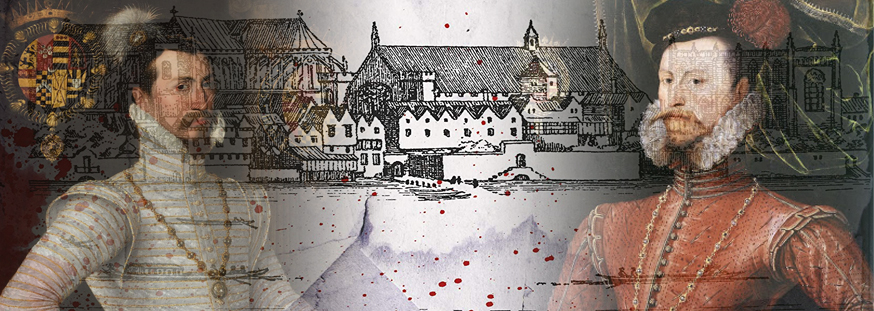
Christopher Radcliff is a Doctor of Law and he is also what  sixteenth century England called an ‘intelligencer’. We might say ‘spy’, ‘secret agent’ or, at a pinch, ‘private eye.’ He is employed by two of the most powerful men in Queen Elizabeth’s service – the brothers Dudley. Robert is the Earl of Leicester and Ambrose the Earl of Warwick.

91c5yMTPQkLRadcliff, the creation of author AD Swanston, made his literary debut in The Incendium Plot (2018). The blurb for that book said that the country was “a powder keg of rumour, fanaticism, treachery and dissent.” Well, a few years on, and things haven’t changed a great deal. The big threat to Good Queen Bess still comes from those devious and malignant Papists, but the adherents of ‘the old religion’ have changed tack. Military conquest by Spain or France has proved ineffectual, so has a more subtle method has been chosen?
Pretty much every one of us is too young to remember a time when our currency was suspect. Yes, there have been periods of inflation (I can remember PM Harold Wilson and ‘The pound in your pocket.”) but we have never doubted that the coins in our pockets or the notes in our wallet were suspect. In February 1574, however, someone has been minting fake testons. They were, in old money, shillings, and the most common coin in circulation for everyday transactions.

BearThe fake testons also bear the image of the bear and ragged staff (right), the emblem of the Earl of Warwick. Clearly, the forgers have a double headed plan. They intend to paralyze normal day to day trade by making shop-keepers wary of accepting coins, but they also seek to diminish the status and power of the Dudley brothers by linking them to worthless coins.

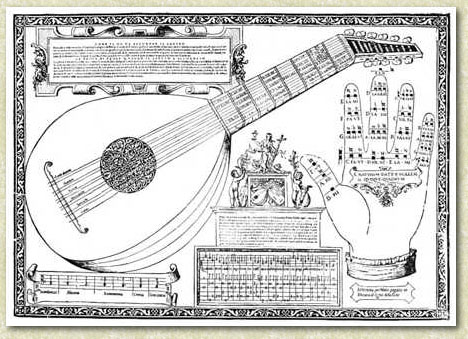
When Radcliff eventually tracks down the person behind the counterfeit coins he discovers not a Papist plot, but a personal search for revenge, fired by a dreadful betrayal and a bitterness so deep that only death can sweeten it. Without giving any more away, I can say that part of this vengeance involves, strange to relate, that most delicate and ethereal of Renaissance instruments, the lute.

Pagano1

Swanston has great fun immersing us in all the contrasting glory and squalor of Elizabethan England. We are led through the magnificent Holbein Gate into the Palace of Whitehall with its tapestries, panelled chambers and priceless paintings, but we also have to tread gingerly amid the horse muck (and worse) as we walk along Cheapside, and try to avoid the grasping hands of its whores and beggars.

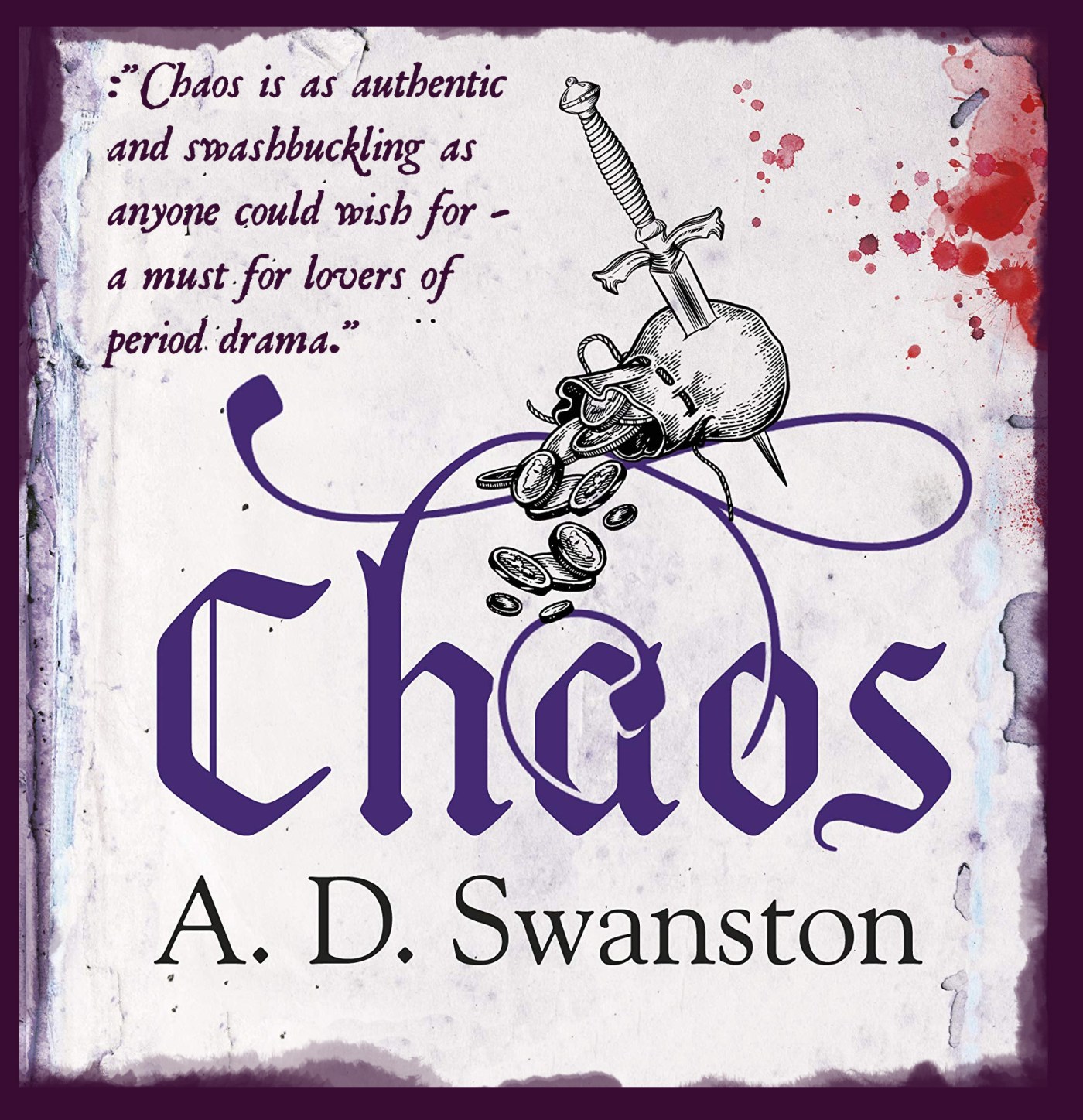
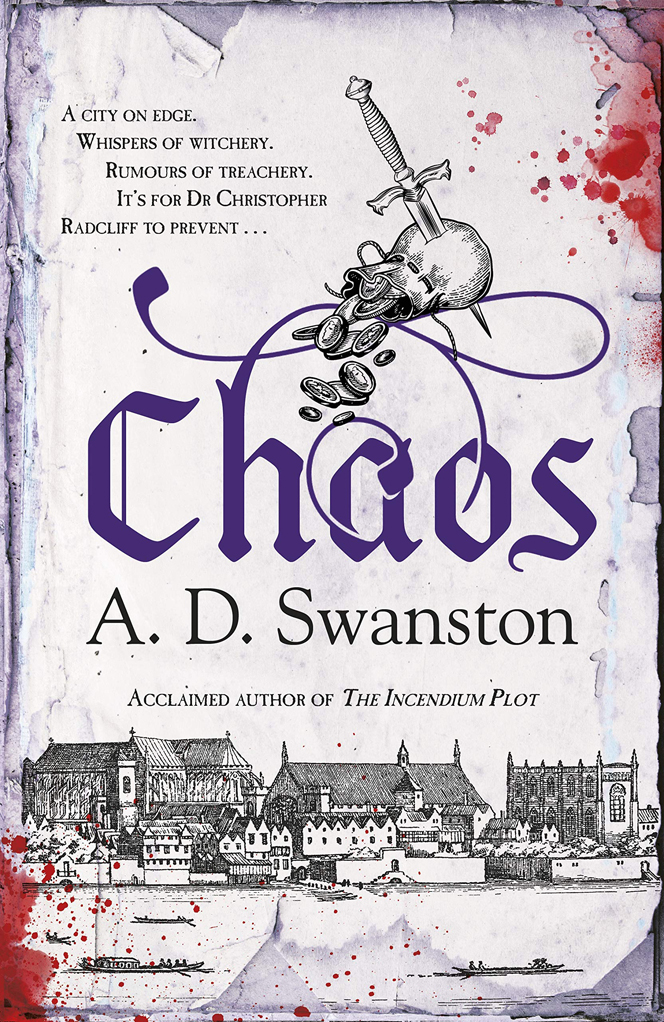
Chaos is as authentic and swashbuckling as anyone could wish for – a must for lovers of period drama. It is published by Bantam in hardback, and by Transworld Digital as a Kindle. Both formats are available now.

THE SARACEN’S MARK . . . Between the covers (click for full screen)

TSM spine010

SW-Perry-photo-1-2-300x482SW Perry (left) whisks us away from our disease ridden present misery to – with almost supernatural prescience – the streets of London in 1593, where plague is also keeping the gravediggers and the parsons working around the clock! The late sixteenth century versions of  plucky NHS employees come in the shape of Bianca Merton, a young Anglo-Italian woman who keeps The Jackdaw, a Bankside tavern (and who is also much in demand as a herbalist – a purveyor of what we now call alternative medicine) and her close friend Dr Nicholas Shelby, whose medical knowledge is more conventional.

The disease has, so far, gone about its malevolent business north of the River Thames, but with no daily calls for social distancing, it finds its way south:

“Her name is Ruth. She is returning to the lodgings on Pocket Lane that she shares with her husband. Ruth feels uncomfortable hot. By the time she reaches home, she will have a fever. She will awake the next morning to find painful swellings in her armpits. Young and strong, she is in the habit of thanking God for a strong constitution. But in a few days she will be dead. The pestilence has crossed the river.”

Bianca is much in demand among the worried residents of Bankside for her concoctions:

“Pomanders of rose leaves, tragacanth gum and camphor to hang around the neck … clove and lemon to mix in a posset . . . also a tincture of bezoar and sorrel. Mix that in water or small beer every morning.”

TSM coverNicholas, however, has been sent on a mission by one of the most powerful men in Queen Elizabeth’s kingdom – her spymaster Sir Robert Cecil. England has a complex relationship with what we now call Morocco, and in particular with the ruler of Marrakesh, but the death of Adolfo Sykes:

“..a small, somewhat bow-legged half-English, half-Portuguese merchant with a threadbare curtain of prematurely white hair that clung to the sides of his otherwise- unsown pate.”

… needs to be investigated, as Sykes is a key strand in Cecil’s silken – but deadly – web of spies and agents. When Nicholas finally arrives in Marrakesh, he discovers that Sykes had uncovered a slavery ring involving, among others a brutal and violent sea captain called Cathal Connell. Now that Nicholas is aware of the secret, it is only a matter of time before Connell and his accomplices come looking for him. While the unpredictable world of Moorish politics find him alternating between foul prison cells and  a life of luxury surrounded by servants, back in London ….

“The pestilence has returned with a vengeance. The Savoy hospital has closed its doors to new patients and posted guards on the water stairs to deter visitors. The chapel’s death-bell tolls with increasing frequency.”

This is a richly rewarding novel, full of fascinating historical detail, but Perry never allows the authenticity of  his main characters to be hidden beneath a superfluity of information about what they are wearing, or the contents of their dinner plate, or elaborate architectural descriptions. Bianca and Nicholas are separate from each other for most of the narrative, but each drives the story forward relentlessly. As we are only too well aware just now, plague knows no historical boundaries, but Perry’s skill as a storyteller is equally timeless – and magical. The Saracen’s Mark is published by Corvus, and is out now.

If you like the sound of what the author calls The Jackdaw series,
then read my review of The Serpent’s Mark.

Blog at WordPress.com.

Up ↑