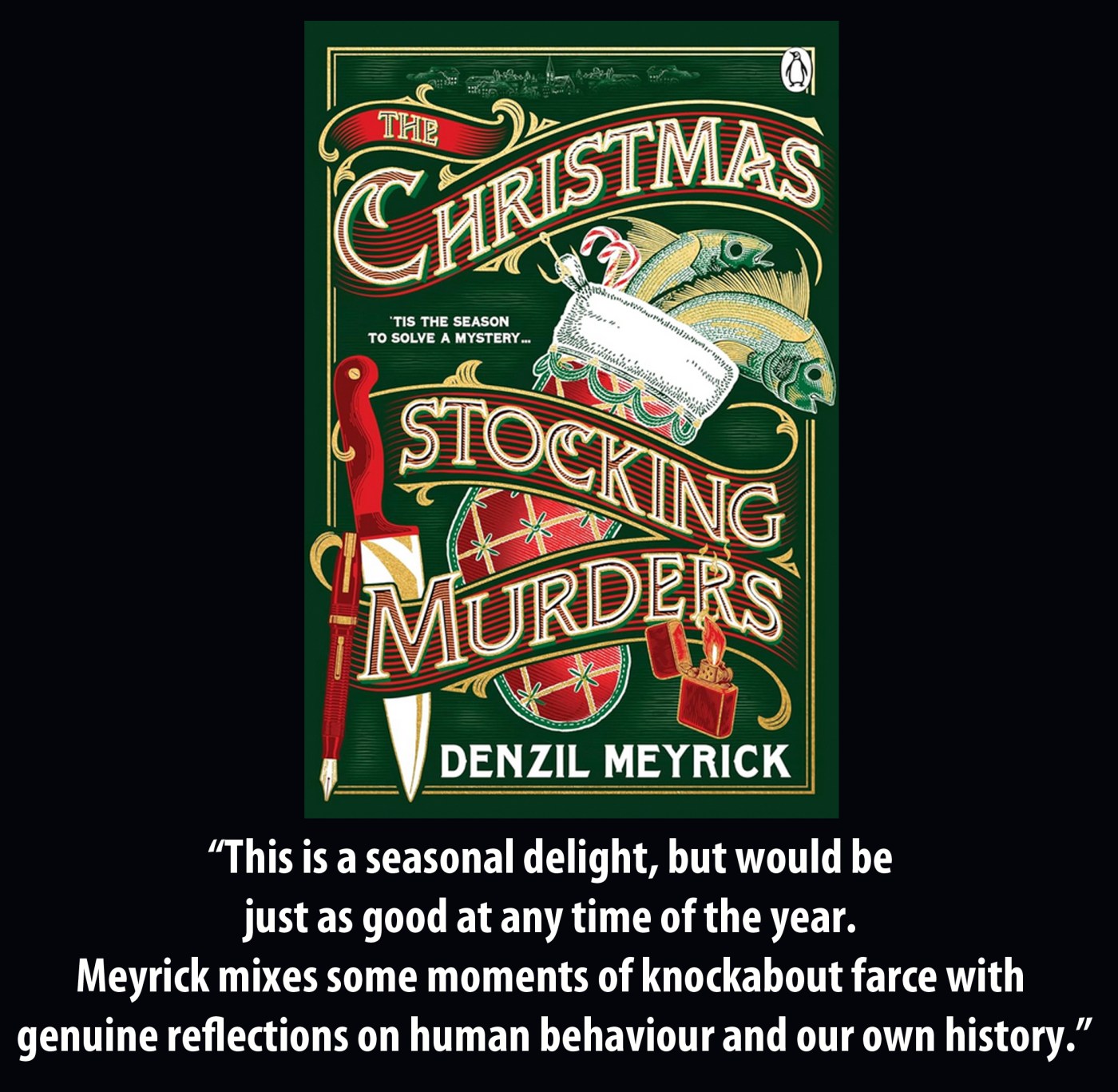

Denzil Meyrick introduced us to 1950s copper Detective Inspector Frank Grasby in Murder at Holly House, and you can read my review of that by clicking the link.
Grasby and his boss Superintendent Juggers are despatched to the little Yorkshire fishing village of Uthley bay to investigate the apparent murder of fisherman. It is just before Christmas 1953 and, as in all good seasonal fiction, it is snowing heavily. When they take up their quarters in The Trout Hotel, they discover that they are in the middle of a very complex conspiracy, involving the smuggling and distribution of women’s stockings. Remember that this is Britain worn down by the struggle against Hitler and Hirohito and, eight years later, with no end to austerity in sight, many people are asking themselves, “ I thought we were supposed to have won the war?”
Despite the general tone of gentle humour there are moments that are deeply serious. Grasby is reassured by Superintendent Juggers that everything is going fine, but he has a pause for thought.
“Now, this instantly sends me into a funk. You see, I heard this type of thing so many times during the war from senior officers. Almost inevitably, there would follow an utter catastrophe, involving swooping Stukas, tanks appearing out of nowhere through a hedge in the bocage, or a division of German paratroopers landing on one’s head. However, I must remember that the war is over, but for me and so many others, we carry it with us like a millstone every day. One that becomes ever more cumbersome as the years go by and the memories crowd in on dark lonely nights.”
One of the things Meyrick captures with uncanny accuracy – and I use the word uncanny because he is too young young to have experienced it himself – is the unique bond which bound British society together in the 1950s. That bond was the shared experience of a generation that had fought two world wars in the space of four decades. Grasby fought Hitler, and Juggers was in the Great War trenches. I was born in 1947, but what my father – and his father – created was an almost tangible sense of time and place that belonged to all of us.
Of course, Grasby and Juggers eventually solve the mystery, despite many blunders and wrong turns, and Meyrick cannot resist the standard Golden Age denouement where the detective gathers everyone together (usually in the library) and exposes the villain after a lengthy explanation.
Meyrick has created a background set of characters who, undoubtedly comical, are just the right side of being grotesque. Grasby himself is undoubtedly clever, but has seen enough death and misery during his time with the army that has little personal bravery left, and his discretion trumps his valour every time. While Grasby is tall and spindly, Juggers is just the opposite. Short, square and perhaps running to fat, he always advances towards the sound of gunfire. Grasby’s father is a genuinely unpleasant fellow. He is a retired Anglican cleric and a total misanthrope. He is as horrible to his son as he was to the parishioners of whom he was supposed to have pastoral care. Grasby has fond memories of his late mother, and is genuinely disgusted by the fact that his father has a new paramour, in the spindly form of Miss Hetty Gaunt, an elderly psychic.
This is a seasonal delight, but would be just as good at any time of the year. Meyrick mixes some moments of knockabout farce with genuine reflections on human behaviour and our own history. To mix comedy with crime takes a very deft touch. We might read of a clumsy and overweight senior copper taking a pratfall, but a couple of pages later we witness the discovery of a dead body – someone’s husband, father or son. Few writers attempt it, and even fewer get it right. Back in the day, Colin Watson with his Flaxborough novels had it down to a ‘T’ and, more recently, Peter Bartram’s Crampton of The Chronicle novels strike exactly the right note. I suggest that Denzil Meyrick is just as good. This book is published by Bantam, and will be available on November 7th.






 The novel is subtitled The Memoirs of Inspector Frank Grasby, and Denzil Meyrick (left) employs the reliable plot-opener of someone in our time inheriting a wooden crate containing the papers of a long-dead police officer, and exploring what was committed to paper. Will crime writers in a hundred years hence have their characters discovering a forgotten folder in the corner of someone’s hard drive? I doubt it – it won’t be anywhere near as much fun.


 The title is, of course, police-speak for missing person, and this gritty novel shines an unforgiving light on the scourge of the County LInes drug trade in Britain. Put simply, the couriers are teenagers of school age up and down the land who deliver baggies of drugs to their customers. They are controlled by big city criminals who use the youngsters and their bikes, who know every little lane and ginnel of their home area to stay one step ahead of the police. Central to the story is the death of a policeman – shot by one of these youngsters – and the efforts of some of his colleagues to avenge his death. Watch my main page for a full review soon.
 This a very advanced look at a novel which will be available nearer Christmas time, although given the miserable summer we have been having, it might be more topical now. It’s December 1952, and a dead stranger has been found lodged up the chimney of Holly House in the remote town of Elderby. Is he a simple thief, or a would-be killer? Either way, he wasn’t on anyone’s Christmas wish list. Inspector Frank Grasby is ordered to investigate. The victim of some unfortunate misunderstandings, he hopes this case will help clear his name. But as is often the way for Grasby, things most certainly don’t go according to plan. Soon blizzards hit the North York Moors, cutting off the village from help, and the local doctor’s husband is found murdered. Grasby begins to realise that everyone in Elderby is hiding something – and if he can’t uncover the truth soon, the whole country will pay a dreadful price.
 This is the start of a new series from the Scottish author. In the small Highland village of Cronchie, a wealthy family are found brutally murdered in a satanic ritual and their heirloom, ‘the devil stone’, is the only thing stolen. The key suspects are known satanists – case closed? But when the investigating officer disappears after leaving the crime scene, DCI Christine Caplan is pulled in to investigate from Glasgow in a case that could restore her reputation. Caplan knows she is being punished for a minor misdemeanour when she is seconded to the Highlands, but ever the professional, she’s confident she can quickly solve the murders, and return home to her fractious family. But experience soon tells her that this is no open and shut case. She suspects the murder scene was staged, and with the heir to the family estate missing, there is something more at play than a mythical devil stone. As she closes in on the truth, it is suddenly her life, not her reputation that is danger! Will Caplan’s first Highland murder case be her last?
 This is the latest in the long-running Tempe Brennan series, and the redoubtable expert in human anthropology is playing away from her Montreal home turf – in the Caribbean paradise of the Turks and Caicos Islands – although there is a Canadian connection, in the shape of a badly chopped up body pulled out of the St Lawrence River. On the island holiday resort, Tempe has been induced to investigate the deaths of a number of young tourists, each of whom is missing a hand. Check my main page for the


 fullybooked2017