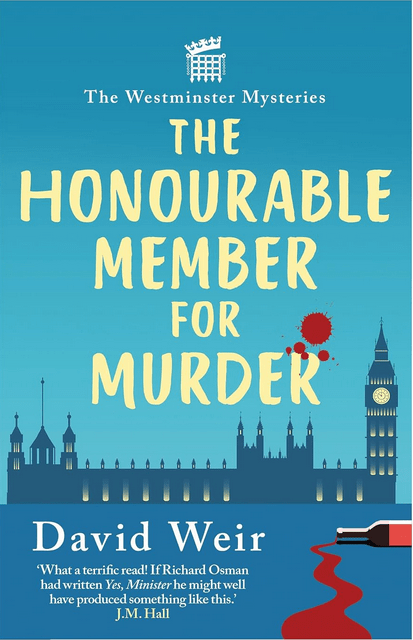
Maxwell Murray is personal assistant to Eliot Oakcroft MP, a handsome but utterly vacuous man with political ambitions that are routinely ignored each time there is a cabinet shake-up. The pinnacle of his career thus far is more of a gentle hillock – he is chairman of the All-Party Parliamentary Group for miscarriages of justice, an appointment mainly designed to keep Oakcroft out of the prematurely grey hair of the Chief Whip.
The body of Charlie Cley is eventually found in a Norfolk cottage. Problem is, though, he did not die three years ago when he was first reported missing, but more like three hours earlier – and from a glass of red wine laced with poison. Rebecca Cley is released from her prison cell on the perfectly reasonable grounds that when her husband died, she was under lock and key in HMP Norton St Meals.
What sort of a hero is Max Murray? Can he carry the novel’s narrative on his back for 300 pages? The short answer is – no. He is too honest, too conciliatory and too hesitant. He needs the buccaneering instincts of Diana and Ronni to drag him from the calm waters of the harbour so that he can challenge the criminal Blackbeards and Captain Kidds out there on the open ocean. Is this Cosy Crime? If one applies the AI definition, “a sub genre of crime fiction without sex, or overt violence, typically featuring an amateur sleuth solving a puzzle or murder in a close-knit or picturesque community, emphasizing puzzle-solving, humour, and with a satisfying resolution where order is restored.’ then, yes, I suppose it is. The humour here is sharp enough, and there is just enough cynicism to lift the novel above the mire of elderly ladies cycling around Cotswold villages trying to discover who killed the local Master of Foxhounds. Such books were dismembered and cleverly eviscerated by the late, great Colin Watson in his excellent book Snobbery With Violence.
The crime(s) are solved eventually. more by the perscipacity of Diana than that of Max.I have a couple of minor quibbles; the last time I went to Fincham, the pubs were quite decent, and there was no sign of the breeze-block monstrosity featured here; as anyone who holds a firearms license will tell you, a rifle and a shotgun are two quite different things. That aside, I enjoyed the book, and found it an entertaining and witty read.
David Weir was born and brought up in Edinburgh where he played a lot of rugby and sang for the Pope in a national choir at Murrayfield and in Glasgow. He was a newspaper reporter for 11 years in Fife, Hampshire, Norwich and London interviewing among others Harry Secombe, Ralph Fiennes and a lot of politicians. Then, he went to work at the House of Commons advising MPs from all parties on constitutional stuff and arcane parliamentary procedures as well as running teams reporting on the Treasury, justice, prisons, courts, migration, policing, and Northern Ireland. This is his first novel, and it will be published by Allison & Busby on 20th August.