

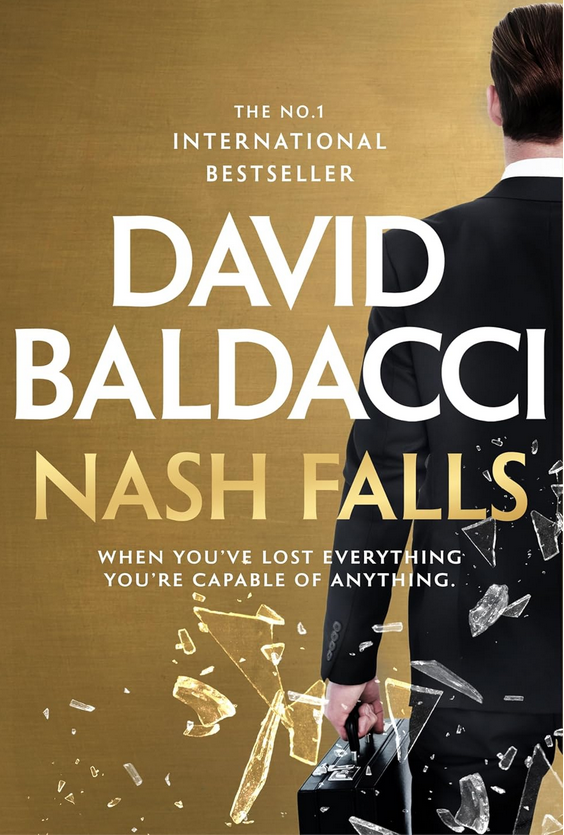
Wily veteran of scores of thrillers, Baldacci certainly builds down his central character in the first few pages. Walter Nash is a lanky, scrawny, rather uptight family man who only ever really loved his deceased pet dog. He is, however, thanks to his number crunching skills with a multinational company, prodigiously rich. And, after his fashion, he tries to be a good husband and father.
His own father, recently deceased, was a brawling and profane Harley-riding Vietnam vet who, to all intents and purposed, despised Walt for his prissy ways and lack of physical presence. One night, Walt has an unwelcome visitor in the shape of an FBI agent, and he has grim news to impart. Walt’s firm, coyly named Sybaritic, has been infiltrated (via one of its senior employees) by a criminal corporation connected to Chinese drug producers. The FBI people explain to Walt that the Chinese, unable to match the USA either militarily or economically, have chosen to inflict a slow death on America through the over-production and distribution of drugs like Fentanyl.
We learn that the ‘inside man’ on this operation is none other than Rhett Temple, the son of the firm’s founder. Then with customary narrative verve, Baldacci describes how Walt Nash’s near-perfect life is reduced to rubble by the perfect storm of an international criminal regime, corrupt cops and bent businessmen desperate to hang on to their wealth. Faced with false – but appalling – accusations, Nash is forced to go on the run, helped by one of his father’s old army buddies, a fearsome black man known as Shock.
What follows is, perhaps, the most implausible part of the story. It is a version of the old riff of a physically inept man who, by training and will power, is transformed into a formidable opponent. Under Shock’s watchful eye Nash is transformed from the puny guy who once had sand kicked in his face by beach bullies, to a remorseless killer. If you don’t get the sand reference, Google ‘Charles Atlas’. The internet will do the rest.
The portrayal of Nash, from his buttoned-down corporate executive days, via family tragedy through to his emergence from that chrysalis as someone quite different, is impressive. My last thoughts, are, I am afraid, something of a spoiler, but I always try to be honest. Walt Nash certainly undergoes a dramatic transformation and, motivated by a sense of vengeance, he rejoins the world from which he had been exiled, his true identity hidden from former acquaintances. However, those wishing for a conclusive resolution to the story must await the sequel, which is trailered at the end of this novel. Nash Falls is published by Macmillan and is out now.


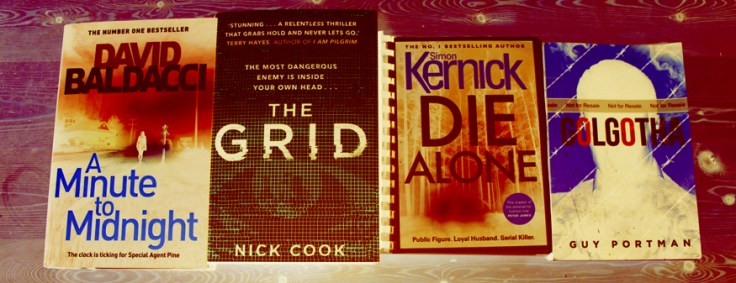
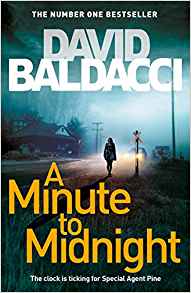 Atlee Pine has anger management issues, and A Minute To Midnight begins as she is put on gardening leave for kicking the you-know-what out of a child rapist. She decides to use this enforced leisure time in another attempt to find out what happened on the fateful night when her sister was abducted and she was left with a fractured skull. Accompanied by her admin assistant Carol Blum, she revisits the scene of the trauma, the modest town of Andersonville, Georgia. Tumbleweed is the word that first comes to mind about Andersonville, but it scrapes a living from tourists wishing to visit the remains of the Confederate prisoner of war camp which, in its mere fourteen months of existence, caged over thirty thousand Union prisoners of whom nearly thirteen thousand were to perish from wounds, disease and malnutrition.
 A series of apparently motiveless murders in Andersonville diverts Pine from the search for her own personal truth, and she is soon enlisted to help the understaffed and under-resourced local cops. The first murder victims – a man and a woman – are killed elsewhere but then delivered to Andersonville bedecked as bride and groom respectively. When it turns out that they were both involved in the porn industry, what first appears to be a significant lead runs into a brick wall.


 rcher served his country with distinction in the war, fighting his way up the spine of Italy, watching his buddies die hard, and wondering about the ‘just cause’ that has trained him to shoot, throttle, stab and maim fellow human beings while, at the same time, preventing him from being at the deathbeds of both parents.
 Wearing a cheap suit, regarded as trash by the local people, and with every cause to feel bitter, Archer checks into the Derby Hotel and contemplates the future. His immediate task is to check in with his Probation Officer, Ernestine Crabtree. Quietly impressed by her demeanour – and her physical charm – Archer goes, in spite of his parole restrictions, for a drink in a local bar, The Cat’s Meow
 ven before Lucas Tuttle answers the door to Archer’s knock by pointing a cocked Remington shotgun at his unwelcome visitor, Archer has learned that the floozie on Pittleman’s arm in the bar is none other than Jackie, Tuttle’s estranged daughter. Archer finds the coveted motor car hidden away on Tuttle’s ranch, but it has been deliberately torched. Cursing his involvement in this blood feud, Archer’s equilibrium and freedom both take a severe knock when Pittleman’s body is found in a bedroom just along the floor from Archer’s room in The Derby. Thrown into the cells as the obvious suspect, Archer is released when he meets up with Irving Shaw – a serious and competent detective – and convinces him of his innocence.
 Pretty much left on his own to solve the case after a violent attempt to silence Jackie, Archer has to summon up very ounce of his military experience and his innate common sense to put himself beyond the reach of the hangman’s noose.
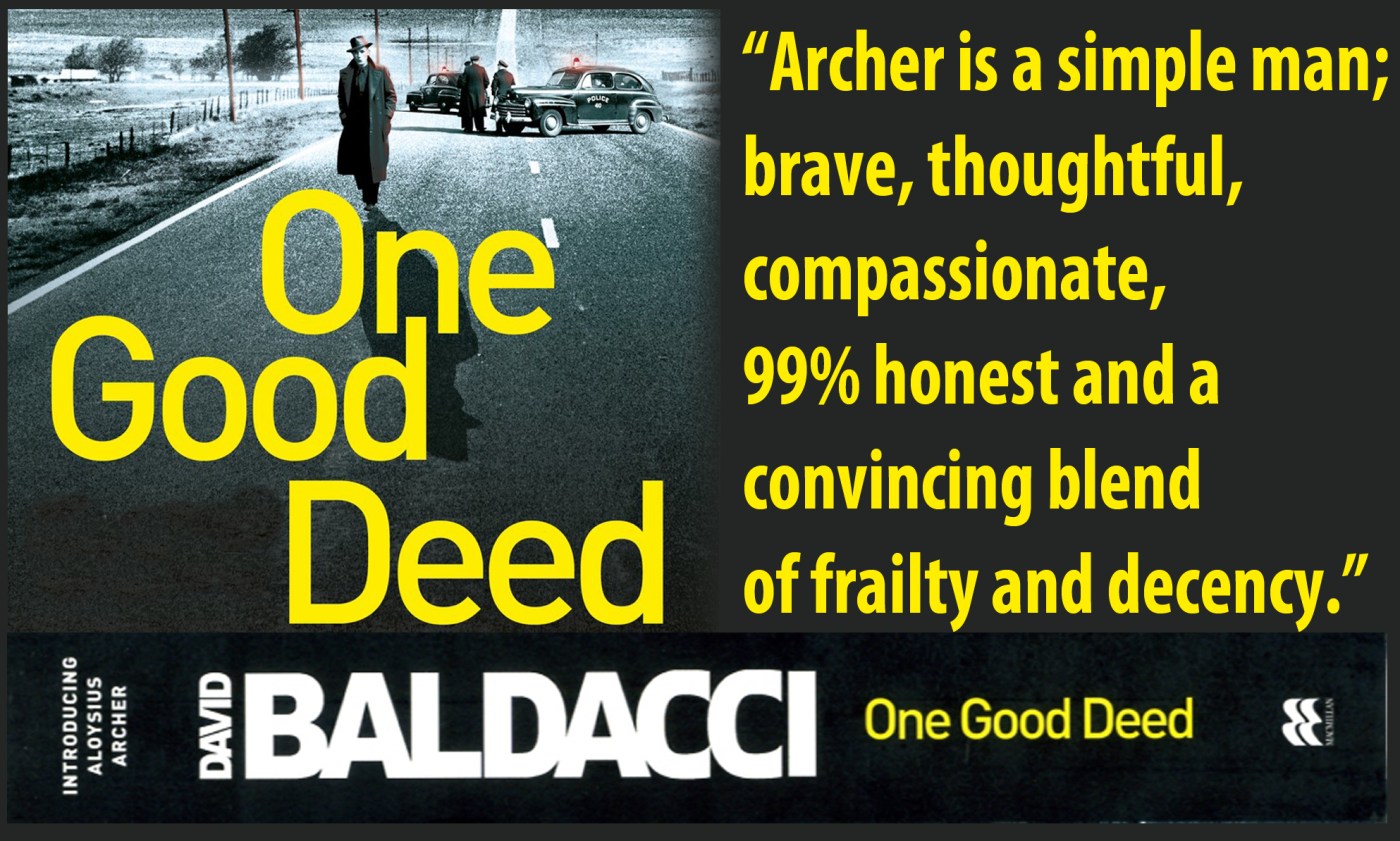
 mplausible as it may sound, given the body count – stabbings, shootings, people devoured by hogs – One Good Deed is a wonderfully warm and feel-good kind of novel. Archer is a simple man; brave, thoughtful, compassionate, 99% honest and a convincing blend of frailty and decency. Baldacci (right) is such a skilled storyteller that the pages spin by, and anyone who loves a crime novel where goodness prevails would be mad to miss this. Mr B also gives us a rather unusual romance – for 1949, at least. One Good Deed is published by Macmillan and is


 fullybooked2017