

Suspected war criminal Hannibal Strauss, a mercenary suspected of war crimes in Libya, Cambodia and elsewhere, is in custody near The Hague awaiting trial before the International *Criminal Court. The wheels of international war crimes justice grind extremely slowly, and as lawyers jostle for position, there is a terrorist outrage in the Netherlands capital. Gunmen open fire on a crowded square, the Grote Markt, killing not only individuals connected with the impending court case, but dozens of random civilians, too. One man involved in the Strauss case, Kon Frankowski, escapes and goes on the run.
*Factual note: the International Criminal Court (ICC) is separate and different from the International Court of Justice (ICJ). The ICJ is part of the United Nations, and investigates countries. The ICC investigates individuals, and is recognised by some – but not all – countries, a notable exception being Russia. Very few people have been convicted and jailed by the ICC, one being Charles Taylor, the former leader of Liberia. A third and unconnected organisation, the International Criminal Tribunal for the Former Yugoslavia, did convict and jail Radovan Karadžić and Ratko Mladić, while Slobodan Milošević died while his trial was in progress.
The mastermind behind the slaughter is an International terrorist known only as The Monk. His organisation has its roots in a pro-Tsarist resistance movement known as the Mladorossi. It has evolved over the decades, but remains a massive threat to international security.
Answering the call to investigate the Grote Markt massacre are Joe Dempsey, and agent with the (fictional) International Security Bureau, and his partner, criminal barrister Michael Devlin. They seem an unlikely pairing, to be honest. Dempsey is Special Forces trained, has killed many men in the course of his job, while Devlin is undoubtedly clever, but I’m not sure what his interlocutory skill brings to the table outside of the interview room. Hey ho, though, it’s a novel, so let’s run with it.
The reason why Frankowski is at the centre of this is that he was money-launderer-in-chief to Hannibal Strauss, and the Hungarian mercenary has entrusted Frankowski with a list of all Russian Mladorossi agents and how they are embedded across the world. This list – in the right/wrong – hands would almost certainly be the end for The Monk and his machinations. Joe Dempsey, however, has a rather delicate personal connection to Frankowski. Frankowski’s wife Maria is the former lover of Dempsey, who reluctantly ended the relationship because of the danger his work would bring to them if they became a family.
While Dempsey and Devlin are on the ground in the Netherlands, Agent Eden Grace – Dempsey’s ISB protégé, is handling things in America, and it is there that Maria Frankowski and her children have gone into hiding, as they have become an pawns in the violent chess game which seeks to find Kon Frankowski and the fatal list.
In all good spy thrillers, we must never take the author’s word that people are who we are told they are, and The Shadow Network is no exception.The Monk is hiding in plain sight, and neither we – nor Dempsey and Devlin – have a clue as to who he really is. This is a thoroughly entertaining thriller with fight scenes so real that just reading them may necessitate a visit to A & E with sympathetic wounds and trauma. It is published by Elliot and Thompson and will available on 15th February. Tony Kent, by the way, is that most unusual of pairings – a criminal barrister and heavyweight boxer. Cross him at your peril!


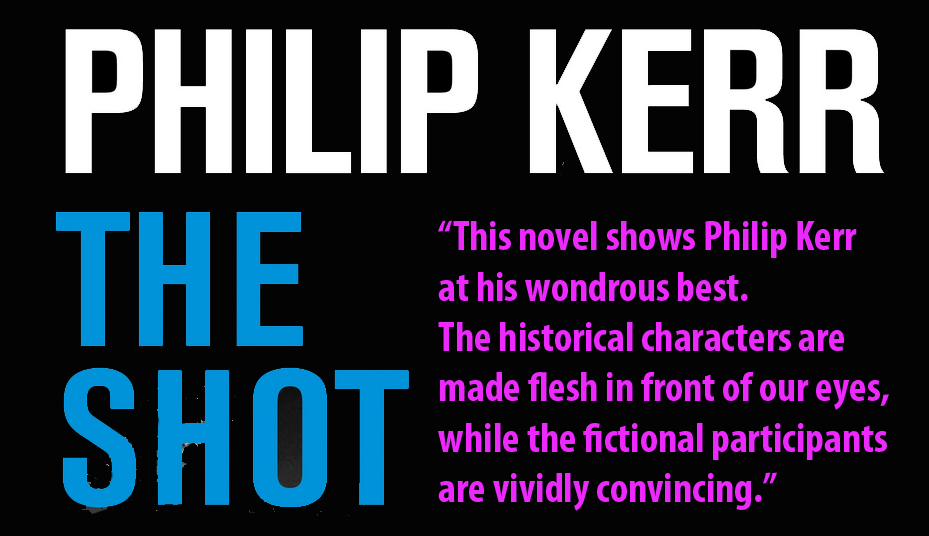
 Quercus has just republished The Shot, a 1999 novel by Kerr. We are in America and it is the late autumn of 1960. In the pop charts, The Drifters were singing Save The Last Dance For Me, and a youthful looking senator called John Fitzgerald Kennedy had just won the election to become the thirty-fifth President of The United States.
 As ever with a Philip Kerr novel, we are in a world populated by a mix of fictional characters and real-life figures. Among the latter are Jack Kennedy himself and the Mob boss Sam Giancana. Giancana hires Jefferson to assassinate Fidel Castro so that the revolution will collapse, and the mafioso can return to their old lucrative ways. Jefferson does his homework and seems all set to put a bullet in Castro’s head.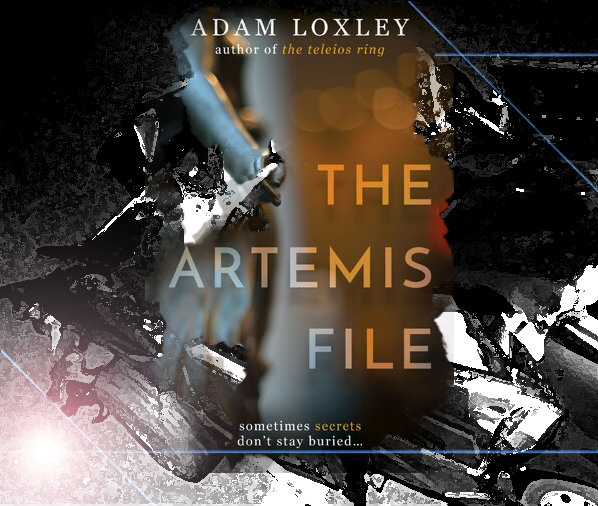

 t takes a very ingenious – not to say devious mind – to fashion a fiction plot which meshes together a whole bagful of disparate elements to make a satisfying whole that challenges the imagination but does not exceed it in possibility. Adam Loxley has done just that in his latest thriller The Artemis File. George Wiggins is Mr Ordinary. He lives in what would have been called, years ago, a bijou residence in the twee Kentish town of Tenterden. He is not Mr Stupid, however. He travels into ‘town’ each day to sit at his desk in Fleet Street where he composes the daily crossword for The Chronicle under his pseudonym Xerxes. Aficionados know that in reality, all that is left of the newspaper industry in Fleet Street are the buildings, and the use of the term to denote popular journalism, but we can forgive Loxley for having the good, old-fashioned Chronicle hanging on by the skin of its teeth when all its fellows have decamped to Wapping or soulless suburbs somewhere off a dual carriageway.
 When George has a rather startling experience in his local pub after a couple of pints of decent beer, the other elements of the story – MI5, the CIA, Russian agents, immaculately dressed but ruthless Whitehall civil servants and, most crucially, the most infamous unsolved incident of the late 20th century – are soon thrown into the mix. Such is George’s conformity, it is easily compromised, and he is blackmailed into writing a crossword, the answers to which are deeply significant to a very select group of individuals who sit at the centres of various spiders’ webs where they tug the strands which control the national security of the great powers.
 eorge Wiggins might have been easily duped and he has few means to fight back, but he recruits an old chum from the Chronicle whose knowledge of the historical events of the 1990s proves key to unraveling the mystery of who wanted the crossword published – and why. While the pair rescue a dusty file from an obscure repository and pore over its contents, elsewhere a much more visceral struggle is playing out. A ruthless MI5 contract ‘fixer’ called Craven is engaged on a courtly dance of death with a former CIA agent, current American operatives and their Russian counterparts.


 fullybooked2017