Search

fullybooked2017

Tag

Christmas

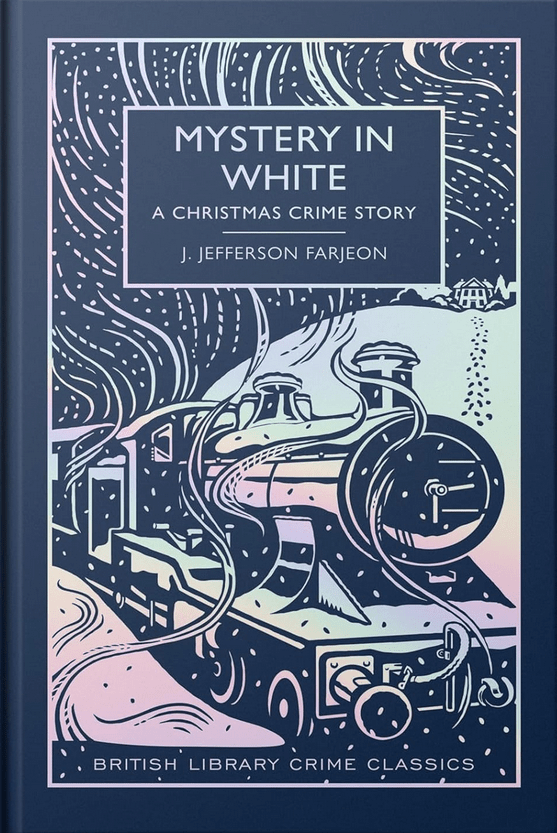
MYSTERY IN WHITE . . . Between the covers

Largely forgotten now, Joseph Jefferson Farjeon was a dramatist and novelist who died in 1955. His reputation has perhaps been eclipsed by that of his sister Eleanor. Coming at the tail end of The Golden Age, Mystery In White was published in 1937. Another book which begins in the snow, The Nine Tailors, came out three years earlier, but that is where the resemblance ends. Wimsey and Bunter’s misadventure in a snow-filled Fenland ditch moves on quite quickly, and covers a much longer period of time.

Here, the 11.37 train from Euston ends up stationary, the line blocked by snow. In one compartment are a variety hall dancer bound for Manchester, a middle class brother and sister named David and Lydia, a rather gauche clerk called Thomson, an old colonial hand referred to only as ‘the bore’, and an older man, Edward Maltby, who claims to be a psychic researcher. He is heading for Naseby, where he hopes to commune with the spirit of King Charles I. Not that it matters, but examining the route of the old LMS line, we might assume that the action takes place somewhere in Bedfordshire.

The beleaguered train guard can offer little hope of quick deliverance for the stranded passengers, and Maltby takes – literally – a bold step, and jumps down from the carriage, stating he will find his way to the nearest village. The others, after a while and quite implausibly, decide to follow him, and after several misadventures in the drifts, arrive at an isolated house, with an unlocked door. Inside is a puzzle, inside a mystery, inside an enigma. A kettle is merrily boiling away on the stove, as if in anticipation of a brew of tea, but the house is, as far as the group can see, unoccupied.

The escapees from the train are busy dusting themselves down and thawing out, when Edward Maltby arrives, in the company of a rough stranger, who soon leaves. Then, the bore from the train, named Hopkins, also arrives and informs the group that in the next compartment* of the carriage, a man has been found dead.

*Back in the day, railway carriages consisted of a number of separate compartments, designed to seat perhaps seven or eight people. Along the right (or left) side of the carriage ran a corridor, and each compartment had a door which opened into it.

The plot develops at pace. The loutish cockney, Smith, who first arrived with Maltby has left, returned and then left again after provoking a one-sided fight with the bore, who we now now is called Hopkins. Young Thomson was sent to bed with a high temperature, but after alarming dreams, got up in a daze, but has now been brought downstairs. The dancer, Lucie Noyes, had injured her foot in a fall, and was also packed off to bed to rest. She has disturbing thoughts about the bed, however, as it seems to have a certain ‘presence’ which is not altogether pleasant, and she took is now downstairs. Meanwhile Maltby has assumed the role of a kind of Magus, and is making enigmatic statements about the psychic dangers of the building. On a more practical note, a letter was discovered which partly explains the open door and tea being laid. A servant had been looking after the house, and was expecting visitors, but of the retainer and the guests there is no sign.

This changes when David decides to go out into the night and look around. Eventually, he finds a young woman wandering about in the snow. She tells him she is Nora Strange, and that she and her elderly father were trying to drive to Valley House. The car became stuck in a drift. David quickly surmises that they were heading for ‘the house’ itself, and the trio make their way back there.

The human story behind the seemingly inexplicable mystery is revealed in a kind of seance in the small hours of Christmas Day. It is not a seance in the accepted sense,as Maltby later explains:

“We hatch ghosts in our own minds out of the logic that is beyond us. Logic, through science, may one day recapture the sounds of the Battle of Hastings, but this will not mean that the battle is still going on. Believe me, Mr. Hopkins, there are quite enough astounding, uncanny, mind-shattering experiences within the boundaries of sheer logic to eliminate the necessity of ghosts for our explanations or our thrills. We are only touching the fringe of these things. We have only touched the fringe of them in this house.”

This is a book of huge charm. The style and dialogue are, inevitably, of their time, but they only add to the magic combination of snow, mystery, Christmas, and, dare I say it, happier times. The novel was republished as a British Library Crime Classic in October of this year.
WHAT CHILD IS THIS? … Between the covers

wcit spine052 copy

Screen Shot 2023-11-30 at 19.45.54In 2021 I reviewed an earlier contribution to the Sherlockian canon by Bonnie MacBird (left) – The Three Locks – and you can read what I thought by clicking the link. Her latest contribution is unashamedly aimed at the Christmas market, but it is worth reading. It begins with that reliable staple –  the box of hitherto unseen papers and notebooks written by John Watson MD. The cynic in me thinks that the good doctor would have had no time to help his great friend with his investigations, as his every waking hour would have been consumed in filling boxes with notebooks, in the expectation that they would be discovered in an auction – or someone’s attic – a century later.

Be that as it may, we are in London in December 1890, and it is snowing (obviously). Watson persuades Holmes to accompany him for lunch, but after they have consumed their roast beef sandwiches and cider, they are forced to intervene when a masked man attempts to abduct a child from his mother. Holmes pursues the villain, while Watson tends to the woman and her frightened child.

Watson eventually catches up with what is happening, while Holmes, perspicacious as ever, soon realises that  the attempted kidnap is related to the boy’s own history as the object of a transaction by an adoption agency. The search for the boy’s real father occupies most of the narrative. I have mentioned before the significant inbuilt challenge facing modern recreators of Holmes – that the majority of the original tales were very short stories, thus posing the problem of how to fill the three hundred pages or so of a modern novel. MacBird opts for the eminently reasonable solution of having a parallel mystery – that of a wealthy (but not particularly sensitive) man of property whose youngest son – something of an aesthete – has gone missing, along with his manservant. Holmes, with the help of a redoubtable Cockney reprobate called Hephzibah, locates the manservant in an expensive apartment, where he has been seen with an alluring young woman. Holmes solves this particular conundrum in a rather 2023 fashion and . . . well, perhaps you can guess, but I won’t spoil the fun.

The illustrations by Frank Cho are delightful, and the whole book is beautifully produced, with elaborate illuminated capital letters at the beginning of each chapter. Some might argue that drawings ask that readers bypass their own visual impressions suggested by the text, but I think this is specious. Generations of readers of the original stories will have had their imaginations shaped by external sources – for example the wonderful Strand Magazine drawings of Sidney Paget – while, for me, the face of Holmes will never be anything other than that of Jeremy Brett.

Some unkind people will moan and roll their eyes at what they consider yet another milking of the Holmes legacy. “Isn’t the teat already dry,” they ask? No, it is not. Chandler’s Philip Marlowe has engendered many imitators, and some of them are very good, but Arthur Conan Doyle created a legend. ACD was mortal, and lived to a decent age, but he bequeathed a character that is for all time. As long as there are writers as skilful and observant as Bonnie MacBird to keep the Holmes flame alight, I will be warming myself in its glow. What Child Is This is published by Harper Collins and is available now.

MURDER AT HOLLY HOUSE . . . Between the covers

MAHHSPINE

Screen Shot 2023-11-26 at 18.28.51The novel is subtitled The Memoirs of Inspector Frank Grasby, and Denzil Meyrick (left) employs the reliable plot-opener of someone in our time inheriting a wooden crate containing the papers of a long-dead police officer, and exploring what was committed to paper. Will crime writers in a hundred years hence have their characters discovering a forgotten folder in the corner of someone’s hard drive? I doubt it – it won’t be anywhere near as much fun.
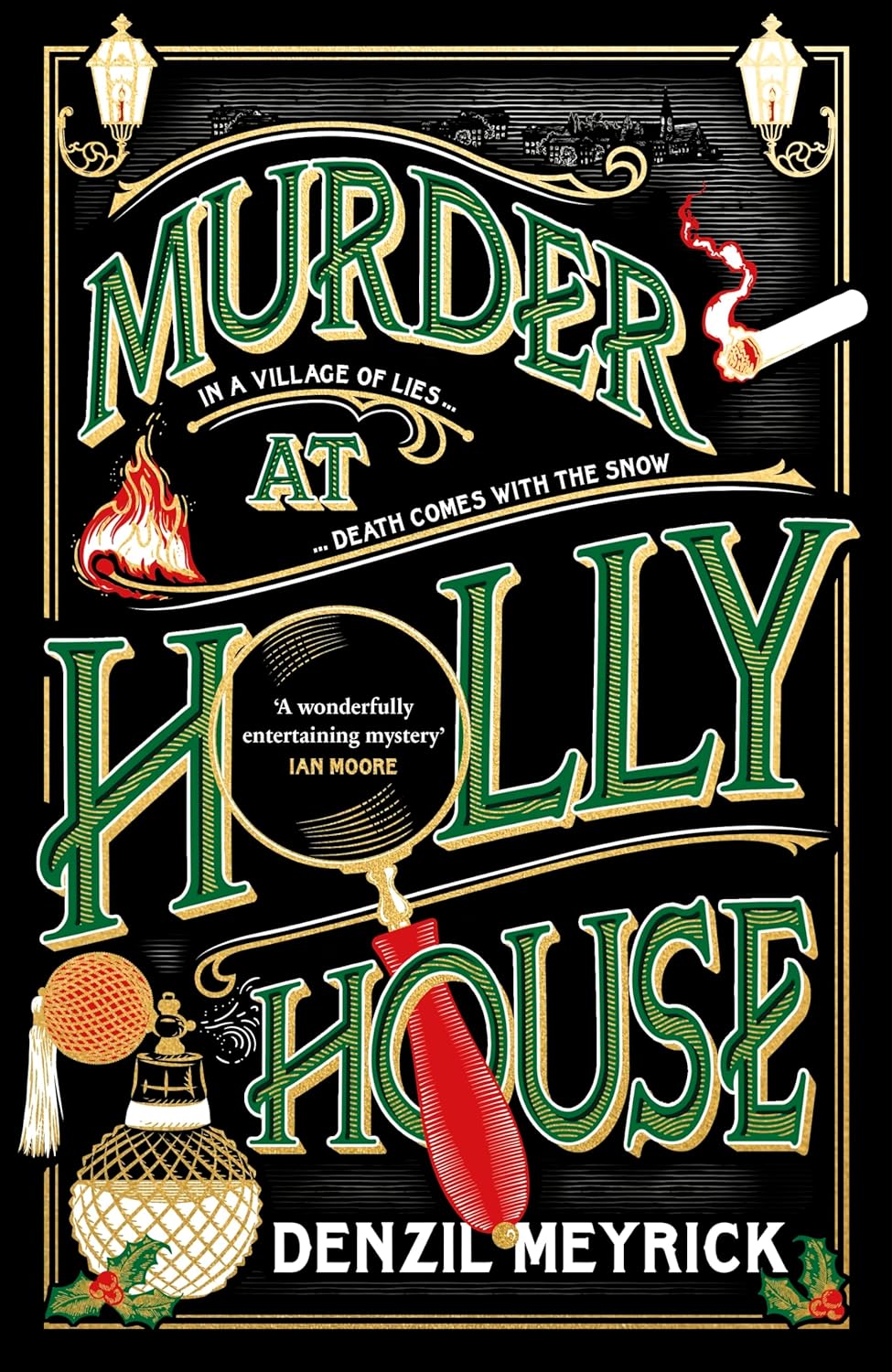
We are in December 1952, although the book starts with an intriguing police report from three years earlier, the significance of which becomes apparent later. Frank Grasby is in his late thirties, saw one or two bad things during his army service, but is now with Yorkshire police, based in York. He is a good copper, albeit with a weakness for the horses, but has made one or two recent blunders for which his punishment is to be sent of the remote village of Elderby, perched up on the North Yorkshire moors. Ostensibly he is there to investigate some farm thefts, but the Chief Constable just wants him out of harm’s way – and the public eye – for a month or two.

Meyrick unashamedly borrows a few ideas from elsewhere. Rather like Lord Peter Wimsey’s car getting stuck in the snow at the beginning of The Nine Tailors, Grasby’s battered police Austin A30 gives up the ghost just short of the village as the snow swirls down, and he has to make the rest of the journey on foot. In Elderby he finds, in no particular order:

♣ A pub called The Hanging Beggar.
♣ Police Sergeant Bleakly – in charge of the local nick, but afflicted with narcolepsy due to his grueling time with the Chindits in Burma.
♣ A delightful American criminology student called Daisy Dean.
♣ A bumptious nouveau-riche ‘Lord of the Manor’ called Damnish (a former tradesman from Leeds, ennobled for his support of the government).
♣ A strange woman called Mrs Gaunt, with whom Grasby and Daisy lodge. Mrs G has a pet raven that sits on her shoulder, and seems to have a mysterious connection to Grasby’s father, an elderly clergyman.

The first corpse enters neither stage right nor left, but rather stage above, when Grasby inadvertently solves Lord Damnish’s smoky fireplace by dislodging an obstruction – a recently deceased male corpse. Next, the American husband of the local GP is found dead in the churchyard. Chuck Starr was a journalist embedded with the Allied forces on D-Day, was appalled by what he saw, and has been writing an exposé on military incompetence. His manuscript – yes, you guessed it – has gone missing.

The more Grasby tugs and frets away at a series of loose ends, the more the fabric of Elderby – as a jolly bucolic paradise inhabited by a few harmless eccentrics – begins to unravel and our man finds himself in the middle of a potentially catastrophic conspiracy.

Some crime novels lead us to thinking dark thoughts about the human condition, while others delight us with their ingenuity, humour and turns of phrase. This is definitely in the latter category but, amidst the entertainment, Meyrick reminds us that war leaves mental scars that can be much slower to heal than their physical counterparts. He takes the threads of familiar and comfortable crime fiction tropes, and weaves a Christmas mystery in a snowy village, but with the shadows of uneasy post-war international alliances darkening the fabric. Murder at Holly House is beautifully written, full of sharp humour, but it is also a revealing portrait of the political tensions rife in 1950s Britain. It is published by Bantam and is available now.
MAHH cover

Blog at WordPress.com.

Up ↑