Search

fullybooked2017

Tag

Chris Nickson

A RAGE OF SOULS . . . Between the covers

This begins as one of the most baffling and impenetrable of Simon Westow’s cases. We are in Leeds, 1826. He solves a case of fraud, the fraudster is sentence to hang, but reprieved. He then returns with his wife to shadow the man he originally tried to defraud. The man, who calls himself Fox, seems connected to his victim, a Mr Barton, via Barton’s wayward son, Andrew. Westow, like Ulysses in Tennyson’s great poem, no longer has “that strength which in old days Moved earth and heaven,” due to a serious wound sustained in a previous case, but his eyes, ears – and legs on the street are provided by his lethal young assistants Jane and Sally.

One of Nickson’s many skills as a writer is to point out the dramatic contrast between the industrial stink of Leeds and the uncorrupted countryside not many miles outside the city. Andrew Barton goes missing, so Jane and the boy’s anxious father make the journey in a chaise towards Tadcaster. Jane investigates the ancient church of St Mary, Lead, solitary and empty in a lonely field. Near the church runs the Cock Beck, which was reported to have run red with blood during the nearby Battle of Towton in 1461, and as she crosses the stream , she makes a terrible discovery.

Quietly, Nickson references the timeless joy of reading. Jane, once an illiterate street urchin, has been taught to read by Mrs Shields, the old lady who has become the mother she never had. Now, Jane spends her spare hours immersed in the novels of Sir Walter Scott and James Fenimore Cooper, borrowed from the circulating library. The printed words take Jane away from the perils and drudgery of her own existence to a world of daring, adventure and hope. In his own way. Nickson does precisely the same thing.

There is a deep sense of poetry in the book, not just in the words, but in the juxtaposition of images. The book begins with Jane witnessing the result of a horrifying industrial accident.  A young girl is being roughly carried to the surgeon, her leg mangled beyond repair. This haunts Jane throughout the book, but then, near the end, there is a kind of redemption. One of the regular characters who ekes out a living on Westow’s streets is Davy, the blind fiddler. Jane’s trauma is redeemed:

“Up by the market cross, Davy Cassidy was playing a sprightly tune that ended as she drew close. He gazed around with his sightless eyes and a girl appeared whispering a word into his ear. He lifted his bow and began to play again, low, mournful. Then the girl stepped forward and began to sing. Jane knew her face. She’d lived with it for months. She’d seen it contorted with pain as the girl was carried from the mill, her leg in shreds. Then when it returned night after night in her dreams. Now she was here, one-legged, supported by a crutch, a voice as unearthly sweet as a visitation as she sang about a girl who moved through the fair. She stood transfixed as a disbelief fragmented and disappeared. The pain she’d heard in the girl that day in February had become beauty. The small crowd was silent, caught in the words, the singing while the world receded around them. The last note ended, a stunned silence, then applause and people pushing forward to put coins into the hat on the ground.”

Eventually, by a mixture of judgment perseverance and good fortune, the mysterious Fox is run to ground in a bloodthirsty finale. A Rage of Souls is Chris Nickson at his best – complex, compelling and, above all. compassionate. It will be published by Severn House on 7th October. You can take a look at earlier Simon Westow books here.

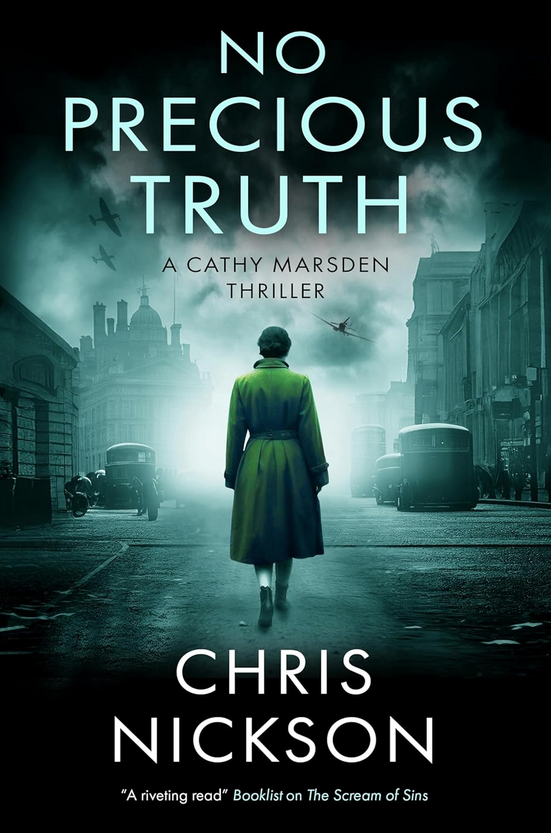
NO PRECIOUS TRUTH . . . Between the covers

In my reading experience, there is no living writer so closely associated with one place than Chris Nickson. Phil Rickson had his Welsh Marches, Robert B Parker had his Boston, Colin Dexter had his Oxford and Christopher Fowler had his (peculiar) London. Sadly, Time has borne those four sons away, but Nickson’s Leeds is now rediscovered in the first of a new series.

It is February 1941. Cathy Marsden is a Sergeant in the Leeds police, but has been seconded to the Special Investigations Bureau, a unit recently set up to investigate black marketeers and other criminals looking to make money out of the war. She is astonished when her older brother, Daniel, turns up at the office. As far as she was aware he was humdrum civil servant in London, pushing pens and folders of documents from one desk to another. Like her, however, he has been seconded, but to another top secret intelligence service, and he is in Leeds to track down a dangerous Dutch double agent called Jan Minuit.

Although I have read and enjoyed them all, Nickson’s Leeds novels tend to have a similar plot, which is basically a manhunt. This enables the author’s creations from Simon Westow to Tom Harper (who gets a brief mention here) to pound the streets of the city in search of a villain. The technical aspect of this is not complicated, as it enables Nickson to put his unparalleled knowledge of the topography to good use. He is clearly in tune with a kind of of geopsychology, which enables readers to follow the footsteps of his characters across the decades, so that thoroughfares like Briggate, The Headrow and Kirkgate become as familiar as our own back yards.

If Minuit is bent on sabotage, Leeds has two prime targets for an agent of The Third Reich. One is pretty much in the open. The Kirkstall iron foundry has been producing components for military vehicles since WW1 and is hard to disguise. The Avro factory at Yeadon, however has been covered in camouflage and disguised – from the air – as open country. This ‘shadow factory’ is working day and night to produce Lancaster bombers, as well as the less celebrated (but equally vital) Anson.

Nickson has a well-established style. It is propulsive. Short sentences. A sense of urgency. Genuine narrative drive.

“Cathy turned off the ring road and started up Wheatwood Lane.The daylight was lasting longer, barely a stretch of dusk on the horizon. Ahead of her, the hill rose steeply, fields on either side, farmland.No chance to go more than a few yards.The road was filled with police cars, a pair of ambulances and the black coroner’s van.,”

“Monday dawned sour with threatening clouds, the colour of old bruises. The air was thick and damp. Yesterday’s promise of spring had vanished like a magician’s illusion. Instead, the rain felt that it like might begin at any time. At least it would deter the Luftwaffe.”

There is a thrilling conclusion to the team’s pursuit of Jan Minuit, and it is Cathy’s resilience and strength which eventually brings the spy/saboteur to his knees. Chris Nickson’s skill lies in his ability to convince us that we are standing beside his characters and sharing their world. In this case, it is Cathy Marsden’s wartime Leeds, with its rationing and privation, its fear that clear nighttime skies will be a gift to the Luftwaffe, and the ever present fear in the hearts of local women that their father, husband, brother, son or boyfriend will be the next name on the mounting list of casualties.

Nickson also reminds us that the horrors of WW1 cast a long shadow. Cathy’s father, once a strapping Yorkshire lad, was gassed in the trenches, and over thirty years later is a wreckage of a man, struggling with the essentials of existence – such as breathing. No Precious Truth will be published by Severn House on 1st April.

THEM WITHOUT PAIN . . . Between the covers

TWP HEADER

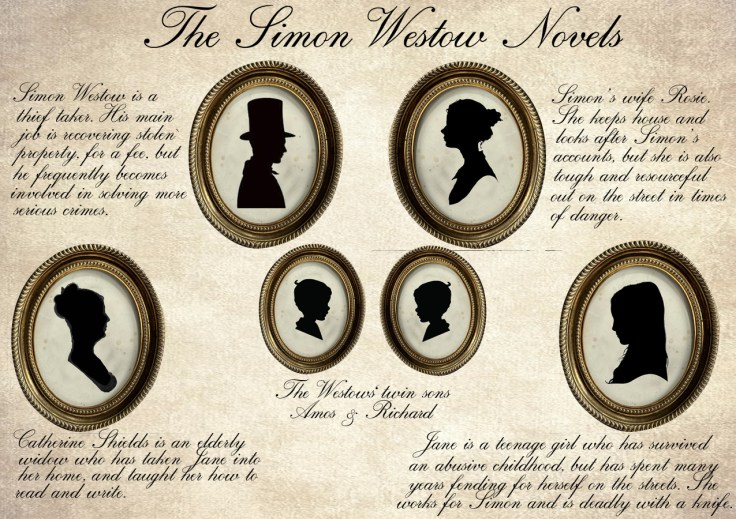
Leeds. The early early summer of 1825. Simon Westow is a Thief-taker, a man who recovers stolen goods for a percentage of their value. He has no legal powers except his own knowledge of the city and a keen intelligence. When he encounters criminals, it is up to the city Constable and the magistrates to apply the law. Followers of this series will be familiar with the dramatis personnae, but for new readers, we have:

Simon Westow, Thief-taker
Rosie, his wife
Richard and Amos, their twin sons
Jane Truscott, former assistant to Westow. Very streetwise and deadly with a knife
Catherine Shields, an elderly widow who has provided Jane with a home
Sally – another child of the streets, and Jane’s replacement

Westow is summoned to the house of Sir Robert Foley, a wealthy man whose man-servant has absconded with two valuable silver cups. Foley wants them returned. When the manservant, Thomas Kendall, is found murdered in a secret room of an old city property just about to be demolished, Westow is told, by a Mr Armistead, that the room was once the workshop of Arthur Mangey, a silversmith, who was executed over a century earlier for the crime of Coin Clipping – snipping the edges off silver coins and then re-using the silver.

When Armistead himself is found murdered, Westow finds himself chasing shadows, and unable to make the connection between the ancient misdeeds of Arthur Mangey and persons unknown who are deeply involved in all-too-recent criminality. There is a seemingly unconnected story line in the book, but old Nickson hands know that it will, eventually, merge with the main plot. A disabled Waterloo veteran, Dobson, has gained a mysterious companion known only as John, but when brutalised corpses begin to appear, John becomes the prime suspect. The corpses have been flayed and brutalised almost beyond recognition. Westow, still doggedly determined to find the missing silver cups is increasingly reliant on the quicksilver street-smarts of Sally, and the old head on young shoulders of Jane, who had hoped for a life away from the streets, but has been drawn back into the dangerous game by her determination to avenge the death of Armistead.

A recurrent theme of Nickson’s Leeds novels, both in these Simon Westow tales, and the Tom Harper stories, set eight decades later, is that of the search. Both Westow and Harper frequently become involved in a search for a key suspect, often someone from ‘out of town’. It is a very simple literary device, but a very effective one, as it provides a platform for Nickson to use his unrivalled knowledge of the city as it once was, its highways, byways, grand houses and insanitary tenements. As we follow Weston’s search for a ruthless killer, the modern streets of Leeds that many readers know are stripped away to reveal the palimpsest of the buildings that once stood there and the people who inhabited them.

Another essential feature of the books is that his heroes don’t inhabit a timeless world, where they are perpetually in their early thirties, strong and vigorous.  Tom Harper aged  as the series went on, but he was allowed a comfortable old age and peaceful death. Here, Simon Westow is shaken by the recognition that, like Tennyson Ulysses, the years have taken their toll:

“ Tho’ much is taken, much abides; and tho’
We are not now that strength which in old days
Moved earth and heaven, that which we are, we are;
One equal temper of heroic hearts,
Made weak by time and fate, but strong in will
To strive, to seek, to find, and not to yield.”

He is aware that his reflexes are slower, the antennae that once sensed danger and threat are less sensitive, and he is ever more conscious of his own mortality, and his need of people like Sally and Jane to watch his back.

The novel boils down to three pursuits. Simon Westow hunts the man who stole Sir Robert’s cups, Sally wants her knife deep inside the man, known only as John, who murdered her fellow urchin Harold, while Jane vows to kill the man who killed the amiable and blameless Armistead.

Screen Shot 2024-09-16 at 10.56.08Chris Nickson never sugar-coats history, and makes us well aware that modern Leeds, with its universities, its international sporting venues and museums, was built on the blood sweat and tears of millions of ordinary people who grew up, toiled, loved lived and died under the smoky pall of its foundry furnaces, and had the deafening percussion of industrial hammers forever ringing in their ears. Jane, Sally and Simon-at a cost-each get their man in this excellent historical thriller, which is published by Severn House and is available now. For reviews of previous Simon Westow stories, click the author image on the left.

THE SCREAM OF SINS . . . Between the covers

TSOS header

Leeds, Autumn 1824. Simon Westow is engaged by a retired military man, Captain Holcomb, to recover some papers which have been stolen from his house. They concern the career of his father, a notoriously hard-line magistrate. Newcomers to the series may find this graphic helpful to establish who is who.

TSWN graphic

Westow takes the job, but is concerned when Holcomb refuses to reveal what might be in the missing papers, thus preventing the thief taker from narrowing down a list of suspects. As is often the case in this excellent series, what begins as case of simple theft turns much darker when murder raises its viler and misshapen head.

Jane, Westow’s sometime assistant, has taken a step back from the work as, under the kind attention of Catherine Shields, she is learning that there is a world outside the dark streets she used to inhabit. The lure of books and education is markedly different from the law of the knife, and a life spent lurking in shadowy alleys. Nevertheless, she agrees to come back to help Westow with his latest case, which has turned sour. When Westow, suspecting there is more to the case than meets the eye, refuses to continue looking for the missing documents, Holcomb threatens to sue him and ruin his reputation.

More or less by accident, Westow and Jane have uncovered a dreadful series of crimes which may connected to the Holcomb documents. Young girls – and it seems the  younger the better – have been abducted for the pleasure of certain wealth and powerful ‘gentlemen’. Jane, galvanised by her own bitter memories of being sexually abused by her father, meets another youngster from the streets, Sally.

Sally is a mirror image of Jane in her younger days – street-smart, unafraid of violence, and an expert at wielding a viciously honed knife. Jane hesitates in recruiting the child to a way of life she wishes to move away from, but the men involved in the child abuse must be brought down, and Sally’s apparent innocence is a powerful weapon.

As ever in Nickson’s Leeds novels, whether they be these, the Victorian era Tom Harper stories, or those set in the 1940s and 50s, the city itself is a potent force in the narrative. The contrast between the grinding poverty of the underclass – barely surviving in their insanitary slums – and the growing wealth of the merchants and factory owners could not be starker. The paradox is not just a human one. The River Aire is the artery which keeps the city’s heart beating, but as it flows past the mills and factories, it is coloured by the poison they produce. Yet, at Kirkstall, where it passes the stately ruins of the Abbey it is still – at least in the 1820s – a pure stream home to trout and grayling. Just an hour’s walk from Westow’s beat, there are moors, larks high above, and air unsullied by sulphur and the smoke of foundry furnaces.

The scourge of paedophilia is not something regularly used as subject matter in crime fiction, perhaps because it is – and this is my personal view – if not the worst of all crimes, then at least as bad as murder.  Yes, the victims that survive may still live and breathe, but their innocence has been ripped away and, in its place, has been implanted a mental and spiritual tumour for which there is no treatment. Two little girls are rescued by Westow, Jane and Sally and are restored to their parents, but what living nightmares await them in the years to come we will never know.

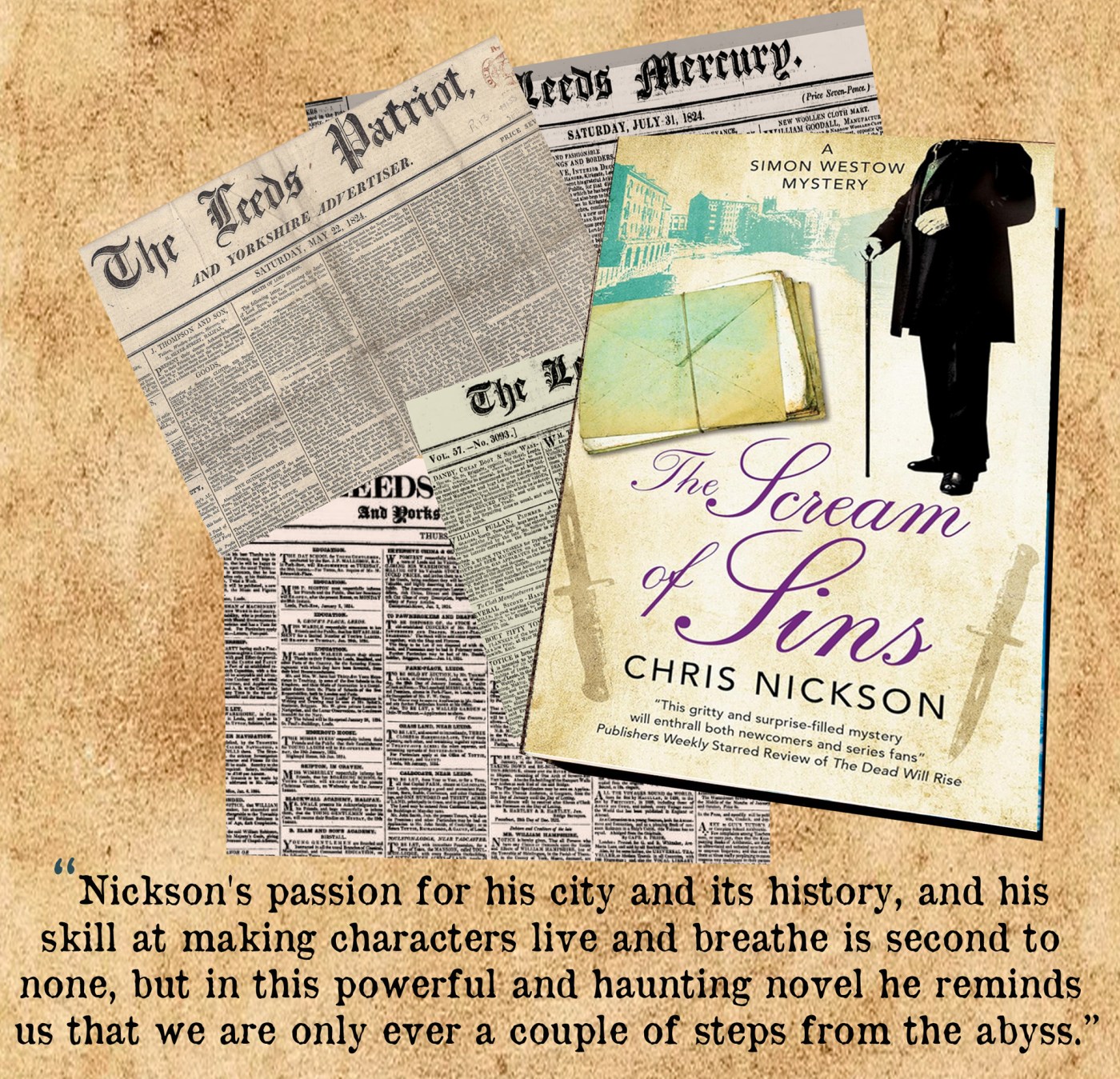
I have come to admire Nickson’s passion for his city and its history, and his skill at making characters live and breathe is second to none, but in this powerful and haunting novel he reminds us that we are only ever a couple of steps from the abyss. The Scream of Sins will be published by Severn House on 5th March.

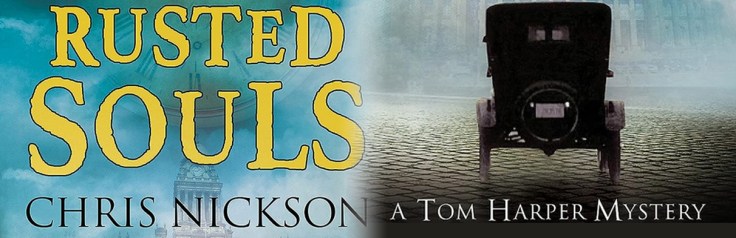
RUSTED SOULS . . . Between the covers

RS HEADER

First sixLeeds, March 1920. Tom Harper is Chief Constable of the City force and, with just six weeks until his retirement, he is dearly hoping for a quiet ride home for the final furlong of what has been a long and distinguished career. His hopes are dashed, however, when he is summoned to the office of Alderman Ernest Thompson, the combative, blustering – but very powerful – leader of the City Council. Thompson has one last task for Harper, and it is a very delicate one. The politician has fallen a trap that is all too familiar to many elderly men of influence down the years. He has, shall we say, been indiscreet with a beautiful but much younger woman, Charlotte Radcliffe. Letters that he foolishly wrote to her have “gone missing” and now he has an anonymous note demanding money – or else his reputation will be ruined. He wants Harper to solve the case, but keep everything completely off the record. Grim-faced, Harper has little choice but to agree. It is due to Thompson’s support and encouragement that he is ending his career as Chief Constable, with a comfortable pension and an untarnished reputation. He chooses a small group of trusted colleagues, swears them to secrecy, and sets about the investigation.
He soon has other things to worry about. A quartet of young armed men robs a city centre jewellers, terrifying the staff by firing a shot into the ceiling. They strike again, but this time with fatal consequences. A bystander tries to intervene, and is shot dead for his pains. Many readers will have been following this excellent series for some time, and will know that tragedy has struck the Harper family. Tom’s wife Annabelle has what we know now as dementia, and requires constant care. Their daughter Mary is a widow. Her husband Len is one of the 72000 men who fought and died on the Somme, but have no known grave, and no memorial excep tfor a name on the Thiepval Memorial to The Missing.. Unlike many widows, however, she has been able to rebuild her life, and now runs a successful secretarial agency. Leeds, however, like so many  communities, is no place fit for heroes:

“‘Times are hard.’
“I know,” Harper agreed.
It was there in the bleak faces of the men, the worn-down looks of their wives, the hunger that kept the children thin. The wounded ex-servicemen reduced to begging on the streets. Things hadn’t changed much from when he was young. Britain had won the war but forgotten its own people.”

Last five

Nickson’s descriptions of his beloved Leeds are always powerful, but here he describes a city – like many others – reeling from a double blow. As if the carnage of the Great War were not enough, the Gods had another spiteful trick up their sleeves in the shape of Spanish Influenza, which killed 228000 people across the country. Many people are still wearing gauze masks in an attempt to ward off infection.

The hunt for the jewel robbers and Ernest Jackson’s letters continues almost to the end of the book and, as ever, Nickson tells a damn good crime story; for me however, the focus had long since shifted elsewhere. This book is all about Tom and Annabelle Harper. Weather-wise, spring is definitely in the air, as bushes and trees come back to life after the bareness of winter, but there is a distinctly autumnal air about what is happening on the page. Harper is, like Tennyson’s Ulysses, not the man he was.

We are not now that strength which in old days
Moved earth and heaven, that which we are, we are;
One equal temper of heroic hearts,
Made weak by time and fate, but strong in will.

As he tries to help at the scene of a crime, he reflects:

There was nothing he could do to help here; he was just another old man cluttering up the pavement and stopping the inspector from doing his job.”

As for Annabelle, the lovely, brave and vibrant woman of the earlier books, little is left:

The memories would remain. She’d have them too, but they were tucked away in pockets that were gradually being sewn up. All her past was being stolen from her. And he couldn’t stop the theft.”

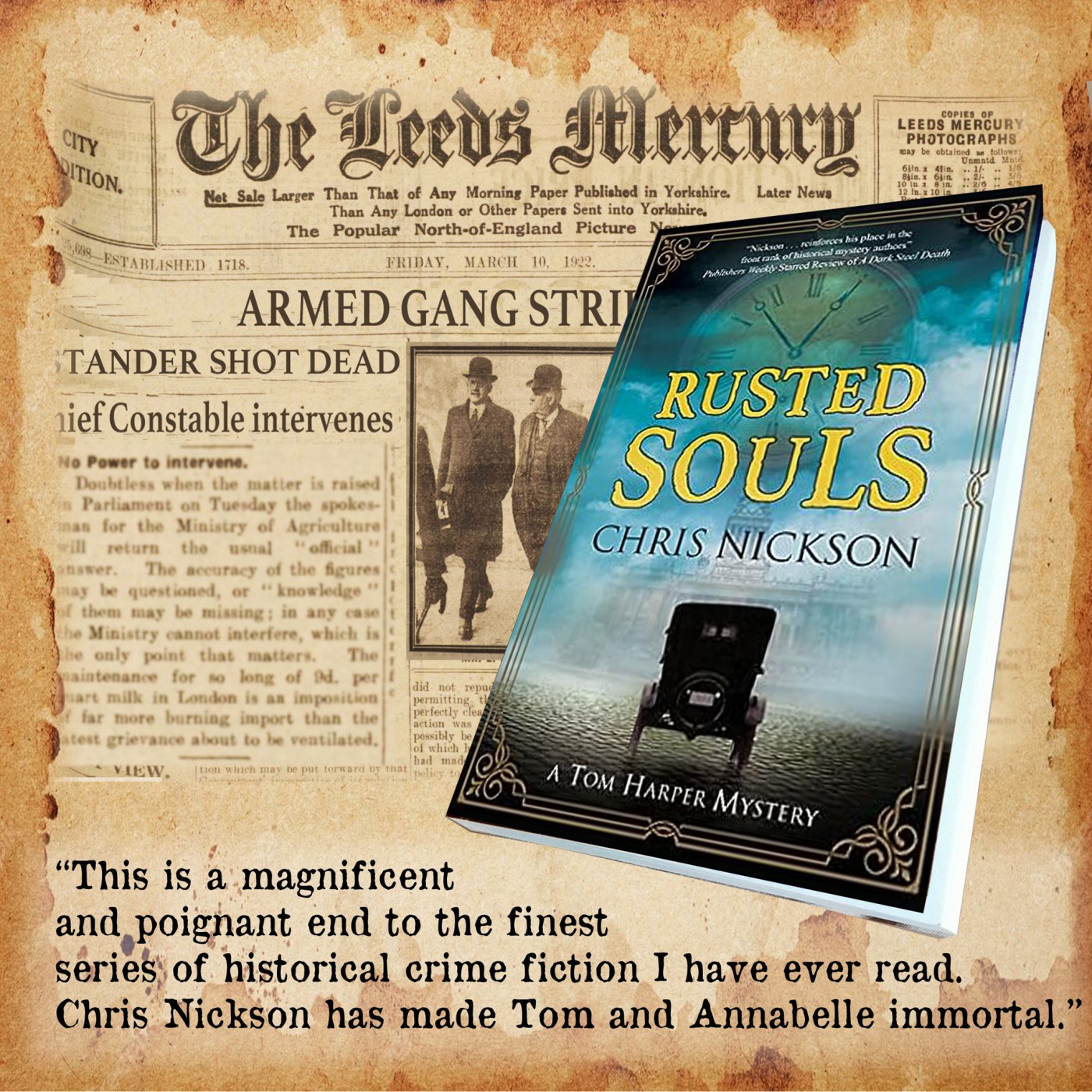
This is a magnificent and poignant end to the finest series of historical crime fiction I have ever read. It is published by Severn House and will be available on 5th September. For more about the Tom Harper novels, click this link.


THE DEAD WILL RISE . . . Between the covers

TDWR header

Chris Nickson is a former music journalist, and has rubbed shoulders with the Great and The Good across the history of rock music, but in these latter days he has earned a considerable reputation as a historical novelist. His books are mostly centred on Leeds, and they cover different historical periods from the 1730s to the 1950s. His latest book features Georgian thief-taker Simon Westow. Back then, there was no organised police force; the only legal officials were parish constables, who tended to be elderly, infirm and incompetent. Westow is more like the 20th century concept of a Private Eye; he recovers stolen property and catches criminals – for a fee.

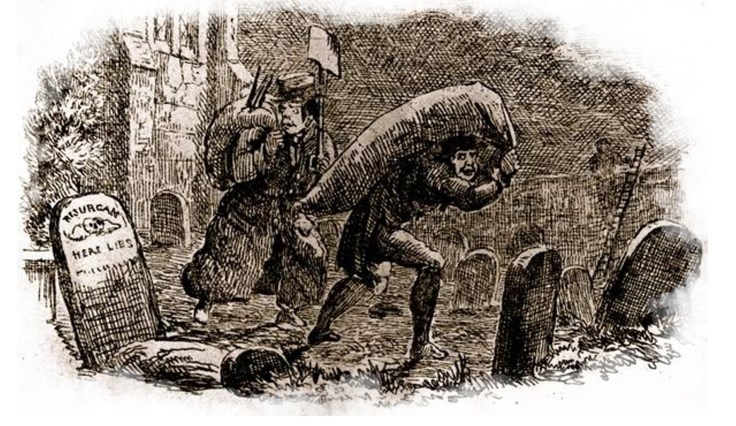
Here, he has an unusual assignment; Local factory boss Joseph Clark asks him to find the men who stole the buried corpse of Gwendolyn Jordan, the daughter of Harmony Jordan, one of his employees. The crime of body snatching is unique in that it involved acts of criminality carried out in the name – some might argue – of a greater good, that being anatomical and medical research. Westow wastes no time on moral philosophy, and with his assistant Jane he sets out to find the Resurrection Men.
RESMEN

Jane is, for me, the most compelling character in any of Nickson’s novels. Raped by her father, disowned by her mother, the teenager has made her living on the streets. Not in the conventional sense by selling her body, but by employing preternatural skills of awareness of danger, cunning and speed of thought; most fearsome of all is the fact that she will use her knife without a moment of compassion or hesitation. She is a stone-cold killer, as many men – now dead and buried – would testify, were they still able to.

Westow’s case load becomes more complex when he and Jane are summoned to the elegant mansion of the infamous Mrs Parker – infamous because she is renowned in Leeds for  marrying a series of wealthy men, who then die, leaving her with an ever expanding fortune. Just for once, she has been bested. A lover has swindled her out of £50 – over £5000 in today’s money – and she wants recompense.

When the usually invulnerable Jane is bested by one of the thugs involved in the corpse trade, and is hurled from a bridge, she is lucky to escape with cuts and bruises. Her pride is hurt more, though, and she vows vengeance. Eventually the elusive Resurrection Men are tracked down, but Westow and his wife Rosie are convinced that there is one big player in the racket left to catch, and this leads to a thrilling – and unexpected –  end to the case,

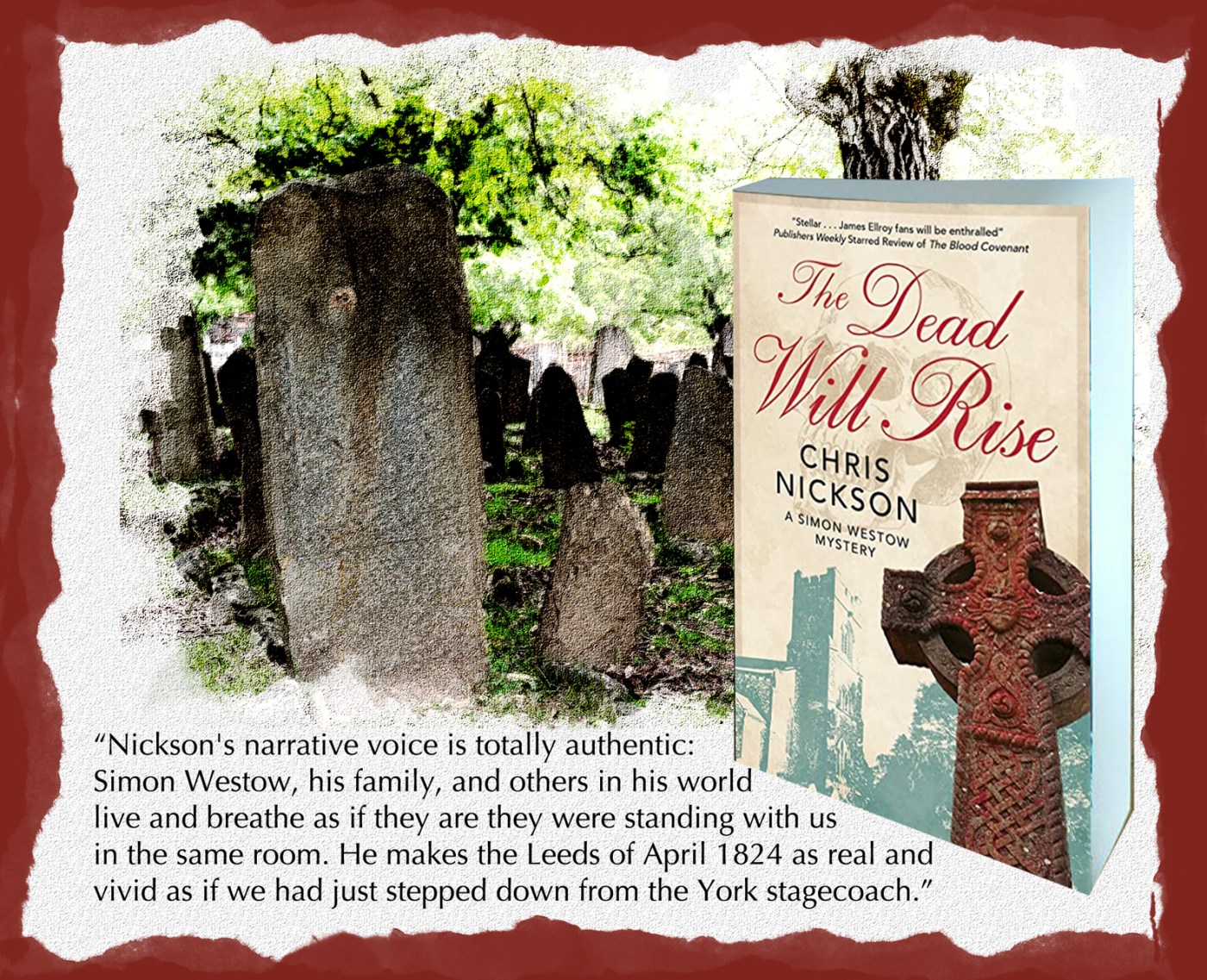
Nickson’s narrative voice is totally authentic: Simon Westow, his family, and others in his world live and breathe as if they are they were standing with us in the same room. He makes the Leeds of April 1824 as real and vivid as if we had just stepped down from the York stagecoach. The Dead Will Rise is published by Severn House and is out now.

Nickson footer

A DARK STEEL DEATH . . . Between the covers

ADSD header

Chris Nickson’s long running saga about  Leeds copper Tom Harper continues with our man now Deputy Chief Constable. We are in January 1917 and, like in other major cities, patrols are on the look out for the silent peril of Zeppelins, while Harper has a possible act of sabotage to investigate after a pile of newspaper and kindling is found inside a warehouse used for storing military clothing. The book begins, however, a month earlier with a true historical incident.

In nearby Barnbow, a huge munitions factory had been established from scratch in 1915. Its prime function was the filling of shells. With the constant drain of manpower to the armed forces, the workforce at Barnbow became over 90% female. On the night of 5th December 1916 a massive explosion occurred in Hut 42, killing 35 women outright, maiming and injuring dozens more. In some cases identification was only possible by the identity disks worn around the necks of the workers. It is believed that the explosion was triggered by a shell being packed with double the required amount of explosives. The dead women, at last, have their own memorial.

Barnbow_Lasses_park_memorial_3_26_August_2017

With the Barnbow investigation ongoing, Harper has more problems on his hands when a sentry outside a barracks in the city is shot dead with, it turns out, a SMLE (Short Magazine Lee Enfield) .303 rifle, adapted for sniping, which was stolen from the barracks own armoury.

There are so many things to admire about this series, not least being the meticulous historical research carried out by the author. One example is the development of police investigative techniques. Back at the beginning, in Gods of Gold (2014), the idea that people could be identified by their fingerprints would have been seen as pure fantasy but, as we see in this novel, it was an essential tool  for the police by 1917.

Nickson text

Back to Tom Harper’s current case. As he and his detectives sift what little evidence there is, they seem to be chasing their own tails. Harper’s worries don’t end as he closes his office door each evening. In an earlier book, we learned the grim news that his vivacious and beautiful wife Annabelle, a tireless campaigner for female equality, has developed early-onset dementia. Harper has employed a Belgian refugee couple to run Annabelle’s pub, and keep a close eye on his wife, but he never knows from one day to the next what state she will be in. If he is lucky, she will show glimpses of her old self; when she is having a bad day, she inhabits a totally imaginary world and slips from all the anchors of reality. The most painful moments for Harper come when Annabelle believes that he is her late first husband, Harry.

Eventually the case breaks. Harper and his team are astonished to find they are facing not just one killer, but a partnership. Two former soldiers, Gordon Gibson and James Openshaw were virtually buried alive when a shell exploded near them on the Western Front. Openshaw was a sniper and Gibson, not much of a shot but with superb eyesight, was his spotter. Both men were invalided out, but Openshaw, after a spell at the famous Edinburgh hospital, Craiglockhart, remains under constant medical care at Gledhow Hall, a Leeds stately home used as a hospital for the duration of the war. It seems that for whatever motive, Gibson smuggled Openshaw  and the rifle out of the hospital to commit the murder of the sentry. Now, Gibson is at large with the rifle and, despite his poor marksmanship, has shot at Tom Harper’s official car, and badly wounded a policeman.

The endgame takes place as Gibson uses all his fieldcraft to find his way into a heavily guarded Gledhow Hall to liberate Openshaw and resume their killing spree. The finale is breathtaking, powerfully written – and deeply moving. A Dark Steel Death is published by Severn House and is available now.

FOR MORE ON THE TOM HARPER SERIES CLICK THE IMAGE BELOW

LEEDS

THE BLOOD COVENANT . . . Between the covers

Screen Shot 2022-01-03 at 18.33.51

One of my sons was at Leeds University, and my impression of the city during visits either to move house or to bring food and supplies, was of a place very much sure of itself, embracing the past while relishing a vibrant future. But this was largely Headingly, the university quarter, full of bookshops, trendy cafes and largely peopled by the offspring of comfortable middle class people like me and my wife.

TBCChris Nickson’s Leeds is a very different place. In the Tom Harper novels (click link) and in this,  the latest account of the career of Simon Westow, thief-taker, things are very, very different. This is Georgian England (1823, in this case) and Westow – in an age before a regular police force – earns his living recovering stolen property, for a percentage of its value. He has no judicial authority, save that of his quick wits, his fists and- occasionally – his knife. Recovering from a debilitating illness, Westow is back on the streets, and is juggling with several different investigations. A man has been hauled out of the river. His throat has been fatally slashed, and one of his hands has been hacked off. His brother hires Westow to answer ‘who?’ and ‘why?’.

A rich and powerful Leeds entrepreneur called Arden sets Westow the task of recovering a pair of valuable candlesticks, stolen from his son. But when the investigation is concluded, all too easily, Westow is forced to wonder if he is not being used as a dupe in some larger scheme. To add to his workload, Westow sets out to avenge the deaths of two lads, apparently starved then beaten to death by brutal overseers at a Leeds factory owned by a mysterious man named Seaton.

Westow’s assistant is a deceptively fragile young woman called Jane. Raped by her father and then thrown out on the street by her mother, she has learned to survive by cunning – and a fatal ability to use a knife, without a second thought, or her dreams being haunted by her victims. She has, to some extent, ‘come in from the cold’ as she no longer lives on the street, but with an elderly lady of infinite kindness.

As Leeds is cut off from the rest of the world by deep snow, there are more deaths, but few answers. The only thing that is clear in Westow’s mind is that there is that – for whatever reason – a blood covenant exists between Arden and Seaton. Two rich and powerful men who have the rudimentary criminal justice system within Leeds at their beck and call. Two men who want ruin – and death – to come to Westow and those he loves.

TBC footer

Before we reach a terrifying finale at a remote farm in the hills beyond Leeds, Nickson demonstrates why he is such a good – and impassioned – novelist. He burns with an anger at the decades of of injustice, hardship and misery inflicted on working people by the men who built industrial Leeds, and made their fortunes on the broken bodies of the poor strugglers who lived such dark lives in the insanitary terraces that clustered around the mills and foundries. In terms of modern politics, Chris Nickson and I are worlds apart and there is, of course, a separate debate to be had about the long term effects of the industrial  revolution, but it would be a callous person who could remain unmoved by the accounts of the human wreckage caused by the huge technological upheavals of the 18th and 19th centuries.

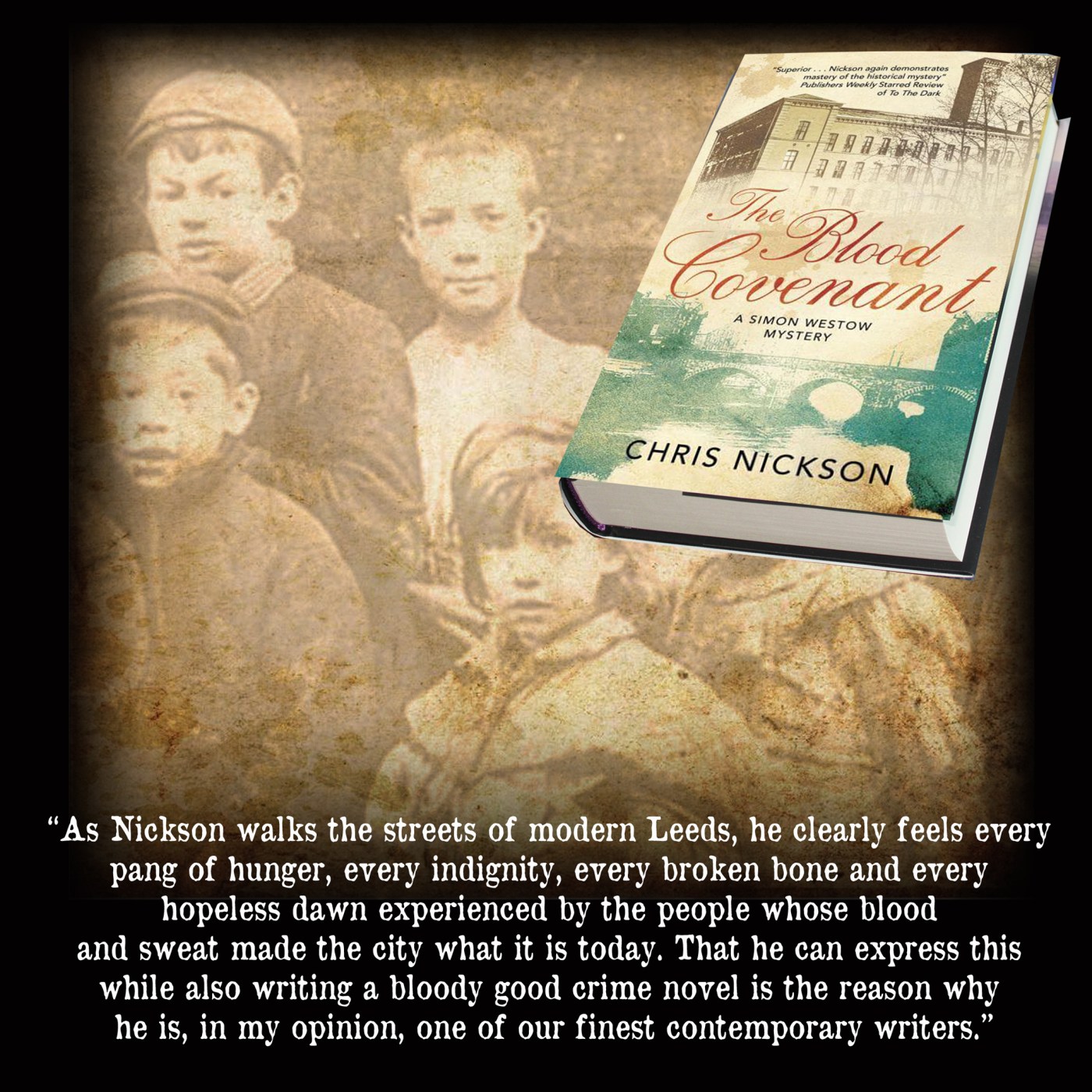
There is. of course, a noble tradition of writers who exposed social injustice nearer to their own times – Charles Dickens, Charles Kingsley, Robert Tressell and John Steinbeck, to name but a few, but we shouldn’t dismiss Nickson’s anger because of the distance between his books and the events he describes. As he walks the streets of modern Leeds, he clearly feels every pang of hunger, every indignity, every broken bone and every hopeless dawn experienced by the people whose blood and sweat made the city what it is today. That he can express this while also writing a bloody good crime novel is the reason why he is, in my opinion, one of our finest contemporary writers. The Blood Covenant is published by Severn House and is out now.

ON MY SHELF . . . January 2022

OMS Header

TS Eliot thought that April was the cruelest month, but I reckon he was wrong. I’ll go for January, every time. The joys of Christmas are reduced to a few deflated plastic Santas, only the last dregs of that litre bottle of Baileys remain and – for some – a reckoning with a credit card provider awaits. Yes, the days are getting longer, by tiny increments, but the metaphorical rebirth that Spring brings seems an age away. Thank God, then, for books. I am grateful to publishers and publicists for these arrivals:

THE LENSKY CONNECTION by Conrad Delacroix

This political thriller is set in the uncertain days of post communist Russia, when the old certainties – grim as they were – were being replaced by a power struggle between oligarchs, gangsters, and those who hedged their bets as to which new power group was most likely to succeed. Major Valery Grosky is a Federal Security Bureau officer fighting organised crime, but when he is pulled off normal duties to build a case against one of the oligarchs, he finds links that run between the most powerful politicians in both Russia and America. This dangerous knowledge plunges Grosky into a fight to save not only his career – but his life. The Lensky Connection is published by Matador, and is available now.

HIVE by April Doyle

There can’t be too many books where bees are the main characters. I seem to remember that in A Slight Trick of The Mind, a Sherlock Holmes homage from Mitch Culln, bees played a pivotal part, but this novel is centred on a criminal conspiracy involving the death of bee colonies and the attempts of a research entomologist Dr Annie Abrams to prevent an ecological disaster. To enter a prize draw to win a copy of the book, go to April Doyle’s Twitter page which is @aprilcdoyle. This will be out on 28th January and is published by The Book Guild.

THE DIGNITY OF SILENCE by June Felton

This book begins in the turmoil of Prague in 1942, where the every breath taken and every move made by the Czech people are controlled by their Nazi masters.  Ernst – and his daughter – have managed to escape to London, but the ensuing years only enhance the sense of guilt he feels, and when he finally returns to the city of his youth, old grievances and bitter memories threaten his sense of himself, and what he once was. Also published by The Book Guild, The Dignity of Silence is out now.

ONE STEP TOO FAR by Lisa Gardner

Sometimes, being a book reviewer feels like wading through a fierce, tugging torrent of flood water. Make a wrong step, and you are done for. Fortunately, there are some authors who provide rock-solid and reliable stepping stones, and Lisa Gardner is one such. Her latest novel is the second in the Frankie Elkin series, following on from Before She Disappeared. You can read my review of that here, but now Frankie returns to discover the truth about a young man who disappeared years ago during a stag weekend. As Frankie and the missing man’s friends try to retrace his steps, they are unaware that they are heading into deep trouble.  This is a Penguin book, and will be published on 20th January. (The cover image is the proof copy)

A FATAL CROSSING by Tom Hindle

This debut novel is set on a transatlantic liner travelling to New York in 1924.  The Endeavour has 2,000 passengers – and a killer – on board, as well as James Temple, a dtermined Scotland Yard inspector. When an elderly gentleman is found dead at the foot of a staircase, ship’s officer Timothy Birch is ready to declare it a tragic accident. But Temple is certain there is more to this misfortune than meets the eye. This is a must for those who like period CriFi and locked room – albeit of a nautical kind – mysteries. Published by Penguin, A Fatal Crossing will be on the shelves from 20th January. Originally from Leeds, Tom Hindle now lives in Oxfordshire, where he lives with his fiancée. He is Inspired by masters of the crime genre, from Agatha Christie to Anthony Horowitz.

CITY OF THE DEAD by Jonathan Kellerman

I don’t know why I should term this “a confession”, but I absolutely love the Alex Delaware/Milo Sturgis novels. More erudite reviewers than I might scoff and summon up metaphors of comfortable slippers and cardigans, but they can go forth and multiply. Yes, there is a formula. Yes there are a several well-worn-grooves, like Milo’s gayness, his gluttony, Alex Delaware’s girfriend’s luthier skills, and the ever-present bloody dog, but the books are superbly written, and Kellerman deserves all the success that comes his way. Here, a corpse discovered almost by accident in a wealthy LA suburb proves to be a professional colleague of Alex, and the case takes on a disturbing – and deeply dangerous aspect. This is also from Penguin, but you will have to wait until 17th February to get your hands on a copy.

AND ON MY KINDLE

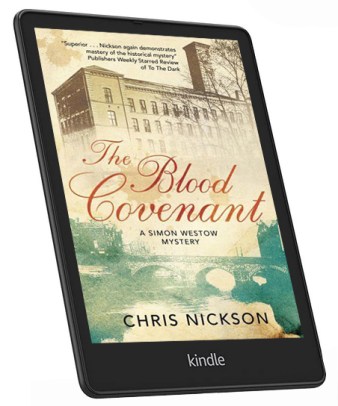
TBC KIndleA new book from Chris Nickson is always a joy, even if the times and circumstances he writes about are seldom a cause for celebration. His cerebral connection with the downtrodden and exploited people who once walked the streets of his native Leeds is almost tangible, and here his words burn white hot as his Georgian thief taker – Simon Westow – becomes involved in several cases at once. He is determined to avenge two boys brutalised in a local mill, while also trying to solve the mystery of a corpse dragged from the local river, throat cut and minus a hand. All this while unwillingly coming to the attention of one of the richest – and most dangerous men in the city. Expect another star turn from the enigmatic – but deadly – assassin known only as Jane, as a ghost from her past threatens to disturb her fragile equilibrium. The Blood Covenant is from Severn House and is available now. Regular visitors to Fully Booked will know I am a great admirer of Chris Nickson. My thoughts on his books are here.

Blog at WordPress.com.

Up ↑