
Search

fullybooked2017

Tag

Cathy Marsden

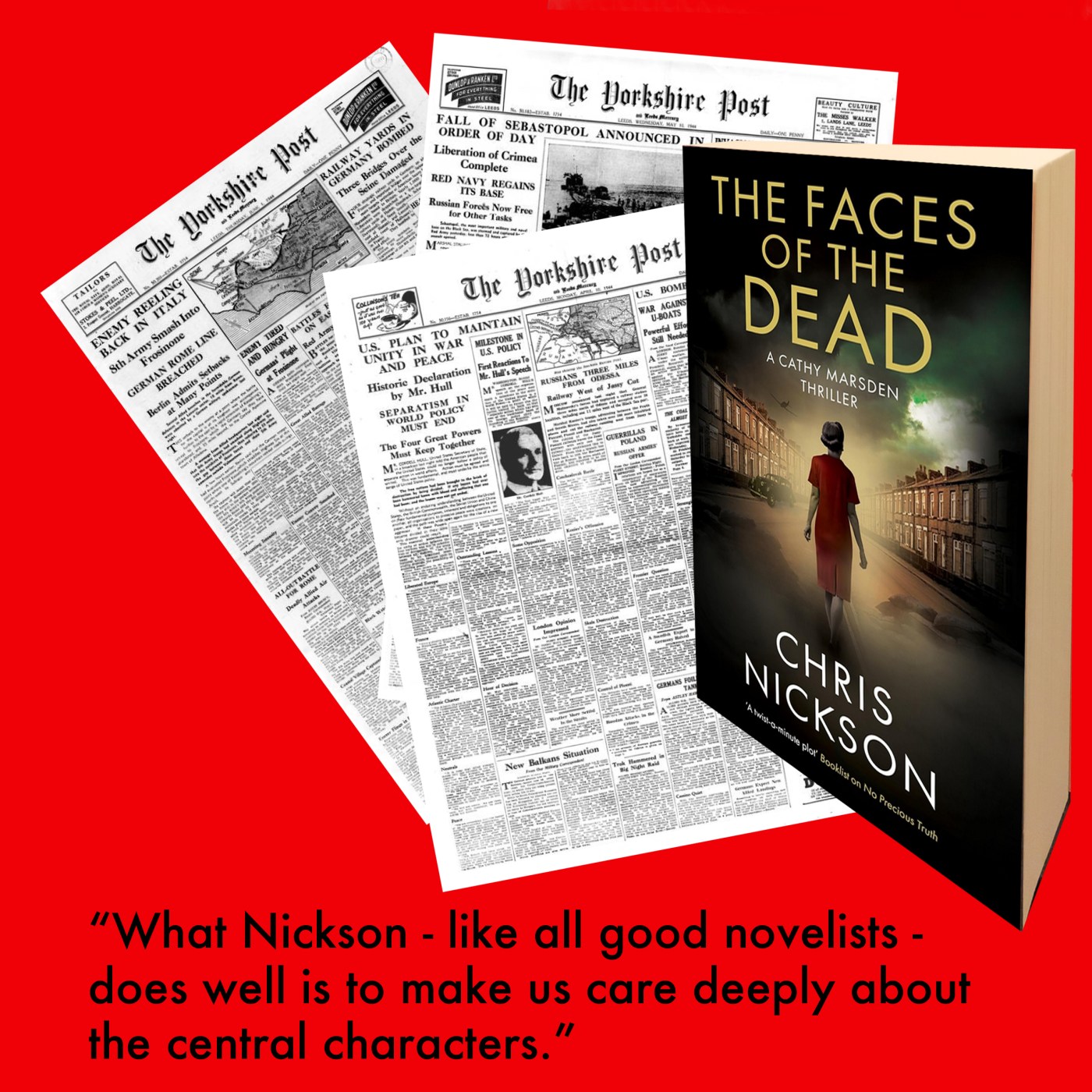
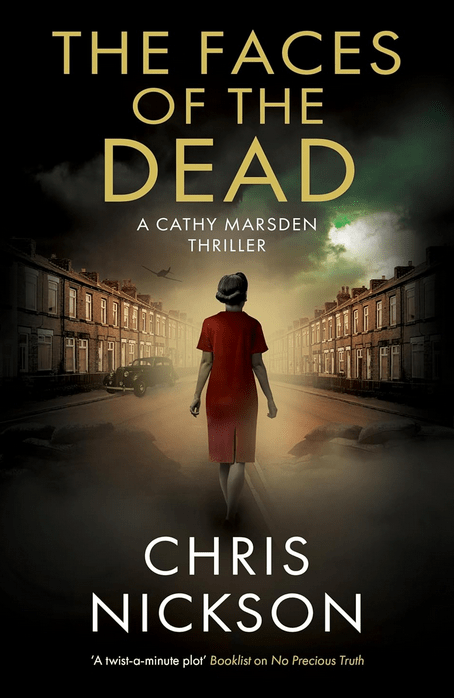
THE FACES OF THE DEAD . . . Between the covers

Can crime novels teach you anything about a location? Fans of the late Phil Rickman would argue that they knew the Hereford/Wales borderlands through his Merrily Watkins novels. Readers of Jim Kelly’s Phillip Dryden books might , as a consequence, claim a nodding acquaintance with the Fens. London? Perhaps too vast and unknowable despite the best efforts of Mark Billingham and Tony Parsons. Leeds? I knew it through countless visits to an undergraduate son, but always found the place rather intimidating. Chris Nickson lives there, and has used it as the background for three series of novels. In those featuring Simon Westow we are in Georgian times. The baton is then handed on to Tom Harper, who bestrides the city like a colossus from Victoria’s reign to the period after The Great War.

Now we are in WW2, with a redoubtable young woman, Cathy Marsden, who has been seconded from the local police force to the Special Investigation Branch, an embryonic group whose work sits in the gap between regular policing and military intelligence. We are in the spring of 1944. Cathy is newly engaged to Tom, a mechanic with the Royal Electrical and Mechanical Engineers. He has served in North Africa, where he has managed to keep himself out of the firing line. Now, after a spell of leave, he has been recalled.

There are rumours that the Allies are building up to ‘something big’. At work, Cathy and her colleagues are investigating a fatal car crash in which a local spiv and his girlfriend were killed. More intriguing is the fact that the boot of the car was filled with handguns stolen from American and British barrack armouries.When another small time local crook, Ricky Hopper, ends up being mangled in the metal waterwheel of a local factory, Cathy realises that these are deep waters, as dark and dangerous as the River Aire itself.

Nickson effortlessly captures the privations of ordinary Britains during the war.
“Cathy settled with her fish paste sandwiches wrapped in greaseproof paper and thermos flask of tomato soup. Her mother made the same thing each week. One more routine of war, she’d be happy to leave behind.”

The author makes other very apposite cultural references. Safe in her own bed, in her own home, Cathy reads herself to sleep with Daphne du Maurier’s Hungry Hill, a romantic saga about an Irish family, published just a year earlier.

Vernon Scannell wrote:
“Whenever war is spoken of
I find
The war that was called Great invades the mind:”

That terrible conflict hangs heavy over the Marsden household. Gassed while ‘doing his bit’, Cathy’s father’s lungs were ruined, and every breath is a struggle. There is a terrible irony that just three decades later, the same mortal enemies are intent on ripping out each others’ hearts.The SIB search narrows in focus. They are looking for two men. Dandy Wilson is the new Mr Big in the Leeds underworld of touts and black marketeers, while Corporal Lyle Brevitt is the source of the pilfered American stores. Anxious to find the latter is US military policeman Frank Graves.The SIB receive reliable information about where to find Wilson, but when they raid the property, their quarry is gone. Given the timescale, the inescapable conclusion is that someone is passing on inside information to the fugitive. Does the leak come from the regular police or – unthinkably – from someone in SIB?

Eventually, both Wilson and Brevitt are tracked down and the traitor within is unmasked. What Nickson – like all good novelists – does well is to make us care deeply about the central characters. Here, we leave Leeds on the eve of ‘D’ Day, and we can only hope that Cathy’s Tom survives what is to come, and returns to claim his bride. The Faces of The Dead was published by Severn House on 7th April.
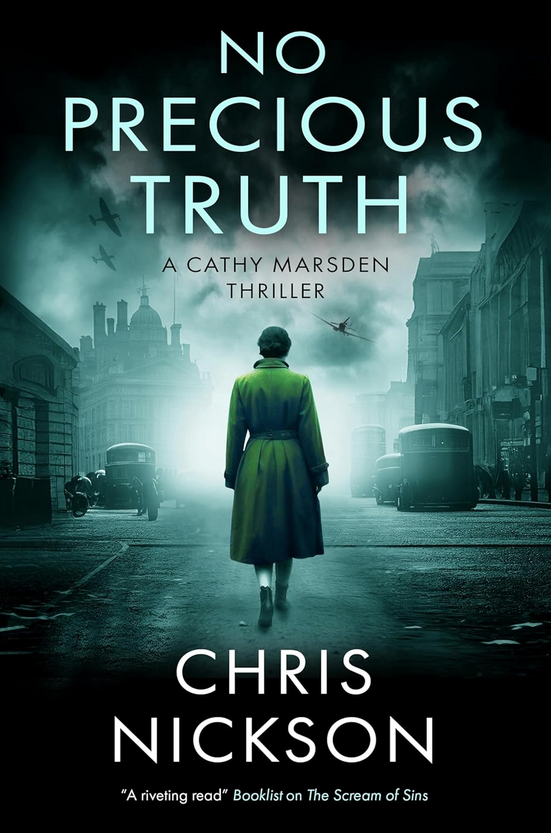
NO PRECIOUS TRUTH . . . Between the covers

In my reading experience, there is no living writer so closely associated with one place than Chris Nickson. Phil Rickson had his Welsh Marches, Robert B Parker had his Boston, Colin Dexter had his Oxford and Christopher Fowler had his (peculiar) London. Sadly, Time has borne those four sons away, but Nickson’s Leeds is now rediscovered in the first of a new series.

It is February 1941. Cathy Marsden is a Sergeant in the Leeds police, but has been seconded to the Special Investigations Bureau, a unit recently set up to investigate black marketeers and other criminals looking to make money out of the war. She is astonished when her older brother, Daniel, turns up at the office. As far as she was aware he was humdrum civil servant in London, pushing pens and folders of documents from one desk to another. Like her, however, he has been seconded, but to another top secret intelligence service, and he is in Leeds to track down a dangerous Dutch double agent called Jan Minuit.

Although I have read and enjoyed them all, Nickson’s Leeds novels tend to have a similar plot, which is basically a manhunt. This enables the author’s creations from Simon Westow to Tom Harper (who gets a brief mention here) to pound the streets of the city in search of a villain. The technical aspect of this is not complicated, as it enables Nickson to put his unparalleled knowledge of the topography to good use. He is clearly in tune with a kind of of geopsychology, which enables readers to follow the footsteps of his characters across the decades, so that thoroughfares like Briggate, The Headrow and Kirkgate become as familiar as our own back yards.

If Minuit is bent on sabotage, Leeds has two prime targets for an agent of The Third Reich. One is pretty much in the open. The Kirkstall iron foundry has been producing components for military vehicles since WW1 and is hard to disguise. The Avro factory at Yeadon, however has been covered in camouflage and disguised – from the air – as open country. This ‘shadow factory’ is working day and night to produce Lancaster bombers, as well as the less celebrated (but equally vital) Anson.

Nickson has a well-established style. It is propulsive. Short sentences. A sense of urgency. Genuine narrative drive.

“Cathy turned off the ring road and started up Wheatwood Lane.The daylight was lasting longer, barely a stretch of dusk on the horizon. Ahead of her, the hill rose steeply, fields on either side, farmland.No chance to go more than a few yards.The road was filled with police cars, a pair of ambulances and the black coroner’s van.,”

“Monday dawned sour with threatening clouds, the colour of old bruises. The air was thick and damp. Yesterday’s promise of spring had vanished like a magician’s illusion. Instead, the rain felt that it like might begin at any time. At least it would deter the Luftwaffe.”

There is a thrilling conclusion to the team’s pursuit of Jan Minuit, and it is Cathy’s resilience and strength which eventually brings the spy/saboteur to his knees. Chris Nickson’s skill lies in his ability to convince us that we are standing beside his characters and sharing their world. In this case, it is Cathy Marsden’s wartime Leeds, with its rationing and privation, its fear that clear nighttime skies will be a gift to the Luftwaffe, and the ever present fear in the hearts of local women that their father, husband, brother, son or boyfriend will be the next name on the mounting list of casualties.

Nickson also reminds us that the horrors of WW1 cast a long shadow. Cathy’s father, once a strapping Yorkshire lad, was gassed in the trenches, and over thirty years later is a wreckage of a man, struggling with the essentials of existence – such as breathing. No Precious Truth will be published by Severn House on 1st April.

Blog at WordPress.com.

Up ↑