
INTRODUCTION
 t is starkly obvious to anyone with even a passing knowledge of international history that the most brutal and bitterly fought wars tend to be between factions that have, at least in the eyes of someone looking in from the outside, much in common. No such war anywhere has cast such a long shadow as the American Civil War. That enduring shadow is long, and it is wide. In its breadth it encompasses politics, music, literature, intellectual thought, film and – the purpose of this feature – crime fiction.
 There have been many commentators, critics and writers who have explored the US North-South divide in more depth and with greater erudition than I am able to bring to the table, but I only seek to share personal experience and views. One of my sons lives in Charlotte, North Carolina. It is a very modern city. In the 20th century it was a bustling hive of the cotton milling industry, but as the century wore on it declined in importance. Its revival is due to the fact that at some point in the last thirty years, someone realised that the rents were cheap, transport was good, and that it would be a great place to become a regional centre of the banking and finance industry. Now, the skyscrapers twinkle at night with their implicit message that money is good and life is easy.
Charlotte is, to put it mildly, uneasy about its history – that of a plantation state based on slavery. The main museum in the city is the Levine Museum of the New South. The title is significant, particularly the word ‘New’. Like most modern museums in the digital age, it reaches out, grabs the attention, constantly provides visual and auditory stimulation, and is a delightful place to spend a couple of hours. Its underlying message is one of apology. It says, “OK, over 150 years ago we got things badly wrong, and it took us a long time to repair the damage. But this is us now. We’re deeply sorry for the past, and we are doing everything we can to redress the balance.”
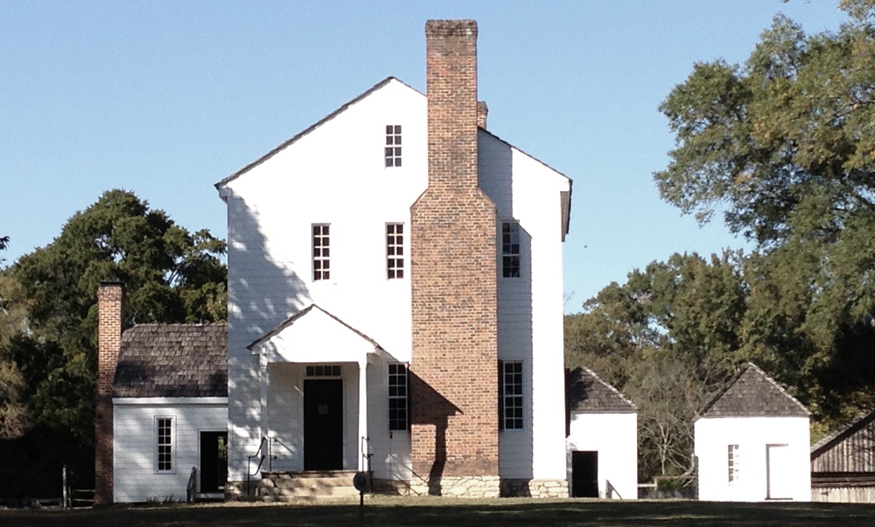
 rive out of Charlotte a few miles and you can visit beautifully preserved plantation houses. Some have the imposing classical facades of Gone With The Wind fame, but others, while substantial and sturdy, are more modest. What they have in common today is that your tour guide will, most likely, be an earnest and eloquent young post-grad woman who will be dismissive about the white folk who lived in the big house, but will have much to say the black folk who suffered under the tyranny of the master and mistress.
 By contrast, a day’s drive south will find you in Charleston, South Carolina. Charleston is energetically preserved in architectural aspic, and if you are seeking people to share penance with you for the misdeeds of the Confederate States, you may struggle. In contrast to the spacious and well-funded Levine Museum in Charlotte, one of Charleston’s big draws is The Confederate Museum. Housed in an elevated brick copy of a Greek temple, it is administered by the Charleston Chapter of The United Daughters of The Confederacy. Pay your entrance fee and you will shuffle past a series of displays that would be the despair of any thoroughly modern museum curator. You definitely mustn’t touch anything, there are no flashing lights, dioramas, or interactive immersions into The Slave Experience. What you do have is a fascinating and random collection of documents, uniforms, weapons and portraits of extravagantly moustached soldiers, all proudly wearing the grey or butternut of the Confederate armies. The ladies who take your dollars for admission all look as if they have just returned from taking tea with Robert E Lee and his family.
 Six hundred words in and what, I can hear you say, has this to do with crime fiction? In part two, I will look at crime writing – in particular the work of James Lee Burke and Greg Iles (but with many other references) – and how it deals with the very real and present physical, political and social peculiarities of the South. A memorable quote to round off this introduction is taken from William Faulkner’s Intruders In The Dust (1948). He refers to what became known as The High Point of The Confederacy – that moment on the third and fateful day of the Battle of Gettysburg, when Lee had victory within his grasp.
“For every Southern boy fourteen years old, not once but whenever he wants it, there is the instant when it’s still not yet two o’clock on that July afternoon in 1863, the brigades are in position behind the rail fence, the guns are laid and ready in the woods and the furled flags are already loosened to break out and Pickett himself with his long oiled ringlets and his hat in one hand probably and his sword in the other looking up the hill waiting for Longstreet to give the word and it’s all in the balance, it hasn’t happened yet, it hasn’t even begun yet, it not only hasn’t begun yet but there is still time for it not to begin against that position and those circumstances…” *
* Lee made the fatal mistake of ordering General Longstreet’s corps to charge uphill, and over open ground, towards strong Union positions on Cemetery Ridge. Known as Pickett’s Charge, it was a catastrophic failure which ended Lee’s invasion of the North. Although Lee enjoyed several subsequent victories he was, from that point on until his surrender at Appomattox in April 1865, fighting a defensive war against Union forces far superior in supplies, armaments and leadership.





 fullybooked2017